“There are some things you cannot learn from a book. There are some things you can only learn by doing them.”
— Taran reflecting on his journey and the limitations of theoretical knowledge.

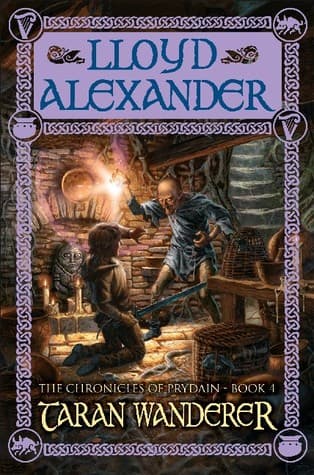
Lloyd Alexander (1900)
Genre
Fantasy / Children's / Young Adult
Reading Time
250 min
Key Themes
See below
Sign in to track this book
Taran, no longer an Assistant Pig-Keeper, travels through Prydain to find his family, discovering that true identity comes from within, not from noble birth.
Taran, the Assistant Pig-Keeper, stands at a crossroads. He helped defeat Arawn and the Horned King, earning respect in Prydain, but still feels unsure of himself. He wants to know his true family, believing that only a noble birth will make him worthy of Princess Eilonwy. With the approval of Dallben and Coll, Taran leaves Caer Dallben with his friend, Gurgi, to find answers about his past. Their first stop is the Marshes of Morva, home to the witches Orddu, Orwen, and Orgoch, known for their old knowledge and unpredictable ways.
At the Marshes of Morva, Taran and Gurgi meet Orddu, Orwen, and Orgoch. The witches, after some playful talk and trading Taran's sword, Dyrnwyn, offer him a choice about his parents. They give him two options: to learn his true family, which might be humble, or to remain ignorant but get a magic item. Taran, still hoping for a noble heritage, chooses to learn the truth. However, the witches do not directly name his parents. Instead, they give him a magic comb, saying it will help him find what he seeks if he understands its real purpose.
Leaving the Marshes, Taran and Gurgi travel to the village of Commot. There, Taran meets Annlaw, a master potter, and admires his craft. Despite his past as a warrior, Taran decides to work for Annlaw. He struggles at first with the delicate work, finding it harder than using a sword. With patient teaching and his own effort, Taran learns pottery, gaining respect for the skill, care, and simple beauty in honest work. This experience starts to change his view of worth from noble birth to personal achievement.
After learning pottery, Taran and Gurgi continue their travels and arrive at another village. Taran meets Dwyvvan, a skilled weaver. Interested in the complex patterns and precise work, Taran decides to apprentice himself again. He finds weaving challenging but rewarding, requiring patience, attention to detail, and a steady hand. Dwyvvan teaches him the techniques and the art and history of the patterns. This time further builds Taran's appreciation for the value of work and the satisfaction of making something useful and beautiful with his hands, a contrast to his earlier focus on fighting.
Taran's journey brings him to the forge of Hevydd, a wise and strong blacksmith. Drawn to the heat and sound of the smithy, Taran asks to become an apprentice. Hevydd, seeing Taran's sincerity, takes him on. The work is physically hard, needing great strength and accuracy, but Taran accepts the challenge. He learns to use the hammer, shape hot metal, and make tools and weapons. Through Hevydd, Taran understands the important role of the smith in society and the satisfaction of making strong, useful items. This experience helps Taran feel more grounded, showing him that true strength is not just in fighting, but in building and creating.
As Taran and Gurgi travel through Prydain, they pass through the Free Commots, self-governing groups where people live by their own skills and rules, free from kings. Taran admires their independence. During his travels, Taran often hears stories of the Mirror of Llunet, a magic item said to show one's true self or identity. He thinks this mirror might hold the answer to his question about his parents, and he decides to find it, believing it will finally reveal his noble birthright.
Taran and Gurgi meet two different people. The first is Craddoc, a lonely hermit who believes all worldly goals are pointless. Craddoc shares his doubts, warning Taran about ambition and life's disappointments. Later, Taran meets Prince Rhun, a young man from the Northern Realms, who is charming but insecure and clumsy. Rhun, though born noble, feels inadequate and struggles with his duties. Taran finds himself advising Rhun, realizing that noble birth does not guarantee wisdom or ability, and that true worth is earned, not given.
Taran, now wiser and more skilled, continues his travels with Gurgi. He no longer just wants to find his noble birth, but to understand himself and the world. He meets various people, some good, some mistaken, and some bad. Taran uses his learned skills – pottery, weaving, smithing, and his kindness – to help those he meets, offering practical help, advice, and protection. He becomes known as 'Taran Wanderer,' a respected person who shows the value of honest work and selfless service, very different from the unsure Assistant Pig-Keeper he once was.
After a long journey, Taran and Gurgi finally reach the hidden Mirror of Llunet. Taran, with hope and fear, looks into it, expecting to see a grand family line, a noble symbol, or a king's face. Instead, the mirror shows only his own face, the face of Taran Wanderer. At first, Taran is crushed, feeling his quest failed and that he is nobody. He believes he has no noble heritage to offer Eilonwy, and his hopes are broken. This moment tests his self-worth completely.
After the first shock and sadness, Taran slowly starts to understand the Mirror of Llunet's message. He realizes that his true heritage is not noble blood, but worth he created himself. His experiences as a potter, weaver, and smith, his acts of kindness, his bravery, and his compassion have made him the man he is. The mirror shows him that his identity comes from his actions and character, not from inherited status. This realization is a moment of deep growth and self-acceptance, freeing him from the idea of a noble past and letting him embrace his true self, Taran Wanderer.
With his quest done and his identity clear, Taran, with Gurgi, returns to Caer Dallben. He is no longer the unsure youth who left seeking a noble birthright, but a mature, confident man who understands that true nobility comes from one's character and deeds. He is at peace with his origins, whatever they are, and ready for the future. His journey taught him important lessons about himself, about the value of work, and about what true worth means. He is now ready to take his place in Prydain, not as a prince, but as Taran, a man of substance and integrity.
The Protagonist
Taran transforms from an insecure youth obsessed with inherited status to a self-assured man who understands that true nobility comes from one's character and deeds.
The Supporting
Gurgi remains a steadfast and loyal companion, his character consistent as a foil and emotional anchor for Taran.
The Supporting
The witches serve as static, enigmatic figures who impart cryptic wisdom that Taran must interpret himself.
The Supporting
Annlaw serves as a mentor figure, stable in his craft and wisdom, guiding Taran's early lessons in manual skill.
The Supporting
Dwyvvan, like Annlaw, is a static mentor figure who helps Taran develop practical skills and a new perspective on value.
The Supporting
Hevydd serves as another static mentor, reinforcing Taran's understanding of the dignity and power of skilled craftsmanship.
The Supporting
Craddoc's character remains static, serving as a philosophical counterpoint to Taran's developing idealism.
The Supporting
Rhun remains a static character, serving as a comparative figure to Taran, demonstrating that noble birth doesn't equate to inherent worth.
The main theme is Taran's search to understand who he is. At first, Taran thinks his identity and value come from a noble family, so he looks for his parents. But through working as a potter, weaver, and smith, and meeting different people, he learns that true identity comes from one's actions, skills, and character, not from inherited status. The moment at the Mirror of Llunet, which shows only Taran's face, makes him accept that his self-worth comes from within and from his deeds as 'Taran Wanderer.'
““I have learned that if I am to be a man, I must be a man of my own choosing. I must be Taran.””
A large part of Taran's journey involves him learning different trades: pottery, weaving, and blacksmithing. These experiences help him grow. He learns the patience, skill, and effort needed for each craft, gaining respect for the artisans and their work. This theme challenges Taran's early ideas about status, showing him that there is value and satisfaction in honest, skilled work. It directly goes against his earlier belief that only noble or heroic acts hold true value, showing that creating and being useful are as important as winning battles.
““There is no shame in any honest calling, Taran. It is the work that counts, and the hands that do it.””
Taran starts his quest believing that being noble is only about birth. He wants to prove himself worthy of Princess Eilonwy by finding a royal family line. However, his experiences in Prydain challenge this idea. He meets Prince Rhun, who is noble by birth but lacks wisdom, and ordinary people who show great courage, honesty, and skill. By the end, Taran understands that true nobility is not inherited but earned through one's character, kindness, and actions. His journey changes the meaning of 'nobility' to a quality of spirit and deed, not bloodline or title, shown by his acceptance of himself as 'Taran Wanderer.'
““I have sought to be a hero, a king, a man of power. But I have found that I am none of these. I am Taran.””
Taran's journey across Prydain is a journey of learning and growth. Each stop and every person he meets teaches him something important, often changing his old ideas. The witches give him unclear advice, the artisans teach him practical skills and humility, and the different people he meets offer various views on life, ambition, and sadness. These experiences change his worldview and values, showing that true wisdom and understanding come from real-life experience and thinking, not just from formal teaching or inherited knowledge.
““The path to wisdom, boy, is not always smooth. And it is not always easy.””
A mystical artifact that reflects one's true self, or the truth of one's identity.
The Mirror of Llunet serves as the ultimate goal of Taran's quest for identity. It is rumored to reveal one's true lineage or destiny. However, its true function is far more profound: it reflects only Taran's own face, forcing him to realize that his identity is not an external secret to be uncovered, but an internal truth to be accepted. It acts as a powerful symbol of self-reflection and the culmination of Taran's journey of self-discovery, ultimately revealing that his worth is self-made rather than inherited.
Taran's temporary roles as a potter, weaver, and blacksmith.
These apprenticeships are a crucial plot device that directly facilitates Taran's character development. By forcing him to engage in manual labor and learn new skills, they strip away his preconceived notions about nobility and heroism. Each craft teaches him patience, precision, humility, and the dignity of honest work, fundamentally shifting his understanding of worth. These experiences are not merely diversions; they are the practical lessons that prepare him for the deeper truth revealed by the Mirror of Llunet, grounding him in the realities of everyday life.
The enigmatic guidance offered by Orddu, Orwen, and Orgoch.
The three witches of Morva provide Taran with a pivotal choice and a magical comb, but their advice is intentionally vague and open to interpretation. This device forces Taran to embark on a journey of self-discovery, rather than simply being handed an answer. Their riddles and conditions ensure that Taran must earn his understanding and that the truth of his identity emerges from his own experiences and introspection, rather than a direct revelation. They act as catalysts for his quest, setting him on a path of indirect learning.
Taran's journey through various communities and encounters with diverse individuals.
Taran's extensive travels across Prydain, meeting people from all walks of life, serve as a crucial plot device for his education. Each encounter, whether with a wise artisan, a cynical hermit, or an insecure prince, offers him a different perspective and challenges his assumptions. This device allows the narrative to explore various facets of human nature, societal roles, and the meaning of worth, ultimately broadening Taran's understanding of the world and himself, making him a more empathetic and well-rounded individual before he confronts his final truth.
“There are some things you cannot learn from a book. There are some things you can only learn by doing them.”
— Taran reflecting on his journey and the limitations of theoretical knowledge.
“Sometimes it is harder to be a man than a hero.”
— Taran's internal struggle with his identity and responsibilities.
“How many times, he wondered, would he have to seek his identity before he found it?”
— Taran's recurring quest for self-discovery and his lineage.
“A man's worth is not in his station but in his heart.”
— A recurring theme, often expressed by various characters, challenging Taran's preconceptions about status.
“The greatest treasure is not gold or jewels, but understanding.”
— Taran learns this lesson through his apprenticeships and interactions with different people.
“A good craftsman takes pride in his work, whatever it may be.”
— Taran's experience as a potter's apprentice, learning the value of honest labor.
“It is not what you are born, but what you grow to be.”
— A central message of Taran's journey, emphasizing personal growth over birthright.
“The world is full of wonders, if only you have eyes to see them.”
— Taran's broadened perspective as he travels and observes different walks of life.
“Sometimes the simplest answers are the hardest to find.”
— Taran's struggle with complex problems and his eventual realization of straightforward truths.
“Every man has his own path, and he must walk it alone.”
— Taran's journey of independence and self-reliance.
“To learn is to live; to live is to learn.”
— A philosophical reflection on the continuous process of learning throughout life.
“The true measure of a king is not the crown he wears, but the heart he bears.”
— Taran's evolving understanding of leadership and true royalty.
“Even the smallest task, done with care, can bring satisfaction.”
— Taran's lessons from his various apprenticeships, finding value in every type of work.
“The past is a road already traveled; the future, a road still to be made.”
— A contemplation on the nature of time and the importance of present action.
Ready to see how well you understood this book? Take our interactive quiz with 10 questions.

Biography coming soon.







