“Every day the boy would bring a gift, a small token of his gratitude. Sometimes it was a button, sometimes a bottle cap, sometimes a smooth grey stone.”
— From 'The Red Tree', describing the boy's offerings to the tree.

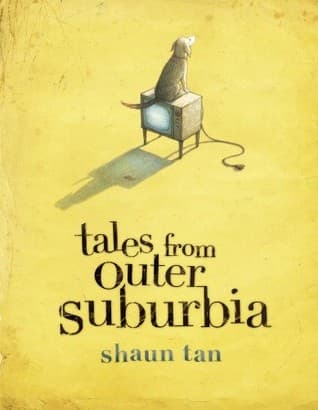
Shaun Tan (2008)
Genre
Fantasy / Children's / Creativity / Young Adult
Reading Time
90 min
Key Themes
See below
Sign in to track this book
Shaun Tan's illustrated tales use giant snails, alien exchange students, and the literal edge of the map to show the strange and funny parts of modern life in ordinary suburbs.
A young girl wakes up to see a black, leafless tree outside her window, which reflects her deep sadness. During her day, she sees many strange and upsetting things: a bottle with a tiny city inside washes ashore, a mechanical bird won't sing, and the world seems not to care about her. Each scene is full of sad images, showing her loneliness and confusion. As the day ends, she goes home, still sad. But then, she finds a small, bright red sapling on her bedroom floor, glowing with warmth and promise. This suggests a bit of hope and the chance for a new start, even in the darkest times.
A suburban family welcomes an alien exchange student named Eric. Eric is a strange, tentacled creature with odd habits. He sleeps in a pond, eats only pebbles, and talks with whistles and clicks. At first, the family struggles to understand and adjust to Eric's ways, which leads to funny misunderstandings and awkward moments. The children are curious but also a bit grossed out, while the parents try to be helpful. Over time, even with their cultural differences, the family starts to appreciate Eric's unique view and his quiet grace in their world. They learn about tolerance and acceptance.
A man finds a discarded, detailed model of a city, broken and unfinished, in a dumpster. He becomes fixated on it, takes it home, and tries to fix and understand its tiny world. The model city, with its small residents and complex structures, seems to reflect parts of his own life and the world around him. He notices how the tiny figures go about their daily lives, unaware of their broken surroundings. By working with the model, the man thinks about flaws, how fragile order is, and the unseen forces that shape our lives. He finds a strange comfort in its flawed beauty and the quiet stories it tells.
A man who feels very unhappy and regretful looks for a mysterious 'amnesia machine' to erase his painful memories. He has the procedure, hoping for a fresh start. At first, he feels free and peaceful, as his past burdens are gone. However, the machine doesn't just erase bad memories; it erases important parts of his identity and connections. He feels lost, without context or personal history, and struggles to make new relationships or understand his place. The story suggests that while forgetting can offer temporary relief, true healing often means facing one's past, not just erasing it.
In a strange town, all the residents are drawn as simple stick figures. They live their daily lives—working, playing, commuting—all in the same plain, simple form. This visual idea shows themes of fitting in, being anonymous, and losing individual identity in modern society. While they do their jobs well, there is a sense of blandness and sameness. The story gently makes fun of the pressure to conform and how people can become interchangeable parts of a bigger system. It asks what it means to be truly unique or to show one's individuality in a world that often promotes sameness.
A boy named Shaun is collecting bottle caps on a beach when he finds a giant, strange, and seemingly lost creature that looks like a teapot mixed with a crab. No one else seems to notice or care about this 'lost thing.' Shaun feels responsible and tries to find its owner or a suitable home for it. He deals with the city's indifferent bureaucracy, which has no category for such a creature. After many failed tries, he finds a hidden, forgotten place where other 'lost things' live, a safe place for the unique and overlooked. He helps the creature find its home among its own kind.
A grandfather tells a story from his youth about making friends with a huge, gentle slug in his backyard. He describes the slug's size, its slow movements, and their special bond. The slug becomes a quiet friend, listening to his youthful dreams and worries. This story, told with warmth and a bit of nostalgia, shows the power of imagination, the wonder of childhood, and the unexpected friendships that can form in odd situations. It also touches on remembering and valuing the extraordinary moments that define our personal histories, even if they seem unbelievable to others.
A group of children discovers a magnificent, impossibly large treehouse in their suburban neighborhood. This is not just any treehouse; it is a sprawling, multi-level structure that seems to defy gravity and logic. It is full of secret rooms, strange machines, and paths to unknown places. It becomes a sanctuary and a way to imagine, a place where they can escape their ordinary lives and explore new possibilities. The treehouse shows the endless potential of childhood creativity and the importance of having a place where wonder and adventure can grow, even in the most normal settings.
A man lives his ordinary life, but sometimes he experiences sudden, strong 'glimmers'—moments of great beauty, wonder, or connection that briefly brighten the mundane. These glimmers can be caused by simple things: how light hits a wall, a specific sound, or a quick look on someone's face. They are brief but powerful, offering a look into a deeper, more meaningful reality. The story explores the idea that even in the routine of daily life, there are hidden moments of magic waiting to be seen, and that true richness often comes from our ability to notice and value these subtle wonders.
A family goes on a summer holiday, driving farther and farther from their suburban home. As they travel, the landscape becomes more sparse and strange, until they reach a literal edge—the end of the world as shown in their map book. The road suddenly stops, leading to an empty, blank space. This surreal discovery makes the family think about how arbitrary boundaries are, both geographical and conceptual. It is a whimsical yet thought-provoking look at limits, the known versus the unknown, and how our understanding of reality is shaped by the stories and maps we make.
The Protagonist/Supporting
Their arc is less about personal transformation and more about a deepening awareness and acceptance of the world's inherent strangeness and beauty.
The Protagonist
She moves from a state of profound despair to discovering a small, personal symbol of hope and renewal.
The Supporting
Eric remains consistently himself, his 'arc' is primarily reflected in the family's changing perception of him.
The Protagonist
Shaun's empathy leads him to successfully find a home for the lost creature, affirming his own sense of purpose and compassion.
The Supporting
From being a bewildered, abandoned creature, it finds a community and a place where it belongs.
The Supporting
His arc is presented as complete, serving as a conduit for memory and imagination.
The Protagonist
He finds a quiet, introspective understanding of imperfection and the nature of reality through his interaction with the model.
The Supporting
They evolve from initial confusion and mild discomfort to a greater understanding and acceptance of profound difference.
Tan often shows the fantastical as a natural, though often unnoticed, part of everyday suburban life. Giant slugs, alien exchange students, and the literal end of the world are treated calmly. This makes the ordinary seem extraordinary and the extraordinary seem ordinary. This theme appears in stories like 'The Exchange Student,' where an alien is hosted with awkwardness and acceptance, or 'The Summer Holiday,' where the world literally ends at the map's edge. This challenges our ideas of reality and invites readers to find wonder in unexpected places.
“Sometimes the world seems to have a mind of its own, an almost human personality.”
Many stories look at feelings of isolation and the search for connection in a world that doesn't seem to care. Characters often feel alone or misunderstood, like the girl in 'The Red Tree' who has a very sad day, or Shaun in 'The Lost Thing' who is the only one to notice and care for the discarded creature. However, the stories also show moments of unexpected connection and belonging, whether it's the red tree offering comfort, Shaun finding a safe place for 'lost things,' or the quiet bond between a boy and a giant slug. This theme highlights the human need to be understood and the many ways we find our place.
“Nobody else seemed to notice it, or if they did, they pretended not to.”
Child characters often show wonder and open-mindedness, seeing the world with a clarity and acceptance that adults often lack. Stories like 'Grandpa's Story' and 'The Tree House' celebrate the vastness of childhood imagination, where giant slugs are friends and treehouses are portals to other places. Shaun's strong empathy for 'The Lost Thing' also shows this theme. It suggests that the ability to see beyond the usual and to embrace what is unique is often strongest in young people. The book encourages readers to regain a childlike sense of wonder.
“I remember a time when the world was full of amazing things, before it became so ordinary.”
Many stories explore what it means to be 'different' or to search for a sense of belonging. Eric, the alien exchange student, represents being different, challenging the family's idea of what is normal. 'The Lost Thing' is a literal example of something that doesn't fit into any group, searching for its place. Even the stick figures highlight a conformity that can erase individual identity. The book gently questions societal norms and celebrates the beauty of being different, suggesting that true belonging often comes from finding a community that accepts one's unique nature.
“Sometimes you just have to look a little harder to find where you belong.”
The effect of memory and the past appears in several stories. 'The Amnesia Machine' directly addresses the wish to erase painful memories, but then shows the great loss of identity that results. In contrast, 'Grandpa's Story' highlights the enriching power of cherished memories and personal history, even if they seem fantastical. The broken model city also acts as a metaphor for broken pasts and the attempt to piece together meaning from incomplete stories. This theme suggests that our past, good and bad, is a key part of who we are.
“A life without memory is like a house without a foundation.”
Fantastical elements are presented as commonplace within a realistic setting.
Tan masterfully blends the mundane with the extraordinary without extensive explanation or justification. Alien exchange students, giant slugs, and the literal end of the world are accepted with a quiet, almost deadpan realism. This device allows for profound commentary on human nature and society, as the characters react to the fantastical with a range of emotions from mild bewilderment to quiet acceptance, mirroring how people often navigate the inexplicable in real life. It invites readers to suspend disbelief and find deeper meaning in the absurdities.
Intricate and evocative illustrations convey as much, if not more, meaning than the text.
Shaun Tan's signature highly detailed and atmospheric illustrations are central to the narrative. They don't just accompany the text; they often carry the primary emotional and thematic weight, filling in gaps, adding layers of meaning, and creating the unique tone of each story. The visual language, with its muted palettes, intricate details, and evocative imagery, allows for ambiguity and encourages interpretation, making the reading experience deeply immersive and personal. The images often depict the internal states of characters or the underlying strangeness of the world.
Characters and situations symbolize broader human experiences or societal critiques.
Many elements in the book function allegorically. 'The Red Tree' is a clear allegory for depression and hope. 'The Lost Thing' represents anything unique or discarded that struggles to find its place. The stick figures symbolize conformity and loss of individuality. These allegories allow Tan to explore complex themes like mental health, environmental neglect, and social pressures in an accessible yet profound way, without being didactic. The stories invite readers to find their own interpretations and connect the fantastical scenarios to real-world issues.
The perspective often leaves room for interpretation about the reality of events.
Many stories are told from a first-person perspective, often a child's, or an adult looking back, which lends itself to a certain subjective reality. Events are presented as they are perceived, blurring the lines between what is literally happening and what might be imagined or filtered through emotion. This ambiguity, particularly in stories like 'Grandpa's Story' or 'The Red Tree,' encourages readers to engage actively with the narrative, questioning what is real and what is symbolic, and deepening the sense of wonder and mystery that pervades the collection.
“Every day the boy would bring a gift, a small token of his gratitude. Sometimes it was a button, sometimes a bottle cap, sometimes a smooth grey stone.”
— From 'The Red Tree', describing the boy's offerings to the tree.
“It’s hard to say exactly when it started. Some say it was the day the first cloud broke away from the sky and sailed off into the sea.”
— Opening lines of 'The Cloud Collectors', introducing the unusual phenomenon.
“The memory of the water buffalo, or rather, the idea of it, became a kind of anchor in the boy’s mind.”
— From 'The Water Buffalo', about the boy's connection to the mythical creature.
“We often wonder if the exchange was fair. What value do you place on a piece of the sky?”
— From 'The Cloud Collectors', reflecting on the trade of clouds for other items.
“He just felt like a small, insignificant part of something much, much bigger.”
— From 'The Red Tree', describing the boy's feeling of alienation.
“Sometimes the best way to solve a problem is to make it bigger.”
— From 'The Cloud Collectors', a paradoxical statement about problem-solving.
“The rules were simple: no talking, no looking directly into their eyes, and always have a small offering ready.”
— From 'The Exchange', detailing the peculiar etiquette with the visitors.
“Perhaps happiness is not something you find, but something you create.”
— From 'The Red Tree', a hopeful conclusion to the boy's journey.
“It was just a small thing, but it seemed to hold the weight of the entire world.”
— From 'The Water Buffalo', describing a significant, yet small, object.
“And sometimes, when you least expect it, a door will open.”
— From 'The Red Tree', a moment of unexpected hope.
“The city was always changing, always moving, always forgetting.”
— From 'The Cloud Collectors', reflecting on the transient nature of urban life.
“It’s funny how a simple thing can become so complicated, just by thinking about it too much.”
— From 'The Amnesia Machine', contemplating the nature of memory and thought.
“We learn to live with the impossible, because what choice do we have?”
— From 'Eric', reflecting on the acceptance of strange occurrences.
“Sometimes, the only way to find what you’re looking for is to stop looking.”
— From 'The Red Tree', a lesson about discovery.
Ready to see how well you understood this book? Take our interactive quiz with 10 questions.

Biography coming soon.







