“A king is not a king because he wears a crown, but because he bears the weight of his people.”
— Merlinnus reflecting on Arthur's leadership qualities.

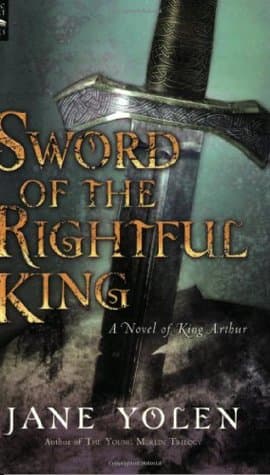
Jane Yolen (2003)
Genre
Fantasy / Historical Fiction / Young Adult
Reading Time
500 min
Key Themes
See below
Sign in to track this book
When Merlin's clever ruse to legitimize a fledgling King Arthur with a sword-in-the-stone test goes awry, the future of England hangs precariously as an unexpected hand claims the legendary blade.
The newly crowned King Arthur Pendragon faces a kingdom still divided and a court full of doubt, especially from powerful barons like Sir Kay. Arthur, young and without the authority expected of a king, struggles to earn respect. Merlin, his old advisor, watches this situation with alarm, fearing a quick downfall or a politically bad marriage. To secure Arthur's position and gain public trust, Merlin creates a grand illusion: a sword in a stone, prophesied to be removable only by England's true king. He places the fae-crafted sword, full of magic, near Tintagel Castle, intending it as a clear sign of Arthur's right to rule.
Merlin's plan starts, and soon, knights and lords from across Britain gather, eager to test their strength and claim the throne. The air is full of anticipation and ambition. Arthur is there, ready to perform the pre-arranged feat. However, before Arthur can try, a young, unknown lad named Gawaine, who came to court to become a squire, approaches the stone. Driven by simple curiosity and a wish to see if it was truly stuck, Gawaine casually grasps the hilt. To everyone's shock, including Merlin, the sword slides easily from the stone into Gawaine's hand. The crowd gasps, and Merlin's carefully built plan lies in ruins, replaced by chaos.
Stunned by Gawaine's unexpected success, Merlin quickly recovers. To prevent immediate chaos, he declares that the sword Gawaine holds is a trick, a fake, and that Gawaine is a fraud trying to undermine the rightful king. He uses his magic and speaking skills to make the crowd doubt, accusing Gawaine of sorcery. The knights and nobles, confused by the events and swayed by Merlin's authority, are in disarray. Some believe Merlin, others suspect a deeper plot, and a few look at Gawaine with awe and suspicion. Gawaine, bewildered by the sudden attention and accusations, finds himself in a difficult spot.
Overwhelmed by the accusations and hostile stares, Gawaine, a simple boy with no political ambition, flees Tintagel Castle with the sword. He understands little of the magic and politics, only that he is suddenly a wanted man. Merlin, determined to get the sword back and restore his plan, sends agents and uses his own magic to track Gawaine. Gawaine, alone and scared, travels through the countryside, trying to avoid capture while dealing with what he accidentally did. He seeks solitude and safety, finding temporary refuge with common people who do not know who he is or what the sword means.
During his flight, Gawaine meets the mysterious Lady of the Lake, a powerful magical being who lives in the water. She has watched the events and knows the truth behind Merlin's magic. The Lady of the Lake tells Gawaine that the sword is not a trick, but a real fae artifact, full of potent magic that responds to true worth, not just lineage or strength. She explains that Merlin's 'test' was flawed because it relied on an illusion rather than true kingly virtue. She advises Gawaine on the sword's power and the great responsibility that comes with it, urging him to understand his path and the possibility of a different kind of kingship.
Back at Tintagel, King Arthur is deeply troubled. Gawaine's success has shaken his confidence. Merlin's aggressive attempts to discredit the boy and get the sword make Arthur question his own claim to the throne. He starts to see Merlin's methods as overly manipulative and wonders if his kingship is truly earned or just a magical construct. Arthur feels isolated and dependent on Merlin, yet also resents his advisor's control. He wants a real connection with his people and a kingship based on more than just magical pronouncements. This creates a growing lack of trust between the young king and his powerful mentor.
After much thought and guided by the Lady of the Lake's wisdom, Gawaine decides he cannot hide. He returns to Tintagel, no longer a frightened boy but a young man with a new sense of purpose. He publicly challenges Merlin's claims, stating that the sword is real and that he removed it honestly. He presents the sword as proof; its fae magic subtly shimmers, clear to those with keen eyes. This act of defiance creates more division at court, forcing many to face what they witnessed and to question Merlin's authority and King Arthur's legitimacy.
To solve the growing problem, a duel is suggested between Gawaine and Arthur, or perhaps a second, public test of the sword. Merlin, desperate to keep control, tries to interfere with his magic, but the Lady of the Lake also intervenes, lessening some of Merlin's influence. During the confrontation, either through a magical clash or a moment of deep insight, the true nature of the sword and Merlin's elaborate magic is revealed to many. It becomes clear that the sword was a genuine test, and Gawaine's success was not a trick, but a demonstration of an innate worthiness that Merlin's magic could not predict or control.
Faced with clear proof and growing unrest among his court, Arthur, with new maturity, accepts Gawaine's claim to the sword. He recognizes that Merlin's intentions, while aimed at securing his throne, were manipulative and had hurt his own legitimacy. Arthur acknowledges Gawaine's worth and the genuine nature of his feat. This moment changes Arthur; he begins to assert his own will, moving away from complete reliance on Merlin's magic and political maneuvering. He starts to understand that true kingship is not just divine right or magical displays, but justice, leadership, and earning the respect of his people.
Having proven his worth, Gawaine is offered a place of honor at Arthur's court, but he chooses his own path, declining the immediate claim to the throne. He understands that his path is not necessarily to be king, but perhaps to serve the kingdom in another way, or simply to live a life true to himself. The sword incident changes how kingship is seen in Britain. Arthur, humbled and enlightened, begins to rule with more wisdom and a stronger sense of justice, building a court based on loyalty and merit rather than only on Merlin's magical influence. This sets the foundation for the legendary court of Camelot, with Arthur now a king truly earning his crown.
The Antagonist/Supporting
Initially controlling and manipulative, Merlin is forced to confront the limits of his power and the unpredictable nature of true worth, leading to a grudging acceptance of Arthur's more independent path.
The Protagonist
Arthur evolves from an insecure, magic-dependent monarch to a more self-assured, independent king who learns to value justice and earned respect over magical pronouncements.
The Protagonist
Gawaine transforms from a naive, frightened boy into a self-assured young man who understands his unique worth and makes his own choice about his destiny.
The Supporting
Acts as a catalyst and mentor, facilitating Gawaine's self-discovery and Arthur's eventual enlightenment.
The Supporting
Remains largely consistent in his skepticism, serving as a foil to Arthur's developing leadership and Gawaine's unexpected rise.
The Supporting
Remains a consistent source of fatherly support and guidance for Arthur.
The Mentioned
Her character arc is not central to this story, but her mention foreshadows her future role in Arthurian legend.
The Mentioned
His influence is primarily historical, shaping the challenges Arthur faces.
This theme explores what makes a king legitimate: divine right, magical pronouncement, lineage, or earned respect and inherent worth. Merlin's magical sword test tries to impose legitimacy, but Gawaine's unexpected success challenges this. It suggests that true kingship comes from an inner quality that cannot be made. Arthur's journey from relying on Merlin's magic to understanding the importance of justice and earning his people's loyalty shows this theme. The book asks if a king can be made by magic, or if he must prove himself through character and action, as Arthur learns.
“'A king is not made by a sword in a stone, but by the heart that wields it, and the hearts of the people he serves.'”
This theme shows the conflict between Merlin's manipulative tactics, driven by a wish for control, and the more genuine leadership seen in Gawaine and eventually Arthur. Merlin's plan to secure Arthur's throne through illusion fails, showing the limits and dangers of manipulation. Arthur's growth involves moving away from Merlin's control, learning to trust his own judgment, and trying to lead with honesty rather than deceit. The story suggests that while manipulation might offer quick fixes, true and lasting leadership needs honesty.
“'You cannot trick a kingdom into believing a lie, Merlin, not when the truth has a sharper edge.'”
The book explores the interplay between predetermined destiny and individual choice. Merlin tries to force destiny through magic, believing Arthur's kingship is fated. However, Gawaine's unexpected ability to pull the sword introduces free will and an alternative path, disrupting Merlin's plan. Gawaine's choice not to claim the throne, despite proving his worth, further shows that individuals have control over their own fate, even with powerful prophecies or magic. Arthur, too, ultimately chooses his own path as king, rather than simply following Merlin's design.
“'Destiny is not a road carved in stone, but a path we choose to walk, with or without a crown.'”
The novel compares different forms and ideas of magic. Merlin's magic is often manipulative, illusionary, and focused on control, used to enforce a specific political outcome. In contrast, the magic of the fae, especially the sword itself and the Lady of the Lake's power, is more elemental, truthful, and responsive to genuine worth. This magic works outside human political schemes. The conflict between these two types of magic, one trying to impose order and the other revealing inherent truth, drives much of the plot. It suggests that not all magic is the same, and some forms align more with truth and natural order.
“'Merlin's magic is a clever cloak; ours is the very wind beneath it.'”
A magical artifact serving as a test of true kingship.
The sword in the stone is the central plot device, initially conceived by Merlin as a glamour to solidify Arthur's claim to the throne. It is meant to be an undeniable sign of divine right, removable only by Arthur. However, its true nature as a fae artifact that responds to genuine worth, rather than Merlin's specific magical programming, leads to Gawaine's unexpected success. The sword serves as a catalyst for conflict, a symbol of legitimacy, and ultimately, a revealer of truth, forcing characters to confront their perceptions of power and kingship.
Merlin's magical deception designed to control outcomes.
Merlin employs powerful glamour and illusion to create the 'test' of the sword in the stone. This device highlights his manipulative nature and his belief that he can orchestrate destiny through magic. The glamour is intended to make the sword appear immovable to all but Arthur, but it ultimately fails because it cannot override the sword's inherent fae magic, which responds to a deeper, more authentic worth. This device underscores the theme of manipulation vs. genuine leadership and reveals the limits of even powerful magic when confronted with truth.
A narrative twist that subverts expectations and drives the plot.
The entire premise of the book hinges on the unforeseen outcome of Gawaine pulling the sword from the stone, directly contradicting Merlin's carefully laid plans. This plot device immediately creates conflict, suspense, and forces all characters to react to an unexpected reality. It challenges the characters' assumptions about destiny, power, and legitimacy, and serves as the primary engine for Gawaine's journey and Arthur's eventual growth. It's a classic subversion of a well-known legend, adding a fresh twist to the Arthurian mythos.
Two contrasting mentors guiding the protagonists.
The book utilizes a dual mentor figure device, with Merlin acting as Arthur's mentor (albeit a manipulative one) and the Lady of the Lake serving as Gawaine's guide. Merlin attempts to mold Arthur into the king he envisions through control and magic, representing an older, more authoritarian form of guidance. The Lady of the Lake, in contrast, empowers Gawaine through truth and understanding, encouraging his self-discovery. This duality highlights the different philosophies of leadership and personal growth, offering contrasting paths for the protagonists to follow.
“A king is not a king because he wears a crown, but because he bears the weight of his people.”
— Merlinnus reflecting on Arthur's leadership qualities.
“The sword is not the power. The power is in the hand that wields it.”
— Merlinnus explaining the nature of Excalibur to Arthur.
“Truth is a sword that cuts both ways, and sometimes the wielder bleeds.”
— Merlinnus warning Arthur about the consequences of honesty.
“A legend is born not from what is, but from what people need to believe.”
— Merlinnus discussing the creation of Arthur's myth.
“The hardest battles are not fought with swords, but within the heart.”
— Arthur contemplating his internal struggles.
“Magic is not a trick; it is a choice to see the world differently.”
— Merlinnus teaching a young apprentice about magic.
“To rule is to serve, and to serve is to love your people more than yourself.”
— Arthur explaining his philosophy of kingship to a knight.
“The past is a ghost that haunts the present, unless we make peace with it.”
— Merlinnus advising Arthur on dealing with his lineage.
“A crown is heavy, but a conscience is heavier.”
— Arthur feeling the burden of his decisions.
“In every ending, there is a beginning waiting to be born.”
— Merlinnus speaking about the cyclical nature of life and rule.
“Strength is not in muscle, but in the will to stand when others fall.”
— Arthur encouraging his knights before a battle.
“The sword chooses the king, but the king must choose to be worthy.”
— Merlinnus on the symbolism of Excalibur and Arthur's journey.
“Fear is a shadow that grows in the dark; bring it to light, and it vanishes.”
— Merlinnus comforting Arthur during a moment of doubt.
“A kingdom is built not on stone, but on the trust of its people.”
— Arthur discussing governance with his council.
“The right path is often the hardest, but it is the only one that leads to honor.”
— Arthur making a difficult decision for the good of Camelot.
Ready to see how well you understood this book? Take our interactive quiz with 10 questions.

Biography coming soon.







