“I know all souls are one and all souls lonely.”
— Suttree reflects on human existence and isolation.

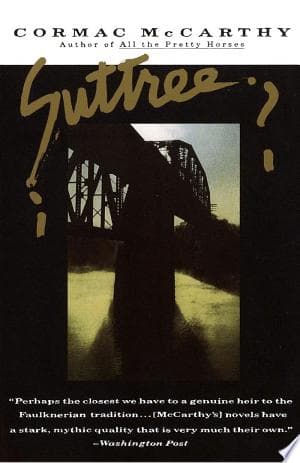
Cormac McCarthy (2010)
Genre
Literary Fiction
Reading Time
1200 min
Key Themes
See below
Sign in to track this book
Cornelius Suttree, an outcast from privilege, finds dignity and humor among the down-and-out people living by the Tennessee River.
Cornelius Suttree, separated from his prominent family in East Tennessee, lives alone on a broken-down houseboat on the Tennessee River near Knoxville. He spends his days fishing, hunting, and watching the various outcasts, squatters, and criminals who live along the riverbanks and in the nearby city. Suttree chose this poor and detached life, turning away from the expectations and comforts of his wealthy background. He talks little, showing quiet strength and a sharp, often sad, view of human nature and the hard parts of their lives. He often thinks about his past, especially his short marriage and the death of his baby son, which adds to his strong sense of loss and feeling alone.
Suttree's isolated life is broken by meetings with the interesting and often desperate people of Knoxville's lower class. He often visits the city for supplies, seeing its decay and the struggles of its residents. He talks with many different people, including prostitutes, moonshiners, and small-time criminals. These talks are often short and about specific things, but they show a clear picture of those on the edges of society. Suttree stays distant, even when he is sometimes pulled into the small fights or sad events of those around him. He watches more than he participates, a quiet viewer of a world that both pushes him away and interests him, showing his chosen isolation.
Suttree's isolation is briefly ended by Gene Harrogate, a young, impulsive, and often foolish person. Harrogate is a frequent small-time criminal, known for odd plans like using dynamite to catch fish or trying to steal watermelons with a stolen goat. Despite how annoying he is, Suttree forms an unwilling connection with him, often helping him out of trouble or giving him food. Harrogate's bad choices often land him in jail, and Suttree visits him there, bringing him small comforts. Their friendship, though uneven, shows a rare part of Suttree's ability to connect with people, though it is always tested by Harrogate's self-destructive habits. Harrogate eventually dies a terrible death in a rock quarry explosion.
For a time, Suttree leaves his houseboat and works at the city's produce market. This experience gives him a different view of working-class life and the city's daily routines. He works alongside other laborers, dealing with the physical demands and the friendship of the market. During this time, he sees different events, from drunk fights to quiet acts of kindness. This time away from the river is a temporary dip into a more typical, though still rough, life, but his natural distance remains. He watches the lives of his coworkers with the same quiet focus he uses for the river people, always keeping some separation.
Suttree starts a strong, but sad, relationship with Joyce, a young prostitute. Their connection is intense, with moments of kindness and raw closeness, giving Suttree a brief feeling of emotional satisfaction. He moves into her broken-down room, sharing a poor life and a deep, if troubled, bond. However, Joyce is very troubled, suffering from mental problems and a history of abuse. Their relationship is full of difficulties, including Joyce's unpredictable behavior and her inability to escape her past. Despite Suttree's efforts to care for her, the relationship cannot last, and Joyce eventually dies in Suttree's arms during a violent seizure, leaving him again with deep sadness and loneliness.
After Joyce's death, Suttree gets very sick with typhoid fever. He has a long period of confusion, with clear, troubling visions and fever dreams that mix reality and his subconscious. Different people care for him, including a kind Black woman named Aunt Polly, who helps him get better. This illness is a difficult experience, bringing him close to death and making him face his own mortality and how fragile human life is. His recovery is slow and hard, leaving him weak but also with a renewed, though still distant, appreciation for life and its short nature.
After he gets better, Suttree returns to his houseboat on the Tennessee River. He goes back to his solitary life, fishing and watching, but with a deeper sense of acceptance. The experiences of loss, illness, and the harsh parts of the world have further set his distance, but also deepened his understanding of human suffering and strength. He continues to see the familiar faces of the river community, but his interactions stay mostly on the edge. His chosen path of isolation is now less a rebellion and more a settled way of being, a quiet life on the edge of society, watching the river flow and the world pass by.
Suttree meets an old man who tells a hard story of being left alone and surviving. The man describes how he was left for dead as a child in a remote area, forced to care for himself against the harsh weather and wild animals. This grim story strongly connects with Suttree, touching on his own feelings of being separated from family and the strong sense of being an outsider. The old man's story shows how uncaring the world can be and the ongoing struggle to live, further strengthening Suttree's sad view of the world and his understanding of the deep sorrows that affect people.
Near the end of the novel, Suttree decides to leave his houseboat and Knoxville. He walks through the countryside, thinking about his life and the people he has known. His journey has no set goal, a physical sign of his continued search for meaning or perhaps just escape. He meets different transient people, sharing short moments of human connection before moving on. This departure means a final break from the life he built on the river and the city's poor areas, but it does not promise a new beginning. Instead, it suggests endless wandering, a man forever on the edges, looking for something undefined.
In the novel's final moments, Suttree meets a lone hunter in the wilderness. Soon after, he feels an unseen follower, a shadowy figure that seems to chase him. This figure represents his inner problems, fears, and the unavoidable nature of his past. He runs, a desperate flight through the woods, until he finally outruns the spectral presence. This last chase is very symbolic. It shows Suttree's lifelong fight with his identity, his past, and the fear that has always followed him. He comes out of the woods, seemingly free, but the ending is unclear, suggesting that while he might have escaped this 'follower,' his journey of inner struggle is far from over.
The Protagonist
Suttree begins and largely ends as a detached observer, but his experiences with love, loss, and illness deepen his understanding of suffering and solidify his chosen path of existential wandering.
The Supporting
Harrogate remains largely unchanged in his foolishness, his arc culminating in his violent, self-inflicted demise.
The Supporting
Joyce's arc is one of tragic inevitability, her attempts at a stable relationship ultimately failing due to her past and mental health, leading to her death.
The Supporting
As a deceased character, Michael has no arc, but his memory profoundly shapes Suttree's character development and motivations.
The Supporting
Aunt Polly's role is largely static, serving as a beacon of compassion during a critical phase of Suttree's life.
The Supporting
His arc is presented through his recounted past, offering Suttree a reflection of enduring hardship.
The Antagonist/Mentioned
The police act as a constant, unchanging antagonistic force against the river community, embodying societal repression.
The Supporting
This collective functions as a dynamic setting and a source of various human stories, constantly shifting but always present.
Suttree's life is shaped by his chosen separation from his wealthy family and regular society. He lives on the edges, watching the world with a deep sense of distance. This is how he deals with his sadness and feelings about existence. This idea is clear in his houseboat home, his few interactions, and his thoughts about how short human connections are. Even in relationships like with Joyce, Suttree struggles to fully connect, always keeping some distance, which shows the deep loneliness in his life.
“He'd long since come to terms with the fact that he was a stranger in the world, and that he would remain so.”
McCarthy honestly shows the darker parts of human nature through the characters and events Suttree sees. The novel is full of violence, cruelty, poverty, and moral decay, especially in the poor communities of Knoxville. Characters like Harrogate often fall victim to their own foolishness or other people's meanness. Suttree watches these acts with quiet acceptance, suggesting a natural evil in the world that is constant and unavoidable, a force that shapes lives and the environment.
“He saw that the world was not a place of order and justice, but a place of chaos and brutality.”
A strong sense of sadness and loss is behind Suttree's character and reasons. The death of his baby son is a core tragedy that adds to his separation and sad view of the world. This idea is made stronger by Joyce's death, which pushes Suttree into another deep period of sorrow and illness. The novel suggests that loss is a natural part of being human, a constant companion that shapes lives and makes people face how fragile and temporary existence is, causing Suttree to pull away from normal life.
“He knew that the dead were never truly gone, but merely resided in the deeper currents of the living.”
Suttree's choice to reject a normal life and his wandering existence show a deep search for meaning. He struggles with the idea that life might be meaningless in a world often shown as uncaring and cruel. His observations of nature and other people's lives are part of his quiet search into the human condition. He does not look for grand answers, but rather a way to live truly in the face of a strange universe. He finds dignity in his quiet acceptance of suffering and his chosen path of solitude.
“What is it that you would have, Suttree? What is it that you are looking for?”
The novel clearly shows the harsh parts of poverty and the clear differences in social class. Suttree, despite his wealthy background, chooses to live among the poorest people: squatters, criminals, and the destitute. The dirtiness of the riverbanks and the city's lower class is shown in detail. This highlights the struggle to survive, the lack of chances, and society's harsh indifference to its outcasts. This idea shows the social criticism within Suttree's personal journey, revealing the raw, honest lives of those at the bottom.
“The poor were not merely lacking, but lacked in a way that was unique to them, and which set them apart.”
Narrative technique revealing Suttree's inner thoughts and observations.
McCarthy frequently employs stream of consciousness and internal monologues to convey Suttree's deep introspection, philosophical musings, and melancholic observations. The narrative often delves into Suttree's mind, revealing his reflections on the human condition, his past, and the natural world, often without clear punctuation or attribution. This device allows the reader direct access to Suttree's detached yet profound worldview, emphasizing his role as an observer and his internal struggle, rather than relying solely on external dialogue or action to define his character.
References to biblical narratives and figures to imbue the narrative with mythic weight.
The novel is rich with biblical allusions, from names like Cornelius (a centurion in Acts) to broader themes of judgment, suffering, and redemption (or the lack thereof). Characters often take on archetypal roles, such as Suttree as a kind of modern-day Job or a Christ-like figure in his suffering and detachment, or the river as a symbolic Jordan. These allusions elevate the seemingly mundane and squalid lives of the characters to a mythic, timeless struggle, giving the narrative a deeper, often pessimistic, spiritual dimension without being overtly religious.
The river acts as a central setting, a source of life, and a symbol of time's relentless flow.
The Tennessee River is more than just a setting; it functions as a character and a powerful symbol. It is Suttree's home, his source of livelihood (fishing), and a constant presence in his life. Symbolically, the river represents the relentless, indifferent flow of time, the cyclical nature of life and death, and the currents of human existence. It mirrors Suttree's own detached observation, flowing onward regardless of the human dramas played out on its banks. Its unchanging presence contrasts with the fleeting, often brutal lives of the characters, grounding the narrative in a natural, elemental force.
A literary style combining vivid, often disturbing, realism with episodic adventures.
McCarthy's writing style in Suttree is characterized by grotesque realism, depicting the squalid, violent, and often bizarre aspects of life on the social fringes with unflinching detail. This is combined with picaresque elements, where Suttree's journey is a series of episodic encounters and adventures with various colorful, often criminal, characters. This blend creates a mosaic of human experience, highlighting the absurd and the tragic, while Suttree, like a picaro, navigates this harsh world as an outsider, observing rather than fully participating in its madness.
“I know all souls are one and all souls lonely.”
— Suttree reflects on human existence and isolation.
“He had divined the shape of the world from the dark of his mother's womb.”
— Describing Suttree's intuitive understanding of life.
“Somebody has been fucking my watermelons.”
— A bizarre and darkly humorous line from a minor character.
“The city lay under a pall of smoke and the river ran like a sewer.”
— Vivid description of Knoxville's industrial decay.
“He saw how the world was made and how it would end.”
— Suttree's visionary moment during a fever dream.
“The only thing that makes life possible is permanent, intolerable uncertainty; not knowing what comes next.”
— Suttree musing on the nature of existence.
“A man is always prey to his own demons.”
— Reflection on inner struggles and personal flaws.
“The river does not require that you live, but it does not object if you do.”
— Observation on the indifferent, powerful force of the Tennessee River.
“He had seen the world in a grain of sand and eternity in an hour.”
— Allusion to William Blake, describing Suttree's perception.
“There is no such joy in the tavern as upon the road thereto.”
— Commentary on anticipation versus fulfillment.
“The past is not dead. It is not even past.”
— Reflection on how history and memory persist.
“He walked in the rain and he was the rain.”
— Poetic description of Suttree's connection to nature.
“In the end, the only thing you can do is go on.”
— Suttree's resigned acceptance of life's struggles.
“The world is everything that is the case.”
— Philosophical musing on reality, echoing Wittgenstein.
Ready to see how well you understood this book? Take our interactive quiz with 10 questions.
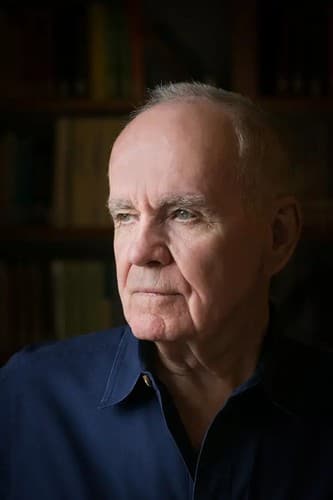
Cormac McCarthy was an American writer who authored twelve novels, two plays, five screenplays, and three short stories, spanning the Western and postapocalyptic genres. He was known for his graphic depictions of violence and his unique writing style, recognizable by a sparse use of punctuation and attribution. McCarthy is widely regarded as one of the greatest American novelists.







