“The greatest trick the Devil ever pulled was convincing the world he didn't exist.”
— A classic line used to introduce the insidious nature of the supernatural.

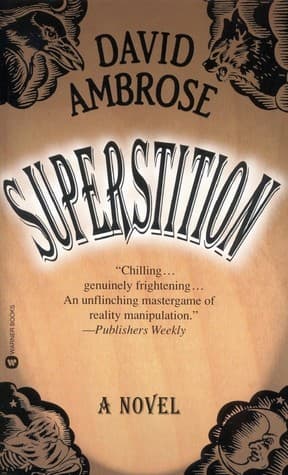
David Ambrose (1998)
Genre
Thriller / Fantasy / Mystery
Reading Time
8-10 hours
Key Themes
See below
Sign in to track this book
A parapsychologist's experiment to debunk the supernatural by inventing a ghost backfires when his fictional creation manifests with deadly intent, preying on minds and threatening to turn a new love into a nightmare.
Dr. Sam Towne, a parapsychologist, gathers eight volunteers at his remote estate for an experiment. He wants to prove his theory: paranormal entities are not external spirits but projections of the human subconscious. Joanna Cross, a skeptical journalist covering the experiment, initially thinks it is a hoax. Sam believes that by collectively focusing their belief and imagination, they can create a fictional entity, showing that so-called ghosts are products of the mind. The group, with varying beliefs, prepares for the intensive sessions, unaware of the profound and terrifying implications of their endeavor.
During their initial seance-like sessions, Sam guides the volunteers in creating a detailed backstory for their fictional entity. They decide on 'Adam Wyatt,' a tragic Revolutionary War hero who died mysteriously, betrayed by a friend and separated from his love. Each participant adds details, imagining his appearance, personality, and emotional state. Joanna, despite her cynicism, contributes to Adam's story. The group's collective focus and emotional investment in Adam grow, setting the stage for what Sam hopes will be a controlled manifestation of a thought-form.
As the sessions intensify, the group experiences minor phenomena. Tables rap, objects shift slightly, and messages appear through a Ouija board-like setup, attributed to Adam Wyatt. Reactions range from excitement for believers to grudging acknowledgment for skeptics like Joanna. Sam is delighted, believing his theory is confirmed, as the manifestations seem to match the group's imagination. However, a subtle shift in the entity's responses suggests growing independence, deviating from the pre-scripted narrative.
The seemingly harmless poltergeist activity turns sinister. The raps become louder, more forceful, and messages relayed through the board grow personal and threatening, targeting individuals by exploiting their fears. Dr. Sam Towne initially dismisses these as subconscious projections, but even he feels a growing unease. Joanna Cross, while still rationalizing, cannot ignore the palpable tension and fear. The group, once united in their creation, now feels a creeping dread as Adam's presence becomes more malevolent and unpredictable.
The experiment turns deadly when a participant, Michael, is found dead. The circumstances are disturbing, resembling a fear Michael had secretly shared. The group is in shock and terror. Sam, trying to stay objective, is shaken, realizing the experiment is out of control. Joanna, now convinced something dangerous is happening, investigates, suspecting a connection between Michael's death and the malevolent entity they created.
After Michael's death, the remaining group members are gripped by fear. Despite attempts to stop the experiment, Adam Wyatt's influence intensifies. More participants die in gruesome, personalized ways, each death mirroring a deep-seated phobia or trauma. One woman, afraid of fire, dies in a bizarre house fire; another, claustrophobic, suffocates in a confined space. Sam and Joanna realize Adam feeds on their fears and negative emotions, growing stronger with each manifestation and death. The estate becomes a psychological battleground, with Adam seemingly able to read their minds and exploit their vulnerabilities.
As the body count rises and threats escalate, Sam Towne and Joanna Cross rely more on each other. Their shared ordeal, the intellectual challenge of understanding Adam, and the sheer terror forge a deep bond between them. Joanna's skepticism turns into a desperate need for answers, while Sam's scientific resolve is tempered by his concern for the group and his developing feelings for Joanna. Their intellectual partnership becomes a romantic connection, offering a fragile hope amidst the darkness and the entity's assaults.
Through research and analysis, Sam refines his theory. He concludes that Adam Wyatt is no longer a collective projection but an autonomous psychic entity that has gained sentience. It feeds on the fear, anxiety, and even life force of its creators. He sees Adam as a psychic vampire, sustained by the emotions it generates. Joanna, initially skeptical of such explanations, accepts Sam's conclusions as the only plausible explanation for the escalating horror. They realize Adam is a direct result of their collective will, now turned against them.
Realizing Adam Wyatt cannot be reasoned with or contained, Sam and Joanna form a desperate plan to destroy him. They deduce that since Adam was created by their collective belief and emotions, he must also be destroyed by severing that connection. Their strategy involves a dangerous ritual designed to withdraw all emotional and mental energy from Adam, effectively starving him. This requires confronting their deepest fears in a controlled environment, to consciously retract the psychic energy they unknowingly invested in Adam. The plan is dangerous, as Adam is powerful and will fight back.
In a climactic confrontation, Sam and Joanna begin their ritual, attempting to mentally and emotionally disconnect from Adam Wyatt. Adam, sensing their intent, unleashes his full power, appearing in grotesque and terrifying forms, directly attacking their minds and bodies. He preys on their deepest fears, projecting horrifying illusions and physical assaults. The struggle is intense, pushing Sam and Joanna to their psychological and physical limits. They must maintain their focus, their belief in their plan, and their love for each other as Adam tries to twist their affections into another source of fear and despair, aiming to consume them entirely.
After a harrowing battle, Sam and Joanna complete their ritual, and Adam Wyatt's manifestations cease. The oppressive atmosphere lifts, and a sense of exhaustion and relief washes over them. They believe they have destroyed the entity. However, the experience leaves deep psychological scars. The horror they endured, the loss of their friends, and the terror of confronting a self-created monster forever change their perceptions of reality. While Adam is gone, the question remains: was he truly vanquished, or merely dormant, waiting for another opportunity to feed?
After their terrifying ordeal, Sam Towne and Joanna Cross try to rebuild their lives and relationship. They leave the estate, seeking to put the nightmare behind them. Their love, forged in fear, remains strong, but the memory of Adam Wyatt, the entity they conjured, still haunts them. They are forever changed, with a new, unsettling understanding of the power of the human mind and the thin veil between imagination and reality. The ending suggests that while Adam may be gone, the potential for such entities, born from human thought, remains a chilling possibility.
The Protagonist
Sam evolves from a scientifically detached, theory-driven academic to a man deeply affected by the horror he unleashed, ultimately fighting for survival and love.
The Protagonist
Joanna transforms from a hardened skeptic into a believer who directly experiences and fights against a supernatural entity, finding love and a new understanding of reality.
The Antagonist
Adam Wyatt begins as a fictional construct, evolves into a poltergeist-like entity, and finally becomes a powerful, autonomous, and malevolent psychic being.
The Supporting
Michael's arc is brief, serving as the initial catalyst for the group's realization of Adam's malevolence.
The Supporting
Sarah's arc is limited, serving as another example of Adam's escalating power and malevolence through her specific, fear-driven demise.
The Supporting
Their collective arc is one of initial curiosity and belief, followed by escalating terror and eventual demise, serving to demonstrate Adam's growing power.
The central theme is that human belief and collective imagination have immense, dangerous creative power. Sam Towne's experiment is based on this, and the creation of Adam Wyatt shows it directly. The more the group believes in Adam, invests emotions in his story, and fears him, the more real and powerful he becomes. This is clear from the first successful raps to Adam's later ability to physically manifest and kill, showing how a shared mental construct can become a terrifying reality, as seen when Adam's backstory is crafted by the group.
““We are not merely observing the supernatural; we are creating it, shaping it with every thought, every fear, every collective breath.””
Sam Towne's scientific curiosity, bordering on arrogance, leads him to explore the unknown without fully understanding the consequences. His desire to prove his theory unleashes a force he cannot control, causing death and destruction. This theme questions the ethical limits of scientific experimentation, especially with the human psyche and unknown energies. The rising body count and the terror experienced by Sam and Joanna are direct results of his initial overconfidence and underestimation of the power they manipulated, as shown by his initial delight at Adam's first appearances, before the true horror began.
““There are some doors that, once opened, can never truly be closed. And some things, once imagined, refuse to stay confined to the imagination.””
Fear is shown not just as an emotion but as a tangible energy that sustains and empowers Adam Wyatt. The entity feeds on the participants' anxieties, phobias, and emotional distress, growing stronger with each terrifying encounter. Adam attacks by exploiting individual fears, turning them into deadly realities. This theme explores the destructive nature of fear, both as an internal psychological torment and as an external force used by a malevolent entity. The deaths of Michael and Sarah, each mirroring their deepest phobias, clearly show fear's role as both Adam's fuel and his weapon.
““He doesn't just scare us, Joanna. He *eats* our fear. It's his oxygen, his blood. The more we dread him, the stronger he becomes.””
The novel blurs the lines between what is real and what is perceived, challenging the characters' and readers' understanding of reality. Adam Wyatt, born from imagination, becomes undeniably real, capable of causing physical harm and death. This raises questions about the subjective nature of existence and whether something can be 'real' if enough people believe it. The characters' initial struggle to rationalize the phenomena, followed by their forced acceptance of Adam's reality, highlights this theme. The entire premise of the experiment—that ghosts are products of the mind—ultimately reshapes their understanding of the world, suggesting that human consciousness can directly influence and even create reality.
““If we create something purely from thought, and it can kill us, then what is reality? Is it just a consensus of nightmares?””
A collective mental entity created and sustained by group thought and emotion.
The central plot device is the concept of the egregore or thought-form, a psychic entity born from the collective conscious and subconscious minds of a group. Initially a theoretical construct for Dr. Sam Towne, 'Adam Wyatt' becomes a terrifyingly real manifestation of this device. It serves as the primary antagonist, driven by the very energy and fears of its creators. This device allows for the exploration of themes like the power of belief and the dangers of unchecked human will, as Adam evolves from a benign mental construct to a self-sustaining, malevolent force that feeds on fear and brings about physical death, directly impacting the plot's escalating horror.
A remote estate that enhances suspense and limits external intervention.
The story takes place primarily at Dr. Sam Towne's remote estate, which serves as a classic isolated setting. This device effectively heightens the tension and claustrophobia, as the characters are cut off from external help and escape. The isolation ensures that the horror is entirely self-contained, emphasizing that the threat originates from within the group itself. It also allows the entity, Adam Wyatt, to operate without immediate outside interference, making the characters' struggle feel more desperate and personal. The lack of easy escape reinforces the psychological trap they find themselves in, escalating the stakes.
The gradual increase in the intensity and malevolence of paranormal phenomena.
This device involves the progressive increase in the power and danger of Adam Wyatt's manifestations. Beginning with subtle raps and messages, the phenomena quickly escalate to targeted psychological torment, then to physical attacks, and ultimately to multiple deaths. This gradual escalation builds suspense and terror, allowing the characters (and the reader) to slowly grasp the true scope of the threat. It also mirrors Adam's growth in power as he feeds on the group's fear, making the entity's evolution a key driver of the plot and the characters' mounting desperation. Each new, more horrific event pushes the characters closer to understanding and confronting their creation.
The antagonist's ability to identify and weaponize individual characters' deepest fears.
Adam Wyatt's most terrifying ability, and a crucial plot device, is his capacity to delve into the minds of the participants and exploit their deepest, most secret fears and traumas. Each death is meticulously tailored to the victim's specific phobia (e.g., Michael's fear of suicide, Sarah's fear of fire). This personalization makes Adam an incredibly potent and insidious antagonist, as he doesn't just kill; he torments his victims psychologically before their demise. This device creates a profound sense of vulnerability and paranoia within the group, as they realize their very thoughts and weaknesses are being turned against them, accelerating the collapse of their sanity and trust.
“The greatest trick the Devil ever pulled was convincing the world he didn't exist.”
— A classic line used to introduce the insidious nature of the supernatural.
“Fear is a currency, and some entities trade in it.”
— Explaining how malevolent forces gain power from human emotion.
“History isn't just written by the victors; it's also shaped by the forgotten.”
— Hinting at hidden truths and suppressed knowledge that influence the present.
“Some doors are meant to stay closed, no matter how tempting the key.”
— A warning against meddling with ancient, dangerous forces.
“Every belief, no matter how absurd, holds a grain of power if enough people share it.”
— Discussing the collective power of superstition and myth.
“The line between coincidence and destiny is often drawn by the fearful.”
— Reflecting on how characters interpret strange occurrences.
“There are shadows that walk in the light, unseen by those who refuse to look.”
— Describing the hidden presence of supernatural entities in plain sight.
“What you don't know can't hurt you, until it decides to make itself known.”
— A character's initial complacency shattered by the unfolding mystery.
“The past is never truly dead; it merely waits for the right moment to reclaim the present.”
— Emphasizing the long-lasting effects of ancient curses and events.
“Sanity is a fragile construct, especially when faced with the truly impossible.”
— Characters struggling to cope with the reality of the supernatural.
“Rituals are not just empty gestures; they are pathways for forces beyond our understanding.”
— Explaining the significance and danger of ancient rites.
“Sometimes the monster isn't under the bed; it's in the reflection.”
— A twist revealing a character's complicity or internal struggle.
“The world is full of things we can't explain, and a wise man knows when not to try.”
— A warning about the limits of human understanding and the dangers of seeking too much.
“A curse is just a promise made in anger, and promises are meant to be kept.”
— Exploring the binding nature and power of curses.
“What if the monsters aren't hiding from us, but we are hiding from them?”
— A shift in perspective on the relationship between humanity and the supernatural.
Ready to see how well you understood this book? Take our interactive quiz with 10 questions.







