“Shade was a runt, the smallest of the litter, and his mother, Ariel, worried about him constantly.”
— Introducing the protagonist, Shade, and his mother's concern for him.

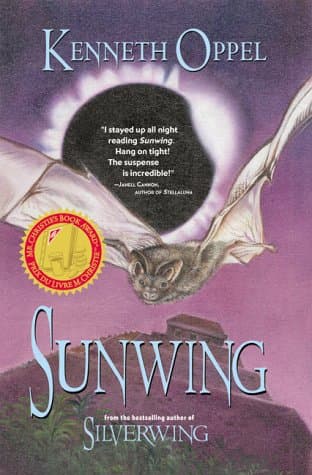
Kenneth Oppel (1999)
Genre
Fantasy / Children's / Young Adult
Reading Time
299 min
Key Themes
See below
Sign in to track this book
Young bat Shade and his friend Marina must escape a deceptive human paradise that is actually an animal testing lab, all while outsmarting the cannibalistic bat Goth and his deadly plan to sacrifice 100 creatures.
After the events of Silverwing, Shade, now a young adult, returns to his Silverwing colony. As winter nears, the colony, led by Frieda, needs a safe, warm place to hibernate. They are drawn by strange, rhythmic lights and a strong fruit scent to a huge, enclosed human structure. Believing it to be a safe place, the whole colony, including Shade, Marina, and even Ariel's outcast group, flies inside. The interior is a vast, artificial jungle full of insects and no predators, seeming like a perfect paradise for the bats. They settle in, relieved to have found such an abundant and safe place, unaware of the sinister reason for their comfortable new home.
Despite the apparent abundance, Shade and Marina notice strange things. Some bats disappear, and others act oddly, showing unusual light-sensitivity and confusion. They watch the humans, whom they call 'Hairless,' carefully monitoring the bats. During a flight, Shade and Marina discover the truth about their 'paradise': it is a large research facility where humans experiment on bats. They see bats being tested and learn that their supposed sanctuary is a trap for a darker purpose, destroying their illusion of safety and creating a desperate need to escape.
As Shade and Marina try to understand the humans' motives, they are horrified to discover that Goth, the terrifying cannibalistic jungle bat they thought was dead, is also imprisoned in the facility. Goth, with his loyal lieutenant, Throbb, has been captured and brought to the same complex. He quickly takes control among the other captive bats, including a group of owls and rats also held there. Goth, always a manipulator, begins to plan his own escape and, more ominously, plans to fulfill a prophecy for his dark god, Zotz, involving a ritual sacrifice of a hundred hearts to gain ultimate power.
Shade and Marina's investigations reveal the terrible truth about the humans' experiments. The Hairless are implanting small, light-sensitive devices into the bats, making their eyes very sensitive and turning them into 'sunwings.' These modified bats are then released into a jungle war zone, where their increased light sensitivity makes them confused and vulnerable, causing them to fly into dangerous situations. The humans are weaponizing the bats, using them as unwitting suicide bombers to disrupt enemy operations, turning the bats into tools of destruction in a conflict they do not understand.
While the humans continue their experiments, Goth carries out his own sinister plan. He believes that by sacrificing a hundred hearts to his god, Zotz, he will gain great power and become a true 'Sunwing,' immune to the sun and able to rule the day. He begins to systematically capture and kill other bats, owls, and rats within the facility, tearing out their hearts in a gruesome ritual. The captive animals live in fear, caught between the invisible threat of the humans and the very visible, immediate danger from Goth and Throbb. Shade and Marina realize they must stop Goth before he finishes his gruesome count.
Facing both the humans' schemes and Goth's bloody ritual, Shade and Marina realize they cannot fight alone. They reach out to the other captive creatures—the owls, led by the wise but tired Throbb, and even some of Goth's own unhappy followers. Despite deep mistrust and natural predator-prey instincts, they form a fragile alliance. The goal is twofold: to stop Goth's ritual and to find a way for all the captive animals to escape the human facility. This alliance is tense but is their only hope for survival.
Working together, Shade, Marina, and their allies plan to escape the human facility. They use a moment of weak security, combining their strengths to get past barriers and create an opening. The escape is chaotic and dangerous, with many bats falling to the humans' defenses or the sheer confusion. Once outside, they find themselves in a dense, unfamiliar jungle, a world much more dangerous than their northern forests. They must now deal with unfamiliar predators, the relentless heat of the sun, and the ongoing threat of the 'sunwing' effect on some of their companions.
Goth, having also escaped or been released, relentlessly chases Shade and the others, determined to complete his ritual. The chase leads them deep into the jungle, to ancient ruins that Goth believes are sacred to Zotz. In a final confrontation, Shade and Goth fight in a brutal aerial battle. Shade, using his courage and intelligence, must outsmart and overpower the larger, more powerful Goth, who is driven by his fanatic devotion to Zotz and his desire for ultimate power. The fate of all the captive bats, and the prophecy of Zotz, hangs in the balance during this desperate fight.
During their last confrontation, Shade realizes that Zotz is not a good or truly powerful god, but a destructive force Goth has embraced and misunderstood. Shade understands that Goth's power comes from fear and manipulation, not divine intervention. Using his knowledge of bat abilities and the environment, Shade defeats Goth, not with brute force, but by outsmarting him and using his weaknesses. Goth is finally beaten, and the threat of his dark god is gone, freeing the surviving bats from his tyranny and allowing them to seek a new, true haven.
With Goth defeated and the human threat gone, the surviving bats, including Shade, Marina, and the rest of their colony, are free to find a new home. They discover a safe, hidden cave system deep within the jungle, far from humans and the lingering shadow of Goth. Here, they can rebuild their colony, raise their young, and live in peace, free from the manipulation and danger they experienced. Shade and Marina, now proven leaders, look towards a future where their kind can thrive, carrying the lessons learned from their hard journey.
The Protagonist
Shade evolves from a curious but often fearful young bat into a decisive, strategic leader who can outwit even the most formidable adversaries.
The Supporting
Marina further solidifies her role as a brave and indispensable companion, demonstrating her unwavering resolve in the face of danger.
The Antagonist
Goth's fanaticism and lust for power intensify, leading to his ultimate downfall as he attempts to fulfill his dark prophecy.
The Supporting
Throbb remains largely subservient to Goth, highlighting the power of fear and manipulation, though he does show moments of indecision.
The Supporting
Frieda continues to lead her colony, adapting to new threats and trusting Shade's growing wisdom.
The Supporting
Ariel learns to cooperate with others for the greater good, softening her initial antagonism towards Shade's group.
The Antagonist
The Hairless remain a consistent, impersonal threat, representing the larger world's indifference and exploitation of nature.
The Mentioned
Zotz's influence is ultimately revealed as a manipulative force that Goth misunderstands, losing its power once Goth is defeated.
The novel looks at the morality of animal testing and using living creatures as weapons. The humans' 'paradise' is a cold, sterile laboratory where bats are subjected to cruel experiments, implanting devices that cause extreme light sensitivity and turn them into unwitting suicide bombers. This shows how life and suffering are ignored when scientific progress or military goals take priority, making the reader question the cost of human conflict and progress. The bats' situation in the facility, caught between human 'advancements' and Goth's savagery, shows how vulnerable nature is to human actions.
“For the Hairless, they were not creatures of flight and freedom, but data points, variables in a grand experiment.”
The main idea of bats being lured into a seemingly perfect sanctuary that turns out to be a prison is a strong example of this theme. The human facility, with its abundant food and no predators, at first seems like a safe haven from the harsh outside world. However, this 'paradise' is a carefully built illusion meant to trick and use the bats. This theme explores how appearances can be deceiving and how trust can be broken, forcing characters like Shade and Marina to look past surface comforts to find the hidden dangers.
“This was no sanctuary. This was a cage, exquisitely designed to lull them into a false sense of security.”
Throughout their ordeal, Shade and his companions must constantly adapt to new threats, from the human laboratory to the jungle. Their ability to survive depends on their resourcefulness, their capacity to form unlikely alliances (e.g., with owls), and their natural instincts. This theme is clear in their escape from the facility and their struggle to navigate an unfamiliar and hostile jungle, showing life's resilience in the face of great difficulty and the constant need to change or die.
“Survival was not about strength alone, but about cunning, and the willingness to see the world anew.”
The novel shows a clear difference between Goth's destructive, selfish evil and the more subtle, detached evil of the humans. Goth's evil is primal, driven by fanaticism and a desire for power through violence and sacrifice, making him a terrifying and immediate threat. The humans' evil, however, is colder, more calculated, rooted in scientific detachment and military goals, which makes it just as, if not more, disturbing. Shade and Marina represent good, striving for life, freedom, and compassion, showing the constant fight against different kinds of evil.
“Some evil was loud, roaring for blood. Other evil was quiet, precise, and just as deadly.”
A main theme is the basic desire for freedom and the horror of being captive. The bats, naturally flying creatures of the open sky, are confined within the artificial environment of the human facility. Their entire existence relies on movement and exploration, making their imprisonment a deep violation of their nature. The struggle to escape is not just for survival, but for the very essence of their being—to fly freely. This theme is emphasized by the contrast between their natural habitats and the controlled, manipulated environment of the laboratory, highlighting the value of independence and the desire to be unbound.
“To be a bat was to be free. To be caged was to be nothing at all.”
A seemingly perfect environment that hides a sinister purpose.
The human facility designed to attract and house the bats serves as an 'artificial paradise.' It's presented as a vast, insect-filled, predator-free jungle, a utopian environment for the bats to hibernate. This device functions as a deceptive lure, drawing the entire colony into captivity under false pretenses. It creates a strong initial contrast between the perceived safety and the eventual revelation of its true, sinister purpose as a research and weaponization lab, heightening the sense of betrayal and danger for the protagonists.
Technological devices that weaponize bats by making them light-sensitive.
The 'sunwing' implants are small devices inserted into the bats by the humans, causing extreme light sensitivity. This plot device serves multiple functions: it explains the strange behavior of some bats, reveals the true, horrifying motive of the humans to use bats as unwitting suicide bombers in a war zone, and creates a unique physical vulnerability for the bats, forcing them to adapt or perish. It represents the destructive power of human technology when applied to nature, and the ethical implications of such experimentation.
A dark religious prophecy driving the antagonist's actions and creating a ticking clock.
Goth's belief in the Zotz prophecy, which demands the sacrifice of a hundred hearts to grant him ultimate power and make him a 'Sunwing,' acts as a major plot driver. This device establishes Goth's fanatical motivation, provides a clear, gruesome goal for the antagonist, and creates a ticking clock for Shade and Marina. It intensifies the stakes, as they must not only escape the humans but also prevent Goth from completing his ritual, which would mean the deaths of many innocent creatures.
The bats' primary sense used to navigate and perceive the world.
Echolocation is not just a biological fact but a crucial plot device that immerses the reader in the bats' unique worldview. It allows Shade and Marina to 'see' their environment, detect hidden dangers, and communicate in ways humans cannot. The narrative frequently describes the world through sound vibrations and echoes, highlighting both the bats' incredible abilities and their vulnerabilities (e.g., the disorientation caused by the 'sunwing' implants). This device makes the dangers and discoveries more vivid and immediate from the bats' perspective.
“Shade was a runt, the smallest of the litter, and his mother, Ariel, worried about him constantly.”
— Introducing the protagonist, Shade, and his mother's concern for him.
“The humans called it a 'sanctuary,' but to Shade, it was a prison.”
— Shade's perspective on the research facility where he and other bats are kept.
“He knew, with a certainty that chilled him, that he had to escape.”
— Shade's resolve to break free from the human facility.
“The world beyond the enclosure was vast and terrifying, but also full of promise.”
— Shade's feelings upon experiencing the outside world for the first time.
“He was a bat, not a pet. He belonged to the sky, not a cage.”
— Shade's internal declaration of his true nature and desire for freedom.
“The greatest danger often lay in the most beautiful places.”
— A realization Shade has while navigating a seemingly idyllic but treacherous environment.
“Friendship wasn't about being the same, but about understanding and supporting differences.”
— Shade's growing bond with other bats and creatures.
“To truly see, you sometimes had to close your eyes and listen.”
— Shade learning to rely on his echolocation and other senses beyond sight.
“The journey was long, and the destination uncertain, but every wingbeat was a step toward home.”
— Reflecting on the arduous migration journey.
“There was a strength in numbers, but a unique power in solitude.”
— Shade contemplating the balance between community and individual strength.
“He had faced predators, storms, and the vast indifference of the world, and he was still flying.”
— Shade's reflection on his resilience after overcoming numerous challenges.
“The world was full of wonders, if you only knew how to look for them.”
— Shade's growing appreciation for the natural world around him.
“Sometimes, the biggest heroes were the ones who were too small to be noticed.”
— A reflection on Shade's own journey and his impact despite his small size.
“He carried the wind in his wings, and the hope of his colony in his heart.”
— Shade's sense of purpose and responsibility during his quest.
Ready to see how well you understood this book? Take our interactive quiz with 10 questions.

Biography coming soon.







