“Summer is a time for adventure, and even a classroom hamster can have one.”
— Humphrey reflects on the possibilities of summer.

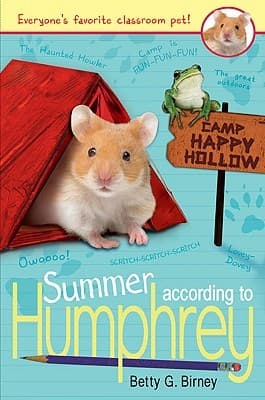
Betty G. Birney (2010)
Genre
Fantasy / Children's / Young Adult
Reading Time
150 min
Key Themes
See below
Sign in to track this book
Humphrey the classroom hamster swaps his cage for a cabin, embarking on a wild outdoor adventure at Camp Happy Hollow where he befriends a mouse, finds a lost frog, and helps his human friends navigate the challenges of summer camp.
As the school year at Longfellow School ends, Humphrey, the classroom hamster of Room 26, worries about summer vacation. He loves his classroom and the children, and the thought of being alone or forgotten makes him anxious. To his relief, Ms. Mac announces that he and Og, the classroom frog, will go to Camp Happy Hollow with her and several students from Room 26 for the summer. This news changes Humphrey's apprehension into excitement. He looks forward to new adventures and continuing to help his friends, even outside the classroom. He prepares for the trip, making sure he has his notebook and pencil ready for any new observations and advice he might need to give.
Upon arrival at Camp Happy Hollow, Humphrey is placed in Cabin 12 with Ms. Mac and a group of Room 26 students, including Gail, Kirk, and Miranda, who are a bit hesitant about camp life. Og is housed in a separate cabin, Cabin 13, which makes Humphrey a little sad. Humphrey quickly begins to observe the children and their struggles, such as Gail's shyness and Kirk's difficulty making friends. During his first night, Humphrey meets a wild mouse named Wally. Wally, initially wary, becomes a friendly guide for Humphrey, sharing insights about the camp and the surrounding woods, and teaching Humphrey about the differences between wild and domesticated animal lives. This new friendship gives Humphrey a sense of belonging in the unfamiliar wilderness.
Gail struggles with homesickness, often calling her mom and feeling left out. Humphrey observes her sadness and tries to offer comfort and distraction. He notices that Gail enjoys drawing, and he encourages her to participate in camp activities. Meanwhile, Kirk, who is usually talkative in school, becomes quiet at camp, finding it hard to connect with the other boys in his cabin. Humphrey makes an effort to visit Kirk's cabin during his nightly explorations, leaving small notes or performing little actions to try and boost Kirk's confidence and encourage him to open up. Humphrey's presence provides quiet support for both children as they navigate their initial camp challenges.
One evening, Humphrey discovers that Og is missing from his terrarium in Cabin 13. He knows the dangers of the outdoors for a classroom frog. He immediately asks Wally for help to search for his amphibian friend. Wally, with his knowledge of the camp grounds and the surrounding nature, becomes an ally in the search. They search the area around Cabin 13, the mess hall, and the path to the lake, following any small lead they can find. Humphrey wants to find Og, remembering their shared experiences in Room 26 and the responsibility he feels for his friend's well-being in an unfamiliar and potentially dangerous environment.
Humphrey and Wally's search for Og leads them closer to the camp's lake. Wally's keen senses and understanding of animal behavior help as they follow faint trails and listen for sounds. Humphrey worries that Og might be in danger from predators or simply unable to survive outside his controlled environment. When they reach the edge of the lake, they discover Og not in distress, but enjoying himself in the natural habitat, surrounded by other frogs and seemingly thriving. Humphrey is relieved but also a bit bewildered by Og's sudden adaptation to the wild, realizing that perhaps Og's needs are different from his own.
Humphrey is torn. Og seems happy in the lake, but Humphrey knows Ms. Mac and the children would be sad if he didn't return. Using his ability to understand human speech, Humphrey 'communicates' with Og. He reminds Og of the children, Ms. Mac, and their life in Room 26, emphasizing the love and care they receive. Og, after thinking, decides to return to camp. Humphrey guides him back, feeling relief and understanding for Og's desire for freedom. Their reunion at the cabin is a joyous one for Ms. Mac and the children, who had been worried.
Throughout the rest of the camp session, Humphrey continues his nightly explorations, often visiting different cabins. He notices Miranda struggling to make friends and feeling left out. He also observes other children having minor conflicts or feeling isolated. Humphrey, in his small but impactful ways, tries to help them connect. He might leave a small note near two children who could benefit from talking, or subtly nudge a shared activity into their path. For instance, he encourages Gail to share her drawings, which helps her connect with another girl who also loves art. His silent interventions help the children navigate the social complexities of camp life, making new friends and resolving small misunderstandings.
As the final days of camp approach, the campers prepare for a talent show. Gail, initially shy, decides to participate by drawing a picture to share. Kirk finds his place, having made a few friends and feeling more comfortable. Humphrey feels a sense of accomplishment watching the children thrive. Before leaving, Humphrey says goodbye to Wally. They reflect on their unlikely friendship and the adventures they shared. Wally expresses his gratitude for Humphrey's understanding of the wild, and Humphrey appreciates Wally's guidance. It's a bittersweet moment, as Humphrey will miss his wild friend, but he also looks forward to returning to school.
When summer camp ends, Humphrey and Og return to Longfellow School and Room 26. Humphrey is happy to be back in his familiar cage, surrounded by the comforting sounds and smells of his classroom. He reflects on his summer adventures, the challenges he faced, and the friendships he helped make. He feels a renewed sense of purpose, knowing that even outside the classroom, he can make a difference in the lives of the children. Og, too, seems content, perhaps having satisfied his craving for the wild. Humphrey looks forward to the new school year, ready to continue his role as the classroom hamster, equipped with new experiences and a deeper understanding of the world beyond his cage.
The Protagonist
Humphrey overcomes his initial anxiety about leaving school, embraces the challenges of camp, and gains a deeper understanding of both wild and domesticated life.
The Supporting
Og explores his wild instincts but ultimately chooses to return to his life as a classroom pet, appreciating the balance between freedom and companionship.
The Supporting
Ms. Mac continues to be a nurturing figure, successfully managing the children and pets in a new environment.
The Supporting
Wally forms an unlikely friendship with a domesticated hamster, sharing his world and aiding him in his quest.
The Supporting
Gail transforms from a homesick and shy camper into a more confident and socially engaged individual.
The Supporting
Kirk moves from being socially isolated at camp to making new friends and feeling more comfortable.
The Supporting
Miranda begins to overcome her feelings of isolation, finding connections with other campers.
The Mentioned
Not applicable, as she does not appear in this book.
Adaptation is central as Humphrey, Og, and the students all face a new environment at Camp Happy Hollow. Humphrey, usually comfortable in his cage, must adapt to the wilderness, making friends with a wild mouse and navigating unknown territories. Og's escape to the lake shows his adaptation to a wild habitat, before he adapts back to camp life. The children, like Gail and Kirk, must adapt to a new social structure and activities, learning to overcome homesickness and shyness. The book shows that embracing change, though challenging, can lead to growth and new experiences.
“Even if things don't stay the same, you can still have fun and help people.”
Friendship is a theme, explored through various relationships. Humphrey's existing bond with Og is tested and strengthened, and his new friendship with Wally, a wild mouse, broadens his understanding of different worlds. Humphrey actively helps friendships among the human campers, helping shy Gail and withdrawn Kirk find their place and connect with peers. The campers' struggles and eventual successes in making friends emphasize the need for connection and belonging, especially in new settings like summer camp.
“A good friend can help you find your way, even when you're lost.”
This theme is most evident in Og's storyline and Humphrey's interactions with Wally. Og, a domesticated frog, finds joy and belonging in the natural lake environment. Humphrey, while curious about the wild, appreciates the safety and purpose of his 'home' in the classroom. Their contrasting experiences, and Og's eventual return, explore the balance between freedom and security, and the idea that 'home' can be where one feels most loved and needed, whether wild or tame.
“Sometimes, even when you're free, you still want to go home.”
Humphrey shows empathy throughout the book, observing the struggles of those around him and finding ways to help. His quiet interventions, whether leaving a note for a lonely child, encouraging participation, or guiding Og home, come from an understanding of others' feelings. The children also learn empathy as they overcome their own challenges and start to connect with each other. The story reinforces the idea that even small acts of kindness and understanding can have a positive impact on others.
“It's a good feeling to help someone who needs it.”
The story is told entirely from Humphrey the hamster's unique perspective.
The entire novel is narrated by Humphrey, the classroom hamster. This device provides a unique and often humorous perspective on human behavior and the world from a small creature's point of view. Humphrey's ability to understand human speech, combined with his inability to directly communicate back, creates situations where he observes, analyzes, and subtly influences events without the humans ever realizing his intelligence. This allows for insightful commentary on childhood challenges and social dynamics that might otherwise be overlooked, while also adding a layer of charming irony.
A physical manifestation of Humphrey's thoughts and observations.
Humphrey carries a tiny notebook and pencil, which he uses to 'write' down his observations, questions, and advice. While the actual writing is a symbolic representation of his internal monologues and problem-solving process, it serves as a tangible plot device. It highlights his intelligence, his methodical approach to understanding the world, and his desire to learn and help. The notebook often frames his reflections and allows the reader direct access to his 'notes' on human behavior and his plans for intervention, making his thought process clear and engaging.
The contrast between domesticated and natural environments and behaviors.
This device is explored through Humphrey's life as a classroom pet versus Wally's life as a wild mouse, and most prominently through Og's escape to the lake. It creates tension and conflict, as Humphrey grapples with the dangers and allure of the wild for his friends. The contrast highlights different forms of freedom, security, and belonging. It forces Humphrey and the reader to consider what 'home' truly means and whether an animal's natural instincts can ever be fully suppressed in a domesticated setting.
Humphrey's indirect actions to influence human behavior.
Humphrey's primary method of helping the children is through subtle, indirect interventions. He cannot speak, so he manipulates objects, leaves notes (which humans assume are from other humans or just random occurrences), or performs small actions that subtly nudge events in a positive direction. For instance, he might 'accidentally' knock over an item to draw attention, or move a drawing to be seen by the right person. This device is central to the plot, showcasing Humphrey's intelligence and empathy without breaking the realism of humans not understanding animal speech.
“Summer is a time for adventure, and even a classroom hamster can have one.”
— Humphrey reflects on the possibilities of summer.
“Sometimes the smallest creatures can make the biggest difference.”
— Humphrey helps solve a problem in the classroom.
“A classroom isn't just a room with desks; it's a place where friendships grow.”
— Humphrey observes the students interacting.
“Even when things seem quiet, there's always something exciting happening if you look closely.”
— Humphrey explores the classroom at night.
“Helping others is the best way to spend a summer day.”
— Humphrey assists a student with a project.
“Every problem has a solution, you just have to think like a hamster.”
— Humphrey uses his creativity to fix a situation.
“Friends come in all shapes and sizes, and sometimes they have fur.”
— Humphrey bonds with other classroom pets.
“Summer adventures don't always mean going far; they can happen right where you are.”
— Humphrey finds fun in the classroom during break.
“Learning doesn't stop when school ends; it happens every day.”
— Humphrey discovers new things over the summer.
“A little curiosity can lead to big discoveries.”
— Humphrey investigates a mystery in the classroom.
“Being brave doesn't mean you're not scared; it means you try anyway.”
— Humphrey faces a challenge during an adventure.
“The best memories are made with friends, whether they're human or hamster.”
— Humphrey recalls fun times with the students.
“Sometimes the quietest voices have the most important things to say.”
— Humphrey listens to a shy student's thoughts.
“Summer is a season of growth, for plants, people, and even hamsters.”
— Humphrey observes changes in the classroom and garden.
Ready to see how well you understood this book? Take our interactive quiz with 10 questions.







