“When Stuart was a year old, which is a good age for a mouse, he was no bigger than a peanut.”
— Describing Stuart's unusual birth and size.

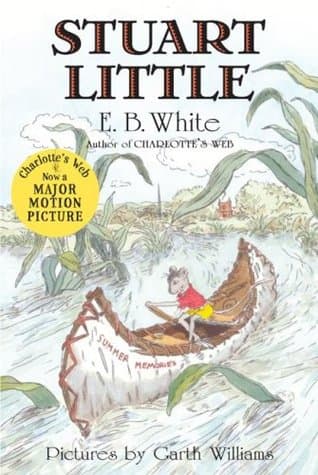
Genre
Fantasy / Children's / Young Adult
Reading Time
90 min
Key Themes
See below
Sign in to track this book
Born to a human family in New York City, the tiny, adventurous mouse Stuart Little embarks on a journey to find his bird friend, Margalo, encountering both danger and wonder along the way.
The Little family, consisting of Mr. and Mrs. Little and their son George, are surprised by their second son, Stuart. Stuart is not a human baby but a fully formed, articulate mouse, barely two inches tall. Despite his unusual appearance, his parents love him and treat him as a regular member of the family. Mrs. Little knits him tiny clothes, and Mr. Little constructs a miniature bed for him from a matchbox. Stuart quickly shows his cleverness, using household objects to navigate the human-sized world, like a tiny hammer to play the piano or a small elevator to reach higher places. His family accepts his unique presence without question.
From an early age, Stuart shows cleverness in adapting to his environment. He often gets into trouble due to his small size, such as falling into a wastebasket or getting tangled in a window shade cord. However, he always finds a way out. Mr. Little builds him a tiny custom-made car, which Stuart uses to drive around the house and even briefly outside. He also helps his mother find her lost ring by being lowered into a drain on a string. These early experiences show Stuart's independent spirit and his ability to overcome challenges, often surprising his family with his solutions. His brother George is initially bewildered but accepts Stuart's unique nature.
One day, a bird named Margalo, injured by a stone, falls into the Little family's house. Mrs. Little nurses her back to health, and Margalo decides to stay, building a nest in a potted plant. Stuart and Margalo quickly become friends, spending their days talking and playing together. Stuart likes Margalo's grace and beauty, and she, in turn, appreciates his kindness and quick wit. Their friendship makes Stuart happy, giving him a companion who understands his unique view of the world. However, Snowbell, the family cat, views their bond with suspicion.
Snowbell, the Little family's cat, becomes jealous of Margalo and the attention she receives. He sees her as an intruder and a potential meal. Snowbell works with a stray cat named Angora to trick Margalo into believing she is in danger. He spreads rumors and fear, making Margalo feel unsafe in the Little home. Fearing for her life, Margalo decides she must leave. She tells Stuart, expressing her sadness at having to depart, but her belief that it is necessary for her safety. Stuart is heartbroken by her decision and the thought of losing his friend.
After Margalo leaves, Stuart is devastated. He realizes how much he misses her and decides he must find her. He tells his family, who, though concerned, understand his resolve. Stuart packs a small suitcase, gets into his miniature car, and sets off on his adventure. He drives out of New York City, heading north, with only a vague idea of where Margalo might have gone. This starts Stuart's journey of self-discovery and his loyalty to his friend, as he leaves the comfort of his home for the first time.
Early in his journey, Stuart encounters a small town where he briefly works as a substitute teacher for a class of human children. He teaches them about being observant and resourceful, drawing from his own experiences. Later, he arrives at Central Park in New York City, where he pilots a model sailboat, the Wasp, in a race against other boats. With his keen eye and quick thinking, Stuart skillfully navigates the Wasp through the challenging waters, winning the race. This event shows his courage and ability to succeed in unexpected situations, earning him temporary fame.
Stuart's journey takes him to various places, including a brief stay in a small town where he tries to find work. He meets a friendly dentist, Dr. Carey, who offers him a job as his assistant. Stuart, with his small hands and keen eyesight, is an excellent dental assistant, able to reach into tiny crevices and handle delicate instruments. He enjoys the work and the stability, but he still thinks about Margalo. He realizes that no matter how comfortable he becomes, his main mission is to find his lost friend, which makes him continue his travels.
While driving through a rural area, Stuart meets Harriet Ames, a girl who is exactly his size. Harriet is a charming and intelligent girl, and Stuart is immediately taken with her. He invites her on a date, and they go for a drive in his miniature car, enjoying each other's company. Stuart feels a strong connection with Harriet, as she is the first person he has met who truly understands his perspective due to her similar size. Their date is a pleasant break in his journey, offering a glimpse of companionship, but Harriet must return home, and Stuart must continue his quest.
After parting ways with Harriet Ames, Stuart continues his solitary journey north. He drives through various landscapes, meeting different people and situations, but his determination to find Margalo never weakens. He learns to rely on his instincts and cleverness to overcome obstacles. As he drives, he often looks up at the North Star, using it as a symbol of hope and guidance. He understands that his quest might be long and difficult, but the memory of Margalo and the belief that he will eventually find her sustains him. The story concludes with Stuart driving confidently into the future, full of purpose and optimism.
The Protagonist
Stuart begins as a curious and resourceful member of his family and evolves into an independent adventurer, driven by loyalty and a quest for his lost friend.
The Supporting
He remains a consistently supportive and accepting father figure, adapting his home to Stuart's needs.
The Supporting
She remains a consistently loving and caring mother figure throughout the story.
The Supporting
He transitions from being a somewhat confused older brother to a supportive and accepting sibling.
The Supporting
She begins as a vulnerable refugee, forms a deep bond with Stuart, and then becomes the driving force behind his quest through her absence.
The Antagonist
He remains a consistently self-serving and antagonistic character, causing direct harm to Stuart's happiness.
The Supporting
She provides a temporary, comforting companionship to Stuart before they part ways, having a minor but significant impact on his journey.
The Mentioned
N/A
The main theme is Stuart's unique identity as a mouse born to humans and his family's acceptance of him. From birth, the Littles treat Stuart as their son, building him special accommodations and loving him regardless of his size or species. This theme continues as Stuart ventures into the world, where he sometimes meets curiosity, but his self-confidence and his family's love help him navigate these interactions without doubt. The story suggests that true identity is not defined by physical form but by spirit and character, and that acceptance from others is important.
“"He was a mouse, but he was also a son. And Mr. and Mrs. Little loved him very much."”
Stuart's life is a constant series of adventures, from navigating his home to his quest for Margalo. The book celebrates exploration and discovery, even in the smallest of creatures. Stuart's journey is not just a physical one across landscapes but also an internal one of self-reliance and courage. He takes on challenges, whether piloting a sailboat or finding a job, always ready for what is ahead. The theme highlights the excitement of the unknown and the growth that comes from stepping outside one's comfort zone, showing that adventure is available to anyone, regardless of size.
“"The world, thought Stuart, was a place to be explored, not just endured."”
The deep bond between Stuart and Margalo is a main part of the story, showing the power of friendship and loyalty. Stuart's entire journey is motivated by his love for Margalo and his determination to find her, showing that true friendship can inspire great deeds. Even after Margalo leaves, her memory and the hope of reunion sustain Stuart through difficulties. The theme emphasizes companionship and the lengths one will go to for a cherished friend. It also contrasts this genuine connection with Snowbell's betrayal, showing the value of trust.
“"He missed Margalo, and he knew he would never be happy until he found her."”
Stuart consistently shows ingenuity and resourcefulness in overcoming the challenges of his small size in a human-scaled world. From using a tiny hammer to play the piano to finding a way to retrieve his mother's ring, Stuart's cleverness is a recurring idea. He builds and adapts, showing practical intelligence that helps him succeed. This theme encourages problem-solving and creative thinking, suggesting that limitations can be overcome with wit and determination. Mr. Little's inventions for Stuart also contribute to this theme, showing the supportive role of human ingenuity.
“"Stuart was a mouse, and he understood how to use small things to his advantage."”
Despite the uncertainties and loneliness of his journey, Stuart maintains an optimistic outlook and a strong hope that he will find Margalo. His belief in a positive outcome, even when things seem difficult, is a central message. The North Star becomes a symbol of this hope, guiding him forward. This theme suggests that optimism is a powerful force that helps one persevere through adversity and that the journey itself, fueled by hope, can be as meaningful as the destination. Stuart's final drive into the unknown is full of this enduring sense of hope.
“"Ahead of him lay a long road, and ahead of him lay a thousand adventures, and at the end of the road Margalo. He had no doubt of it."”
Giving human characteristics to an animal character.
The most prominent plot device is the anthropomorphism of Stuart Little. He is a mouse who speaks, thinks, wears clothes, drives a car, and is treated as a human son by his family. This device allows the author to explore human experiences and emotions through the unique perspective of a tiny creature, creating a sense of wonder and possibility. It also enables the narrative to delve into themes of identity and acceptance without being constrained by strict biological realism, making the fantastical elements feel natural within the story's world and allowing readers to easily empathize with Stuart.
A journey undertaken to achieve a specific goal.
Stuart's search for Margalo forms a classic quest narrative. After Margalo's disappearance, Stuart embarks on a journey with a clear objective: to find his lost friend. This structure provides the framework for the plot, allowing Stuart to encounter various characters and situations that test his resolve and demonstrate his character. The quest is not just a physical journey but also a journey of self-discovery and independence, as Stuart leaves the safety of home to pursue his goal. The open-ended conclusion emphasizes the ongoing nature of life's quests.
The contrast between Stuart's tiny scale and the vastness of the human world.
This device highlights the challenges and unique perspectives of Stuart's existence. Everyday objects become obstacles or tools, and the sheer scale of the world around him constantly presents adventures. A drain becomes a dangerous tunnel, a model sailboat race is a grand naval battle, and a car becomes a powerful vehicle. This contrast emphasizes Stuart's ingenuity and resilience, while also inviting the reader to imagine the world from a different, smaller viewpoint. It also underscores the theme of identity, as Stuart must constantly adapt his small self to a large world.
A guiding light representing hope and direction.
The North Star serves as a powerful symbol in Stuart's journey. As he drives north, searching for Margalo, he frequently looks to the North Star for guidance. It represents his unwavering hope, his clear direction, and the constant, steadfast nature of his quest. Even when the path is uncertain, the North Star is a fixed point of reference, reminding Stuart of his purpose and encouraging him to continue. It symbolizes the internal compass that drives him forward and the optimism he maintains despite the distance and time separating him from his friend.
“When Stuart was a year old, which is a good age for a mouse, he was no bigger than a peanut.”
— Describing Stuart's unusual birth and size.
“The world, he reflected, was a complicated place, and not at all arranged in a neat and orderly fashion.”
— Stuart's thoughts during his adventures, reflecting on life's unpredictability.
“He was a mouse, but he had a human heart, and he loved the thrill of the chase.”
— Describing Stuart's spirit and his desire for adventure.
“Stuart felt a lump in his throat. He knew he would never see Margalo again.”
— Stuart's emotional farewell to Margalo as she flies south for the winter.
“The best thing about animals is that they don't talk much.”
— A humorous observation about animals, reflecting a certain simplicity.
“He was a small person, but he had a large spirit.”
— A general description of Stuart's character and resilience.
“Stuart looked at the road ahead. It was long and dusty. He knew he had a long way to go.”
— Stuart's determination as he sets out on his journey to find Margalo.
“It is not often that someone comes along who is a true friend and a good writer. Charlotte was both.”
— Though from 'Charlotte's Web', this quote reflects E.B. White's style and themes of friendship, applicable to 'Stuart Little's' spirit.
“He learned that the world was full of surprises, and that you never knew what might happen next.”
— Stuart's growing understanding of the unpredictable nature of life during his travels.
“Stuart knew that he would never give up. He would keep going, no matter what.”
— Stuart's unwavering resolve in the face of challenges.
“The sun was up, the sky was blue, and the world was calling.”
— Stuart's feeling of optimism and readiness for adventure at the start of a new day.
“He was a mouse who had learned to live in a human world, and he was proud of it.”
— Stuart's acceptance of his unique identity and place in the world.
“He felt a great longing for something he could not name, a longing for the open road and the unknown.”
— Stuart's innate desire for exploration and new experiences.
“The wind was blowing, and the leaves were dancing. It was a perfect day for a journey.”
— Describing the setting as Stuart embarks on a new leg of his travels.
Ready to see how well you understood this book? Take our interactive quiz with 10 questions.

E.B. White was a celebrated American author renowned for his children's literature and essays. His most beloved works include the classic novels "Stuart Little" and "Charlotte's Web," alongside the poignant New York City portrait, "Here Is New York." White's clear, elegant prose and insightful observations earned him a lasting place in American literature.







