“Strega Nona, the Strega Nona, she's the Strega Nona, she is.”
— The villagers' song about Strega Nona.

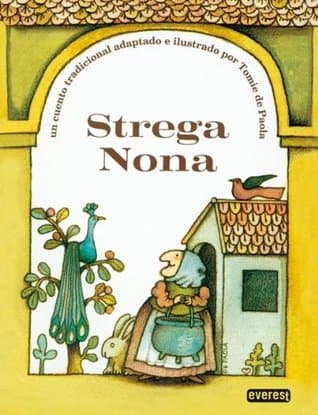
Tomie dePaola (1934)
Genre
Fantasy / Children's
Reading Time
10 min
Key Themes
See below
Sign in to track this book
When Big Anthony, left alone with Strega Nona's magic pasta pot, unleashes an uncontrollable torrent of pasta upon the town, he learns that even the simplest magic demands respect and a spoon.
Strega Nona is a kind 'Grandma Witch' in a small Italian village. She is known for curing illnesses, finding lost items, and, most famously, having a magic pasta pot. This pot makes endless pasta but needs a special charm to start and another to stop. The villagers respect her magic. One day, Strega Nona, getting older, decides she needs help with her chores. She puts up a sign, and Big Anthony applies. A village woman warns Strega Nona that Big Anthony does not pay attention, but Strega Nona hires him. She tells him to tend her garden, feed her goats, clean her house, and never touch her magic pasta pot.
Big Anthony does his chores for Strega Nona, but he becomes more curious about the magic pasta pot. One night, he secretly watches through a window as Strega Nona prepares supper. He sees her light candles, make the sign of the cross, and then sing a specific chant: 'Bubble, bubble, pasta pot, boil me some pasta, nice and hot. I'm hungry and it's time to sup, fill me a bowl and fill it up.' The pot immediately begins to bubble and produce pasta. After eating, Strega Nona blows three kisses to the pot, saying 'Enough, enough, pasta pot, I have all the pasta that I want.' The pasta stops, and the pot becomes still. Big Anthony only remembers the starting charm.
A few days later, Strega Nona announces that she needs to travel over the mountain to visit Strega Amelia for a day to discuss remedies and potions. She reminds Big Anthony of his duties and, again, sternly warns him, 'And Big Anthony, not a word about my magic pasta pot to anyone. And most especially, do not touch it!' Big Anthony, feeling confident and having a secret plan, assures her he won't. As soon as Strega Nona departs, Big Anthony begins to plan how to impress the villagers with the magic pot, sure he knows exactly how it works.
After Strega Nona leaves, Big Anthony waits until noon. He then goes into the village square, ringing the church bell to gather everyone. He proudly announces that he will make pasta for the entire town using Strega Nona's magic pasta pot. The villagers are doubtful but interested. Big Anthony brings the pot to the square, lights candles, makes the sign of the cross, and recites the charm he remembers: 'Bubble, bubble, pasta pot, boil me some pasta, nice and hot. I'm hungry and it's time to sup, fill me a bowl and fill it up.' To everyone's surprise, the pot begins to bubble and produce a lot of delicious pasta.
The villagers are happy, cheering and filling their bowls with fresh pasta. Big Anthony feels successful. However, he soon realizes a problem: he does not remember the stopping charm. The pot continues to make pasta quickly. It fills the pot, then the table, then the square. The villagers, at first happy, become more worried as the pasta flows without stopping. Big Anthony tries to blow kisses and shout 'Enough!' but nothing works. The pasta stream becomes a river, covering houses and threatening to flood the entire village.
Just as the pasta threatens to cover the entire village, Strega Nona returns from her trip. She sees the river of pasta flowing down the mountain and into the town. Upon arriving, she quickly understands what Big Anthony has done. Without delay, she goes to the overflowing pasta pot, blows three kisses, and says, 'Enough, enough, pasta pot, I have all the pasta that I want.' The pasta pot immediately stops making pasta. The flow stops, leaving the entire village buried in a mountain of pasta.
The villagers are relieved but also face a huge mess. Strega Nona, calm but firm, turns to Big Anthony, who is hiding, covered in pasta. She says there is only one way to clean up the mess and teach Big Anthony a lesson about obedience and respecting magic. She tells the villagers to bring Big Anthony to the town square. Then, she hands him a fork and tells him, 'And now, Big Anthony, you must eat all the pasta.' Big Anthony, humbled and very tired, begins the huge task of eating the seemingly endless amount of pasta he created.
The Protagonist
She maintains her wise and benevolent nature, demonstrating her authority and responsibility in dealing with Big Anthony's misuse of her magic.
The Antagonist/Supporting
He begins as a disobedient and overconfident assistant and ends up humbled and remorseful after causing a village-wide pasta disaster.
The Supporting
They move from skepticism to delight to panic, ultimately relieved by Strega Nona's intervention.
The Mentioned
No arc, as she does not appear directly in the story.
The main theme is about the serious results of disobeying clear instructions and misusing power. Big Anthony's failure to listen to Strega Nona's repeated warnings about the magic pasta pot leads directly to the pasta flood. His overconfidence and not paying attention to the full instructions cause a village-wide disaster, ending with his punishment of having to eat all the extra pasta. This shows how important it is to respect rules and the possible dangers of unchecked ambition or carelessness.
“And Big Anthony, not a word about my magic pasta pot to anyone. And most especially, do not touch it!”
The story shows how important it is to respect powerful tools and the knowledge needed to use them responsibly. Strega Nona understands the magic pot's power and the exact ritual needed to control it. Big Anthony, however, only knows half the information, which makes him think he can control something he does not fully understand. His failure to respect the magic, or Strega Nona's greater knowledge, causes chaos. The pot itself symbolizes power that needs careful handling and complete understanding.
“He'd seen Strega Nona do it many times. Bubble, bubble, pasta pot, boil me some pasta, nice and hot. I'm hungry and it's time to sup, fill me a bowl and fill it up.”
Big Anthony's story goes from overconfidence to humility. His wish to impress the villagers and his belief that he could master Strega Nona's magic without full understanding lead to a public and messy failure. The punishment of eating all the pasta is a direct, clear result that forces him to face the size of his mistake. This experience teaches him humility and the value of listening and following instructions, even if it is a very uncomfortable way to learn.
“And now, Big Anthony, you must eat all the pasta.”
The story touches on community and individual responsibility within it. Strega Nona uses her magic for the good of the village, fulfilling a responsible role. Big Anthony, in contrast, acts selfishly and without responsibility, affecting the entire community negatively. The villagers' experience of delight, fear, and relief shows how individual actions can have wide effects. Strega Nona's solution to the problem, and Big Anthony's community punishment, reinforces the idea that one's actions affect everyone.
“The pasta was everywhere. It was coming out of the doors and windows of the houses. The people were up on their roofs.”
A magical artifact that drives the central conflict
The magic pasta pot is the primary plot device, serving as both a source of wonder and the catalyst for conflict. It is a symbol of power and temptation. Its ability to produce endless pasta is central to Strega Nona's reputation and Big Anthony's desire to impress. The pot's magical properties, specifically requiring a precise charm to stop, create the escalating crisis when Big Anthony only remembers the starting charm, leading to the pasta flood. It is the object around which all major plot points revolve.
Early hints of impending trouble and consequences
The story uses foreshadowing through explicit warnings given to Big Anthony. First, a village woman warns Strega Nona that Big Anthony 'doesn't pay attention.' More directly, Strega Nona repeatedly warns Big Anthony not to touch the magic pasta pot and not to speak of it. These warnings build tension and prepare the reader for Big Anthony's inevitable disobedience and its disastrous outcome, making the eventual pasta flood a consequence that the reader expects, given the ignored advice.
The audience knows more than Big Anthony
Dramatic irony is employed when Big Anthony believes he knows how to operate the magic pot because he only saw Strega Nona perform the starting charm. The reader, having witnessed Strega Nona's full ritual (starting and stopping), understands Big Anthony's fatal flaw long before he does. This creates suspense and a sense of impending doom as Big Anthony confidently sets his plan in motion, unaware of the crucial piece of information he is missing, making his eventual downfall more impactful.
Repetitive action that builds to a climax
The story uses a cumulative structure, particularly in the escalating disaster of the pasta. Initially, the pot fills bowls, then the table, then the square, then houses, and finally the entire village. This repetitive, ever-growing accumulation of pasta builds the tension and visual humor, emphasizing the uncontrolled nature of the magic and the severity of Big Anthony's mistake. Each stage of the pasta flood is more overwhelming than the last, leading to the climax of Strega Nona's return.
“Strega Nona, the Strega Nona, she's the Strega Nona, she is.”
— The villagers' song about Strega Nona.
“Big Anthony was a good-for-nothing. He was always hungry. He was always lazy. And he was always getting into trouble.”
— Introduction to Big Anthony's character.
“And Strega Nona said, 'Big Anthony, I have to go away for a few days. You are to sweep the house and wash the dishes. But, whatever you do, do not touch the pasta pot.'”
— Strega Nona giving instructions to Big Anthony before leaving.
“Bubble, bubble, pasta pot, boil me some pasta, nice and hot. I'm hungry and it's time to sup. Boil enough pasta to fill me up.”
— Strega Nona's incantation for the magic pasta pot.
“And when she had enough, she sang, 'Enough, enough, pasta pot, I have my pasta, nice and hot. So stop now, stop now, pasta pot, before I get too much.'”
— Strega Nona's incantation to stop the pasta pot.
“Big Anthony watched and watched. He watched Strega Nona make the pasta. He watched Strega Nona stop the pasta. And he thought, 'I can do that.'”
— Big Anthony observing Strega Nona's magic.
“Bubble, bubble, pasta pot, boil me some pasta, nice and hot. I'm hungry and it's time to sup. Boil enough pasta to fill me up.”
— Big Anthony's first attempt to use the magic pasta pot.
“The pasta pot began to bubble and boil. Soon it was full of pasta. Big Anthony ate and ate.”
— Big Anthony enjoying the pasta from the magic pot.
“But Big Anthony did not know the magic words to stop the pot.”
— Realization of Big Anthony's mistake.
“The pasta came out of the pot and onto the table. It came out of the pot and onto the floor. It came out of the pot and out the door.”
— The pasta overflowing and flooding the town.
“The whole town was filled with pasta. The mayor was very angry.”
— The townspeople's reaction to the pasta flood.
“Strega Nona came home. She saw the pasta. She saw Big Anthony. She knew exactly what had happened.”
— Strega Nona returning to find the disaster.
“Strega Nona sang the magic words. 'Enough, enough, pasta pot, I have my pasta, nice and hot. So stop now, stop now, pasta pot, before I get too much.'”
— Strega Nona stopping the overflowing pasta pot.
“And then Strega Nona looked at Big Anthony. 'Big Anthony,' she said, 'you will eat all the pasta.'”
— Strega Nona's punishment for Big Anthony.
“And Big Anthony ate and ate and ate until all the pasta was gone. And he never touched the pasta pot again.”
— Big Anthony's long and arduous task of eating all the pasta.
Ready to see how well you understood this book? Take our interactive quiz with 10 questions.

Biography coming soon.







