“My life is a story that has lost the thread.”
— Narrator's reflection on his fragmented existence and desires.

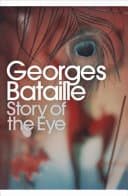
Georges Bataille (2001)
Genre
Thriller / Philosophy
Reading Time
120 min
Key Themes
See below
Sign in to track this book
A young man and his lovers explore sadism and defilement, culminating in a shocking act that shatters reality.
The unnamed narrator, a young boy, tells of his early sexual experiences with Simone, a slightly older girl. Their first encounters show a shared curiosity and a mix of innocence and breaking rules. They experiment with acts involving urination and defilement, which become central to their sexual dynamic. The narrator also introduces Marcelle, a mentally unstable young woman who lives with her wealthy parents. Marcelle's fragile mind and repressed desires quickly draw her into the narrator and Simone's world, setting up more extreme explorations of their developing sexuality and societal taboos.
Marcelle is increasingly drawn to the narrator and Simone's activities and becomes a key participant in their escalating sexual experiments. Her delicate mental state makes her open to their influence and the appeal of breaking rules. They engage in public acts of exhibitionism and defilement, such as Marcelle urinating in a church or having sex in public places, which thrill and disgust them. The narrator watches Marcelle's reactions closely, noting her alternating states of ecstatic arousal and deep distress. This hints at the dangerous path their desires are taking, pushing the limits of their sanity and societal norms.
A disturbing event happens when Marcelle, during an intense sexual encounter with the narrator and Simone, accidentally causes a priest to have a fatal heart attack. The sight of the priest's bulging eye in death, combined with earlier images of Marcelle's eye and other round objects, gives the 'eye' deep symbolic meaning for the narrator. It links to sexual ecstasy and death, to seeing and being seen, and to breaking boundaries. This event strengthens the trio's bond in shared rule-breaking and guilt, pushing them deeper into their world of forbidden desires.
After the priest's death and the continuous pressure of their extreme sexual activities, Marcelle's already fragile mental state quickly worsens. Her behavior becomes erratic, with public outbursts, self-harm, and no regard for social rules. Her parents, unable to cope with her madness, put her in an asylum. The narrator and Simone visit her there, continuing their sexual acts even in the institution, further blurring the lines between sanity and madness and showing their commitment to their transgressive lifestyle, even as it consumes one of them.
Seeking new experiences and perhaps an escape from the consequences of their actions with Marcelle, the narrator and Simone travel to Spain. There, they meet Donatien, a young bullfighter. Donatien's job, linked to death, violence, and spectacle, connects with their own desires to break rules. Their sexual encounters in Spain become even more extreme, including sadism and a fascination with bodily fluids and death. The Spanish setting, with its brutal culture, provides a place for their continued exploration of the limits of human experience, sex, and mortality, far from their previous life's constraints.
During a bullfight, Donatien is fatally gored. The narrator and Simone are present and witness his violent death. In a disturbing act, Simone collects Donatien's testicles after his death. This act strengthens the novel's symbolism, especially the link between round objects (eyes, eggs, testicles) and themes of sexuality, death, and breaking rules. Taking Donatien's body parts is a macabre trophy, showing their pursuit of extreme experiences and their disregard for conventional morality and the sanctity of life, even in tragedy.
The narrator and Simone find themselves on a yacht, where their rule-breaking acts continue to escalate. They meet another priest, and their activities involve an egg, which, like the eye and testicles, becomes another symbolic round object in their acts of defilement. The egg is used in a sacrilegious way, emphasizing their rejection of religious sanctity and their desire to desecrate symbols of purity and order. The yacht's confined space and the unsuspecting priest create a heightened sense of forbidden pleasure and the thrill of hidden rule-breaking, pushing their limits even further.
The yacht episode's climax involves a final, shocking act of defilement. Simone, with the narrator's help, performs a sexual act on the priest using the egg. This act combines their recurring symbols: the round object (egg), the religious figure (priest), and the theme of penetration and breaking rules. The priest's reaction, especially his eye, again becomes a focus, mirroring the earlier death of the first priest and Marcelle's experiences. This scene represents the peak of their blasphemous desires, a complete reversal of sacred and profane, and a statement on their relentless pursuit of the absolute limit.
After their adventures, the narrator and Simone return to the asylum where Marcelle is. They find her in a state of complete and irreversible madness, her mind shattered by her experiences. Despite her condition, the narrator and Simone continue to have sex with her, showing their continued fascination with her broken state and their inability or unwillingness to separate their desires from her suffering. Marcelle's final state reminds us of the destructive power of their shared rule-breaking, a representation of the ultimate results of their pursuit of the forbidden.
Towards the end, the narrator reflects on their journey, considering the philosophical meaning of their extreme sexual acts and rule-breaking. He thinks about the nature of experience, the limits of human desire, and the relationship between ecstasy, defilement, and death. The story does not judge but instead explores these themes directly. The narrator suggests that their acts, though perverse, were a real attempt to reach ultimate knowledge or experience, going beyond conventional morality to confront the depths of human existence and the intoxicating appeal of the forbidden.
The Protagonist
From innocent experimentation, he evolves into a detached chronicler of extreme transgression, ultimately reflecting on the philosophical implications of his journey.
The Protagonist/Supporting
She consistently pushes the boundaries of their sexual acts, evolving into a figure of ultimate transgression and defilement.
The Supporting
She descends from a state of fragile mental health into complete and irreversible madness due to her participation in extreme acts.
The Supporting
His brief appearance culminates in a violent death that fuels the protagonists' transgressive rituals.
The Mentioned
His accidental death serves as a catalyst for deeper transgressions and the emergence of key symbolism.
The Mentioned
His presence facilitates the ultimate act of sacrilege and defilement by the protagonists.
The Mentioned
They attempt to restore order by institutionalizing Marcelle, ultimately failing to contain the chaos she embodies.
The novel explores breaking rules as a way to reach ultimate experience or knowledge. It deliberately defiles the sacred (e.g., churches, priests, the sanctity of life) to show that moral boundaries are arbitrary. Acts like urinating in a church, desecrating a priest, or collecting body parts are not just perverse; they are presented as a path to a deeper, forbidden understanding of existence. Bataille suggests that true ecstasy and freedom come from violating taboos and confronting the forbidden.
“''What is sacred is the limit beyond which one cannot go.''”
These three elements are always linked in the story. Sexual acts often involve violence, defilement, and the closeness of death, suggesting that true eroticism is at this dangerous meeting point. The 'eye' is a main symbol, representing vision, penetration, and the moment of ultimate experience, often connected to both sexual climax and death (e.g., the priest's bulging eye, Marcelle's eye, the sun). Round objects like eggs and testicles further strengthen this symbolism, becoming tools for rule-breaking acts and showing the fragile boundary between life and death, pleasure and pain.
“''The eye is the sex, and the sex is the eye.''”
The line between madness and sanity is often unclear, especially through Marcelle. Her mental decline is not just a result of the group's actions but is also shown as a possible way to a different kind of truth or experience, beyond rational thought. The protagonists' extreme actions are depicted with a certain logical consistency within their perverse framework, challenging common ideas of sanity. The novel suggests that seeking ultimate experience might lead to madness, where societal norms no longer matter.
“''Madness is the only sane response to a world that makes no sense.''”
The entire story is a relentless search to push the limits of human experience. The narrator and Simone are driven by a strong desire to explore the absolute limits of pleasure, pain, and rule-breaking. They want to shatter all taboos and conventions, believing that true freedom and understanding come from venturing into the forbidden. This pursuit has costs, as seen in Marcelle's fate, but for the protagonists, the journey into the depths is its own reward, showing the human capacity for extreme desire and the longing for the absolute.
“''We were seeking the limit, the ultimate point where pleasure and horror coincided.''”
A main theme is the deliberate desecration of religious symbols and figures. From urinating in a church to sexually assaulting a priest with an egg, the protagonists actively commit blasphemous acts. This is not just rebellion but a philosophical stance, an attempt to reverse the sacred and the profane, to find eroticism and meaning in what is typically considered sinful and disgusting. By defiling the holy, they challenge the foundations of Western morality and religious belief, asserting a new, darker form of spiritual experience.
“''To defile is to create, to transform the sacred into the profane, and thereby to reveal its true nature.''”
Eyes, eggs, and testicles as recurring symbols of sex, death, and transgression.
Bataille heavily employs the symbolism of spherical objects throughout the narrative. The eye, in particular, is a dominant motif, appearing as Marcelle's eye, the priest's bulging eye in death, and even the sun. It represents vision, penetration, and the moment of ultimate experience where boundaries dissolve. Eggs and testicles are also used, often in transgressive contexts, linking them to sexuality, fertility, and defilement. These objects create a powerful, visceral connection between sight, touch, and the taboo, constantly reinforcing the novel's central themes of sex, death, and the breaking of boundaries.
The story is told from the subjective and highly biased perspective of the unnamed narrator.
The entire narrative is recounted in the first person by the unnamed male protagonist. This narrative choice immerses the reader directly into his subjective and often disturbing worldview. The narrator's detached yet intensely analytical tone, combined with the extreme nature of the events, raises questions about his reliability. He presents his actions and observations without moral judgment, often rationalizing them through a perverse philosophical lens. This allows Bataille to explore the psychological depths of transgression without imposing external moral condemnation, inviting the reader to grapple with the narrator's unique perception of reality.
Deliberate placement of religious or pure elements alongside acts of defilement and perversion.
Bataille frequently uses the juxtaposition of the sacred and the profane to heighten the sense of transgression and shock. Scenes of sexual defilement occur in churches, priests become objects of sacrilegious acts, and symbols of purity (like eggs) are used in perverse ways. This device serves to dismantle conventional moral frameworks and expose the inherent tension between order and chaos, purity and corruption. By bringing these opposing forces into direct contact, the novel emphasizes the protagonists' deliberate challenge to societal taboos and their search for meaning in the inversion of established values.
Characters' extreme actions are often presented without deep psychological backstory or moral justification.
The novel deliberately avoids providing extensive psychological backstories or conventional moral justifications for the characters' extreme actions. The protagonists' drives are presented as almost primal, an inherent urge towards transgression and the pursuit of ultimate experience. This lack of explicit motivation forces the reader to confront the actions themselves rather than seeking easy explanations. It emphasizes the philosophical underpinnings of Bataille's work, suggesting that these desires are fundamental to human nature, rather than mere psychological aberrations, and that the 'why' is less important than the 'what' and its implications.
“My life is a story that has lost the thread.”
— Narrator's reflection on his fragmented existence and desires.
“The eye is a sphere of liquid, blood, and tears.”
— Describing the symbolic and literal nature of the eye, a central motif.
“A world of pure desire, where everything is permitted.”
— Describing the characters' pursuit of extreme experiences and transgressions.
“What is sacred is precisely what is most profane.”
— A philosophical statement on the intertwining of the sacred and the profane.
“We were creating a new kind of game, one that had no rules.”
— Referring to the escalating and boundary-less sexual acts performed by the characters.
“The sun, too, is an eye, but an eye that has been torn out.”
— Connecting the sun's radiant power to the violent imagery of the eye.
“To live is to burn, to burn is to be consumed.”
— A reflection on the intensity of life and the inevitability of destruction.
“Pleasure and horror are two sides of the same coin.”
— Highlighting the inseparable nature of extreme sensations in the narrative.
“The abyss opened, and we plunged into it.”
— Describing the characters' descent into increasingly transgressive acts.
“Death is the ultimate orgasm.”
— A provocative statement linking the ultimate sexual release with mortality.
“The world is a vast, open wound.”
— A bleak and nihilistic view of existence presented through the narrator's lens.
“Silence is the only appropriate response to certain revelations.”
— After witnessing or participating in particularly shocking events.
“We were like gods, creating our own universe of sensation.”
— Reflecting on the power and autonomy felt by the characters in their illicit activities.
“Every secret is a wound that never heals.”
— Exploring the enduring impact of hidden desires and actions.
Ready to see how well you understood this book? Take our interactive quiz with 10 questions.

Georges Albert Maurice Victor Bataille was a French philosopher and intellectual working in philosophy, literature, sociology, anthropology, and history of art. His writing, which included essays, novels, and poetry, explored such subjects as eroticism, mysticism, surrealism, and transgression. His work would prove influential on subsequent schools of philosophy and social theory, including poststructuralism.







