“The wind was a living thing in the city of Orokos, a constant, whispering presence that shaped the very stones.”
— Opening description of the unique city of Orokos and its defining characteristic.

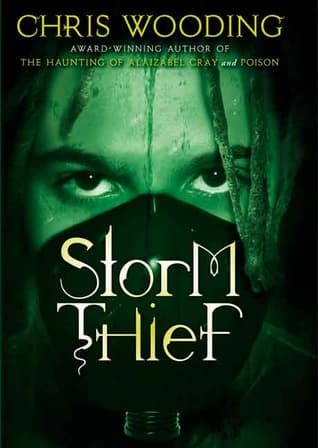
Chris Wooding (2006)
Genre
Fantasy / Science Fiction / Young Adult
Reading Time
320 min
Key Themes
See below
Sign in to track this book
In the ever-changing city of Orokos, where reality is rewritten by probability storms, three heroes find a map that could unlock the city's ancient secrets, starting a dangerous race against those who want that power for themselves.
The story starts with Rail, a skilled parkour artist and thief, trying to steal something valuable from a high-rise in Orokos. Agents from the Protectorate, the city's police, chase him. Rail's partner, Moa, can sense probability storms and guides him through the city via a comm-link. As they barely escape, a large 'reality storm' gathers over Orokos. These storms change reality randomly, altering buildings, objects, and people, making escape risky and adding danger to their flight from the Protectorate.
During their escape, Rail and Moa hide in a forgotten, storm-damaged part of the city. There, they find a hidden room with an ancient map etched on a strange metal surface. Next to the map, they discover a dormant automaton, a machine of unknown origin. Moa, using her abilities, accidentally turns on the automaton, which calls itself a 'geas' – a guardian of the map. The automaton, though unclear at first, says the map holds a secret vital to Orokos, hinting at a power beyond the city's walls.
Chief Vago, the head of the Protectorate Secret Police, wants to control Orokos and use the probability storms. He learns about the artifact Rail and Moa stole, and more importantly, about the ancient automaton being activated. Vago has old knowledge and believes the automaton and map are linked to the storms' true nature and a power that could reshape Orokos. He sends his best agents, the 'Storm Wardens,' to find Rail and Moa, not just for the theft, but for the information they have.
The automaton, which Rail and Moa name Geas, explains that the map is a schematic of Orokos, showing its forgotten systems and the storms' true source. Geas reveals that Orokos is an ancient, self-sustaining machine built for a forgotten purpose, and the storms are a sign of its failing functions. Geas guides them through dangerous, storm-hit parts of the city, explaining the map's symbols and hinting at a 'heart' of Orokos that must be reached to understand and possibly control the storms.
As Rail, Moa, and Geas go deeper into Orokos, they often fight Chief Vago's Storm Wardens. These trained agents have special gear to navigate and even partly control the probability storms. The fights are brutal, making Rail use all his parkour skills and Moa push her storm-sensing abilities. During one fight, Geas shows it can defend itself, making it even more important for the trio's survival and mission. The chase gets more intense, showing Vago will do anything to get the map and Geas.
Through Geas's explanations and her own growing sensitivity to the storms, Moa starts to understand her unique nature. She finds out she isn't just sensing the storms but is connected to them, a product of Orokos's original design, or perhaps a change caused by long exposure to storm energy. This explains her abilities and her deep connection to the city's pulse. It also suggests her role in controlling or understanding the storms is far greater than she or Rail imagined, making her a key part of the puzzle.
Following the map, Rail, Moa, and Geas go into the 'Under-City,' a vast network of ancient machines and forgotten structures beneath Orokos. This area is even more unpredictable, with reality storms creating strange, distorted landscapes and dangerous pockets of altered physics. Here, they face not only the Storm Wardens but also mutated creatures and environmental dangers from centuries of storm activity. The Under-City shows the true, vast scale of Orokos as an engineered structure, far beyond what its surface inhabitants understand.
Chief Vago, using his old knowledge and technology, tracks Rail, Moa, and Geas to the heart of the Under-City. He believes this is where Orokos's ultimate power lies, the key to controlling or using the probability storms. The race becomes a desperate struggle as the trio, guided by Geas, navigates the final, most dangerous parts of the city's core. They realize Vago plans to take this power for himself, no matter the cost, possibly dooming Orokos to a more chaotic future.
At the heart of Orokos, inside a large, storm-generating chamber, Rail, Moa, and Geas finally confront Chief Vago and his remaining Storm Wardens. Here, Geas fully activates the core, revealing Orokos's true nature: it is a giant, self-repairing terraforming machine, built by an ancient civilization to stabilize an unstable planet. The probability storms are its erratic attempts to fix itself, and Orokos is not a city on an island, but the island itself. Moa's unique abilities are shown to be a direct result of her being a 'key' or interface to Orokos's systems, able to connect with and potentially control its functions.
A fierce battle breaks out between Rail, Moa, and Vago. Vago tries to take control of the core, thinking he can weaponize the storms. Moa, guided by Geas, realizes she can either stabilize Orokos, ending the storms and letting the city heal, or let it continue its chaotic, self-destructive cycle. Rail fights to protect Moa, while Geas provides vital information and defense. Orokos's fate hangs in the balance as Moa makes a critical decision, understanding the huge responsibility that comes with her connection to the ancient machine.
Moa, using her connection, interfaces with Orokos's core, stabilizing its erratic functions. The probability storms start to lessen, and the city slowly begins to form a more stable structure. Vago is defeated, his plans for control stopped. While things aren't immediately 'normal,' the constant reality shifts are gone. Rail and Moa, with Geas, emerge from the Under-City into a changed Orokos, one with the potential for growth and a future free from the chaos that defined its past. The exact nature of this new Orokos, and their place in it, remains to be seen.
The Protagonist
Rail evolves from a self-interested survivor to a protector willing to face immense danger for the greater good of Orokos and Moa.
The Protagonist
Moa discovers her true identity as a 'key' to Orokos, embracing her power and responsibility to stabilize the city.
The Supporting
Geas fulfills its ancient purpose by guiding its chosen 'keys' to the heart of Orokos, ensuring the city's survival.
The Antagonist
Vago's insatiable lust for power leads to his ultimate downfall and the thwarting of his plans for Orokos.
The Supporting
As a collective, they represent the oppressive force that must be overcome for Orokos to find freedom.
The Mentioned
Their ancient design, though decaying, is ultimately preserved and reactivated through Moa's actions.
The probability storms constantly change Orokos's physical reality, making characters question what is real. This appears most clearly in the shifting cityscapes, where buildings change and objects appear or disappear. Moa's ability to 'feel' these shifts shows a deeper, intuitive understanding of reality. The book explores how people adapt to, or are driven mad by, this fluid reality, and its impact on their identity and place in the world. The discovery that Orokos itself is a machine built to change reality further highlights this theme.
““Reality was a fluid thing in Orokos, a canvas constantly being repainted by the whims of the storms.””
This theme is central to the conflict between Chief Vago and the heroes. Vago wants complete control, seeking to use the chaotic probability storms for his own oppressive rule. Rail and Moa, at first, deal with the chaos out of necessity, but their journey leads them to understand Orokos's deeper systems. The ending involves finding a balance, not by removing the storms, but by bringing Orokos's core systems into a stable state, suggesting that true order comes from understanding and harmony rather than force.
““Order was a lie. The city breathed chaos, and only by dancing with it could you survive.””
Moa's journey of self-discovery is a key part of this theme. She feels different, an outsider, until she finds her true connection to Orokos and her role as a 'key' to its systems. Rail, a street thief, struggles to find his place in a society that rejects him, but finds purpose and belonging through his bond with Moa and their shared goal. The citizens of Orokos, living in a city that constantly redefines itself, also deal with their collective identity, questioning what it means to be an 'Orokosian' when their world is so unstable.
““She was a part of Orokos, not merely living within it, but woven into its very fabric, a piece of the great machine.””
Orokos is a city built on forgotten history and old technology. The discovery of the map and the activation of Geas slowly reveal the city's true purpose and origin, showing it as a huge, ancient machine. The past, though buried and changed by centuries of storms, greatly affects the present. Characters like Vago try to use this legacy, while Rail and Moa aim to understand and fix it. The story emphasizes that ignoring or misunderstanding the past can lead to destruction, while understanding it offers the chance for a better future.
““The city was a testament to a wisdom long lost, a whisper from a time when gods walked the earth, or at least, men who built like them.””
Unpredictable reality-altering weather phenomena.
The probability storms are the central environmental and narrative device. They are unpredictable, localized weather events that physically rearrange reality, altering landscapes, buildings, and even living beings. They serve as both a constant threat and a catalyst for plot progression, forcing characters to adapt, creating new obstacles, and revealing hidden areas. Their erratic nature emphasizes the chaotic setting of Orokos and drives the characters' quest to understand and ultimately control them.
A schematic of Orokos, revealing its true nature and hidden pathways.
The ancient map, discovered by Rail and Moa, is not a conventional geographical map but a complex schematic of Orokos's internal workings. It acts as a guide, leading the protagonists through the forgotten layers of the city and revealing the true nature of its core systems. The map is often cryptic, requiring interpretation by Geas, which enhances the sense of mystery and discovery. It is the key to unlocking Orokos's secrets and the primary object of desire for both the heroes and the antagonist.
A sentient mechanical guardian and source of ancient knowledge.
Geas, the ancient automaton, functions as a living archive and guide. Its role is to provide exposition, interpret the map, and reveal crucial information about Orokos and the storms. Its cryptic manner of speaking adds to the sense of mystery and forces the characters (and the reader) to piece together the larger puzzle. Geas also serves as a protector, using its ancient mechanisms to defend the protagonists, and ultimately facilitates Moa's connection to the city's core.
A unique, intuitive ability to perceive and connect with the probability storms.
Moa's inherent sensitivity to the probability storms serves as a crucial plot device, driving her character arc and enabling key discoveries. This ability allows her to warn Rail of approaching storms, navigate treacherous shifting landscapes, and eventually, to directly interface with Orokos's core. It establishes her as a unique individual, intrinsically linked to the city's fate, and provides a 'magical' element within the science-fantasy setting, making her the ultimate key to resolving the city's chaos.
“The wind was a living thing in the city of Orokos, a constant, whispering presence that shaped the very stones.”
— Opening description of the unique city of Orokos and its defining characteristic.
“Even a thief can have a code, and Talon's was simple: don't get caught.”
— Introducing Talon's pragmatic philosophy as a young thief.
“A storm was coming, not just of weather, but of fate.”
— Foreshadowing the major conflicts and changes awaiting the protagonists.
“The city was built on lies and powered by forgotten magic.”
— Describing the fundamental, hidden nature of Orokos.
“Sometimes the greatest treasures are not things you can hold in your hand.”
— Reflecting on the value of friendship and loyalty.
“Fear was a cold companion, but it could also be a motivator.”
— Talon's internal thoughts about facing danger.
“The wind whispers secrets if you know how to listen.”
— Relating to the city's unique wind-based magic and communication.
“No one is truly free when their life is dictated by the whims of others.”
— Shori's realization about her own lack of agency.
“The past is a heavy cloak, but you can choose to shed it.”
— A character contemplating moving on from past mistakes or circumstances.
“Survival was a constant negotiation with the impossible.”
— Describing the harsh realities of life in the lower levels of Orokos.
“Magic wasn't just about power; it was about understanding, about connection.”
— A deeper insight into the nature of the magic within the world.
“Even in the darkest places, a flicker of hope can ignite a fire.”
— A moment of optimism amidst despair for the protagonists.
“The world doesn't care about your intentions, only your actions.”
— A harsh lesson learned by one of the characters.
“Sometimes the only way to save something is to let it go.”
— A difficult decision made in the climax of the story.
Ready to see how well you understood this book? Take our interactive quiz with 10 questions.

Chris Wooding is a prolific British author known for his engaging young adult fantasy and adventure novels. His notable works include the "Tales of the Ketty Jay" series, beginning with "Retribution," the "Mortal Engines"-esque "Storm Thief," and the dark fantasy "The Haunting of Alaizabel Cray." Wooding's writing is characterized by its fast-paced plots, vivid world-building, and compelling characters, earning him a dedicated readership.







