“Sometimes, the only way to survive is to become the monster.”
— A character reflects on the moral compromises made during the storm's siege.

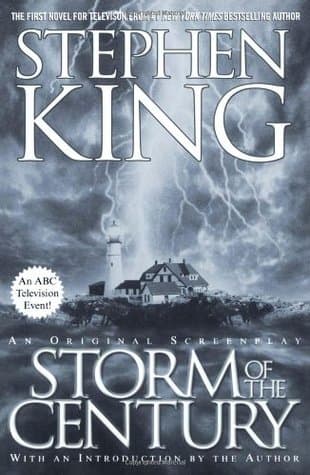
Stephen King (1999)
Genre
Thriller / Fantasy / Mystery
Reading Time
6-8 hours
Key Themes
See below
Sign in to track this book
A malevolent stranger traps an isolated Maine island community during a brutal blizzard, demanding an unspeakable sacrifice in exchange for their survival.
Little Tall Island, a remote community off the coast of Maine, prepares for a historic nor'easter, called the 'Storm of the Century.' As the blizzard gets worse, Martha Clarendon, an elderly island resident, is murdered in her home. Constable Mike Anderson, the island's law enforcement officer, finds a mysterious, older man named Andre Linoge calmly sitting in Martha's living room, holding a distinctive cane with a silver wolf's head. Linoge admits to the murder, saying he 'made her afraid.' Despite the extreme weather, Mike arrests Linoge and brings him to the town hall, where the islanders are gathering for shelter from the storm. Linoge's unsettling manner and strange statements immediately make the community uneasy.
Held in a temporary cell in the town hall's basement, Linoge starts to influence the islanders. He reveals private, often shameful, secrets about various residents, causing arguments and distrust in the crowded hall. He knows about Robbie Beals' secret affair, Cat Withers' shoplifting, and even Constable Mike Anderson's private thoughts. Linoge also shows supernatural abilities, moving objects with his mind, appearing outside his cell, and causing intense psychological distress. He repeatedly says the mysterious phrase, 'Give me what I want, and I'll go away,' without saying what he wants, which increases the islanders' fear and confusion. Mike tries to keep order and protect the community from this evil force.
Linoge's psychological attack gets worse as he sends vivid, horrifying nightmares and waking visions into the minds of the islanders. Several residents, unable to cope with the torment and the revelation of their deepest shames, commit suicide. Ralph Emerick, a respected islander, hangs himself, and later, Henry Fogg, another islander, also takes his own life. These tragic events make the community more despairing and panicked. Mike Anderson, while trying to protect his wife Molly and their young son Ralphie, realizes the situation: Linoge is not just a madman but a supernatural being, systematically breaking down the islanders' will. The storm rages outside, trapping them with their tormentor.
After the suicides and continued psychological torture, Linoge finally tells the terrified islanders who he is. He is an ancient, demonic being, not human, and he has come to Little Tall Island not for revenge or chaos, but for a specific purpose related to his own kind. He explains that he is old and dying, and needs an 'heir' – a successor to continue his evil. He demands that the islanders choose one of their children to be given to him. This revelation ends any hope of a simple solution and forces the community to face an unthinkable choice. Mike Anderson tries to reason with him, but Linoge is firm in his demand, emphasizing the terrible consequences if they refuse.
Linoge gathers the remaining adults of Little Tall Island and presents his terrifying offer: they must choose one child from the community to become his apprentice, to inherit his power and continue his work. If they refuse, he promises to unleash a storm so destructive it will wipe out the entire island and everyone on it. He makes it clear this is a demand, not a negotiation. The islanders are horrified and conflicted, struggling with an impossible moral problem. Mike Anderson strongly opposes the idea, trying to unite the community against Linoge, but the fear of complete destruction and the psychological toll of Linoge's torment weigh heavily on everyone.
After Linoge's ultimatum, the islanders hold a tense and emotional town meeting. Parents desperately beg for their children's lives, while others argue for the survival of the community. Arguments erupt, tears flow, and the bonds of their close-knit society begin to break under the immense pressure. Mike Anderson tries to lead them to defiance, but the sheer terror of Linoge's threats and the memory of the suicides make many hesitant. Robbie Beals, still affected by his revealed secret, is vocal about sacrificing a child to save the rest. The moral structure of Little Tall Island is severely tested as they debate the unspeakable.
Despite Mike Anderson's pleas to resist Linoge and fight for all their children, the fear of complete destruction ultimately sways most people. The islanders, in a moment of collective desperation and terror, vote to agree to Linoge's demand. They decide to draw lots to determine which child will be sacrificed. The atmosphere is heavy with despair and self-loathing as the children's names are written down. Mike is devastated by their decision, feeling a deep sense of betrayal and horror. The lottery proceeds, a grim ritual that will always haunt the survivors of Little Tall Island.
The name drawn from the lottery is Ralphie Anderson, Mike and Molly's young son. This crushes Mike, who had fought so hard against the idea of sacrifice. Molly is hysterical, unable to understand the horror. Mike, full of rage and despair, refuses to hand over his son. Linoge, however, uses his power, making it clear that the choice has been made, and any defiance will result in the promised annihilation. The other islanders, though horrified for Mike and Molly, are too terrified to intervene, having already committed to their decision. Mike faces the ultimate test of his morality and parental love.
With Ralphie Anderson chosen as his apprentice, Linoge takes the boy. The scene is agonizing for Mike and Molly, who must watch their son, seemingly in a trance, walk away with the demonic being. Linoge makes a final, chilling statement, confirming his nature and the success of his mission. He then leaves the island, vanishing into the lingering storm. The islanders are left with a deep sense of loss, guilt, and the horrifying knowledge of what they have done. The storm begins to calm, leaving behind not just physical damage, but an indelible mark on the soul of Little Tall Island.
Afterward, Little Tall Island is forever changed. The community is broken, haunted by the memory of their collective decision and the children who were lost. Mike Anderson, unable to live with the guilt and the constant reminder of Ralphie's sacrifice, divorces Molly and leaves the island. He moves to the mainland and becomes a U.S. Marshal. Years later, while on assignment, he sees an older Ralphie – now a young man with a cane topped with a silver wolf's head, like Linoge's. Ralphie is with a young girl, clearly preparing to take her as his own apprentice, continuing the cycle of evil. Mike recognizes the horror but cannot intervene, forever marked by the 'storm of the century' and his son's monstrous inheritance.
The Protagonist
Mike begins as a steadfast protector, but is ultimately broken by the community's decision and the loss of his son, leading him to a life of quiet despair and resignation.
The Antagonist
Linoge arrives, executes his plan to secure an heir, and departs, his character remaining consistently evil and manipulative.
The Supporting
Molly experiences the profound trauma of losing her son to Linoge, leading to the dissolution of her marriage and a life shattered by grief.
The Supporting/Victim
Ralphie is an innocent child who is tragically transformed into a harbinger of evil, continuing Linoge's legacy.
The Supporting
Robbie's hidden shame is revealed, leading him to advocate for child sacrifice, ultimately surviving but with a heavy conscience.
The Supporting
Cat's secret is exposed by Linoge, contributing to the community's fear and moral decline.
The Mentioned/Victim
Martha is murdered by Linoge, setting the stage for the entire narrative.
The Supporting/Victim
Ralph is driven to suicide by Linoge, becoming an early casualty of the storm.
The main theme explores how a close-knit community's moral values break down when faced with an impossible, terrifying choice. The islanders of Little Tall must choose between individual lives and collective survival, ultimately sacrificing an innocent child. This decision shows how fragile ethical principles are when faced with overwhelming fear and the basic instinct for self-preservation, demonstrating how easily people can justify terrible acts.
“Give me what I want, and I'll go away.”
Andre Linoge is a primal, ancient evil that seeks not conquest but to spread through temptation and corruption. He offers a seemingly 'easy' way out of annihilation, preying on the islanders' fears and weaknesses. His power is not just in his supernatural abilities, but in his ability to expose and exploit human flaws, turning community members against each other and forcing them to commit their own evil acts, making them complicit in their downfall.
“I am not a man. I am older than any man you have ever known, and I have come for one of your children.”
Ralphie Anderson's sacrifice represents the ultimate loss of innocence, not just for the child, but for the entire community. Choosing a child for a demonic entity permanently stains the islanders, stripping them of their moral purity. Mike Anderson feels a deep betrayal by his community, and ultimately, the betrayal of his own son, as he cannot stop the horrific act. This theme explores the lasting scars left by such a deep moral failure.
“He's just a little boy... how could you?”
Linoge's main weapon, besides his supernatural abilities, is his knowledge of the islanders' deepest, most shameful secrets. By exposing affairs, petty crimes, and hidden thoughts, he breaks down trust and unity in the community. This psychological warfare leaves the islanders vulnerable, isolated, and more likely to give in to his demands, showing how personal shame can be used to destroy collective resistance.
“I know all your secrets. I know what you do in the dark.”
A literal and metaphorical backdrop for chaos and isolation.
The unprecedented blizzard serves as both a literal plot device, trapping the islanders with Linoge, and a powerful metaphor. Physically, it cuts off Little Tall Island from the mainland, ensuring no outside help can arrive and forcing the community to confront Linoge alone. Metaphorically, the storm mirrors the internal turmoil and moral chaos engulfing the islanders, representing the 'storm' within their souls as they grapple with an unthinkable choice. Its intensity reflects the escalating horror of the situation.
A symbolic object representing Linoge's power and the passing of his legacy.
Linoge's distinctive cane is a recurring symbol throughout the story. It is present at Martha Clarendon's murder, serves as a visual identifier for Linoge, and ultimately, its appearance in Ralphie Anderson's hand in the epilogue confirms his succession to Linoge's evil. The wolf, often associated with cunning, predation, and the wild, reinforces Linoge's predatory nature. The cane acts as a tangible representation of the demonic entity's power and the continuity of his malevolent lineage.
A chilling mechanism for community-sanctioned sacrifice.
The lottery, a seemingly democratic process, is employed by the islanders to choose which child will be sacrificed to Linoge. This device is particularly chilling as it transforms an unspeakable act into a formalized, collective decision, distributing the guilt among the community members. It highlights the desperation and moral bankruptcy that takes hold, making the sacrifice appear as a 'fair' or 'necessary' evil, rather than an individual act of murder. It mirrors the classic short story 'The Lottery' by Shirley Jackson in its depiction of communal horror.
Linoge's primary method of breaking the islanders' will.
Linoge's ability to read minds, expose secrets, and project terrifying visions and nightmares into the islanders' minds is a crucial plot device. This psychological warfare systematically breaks down the community's unity, trust, and individual sanity. It drives some to suicide and weakens the resolve of others, making them susceptible to his demands. It emphasizes that Linoge's power isn't just physical, but deeply insidious, targeting the very fabric of human consciousness and moral fortitude.
“Sometimes, the only way to survive is to become the monster.”
— A character reflects on the moral compromises made during the storm's siege.
“The storm doesn't just bring snow; it brings the truth.”
— Narrator describing the storm's supernatural ability to reveal secrets.
“Fear is a storm in the mind, and it can bury you faster than any blizzard.”
— A character warns about the psychological toll of the events.
“In the end, we all make our own bargains with the devil.”
— A character discusses the choices made under extreme pressure.
“The island was a prison, and the storm was the warden.”
— Description of Little Tall Island's isolation during the blizzard.
“Evil doesn't always roar; sometimes it whispers in the wind.”
— Reflecting on the subtle, insidious nature of the antagonist's influence.
“You can't outrun your past, especially when it's buried in the snow.”
— A character confronts their history resurfacing during the storm.
“The cold has a way of freezing not just the body, but the soul.”
— Describing the physical and spiritual effects of the storm.
“When the world goes white, you see things you never wanted to.”
— A character's realization during the blinding snowstorm.
“Some sacrifices are too heavy to bear, but we bear them anyway.”
— Reflecting on the burdens shouldered by the island's residents.
“The storm was a test, and we all failed in our own ways.”
— A character's somber assessment of the community's response.
“In the silence of the snow, you can hear the echoes of your own heart.”
— A moment of introspection during the quiet of the blizzard.
“Monsters are real, but sometimes they look just like us.”
— A warning about the hidden darkness within people.
“The price of safety is often higher than we're willing to pay.”
— Discussing the costly decisions made to protect the island.
Ready to see how well you understood this book? Take our interactive quiz with 10 questions.

Stephen Edwin King is an American author of horror, supernatural fiction, suspense, crime, science-fiction, and fantasy novels. Described as the "King of Horror", his books have sold more than 350 million copies as of 2006, and many have been adapted into films, television series, miniseries, and comic books. King has published over 65 novels/novellas, including seven under the pen name Richard Bachman, and five non-fiction books. He has also written approximately 200 short stories, most of which have been published in book collections.







