“The building was on fire, and it wasn't my fault.”
— Opening line of the novel, setting the tone for Harry Dresden's chaotic adventures.

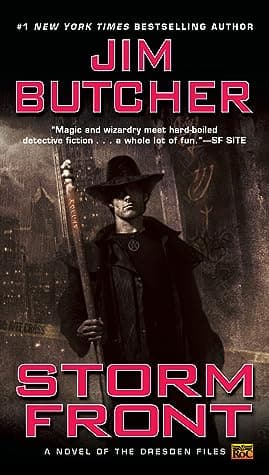
Jim Butcher (2000)
Genre
Fantasy / Mystery
Reading Time
450 min
Key Themes
See below
Sign in to track this book
A wizard-for-hire in modern Chicago, down on his luck, gets caught in a dark magic murder case, using his wit and magic against a dangerous, hidden enemy.
Harry Dresden, a wizard and private investigator, is having money problems in his Chicago office. His only regular client is the Chicago Police Department, specifically Lieutenant Karrin Murphy, who leads Special Investigations. Murphy calls Harry to a crime scene where two bodyguards of mob enforcer "Gentleman" John Marcone are dead, their hearts exploded by black magic. Marcone was there but unharmed, briefly paralyzed by the magic. Harry quickly identifies the work of a powerful black magic user and, using a tracking spell, finds the killer is still in the city. Black magic makes Harry cautious, as such users are dangerous and often target other wizards.
Harry does not want to work for a mob boss, but Marcone offers him a lot of money to find the killer targeting his group. Harry accepts, needing the money and interested in the mystery. His investigation takes him to "Mac's," a neutral bar for supernatural beings, where he asks contacts for information but learns little. He also visits Mister, his large, smart cat, for comfort and a sense of normal life among the growing magical threats. The case quickly grows when Harry finds a link to Victor Sells, a man with a dark secret, and Monica Sells, who asks Harry for help, saying her husband is involved in something bad.
Monica Sells hires Harry to find her missing daughter, Elaine. She says her husband, Victor, has been using black magic and has a magic book. She fears for Elaine's safety and thinks Victor is behind the murders. Harry takes the case, his suspicion of Victor Sells increasing. Soon after, two magical thugs, Fomor, attack Harry in his office. He fights them off with difficulty, realizing the black mage knows he is investigating and is trying to stop him. This attack confirms the extreme danger he is in and the power of his enemy.
Harry meets Susan Rodriguez, a reporter for the 'Midwestern Arcane' who is also looking into the supernatural murders. He does not trust reporters at first, but they form an alliance, sharing information. Harry breaks into Victor Sells' apartment and finds a hidden room with black magic items, including a bloody altar and human remains. He finds proof that Victor has been doing blood magic rituals, sacrificing people for power. This confirms Victor as a main suspect, but Harry also senses a deeper, more evil force at work, realizing Victor might be a tool rather than the leader.
Marcone, impatient, confronts Harry, making it clear that Harry must succeed. Meanwhile, Morgan, a Warden of the White Council of Wizards, visits Harry. Morgan warns him about black magic and reminds him of the Council's strict rules against it. Morgan's presence is a subtle threat, reminding Harry that the Council is watching him because of his past actions and reputation for breaking rules. This adds more pressure and danger, as Harry must stop the killer and deal with the politics and scrutiny of the magical world.
Harry tracks Victor Sells to his hidden place under an old building. Inside, he finds Victor doing a ritual, trying to sacrifice Elaine Sells. Harry steps in, fighting Victor with magic. Victor, powered by his dark rituals, is a strong opponent. Harry stops the ritual and saves Elaine, but Victor escapes, badly hurt. Harry realizes Victor is not just a beginner; he has been gaining power and using it for terrible things, wanting to live forever and have control, hinted at by his use of a dark magic book.
Back at his lab, Harry talks to Bob, a smart air spirit in a skull, who knows a lot about magic. Bob reveals that Victor Sells' magic book is a copy, and a much older and more dangerous black mage named He Who Walks Behind is likely behind the murders. This being feeds on mortals, giving them power for their souls and service. Harry realizes Victor was just a tool, controlled by a much older and more evil force. This significantly increases the danger, as Harry now faces an enemy far beyond a human black mage.
Marcone, learning of He Who Walks Behind, tries to capture the being for his own goals, hoping to control its power. This leads to a chaotic fight where Marcone's men are quickly defeated by the being's power. Harry arrives, knowing he must stop He Who Walks Behind from fully appearing and causing wide destruction. The being is powerful and terrifying, able to change reality and drain life. Harry fights a desperate battle, using all his magic and cleverness against the old evil.
In a desperate act, Harry does a dangerous ritual, using his own life force to banish He Who Walks Behind. The ritual is very draining and almost kills him, leaving him very weak and near death. He manages to trap the being, forcing it back into the Nevernever, the spirit world. The immediate danger is gone, but the experience leaves Harry scarred, both physically and magically. He understands the great power and danger of the supernatural world, and the personal cost of being a wizard who fights against it.
Afterward, Harry is badly hurt but recovers with help from Elaine Sells, who shows a surprising talent for healing magic. Marcone, impressed by Harry's power and survival, offers him a truce and future work. Lieutenant Murphy remains cautiously trusting but careful of Harry's methods. Harry has fought a powerful evil, saved Elaine, and shown the dangers of black magic, but he knows He Who Walks Behind is not truly gone, only banished. The experience confirms his role as Chicago's only professional wizard, and gives him a deeper understanding of the dark forces he constantly fights.
The Protagonist
Harry begins as a struggling, somewhat jaded wizard and ends with a renewed sense of purpose, having faced and overcome a truly ancient evil, reaffirming his commitment to protecting Chicago.
The Supporting
Murphy's initial skepticism of magic is deepened into a reluctant acceptance and growing trust in Harry, solidifying their professional partnership.
The Antagonist/Supporting
Marcone starts as a hostile client but gains a grudging respect for Harry after witnessing his power and integrity, leading to a complex, ongoing relationship.
The Supporting
Bob's role as a source of information and sarcastic commentary remains consistent, but his bond with Harry is reaffirmed through their shared peril.
The Supporting
Susan transitions from a skeptical journalist to a believer in magic and a romantic partner for Harry, becoming deeply involved in his dangerous world.
The Antagonist
Victor's descent into black magic and his manipulation by He Who Walks Behind culminates in his defeat and the exposure of his monstrous deeds.
The Supporting
Monica's desperate search for her daughter leads her to Harry, ultimately resulting in Elaine's rescue and a glimpse into the magical world.
The Supporting
Elaine is rescued from her father's sacrifice, discovering a latent magical ability for healing in the process.
The Antagonist
He Who Walks Behind attempts to fully manifest in the mortal world through its pawn, Victor Sells, but is ultimately banished back to the Nevernever by Harry Dresden.
Harry Dresden, as a wizard, has great power, which comes with much responsibility and close watch. He always remembers the White Council's rules against black magic and how his own abilities could be misused. His fight to use his power for good, often against great odds and at great personal cost, is central to the story. Victor Sells' misuse of power for selfish, destructive reasons clearly contrasts with Harry's efforts to protect innocent people. Harry's near-fatal sacrifice to banish He Who Walks Behind shows the heavy burden he carries.
“"The world is full of monsters, Harry. And you're the only one who can stop them. Don't ever forget that."”
The novel shows a clear difference between good and evil through Harry Dresden and Victor Sells/He Who Walks Behind. It also explores unclear morals, especially with characters like Gentleman John Marcone, a mob boss who is ruthless but follows certain rules, and whom Harry reluctantly works with. Harry often breaks the White Council's rules, blurring the lines of what is strictly 'good' to find justice. The story suggests that true evil corrupts, but fighting it often means dealing with complex situations.
“"There are things in the world that are just plain evil. They don't have a good side. You don't negotiate with them. You don't reason with them. You just fight them."”
Harry Dresden is alone as the only professional wizard in Chicago, working between the normal and supernatural worlds. He is an outsider in both—misunderstood by the police and viewed with suspicion by the White Council. This isolation causes Harry loneliness and difficulty, as he has few people he can truly trust or depend on. His struggle to connect with others, especially romantically with Susan Rodriguez, is made harder by his dangerous job and the secrets he must keep. His apartment, full of magical items, further shows his separation from everyday life.
“"It was a lonely job, being a wizard. And it was going to get a lot lonelier before it was over."”
'Storm Front' clearly shows a hidden supernatural world existing with everyday Chicago. The plot reveals that under the surface of normal life, old evils, magical creatures, and powerful magic users are active. This theme begins early, with the police needing Harry's help for a case they do not understand. Places like Mac's bar, where various supernatural beings meet, and the subtle magical signs Harry finds, constantly remind the reader that the world is much more complex and dangerous than it appears to those who do not know about it. This hidden reality constantly challenges what the characters think.
“"The everyday world is actually full of strange and magical things—and most don't play well with humans."”
Throughout the novel, characters make choices with serious results. Victor Sells' choice to use black magic leads to his corruption and downfall, and his family's suffering. Marcone's choice to get involved with the supernatural world and try to control it brings him into direct conflict with powerful forces. Harry himself constantly makes difficult choices, often risking his life or breaking rules, which affects his standing with the White Council and his own well-being. The story shows that every action, especially in the magical world, has a significant and often dangerous price.
“"Magic. It can get a guy killed."”
Provides direct access to Harry's thoughts, humor, and perceptions.
The entire novel is narrated from Harry Dresden's first-person perspective. This device allows readers direct access to Harry's sarcastic wit, his internal struggles, his observations about both the mundane and magical worlds, and his unique worldview. It helps to build immediate rapport with the protagonist, making his struggles and triumphs more personal and engaging. This narrative choice also limits the reader's knowledge to only what Harry perceives, often building suspense and allowing for reveals that surprise both Harry and the audience simultaneously.
A defined system of magic with rules, limitations, and personal costs.
Butcher establishes a clear and consistent magic system where spells require energy, focus, and often a personal cost or risk. Harry's magic is primarily elemental (fire, wind, force) and investigative, but not limitless. The White Council's Laws of Magic, particularly against black magic and mind manipulation, create clear boundaries and moral dilemmas. This device makes the magic feel grounded and believable within the fantasy context, preventing it from being an 'anything goes' solution. It also highlights the danger of magic when misused, as exemplified by Victor Sells' dark practices.
A parallel spirit world that serves as a source of magic and dangerous entities.
The Nevernever is introduced as a parallel dimension, a spirit world that exists alongside the mortal realm. It is the source of magical energy and home to various supernatural beings, including the Fomor and entities like He Who Walks Behind. It serves as a mystical backdrop and a place of immense danger, where the rules of the mortal world do not apply. This device expands the scope of the world beyond Chicago, hinting at a vast, ancient, and perilous supernatural reality that Harry must constantly contend with, and from which the greatest threats often emerge.
A forbidden book of dark magic that corrupts its users.
The black grimoire, initially found in Victor Sells' possession, serves as a powerful symbol and plot driver. It represents forbidden knowledge, the allure of unchecked power, and the corrupting influence of black magic. Its contents are dangerous, requiring human sacrifice and leading its users down a path of depravity. The fact that Victor's grimoire is a copy, hinting at a more powerful original, further emphasizes the depth of the dark magic at play and the ancient evil behind it. It is the catalyst for Victor's actions and a key piece of evidence in Harry's investigation.
“The building was on fire, and it wasn't my fault.”
— Opening line of the novel, setting the tone for Harry Dresden's chaotic adventures.
“I don't believe in fairies. I believe in fairies with guns.”
— Harry's pragmatic view on supernatural threats in the modern world.
“Paranoid? Probably. But just because you're paranoid doesn't mean there isn't an invisible demon about to eat your face.”
— Harry reflecting on his cautious nature as a wizard detective.
“I'm not a hero. I'm a wizard. I'm just trying to pay the rent.”
— Harry downplaying his role while explaining his motivations.
“Magic comes from life itself, from the interaction of nature and the human spirit, from the energy of all living beings.”
— Harry explaining the nature of magic in his world.
“The White Council of Wizards can kiss my ass.”
— Harry expressing his rebellious attitude toward magical authorities.
“I'm not much for subtlety. I'm more of a 'hit it with a hammer' kind of guy.”
— Harry describing his straightforward approach to problem-solving.
“There's power in the touch of another person's hand. We acknowledge it in little ways, all the time.”
— Harry musing on human connection and its magical significance.
“I'm not a morning person. I'm not an afternoon person. I'm not an evening person. I'm a 'leave me the hell alone' person.”
— Harry's grumpy attitude about social interactions.
“The truth is a slippery thing. It changes shape depending on who's holding it.”
— Harry reflecting on the nature of truth during his investigations.
“I've got a cat. He's a pain in the ass, but he's my pain in the ass.”
— Harry talking about his familiar, Mister, with affection.
“Sometimes you have to take a stand. Not because it's easy, but because it's right.”
— Harry explaining his moral code despite the risks.
“I'm in the book. Under 'Wizards.'”
— Harry's dry response when someone questions his profession.
“Fear is a good thing. It means you're paying attention.”
— Harry advising on how to survive in a dangerous world.
Ready to see how well you understood this book? Take our interactive quiz with 10 questions.
Biography coming soon.







