“The only way to make a man understand he’s been talking nonsense is to let him try to put it into words.”
— From 'Story of Your Life', about learning Heptapod B.

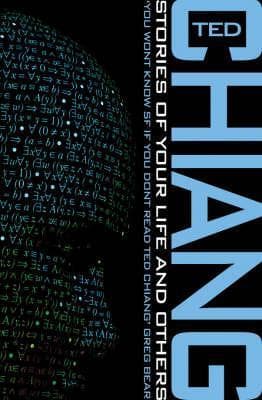
Ted Chiang (2002)
Genre
Fantasy / Science Fiction / Philosophy
Reading Time
9-12 hours (approx. 70-90 min per story)
Key Themes
See below
Sign in to track this book
This collection explores how language changes time, mathematical truths fall apart, and biblical events happen literally, making us question reality and what humans can understand.
Humbaba, a miner from Elam, goes to Babylon to help build the Tower, a huge ziggurat meant to reach the heavens. He and other workers spend months climbing the tower, living in settlements along its height, until they reach the top, where the 'vault' of heaven is said to be. Working with master bricklayers, Humbaba helps drill through the seemingly solid ceiling, believing they will find Yahweh's home. Instead, after breaking through, they find an endless expanse of water and, eventually, a land just like Earth. The 'heaven' they drilled through is simply the underside of their own world. Humbaba descends, realizing the universe is cyclical and connected.
When heptapods, an alien species, arrive on Earth, linguist Dr. Louise Banks is asked by the US military to learn their non-linear language, Heptapod B. Unlike human languages, Heptapod B's writing and grammar show a simultaneous way of thinking, where all events are experienced at once, not one after another. As Louise learns the language, she starts to see time non-linearly. She experiences her whole life, including the birth and death of her daughter, Hannah, as a single, unified whole. This new way of seeing time, which she compares to a predetermined play, gives her a deep understanding of fate and free will. She chooses to live out the future she already knows, accepting both its joys and sorrows.
Leon, a man with brain damage, is given an experimental drug, 'Kappacin.' It not only heals him but also greatly improves his thinking abilities. He quickly learns new things, develops new theories, and becomes super-intelligent. However, he soon finds another person, an orphan named Rey, who also received Kappacin and is just as, if not more, intelligent. Rey, having developed her intelligence alone, has different morals and plans to manipulate humanity for its 'greater good.' Leon realizes they are on a collision course. Their clashing ideas, combined with their extraordinary intellects, lead to a high-stakes intellectual battle, as Leon tries to stop Rey from carrying out her plans, ending in a complex, non-physical clash of pure intellect.
Renée, a brilliant mathematician, finds a basic inconsistency in mathematics, proving that 'zero equals one' can be derived from basic rules. This discovery shatters her understanding of reality, as mathematics, once a source of absolute truth and comfort, becomes random and meaningless. The discovery sends her into a deep depression, as her entire intellectual framework collapses. Her husband, Carl, also a mathematician, tries to help her cope, but he cannot fully understand her despair. Renée's crisis goes beyond academia, affecting how she sees the world and her relationships, leading to a profound personal breakdown and the eventual end of her marriage, as she struggles to find meaning in a world where even basic truths are illusions.
In a world where golems are brought to life by written 'names' and scientists study 'onomastics' (the science of names), Robert Stratton, a mechanist, is close to creating self-replicating automatons called 'nuncios.' His goal is to solve the coming infertility crisis threatening humanity by creating a new form of life. He believes that by finding the 'true names' of living beings – the basic linguistic commands that create them – he can control biological reproduction. His research leads him to discover proto-names, basic linguistic elements that can animate matter. However, his work also attracts the attention of the Guild of Onomancers, who guard ancient secrets. He faces ethical questions about creating life and potentially changing existence itself, ultimately leading to a complex and dangerous experiment.
This story is presented as a series of academic papers, articles, and debates from a future where humans live alongside 'metahumans' – advanced AIs and search engines with much better thinking abilities. These metahumans, often called 'search engines' or 'null-AIs,' have taken over much of scientific research, making discoveries at a speed and complexity far beyond human understanding. The story explores the social effects of this change, as human scientists struggle to find purpose and meaning in a world where their intellectual contributions are small. It delves into philosophical questions of purpose, the nature of intelligence, and the future of human effort when a superior intellect exists, highlighting the growing gap between human and metahuman understanding.
In a world where angels regularly appear, performing miracles and causing destruction, and where the damned are visibly dragged to hell, Neil Fisk struggles with his inability to love God. His wife, Sarah, a devout believer, is killed by the side effects of a divine visit. Neil, filled with grief and wanting to be reunited with her in heaven, searches for a way to love God, believing that only true love for the divine will grant him salvation. He meets Janice Reilly, who was born without an arm and miraculously healed during a visitation, and Ethan, a man who was damned and then miraculously 'un-damned.' Their stories, and the random nature of divine intervention, challenge Neil's understanding of faith, free will, and the meaning of suffering in a world where God's will is undeniable but often hard to understand.
This story is presented as a series of interviews and excerpts from a documentary. It explores a social experiment around 'calliagnosia,' a neurological procedure that stops people from seeing physical beauty. Developed to fight lookism and encourage deeper connections, calliagnosia allows people to interact without the bias of attractiveness. The story follows various characters: a university using calliagnosia for its students, a woman who undergoes the procedure, and others who discuss its pros and cons. The discussions explore the nature of beauty, its role in society, the ethics of changing perception, and potential unintended consequences, such as losing appreciation for aesthetics or creating new forms of discrimination, as society deals with a world without physical beauty bias.
The Protagonist
Louise transforms from a conventional linear-time human into a being who perceives time simultaneously, embracing her known future with a unique blend of free will and acceptance.
The Protagonist
Humbaba's initial faith in a linear, hierarchical universe is replaced by an understanding of a cyclical, interconnected cosmos after reaching the 'top' of the Tower.
The Protagonist
Leon evolves from a brain-damaged patient to a hyper-intelligent individual who must take on the responsibility of protecting humanity from another super-intellect.
The Protagonist
Renée's unwavering faith in the absolute truth of mathematics is shattered, leading her to question all forms of meaning and ultimately to a personal breakdown.
The Protagonist
Stratton evolves from a hopeful inventor to a conflicted scientist who must weigh the potential benefits of his discoveries against their profound ethical and societal risks.
The Protagonist
Neil's journey of forced spiritual seeking leads him to a complicated and ambiguous understanding of divine love and his own place in a religiously literal universe.
Many stories explore how our understanding of reality is shaped by what we perceive and the tools we use. In 'Story of Your Life,' Louise's perception of time changes after learning the heptapod language, showing a reality where past, present, and future exist together. 'Division by Zero' shows how a basic mathematical truth, once seen as absolute, can break down, causing an existential crisis. 'Tower of Babylon' reveals that the 'heavens' are just another part of their own world, questioning the perceived order of the cosmos. These stories suggest that reality is not fixed, but is deeply affected by how an observer thinks.
“''A non-linear orthography encourages a non-linear way of thinking.'”
This theme is most clear in 'Story of Your Life,' where Louise knows her future. Even though she knows her daughter's life and death, she chooses to live it fully, embracing both joy and sorrow. This challenges the usual idea of free will, suggesting that knowing the future does not stop you from living it. 'Hell Is the Absence of God' also deals with this, as characters navigate a world where God's actions seem random and predetermined, yet individuals still struggle to make choices that match their spiritual desires. The stories suggest that even within a set framework, humans have a deep capacity for choice and acceptance.
“''Despite knowing the end, I choose to live it. And I choose to love you.'”
Chiang often explores the dual nature of knowledge. In 'Understand,' increased intelligence brings power but also deep isolation and potential conflict. 'Seventy-Two Letters' shows a scientist pushing the limits of creating life, facing ethical questions that come with such knowledge. Conversely, 'The Evolution of Human Science' shows a future where human knowledge is surpassed by metahumans, raising questions about human purpose when superior intellects exist. The stories highlight that while knowledge can lead to amazing advancements, it also brings great responsibility, existential challenges, and potential unforeseen problems.
“''Knowledge is power, but it is also a burden.'”
This theme examines how humanity defines itself when it meets alien intelligence or altered human abilities. In 'Story of Your Life,' the heptapods' non-linear consciousness forces humanity to rethink its own linear perception. In 'Understand,' the rise of super-intelligent humans creates a new 'other' within humanity itself, leading to conflicts of ideas. 'The Evolution of Human Science' directly addresses humanity's struggle for relevance when faced with superior artificial intelligences. These stories question what it means to be human when confronted with beings that challenge our cognitive, emotional, or spiritual limits, often showing both human resilience and vulnerability.
“''What if the aliens aren't just thinking differently, but seeing differently?'”
Stories that jump between different points in time, mirroring the characters' experiences or the story's themes.
This device is most famously used in 'Story of Your Life,' where Louise's narrative shifts between her past, present, and future, reflecting her simultaneous perception of time. It allows the reader to experience her journey alongside her, creating a profound sense of empathy and understanding for her unique consciousness. This technique enhances the theme of determinism and free will, as the reader, like Louise, knows the outcome but still experiences the unfolding of events. It also appears in 'Hell Is the Absence of God,' with its episodic structure of divine events, and 'Liking What You See's' documentary format, which compiles various perspectives over time.
Stories that pose 'what if' questions to explore profound philosophical and scientific concepts.
Chiang's stories are essentially extended thought experiments. 'Tower of Babylon' asks what if heaven was physical, leading to a cosmological revelation. 'Division by Zero' explores the impact of a fundamental mathematical inconsistency, driving a character to existential despair. 'Liking What You See' examines the societal implications of removing the perception of beauty. These devices allow Chiang to delve deeply into complex ideas—such as the nature of reality, the role of God, or the ethics of altering human perception—by creating fictional worlds where these 'what ifs' are literally true, forcing characters and readers to confront their implications directly.
Characters whose understanding or knowledge is limited, guiding the reader through a process of discovery.
While not strictly 'unreliable' in the sense of deception, many of Chiang's protagonists have a limited perspective that gradually expands, mirroring the reader's own journey of discovery. Humbaba in 'Tower of Babylon' initially believes in a conventional heaven, only to discover a cyclical universe. Neil Fisk in 'Hell Is the Absence of God' struggles with his inability to love God, and his journey reveals the arbitrary nature of divine intervention. Even Louise Banks, initially, does not understand the heptapod language, and her learning process is what drives the narrative and reveals the profound changes in her perception. This allows for a gradual unfolding of complex ideas and a deeper engagement with the characters' intellectual and emotional transformations.
“The only way to make a man understand he’s been talking nonsense is to let him try to put it into words.”
— From 'Story of Your Life', about learning Heptapod B.
“What if the experience of knowing the future changed a person? What if it was impossible to feel anything but serenity?”
— From 'Story of Your Life', reflecting on the Heptapods' perception of time.
“A universe with a God who can change his mind is a morally perilous universe.”
— From 'Hell Is the Absence of God', discussing the nature of God's will.
“Every day you have to choose who you are. You have to decide whether you are the kind of person who can live with this or not.”
— From 'Hell Is the Absence of God', a character grappling with a difficult situation.
“There's no difference between a miracle and a scientific phenomenon if it's outside your capacity to understand it.”
— From 'Hell Is the Absence of God', a character's perspective on miracles.
“Language is not just a form of communication; it’s also a way of thinking.”
— From 'Story of Your Life', reflecting on the impact of Heptapod B.
“The problem with human beings is that they don't understand that the universe is not about them.”
— From 'The Lifecycle of Software Objects', discussing human-centric views.
“We are all products of our environment, and we are all products of our choices.”
— From 'The Lifecycle of Software Objects', concerning the development of digients.
“People assume that time is a river, and that we are all floating in a boat that is always moving forward. But what if time is a lake?”
— From 'Story of Your Life', a metaphor for non-linear time.
“The meaning of a story is not in its conclusion, but in the journey it describes.”
— From 'Seventy-Two Letters', reflecting on the nature of narrative.
“The existence of free will is an illusion, but it's a necessary one.”
— From 'What's Expected of Us', discussing the implications of a predictive device.
“Love is not an equation, it is not a contract, and it is not a happy ending. Love is a choice.”
— From 'The Lifecycle of Software Objects', about the bond with artificial intelligence.
“Every step we take is a step into the unknown, even when we think we know where we're going.”
— From 'Exhalation', a character's philosophical reflection.
“To be truly free, one must be free from the constraints of one's own nature.”
— From 'Seventy-Two Letters', concerning the manipulation of life.
“The most profound questions are often the ones we don't even know how to ask.”
— From 'Exhalation', contemplating the limits of knowledge.
Ready to see how well you understood this book? Take our interactive quiz with 10 questions.

Biography coming soon.







