“Whose woods these are I think I know.”
— The narrator begins by identifying the owner of the woods.

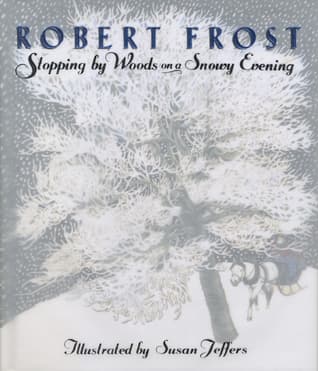
Robert Frost (1969)
Genre
Children's
Reading Time
5 min
Key Themes
See below
Sign in to track this book
This re-illustrated edition invites young readers to find hidden animals as a traveler pauses his sleigh on a snowy New England evening, capturing winter's quiet beauty.
The story begins with a lone traveler, dressed warmly against the cold, riding his horse through a snow-covered forest. It is the year's darkest evening, likely the winter solstice, which highlights the scene's quiet and isolation. The traveler stops his horse between the woods and a frozen lake, near a small, snow-dusted village. He is in the woods belonging to a villager he knows. He pauses to simply watch the beauty of the falling snow and the deep, dark woods, finding a temporary break from his journey and duties.
The traveler's small horse, used to moving steadily towards a goal, seems puzzled by the sudden stop. It shakes its harness bells, a subtle gesture the narrator sees as a question or unease. There is no farmhouse nearby, no usual reason to stop in such a remote place. The horse's action shows how unusual the traveler's pause is, contrasting its practical, goal-focused nature with the man's more thoughtful one. The only other sound is the soft wind and the quiet fall of snowflakes.
Despite the horse's implied impatience, the traveler is captured by the woods' beauty and quiet. He calls them 'lovely, dark and deep,' suggesting a powerful, almost hypnotic pull. The falling snow adds to the calm, almost magical atmosphere. He feels a strong desire to stay in this peaceful, isolated place, to lose himself in the moment and nature's quiet wonder, away from the world's demands.
Just as the woods seem to draw him fully into their peaceful embrace, the traveler remembers his responsibilities. He has 'promises to keep' and a long way to travel before he can rest. This thought pulls him back from giving in completely to the woods' allure. The phrase 'miles to go before I sleep' is repeated, emphasizing the weight of his duties and the need to continue his journey despite the wish to linger.
With a final, lingering look at the enchanting woods, the traveler decides to move on. He gently urges his horse forward, breaking the quiet that had surrounded them. The woods' spell is broken, and his life's practical demands return. He leaves the quiet, snowy scene behind, carrying the memory of its beauty but committed to fulfilling his duties, pushing onward into the night.
The Protagonist
The Traveler experiences a brief but intense internal conflict, ultimately reaffirming his commitment to his duties despite the strong temptation of the woods.
The Supporting
The horse remains constant, serving as a catalyst for the traveler's decision to move on.
The Mentioned
Does not have an arc, as they are not present in the story.
This main theme explores the conflict between the deep peace and beauty of nature and the responsibilities that connect people to human society. The traveler is strongly drawn to the 'lovely, dark and deep' woods, finding a temporary escape from his journey. However, the repeated line 'And miles to go before I sleep' highlights the unavoidable pull of his 'promises to keep,' forcing him to choose duty over nature's appealing quiet. This conflict shows the ongoing human struggle to balance personal desires for escape or thought with daily life's demands.
“The woods are lovely, dark and deep, But I have promises to keep, And miles to go before I sleep, And miles to go before I sleep.”
The poem has a strong sense of solitude, creating a perfect setting for thought. The traveler is alone, except for his horse, allowing him to fully experience the snowy landscape. This isolation is not lonely; rather, it is needed for deep thought and appreciating beauty. The scene's quiet, broken only by the soft sounds of snow and wind, emphasizes the chance for the traveler to pause and think about his journey, his life, and his choices.
“My little horse must think it queer To stop without a farmhouse near Between the woods and frozen lake The darkest evening of the year.”
Though not directly stated, the 'lovely, dark and deep' woods, especially on 'the darkest evening of the year,' suggest a desire for ultimate rest or even death. The temptation to stay in the peaceful, silent woods can be seen as a longing for an end to life's tiring journey. The repeated 'miles to go before I sleep' can be read literally (physical sleep) but also as a metaphor for life's journey before the final sleep of death. The woods represent a deep, almost spiritual peace that is both inviting and potentially final.
“The woods are lovely, dark and deep,”
Objects and settings represent abstract ideas.
The woods symbolize temptation, escape, peace, and potentially death or ultimate rest. Their 'dark and deep' nature suggests both mystery and a profound, all-encompassing solace. The horse symbolizes practicality, duty, and the demands of the external world, gently pulling the traveler back to reality. The 'promises to keep' are symbolic of the traveler's obligations, responsibilities, and the ties that bind him to his life and community, preventing him from succumbing to the woods' allure.
Vivid sensory descriptions create a strong visual and atmospheric experience.
Frost uses rich imagery to paint a vivid picture of the snowy evening. Phrases like 'woods are lovely, dark and deep,' 'fill up with snow,' 'frozen lake,' and 'downy flake' appeal directly to the reader's senses of sight and touch. The sound of 'harness bells' and 'easy wind and downy flake' adds an auditory dimension, creating an immersive and serene atmosphere that is central to the poem's contemplative mood and the traveler's experience.
Repeating words or phrases for emphasis and rhythm.
The most prominent use of repetition is the final two lines: 'And miles to go before I sleep, / And miles to go before I sleep.' This repetition serves to emphasize the weight of the traveler's obligations and the long journey ahead. It creates a lingering, almost haunting effect, reinforcing the theme of duty and the traveler's reluctant departure from the woods. It also adds a rhythmic, almost lullaby-like quality, underscoring the desire for rest that is ultimately deferred.
“Whose woods these are I think I know.”
— The narrator begins by identifying the owner of the woods.
“His house is in the village though;”
— The narrator notes the owner is not present.
“He will not see me stopping here”
— The narrator feels unobserved in the woods.
“To watch his woods fill up with snow.”
— The narrator's purpose for stopping is to observe the snowfall.
“My little horse must think it queer”
— The narrator imagines the horse's perspective on the stop.
“To stop without a farmhouse near”
— The horse's usual stops are near human dwellings.
“Between the woods and frozen lake”
— Describing the desolate location of their stop.
“The darkest evening of the year.”
— Emphasizing the deep winter and short daylight.
“He gives his harness bells a shake”
— The horse expresses its confusion or impatience.
“To ask if there is some mistake.”
— The narrator interprets the horse's action.
“The only other sound’s the sweep”
— Highlighting the profound quiet of the snowy woods.
“Of easy wind and downy flake.”
— Describing the gentle sounds of the winter environment.
“The woods are lovely, dark and deep,”
— The narrator expresses admiration for the woods.
“But I have promises to keep,”
— The narrator acknowledges responsibilities that call him away.
“And miles to go before I sleep.”
— The narrator must continue his journey, facing a long road ahead.
Ready to see how well you understood this book? Take our interactive quiz with 10 questions.

Robert Lee Frost was an American poet. His work was initially published in England before it was published in the United States. Known for his realistic depictions of rural life and his command of American colloquial speech, Frost frequently wrote about settings from rural life in New England in the early 20th century, using them to examine complex social and philosophical themes.

Dan Gemeinhart
4.5

Kate O'Hearn
4.4

Jeanne Birdsall
4.4

Jen Wang
4.4

Wendelin Van Draanen
4.3

John Marsden
4.3

Chris Van Allsburg
4.3

Jennifer A. Nielsen
4.2