“The gods are in the earth and the sky and the water, not just in the words of a priest.”
— Runners often have a more direct connection to nature and the land.

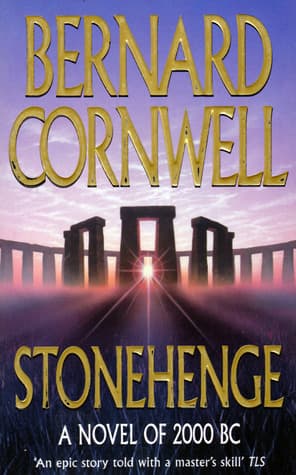
Bernard Cornwell (1999)
Genre
Fantasy / Historical Fiction / Romance
Reading Time
10-12 hours
Key Themes
See below
Sign in to track this book
Three warring brothers—a ruthless warrior, a zealous sorcerer, and a practical builder—are bound by a dangerous vision to build Stonehenge, changing their fate and their ancient land.
The story begins in Ratharryn, ruled by Chief Tribann. A chieftain from a distant land arrives, wounded by a rival tribe. Before dying, he gives Tribann a large amount of gold, a rare wealth. Tribann's son, Camaban, a visionary and sorcerer, sees the stranger's death and the gold as a divine sign. He believes the gods demand a magnificent new temple, unlike any before, to replace their small, old one. Camaban's strong belief, fueled by a vivid dream, starts to convince the tribe, setting the stage for building Stonehenge.
Tribann's oldest legitimate son, Lengar, is a warrior driven by ambition. He dislikes his father's perceived weakness and Camaban's growing influence, seeing the temple as a waste of resources and a threat to his future power. Lengar secretly plans to undermine Tribann and take control of Ratharryn. He gathers loyal warriors and forms alliances, positioning himself to become chief. His ruthlessness is clear, and he sees the temple project mostly as a way to increase his own power, not as a spiritual undertaking like Camaban does.
Saban, the youngest of Tribann's sons, is practical and observant, with a talent for engineering and problem-solving. While his brothers focus on power and prophecy, Saban works on the real challenges of Camaban's vision. He starts experimenting with ways to move large stones, understanding the huge difficulties involved. His first attempts, though small, show his natural skill for mechanics and organization. Saban's early success in moving smaller stones gives the first real proof that Camaban's ambitious temple, requiring huge stones, might be possible, earning him the laborers' respect.
With Camaban's spiritual guidance and Saban's engineering skill, the tribe starts work on the first, smaller stone circle. The huge effort both unites and divides the community, with many questioning its possibility and cost. During this time of hard labor and tribal tension, Tribann's health worsens. Lengar, seeing his chance, causes his father's death, making it look accidental. With Tribann gone, Lengar takes the chieftainship, immediately asserting his authority over the temple project and the tribe. His rise to power changes the dynamics of the construction and the brothers' relationships.
As the new chief, Lengar dictates the terms of the temple's construction. He sees it as a monument to his own power, demanding larger stones and more extravagant designs, often at great cost to the tribe's resources and the laborers' lives. He pushes the workers hard, using fear to maintain control. Camaban, though the visionary, finds himself increasingly ignored by Lengar, his spiritual authority overshadowed by his brother's brute force. Saban, while essential for the engineering, tries to lessen Lengar's harsh demands and protect the workers, leading to growing resentment among the people.
Camaban's visions require unique blue stones from a distant, sacred mountain. This means a dangerous journey and talks, or conflict, with other tribes. Lengar, wanting conquest, leads an expedition, planning to take the stones by force. Saban, however, argues for diplomacy and a more strategic approach. During the difficult journey, Saban's natural leadership, resourcefulness, and empathy for his men contrast with Lengar's brutality. His ability to form alliances and navigate dangerous lands helps acquire the blue stones, though with significant loss and skirmishes, further showing his growing influence and Lengar's shortsightedness.
The temple's vision grows to include massive sarsen stones, far larger than anything tried before. Saban creates increasingly complex and clever methods for quarrying, transporting, and erecting these huge stones, often involving hundreds of men and animals. The Great Circle's construction becomes the tribe's main focus, taking all their energy. This period shows both incredible human ingenuity and immense suffering, with accidents and deaths common. Saban's reputation as a master builder and a compassionate leader grows, even as he deals with Lengar's constant interference and Camaban's increasing demands for spiritual purity and sacrifice.
As the temple progresses, Camaban becomes more ascetic and fanatical. He creates a strict priestly order, imposing rigid rituals and demanding greater sacrifices, both material and human, to please the gods and ensure the temple's completion. His pronouncements become absolute, and he sees any deviation as blasphemy. This creates tension with Saban, who cares about the people's well-being, and with Lengar, who dislikes Camaban's spiritual authority intruding on his temporal power. Camaban's zealotry turns the temple from a symbol of hope into a source of fear and oppression for many in the tribe.
Lengar's oppressive rule and endless desire for power lead to his downfall. His cruelty alienates his people and even some loyal warriors. A moment of betrayal and rebellion, perhaps helped by Saban, leads to Lengar's death. This event frees the tribe from his tyranny, but it also breaks the fragile unity between the brothers. Saban, now the leader, must deal with the aftermath of Lengar's rule and Camaban's increasing fanaticism, who sees Lengar's death as divine judgment and proof of his own prophetic power.
With Lengar gone, Saban takes full leadership of the tribe and the temple project. He brings order and compassion, prioritizing his people's welfare while still pushing the construction forward. He improves engineering techniques, ensuring the final structure's stability and beauty. The huge sarsen trilithons are raised, forming the iconic horseshoe shape. Saban's leadership balances practicality, vision, and empathy, creating a monument that is both an engineering feat and a symbol of human spirit, though born from much suffering and conflict.
As the temple nears completion, Camaban's spiritual fervor peaks. He focuses on aligning the stones with the solstices, believing this will unlock the gods' ultimate power. The first major astronomical alignment, likely the summer solstice, becomes a moment of deep spiritual meaning. Camaban performs elaborate rituals, interpreting the celestial events as direct communication from the divine. This moment confirms the temple's purpose as a sacred observatory and a place of immense spiritual power, fulfilling Camaban's lifelong vision, even as he becomes more detached from his people's earthly concerns.
With the Great Temple complete, Saban confirms his role as the wise and just chief of Ratharryn. He focuses on rebuilding the community, encouraging trade, and ensuring peace. The temple, a monument to the gods, also becomes a symbol of his people's ingenuity and resilience. Saban's rule brings stability and growth for the tribe, moving past the brutal rivalries. His legacy is not just the magnificent stone circle, but the lasting prosperity and cultural strength of the people who built it, a testament to his balanced leadership and his ability to unite a fractured community.
The Protagonist
Saban evolves from a quiet observer and skilled craftsman into a wise and just chief, balancing the spiritual and practical needs of his people to complete Stonehenge and establish lasting peace.
The Antagonist
Lengar rises to power through violence and manipulation but ultimately falls due to his own unchecked cruelty and the rebellion it incites.
The Supporting
Camaban's initial pure vision for a temple evolves into a zealous, demanding spiritual authority, becoming increasingly detached from humanity as the monument nears completion.
The Supporting
Tribann's reign ends tragically, and his death serves as a catalyst for the power struggles that define the early stages of Stonehenge's construction.
The Supporting
Pagan remains a constant, loyal companion to Saban, witnessing and aiding his rise to leadership and the completion of the temple.
The Supporting
Seren provides Saban with emotional stability and a personal stake in the future, ultimately becoming his partner in forging a new society.
The Mentioned
The stranger's brief appearance and death serve as the inciting incident, providing the initial resources and spiritual impetus for the temple's construction.
The novel explores different forms of power: Lengar's tyrannical force; Camaban's spiritual and manipulative authority; and Saban's empathetic, practical leadership. Lengar's rule brings suffering and division, while Camaban's zealotry demands great sacrifice. Saban's rise shows that true leadership means serving the people, balancing vision with practicality and compassion. This is clear in Saban's innovative stone-moving techniques that prioritize worker safety, a sharp contrast to Lengar's disregard for human cost during the sarsen stone transport.
“A leader's true strength is not in how many he can command, but in how many he can inspire to build a better future.”
The building of Stonehenge is driven by Camaban's deep, but increasingly fanatical, faith. The theme explores the line between spiritual devotion and destructive zealotry. Camaban's growing demands for human and material sacrifices, justified by divine will, highlight the dangers of unchecked religious fervor. The tribe's willingness to endure great hardship and death for a spiritual ideal questions the cost of faith. This is seen in the grueling, often fatal, efforts to quarry and transport the blue stones, driven by Camaban's belief in their divine importance.
“The gods demand more than just stones; they demand our very souls, laid bare upon the altar of their greatness.”
Despite the huge challenges, primitive tools, and brutal conditions, Stonehenge's construction shows human ingenuity and resilience. Saban's character embodies this theme, constantly finding new ways to move and erect the huge stones. The tribe's collective effort, enduring hardship, loss, and tyranny, shows humanity's ability for great achievement when united by a common, though complex, purpose. The detailed descriptions of Saban's sledges, rollers, and leverage systems for the sarsen stones exemplify this theme.
“There is no stone too heavy, no distance too far, if the will to move it is stronger than the fear of its weight.”
At its core, Stonehenge is a story of three brothers, united by blood but divided by ambition, vision, and character. Lengar's ruthless pursuit of power, ending in patricide and tyranny, contrasts with Saban's empathetic and practical approach, and Camaban's spiritual fervor. Their constant clashes, betrayals, and Lengar's eventual death, drive much of the plot and explore the destructive nature of unchecked sibling rivalry when mixed with the struggle for control over a large project and a people. The initial conflict over Tribann's succession and Lengar's later oppression of Saban and Camaban are central to this theme.
“Blood binds us, but ambition tears us apart, leaving only the stones to bear witness to our fractured souls.”
The novel shows a new civilization dealing with complex social structures, technology, and beliefs. Building Stonehenge represents a key moment in human history, marking a shift from nomadic life to settled, organized societies capable of huge feats. It highlights the development of specialized labor, engineering principles, and a structured priesthood. The detailed planning and execution needed for the temple's construction show the basic elements of early civilization forming. The project's sheer scale, requiring thousands of man-hours and inter-tribal cooperation, illustrates this societal evolution.
“We are not merely moving stones; we are forging a future, chiseling our mark onto the face of the earth, for all generations to see.”
The initial catalyst for the temple's construction.
The gold brought by the dying stranger serves as a crucial inciting incident. It is not merely wealth but a symbol of external influence and a divine sign in Camaban's eyes. It provides the initial material resources and, more importantly, the spiritual justification for the monumental undertaking of Stonehenge. Without this unexpected 'gift,' Camaban's vision might never have gained traction, and the tribal dynamics would have unfolded very differently, lacking the immediate impetus for such a grand project.
Divine prophecies that dictate the temple's design and scale.
Camaban's frequent and increasingly specific visions act as a powerful plot device, driving the ever-expanding scale and complexity of Stonehenge. These visions are presented as direct communications from the gods, making them unquestionable to Camaban and, to a degree, to the tribe. They justify the immense sacrifices and push the boundaries of what is considered possible, leading to the inclusion of the blue stones, the sarsen stones, and the precise astronomical alignments. They create both the inspiration and the source of conflict as Saban struggles to execute them and Lengar resents their dictates.
The celestial precision that gives the temple its ultimate purpose.
The precise alignment of Stonehenge with the solstices and other celestial events serves as a powerful symbol of the temple's spiritual and scientific purpose. It provides a clear, measurable goal for the builders and a source of awe for the people. This device highlights the advanced understanding of the heavens possessed by the builders and elevates the temple beyond a mere pile of stones into a cosmic observatory. It also underscores Camaban's spiritual drive and Saban's engineering precision, as they both strive to achieve this perfect harmony between earth and sky, giving the monumental effort a profound, lasting significance.
The central conflict driving character development and plot progression.
The intense rivalry between Lengar, Camaban, and Saban is the primary engine of the narrative. It creates constant tension, internal and external conflicts, and dictates the power dynamics within the tribe. Each brother represents a different facet of human ambition and motivation, and their clashes—for power, spiritual dominance, or the welfare of the people—directly influence the construction process, the suffering endured, and the eventual leadership of Ratharryn. This rivalry transforms a historical construction project into a deeply personal and dramatic human story.
“The gods are in the earth and the sky and the water, not just in the words of a priest.”
— Runners often have a more direct connection to nature and the land.
“Every man has a destiny, some to build, some to destroy, and some to simply watch.”
— The concept of fate and individual roles in the grand scheme of things.
“Love is a fire, and like all fires, it can warm or it can burn.”
— Reflecting on the passionate and sometimes destructive nature of relationships.
“The dead do not care for our tears, only for our memories.”
— A pragmatic view on grief and the importance of remembering ancestors.
“Truth is a sharp stone, and often it cuts those who try to hide it.”
— The idea that secrets eventually come to light and have consequences.
“Great stones do not move themselves. Men move them, with sweat and blood and belief.”
— Highlighting the immense human effort and determination behind the construction of Stonehenge.
“Peace is not the absence of war, but the absence of fear.”
— A deeper understanding of true peace beyond mere cessation of conflict.
“A man without a tribe is a leaf without a tree, easily blown away.”
— Emphasizing the importance of community and belonging in a tribal society.
“The future is a path we walk, not a wall we stare at.”
— Encouraging agency and action rather than passive acceptance of fate.
“Power is not in the size of your spear, but in the strength of your will.”
— A commentary on true power being internal rather than purely physical or material.
“The gods demand sacrifice, but they also demand a heart that dares to dream.”
— Balancing religious duty with personal ambition and vision.
“Some men build monuments to their gods, others build monuments to themselves.”
— Contrasting motivations behind great undertakings, whether for divine glory or personal legacy.
“The greatest battles are not fought with spears and shields, but in the minds of men.”
— Highlighting the internal conflicts, strategies, and psychological warfare that often precede or accompany physical battles.
Ready to see how well you understood this book? Take our interactive quiz with 10 questions.

Bernard Cornwell is a prolific British author celebrated for his masterful historical fiction. He is best known for his Sharpe series, chronicling the Napoleonic Wars, and his Warlord Chronicles, which reimagines Arthurian legend. Cornwell's work is lauded for its meticulous research, gritty realism, and compelling narratives.







