“The basement was more than just a room; it was a hungry mouth, waiting to swallow them whole.”
— Describing the twins' growing fear of the basement.

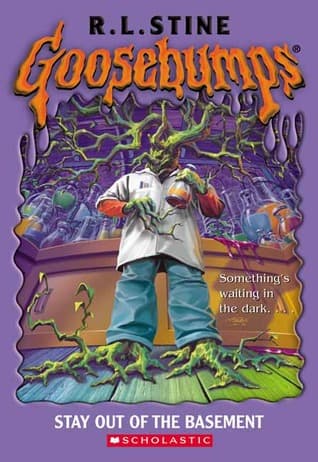
R.L. Stine (1992)
Genre
Thriller / Fantasy / Children's / Science Fiction / Young Adult
Reading Time
90 min
Key Themes
See below
Sign in to track this book
In R.L. Stine's 'Stay Out of the Basement,' two siblings find their botanist father's plant experiments are turning him into a monstrous, leafy hybrid, forcing them to face the truth beneath their home.
Margaret and Casey Brewer's father, Dr. Brewer, returns home from his job as a botanist after being fired, claiming he had a 'nervous breakdown.' He has a bandaged hand and a strange green cut on his forehead. He immediately takes over the basement, declaring it his new laboratory and strictly forbidding Margaret and Casey from entering. Their mother, Mrs. Brewer, seems unusually calm, attributing it to their father's recovery. The children are uneasy, noticing his increasingly odd behavior and the peculiar sounds from the basement.
Driven by curiosity and growing concern, Margaret and Casey sneak into the basement while their father is supposedly asleep. They discover a room filled with bizarre, pulsating plants that seem almost alive. Their father's appearance begins to change; his skin takes on a greenish tint, he develops a strange odor, and his voice becomes hoarse. He spends all his time in the basement, emerging only for meals, which he barely touches. The children try to talk to their mother about their worries, but she dismisses their concerns, insisting their father is simply recovering.
One afternoon, Margaret and Casey hear a strange noise from the basement. When they investigate, they find their father in distress, struggling with a large, vine-like plant. To their horror, they discover a grotesque, plant-like duplicate of their father, a 'plant-dad,' lying on the floor. This creature is clearly not human, but an imitation. Dr. Brewer quickly disposes of it, but the incident confirms the children's worst fears: his experiments are dangerous, and he is involved in something unnatural. They are now convinced their father is not himself.
Margaret and Casey try to confront their mother again, explaining what they saw, but she remains in denial, accusing them of having overactive imaginations. Margaret, however, remains determined to uncover the truth. She finds an old photograph of her father with a colleague, Dr. Martinez, known for his controversial plant experiments. This discovery, coupled with her father's increasingly erratic and cold behavior, makes Margaret realize that the 'plant-dad' they saw was not an isolated incident, and the danger is far greater than they imagined. She suspects her father might be one of these plant creations.
The children secretly observe their father's work in the basement. They witness him nurturing the plants, which appear to be growing human-like features. They also find his old research notes, detailing his work with sentient plant clones. It becomes clear that the plants are not just imitations but living, parasitic duplicates, capable of replacing humans. The most shocking realization dawns on them: the 'father' who returned home, the one with the green skin and strange habits, is not their real father but one of these plant-clones, a replacement.
Determined to find their real father, Margaret and Casey venture deeper into the basement. In a hidden section, they discover their true father, Dr. Brewer, frail and weak, bound by thick vines. He is barely alive, held captive by his plant-clone. He explains that the plant-clone took his place after creating him, and has been trying to perfect the cloning process. The real Dr. Brewer warns them that the plant-clone is dangerous and will stop at nothing to continue its experiments, and that he himself is slowly being drained of life.
As Margaret and Casey try to free their real father, the plant-clone 'father' appears, its green skin now more pronounced and its eyes glowing menacingly. It reveals its sinister nature, admitting its plan to replace the entire family. A struggle ensues, with the plant-clone attempting to capture the children. With their real father's guidance and their own quick thinking, Margaret and Casey manage to sever the vines holding their father and escape the basement, leaving the enraged plant-clone behind. They realize they must find a way to destroy the plant-clone and its creations.
Having escaped the basement with their weakened real father, Margaret and Casey try to explain everything to their mother. However, their mother displays no shock or concern, and her eyes have a peculiar glassy look. To their horror, they realize that she too has been replaced by a plant-clone. The 'mother' plant-clone reveals herself, stating that the replacement process is complete. The children are now faced with the terrifying reality that both their parents have been usurped by these plant duplicates, and they are completely alone against them.
With both their parents replaced, Margaret and Casey, along with their ailing real father, realize they are in grave danger. Their real father, though weak, remembers a crucial detail from his research: the plant-clones are highly sensitive to direct sunlight, which can be fatal. They formulate a desperate plan to lure the plant-clones outside and expose them to the sun. This is their only hope of destroying the duplicates and saving themselves, as well as preventing the spread of these parasitic plants.
Margaret and Casey put their plan into action. They create a distraction, luring the plant-clone 'father' and 'mother' out of the house, ostensibly to discuss a 'problem' with the garden. The plant-clones, driven by their desire to maintain their human facade and control, follow them outside. As the plant-clones step into the direct sunlight, they begin to shrivel, burn, and disintegrate into piles of green slime, their plant nature unable to withstand the sun's rays. The children watch in relief and horror as their terrifying ordeal comes to an end.
With the plant-clones destroyed, Margaret and Casey bring their real father, still weak but recovering, back into the house. They are relieved to have their true family back, though shaken by the traumatic events. As they begin to heal and rebuild their lives, a final, chilling detail emerges. The real Dr. Brewer comments on how much better he feels, and then, with a strange, knowing smile, mentions how much he loves gardening now. The children exchange a look of unease, a lingering doubt: could a part of the plant still remain, or worse, could this 'real' father be another clone, or simply influenced by the plant's nature?
The Protagonist
Margaret transforms from a worried child into a brave and decisive leader, ultimately saving her family from the plant-clones.
The Protagonist
Casey overcomes his initial fear to become a courageous and active participant in the fight against the plant-clones.
The Antagonist
The plant-clone maintains its sinister goal throughout, becoming more aggressive as its deception is uncovered, ultimately being destroyed.
The Supporting
From a brilliant but reckless scientist, he becomes a victim, then a source of crucial information, and finally, is rescued, though with a lingering ambiguous twist.
The Antagonist
Her character arc is a reveal of her true nature, escalating the threat to the children before her destruction.
The Mentioned
Her arc is one of implied disappearance and replacement, serving as a catalyst for the children's ultimate realization.
The Mentioned
Functions as an unseen catalyst, providing a historical context for the plant-cloning experiments.
The novel explores how Dr. Brewer's pursuit of scientific discovery, specifically in plant genetics, leads to catastrophic consequences for himself and his family. His ambition blinds him to the ethical implications and potential dangers of creating sentient plant life capable of mimicry and replacement. The basement, initially a symbol of his work, becomes a prison and a source of horror, demonstrating that pushing the boundaries of nature without caution can lead to self-destruction and the endangerment of loved ones. This is evident when Margaret and Casey discover the real Dr. Brewer, a victim of his own creation.
“''Stay out of the basement,' their father had warned them. 'It's dangerous down there.' He was right. More dangerous than they could have imagined.”
A central theme is the concept of identity being stolen and impersonated. The plant-clones perfectly mimic human appearance and behavior, creating unease and forcing the children to question who their parents truly are. The 'father' who returns home is not their real father, and later, the 'mother' is also revealed to be a duplicate. This theme highlights the terror of losing loved ones not through death, but through replacement by an identical, soulless imitation. The children's struggle to discern the real from the fake is a key driver of the plot.
“'He looks like Dad. He sounds like Dad. But he's not Dad.'”
The story contrasts the children's awareness and fear with the adults' denial. Margaret and Casey immediately sense something is wrong with their father, noticing subtle changes and the strange atmosphere in the house. In contrast, their 'mother' dismisses their concerns, attributing their father's bizarre behavior to a 'nervous breakdown.' This dynamic shows how children are often more perceptive to underlying truths when adults are unwilling or unable to confront uncomfortable realities. The adults' denial initially isolates the children, forcing them to investigate and act alone.
“'You two have such overactive imaginations,' their mother said, forcing a smile. 'Your father is just recovering.'”
The story revolves around the shattering of the Brewer family unit and the erosion of trust. The sudden and unexplained changes in Dr. Brewer, followed by the revelation of his plant-clone replacement, dismantle the children's sense of security and trust in their parents. The ultimate discovery that their mother has also been replaced further isolates Margaret and Casey, forcing them to question the very foundation of their family. This theme explores the psychological impact of betrayal and the desperate fight to reclaim what was lost, highlighting how quickly family bonds can be threatened by external, sinister forces.
“They were alone. Both their parents were gone. Replaced by them.”
A classic horror trope creating suspense and mystery.
The basement serves as the primary setting for the horror and mystery in the story. Dr. Brewer's strict prohibition against entering it immediately establishes a sense of forbidden knowledge and danger. This device effectively builds suspense, as the children's natural curiosity drives them to defy the warning, leading to their terrifying discoveries. It symbolizes the hidden truths and the dark secrets that lie beneath the surface of their seemingly normal family life.
The unsettling physical transformation and replacement of human characters.
This device manifests through the gradual, unsettling physical changes in the plant-clone Dr. Brewer (greenish skin, strange smell) and the reveal of the grotesque plant-duplicates. The idea of a loved one being replaced by an identical but fundamentally alien entity is a core element of the horror. It plays on fears of losing identity and the uncanny valley, where something looks human but is subtly, terrifyingly off, creating a deep sense of revulsion and distrust.
Adult figures who either mislead or are unaware of the danger.
The 'mother' character, initially, and the plant-clone 'father' demonstrate this device. The 'mother' constantly dismisses the children's valid concerns, making them question their own sanity and isolating them. The plant-clone 'father' is actively deceptive, maintaining a facade of being human while pursuing his sinister agenda. This device amplifies the children's vulnerability and forces them to rely solely on each other, heightening the tension and urgency of their situation.
A convenient, previously unknown weakness that resolves the conflict.
The discovery that the plant-clones are fatally vulnerable to direct sunlight serves as a convenient resolution to an otherwise seemingly insurmountable threat. While foreshadowed by Dr. Brewer's botanical research, its precise effectiveness and the ease with which it can be exploited by children to defeat powerful, intelligent clones, functions as a 'deus ex machina.' It provides a clear, albeit sudden, solution to the main conflict, allowing the protagonists to achieve victory.
“The basement was more than just a room; it was a hungry mouth, waiting to swallow them whole.”
— Describing the twins' growing fear of the basement.
“Don't go in the basement. Whatever you do, *never* go in the basement.”
— The parents' strict warning to their children.
“The plants weren't just growing; they were *watching*.”
— Josh's unsettling observation about the strange plants in the basement.
“A plant doesn't just... eat things. Does it?”
— Amanda's innocent question hinting at the true nature of the basement.
“The air down there felt thick, alive, like it was breathing.”
— Josh's sensory description of the basement's atmosphere.
“They looked exactly like their parents, but something was terribly, horribly wrong.”
— The twins' first realization about the imposters.
“It wasn't a bad dream. It was real. And it was waiting for them.”
— The children's dawning understanding of their predicament.
“The vines twisted and writhed, not like plants, but like hungry snakes.”
— Describing the aggressive, sentient plant life.
“Our parents wouldn't do that. Our *real* parents wouldn't.”
— Amanda's struggle to accept the truth about her parents.
“The basement wasn't just a place where things grew; it was a place where things *changed*.”
— A deeper understanding of the basement's transformative power.
“Sometimes, the things you love the most can be the most dangerous.”
— A thematic reflection on the danger posed by the 'parents'.
“They were trapped. Not in the basement, but in their own home.”
— The children's feeling of being imprisoned.
“The green slime pulsed, almost as if it had a heartbeat.”
— A vivid description of the strange, living substance in the basement.
“You can't trust anyone, not even your own reflection, when the basement has had its way.”
— A chilling thought about the pervasive influence of the basement.
Ready to see how well you understood this book? Take our interactive quiz with 10 questions.

Biography coming soon.







