“Violence, naked force, has settled more issues in history than has any other factor, and the contrary opinion is wishful thinking at its worst.”
— A lecture by Mr. Dubois on history and civics.

Robert A. Heinlein (1959)
Genre
Fantasy / Science Fiction
Reading Time
9-10 hours
Key Themes
See below
Sign in to track this book
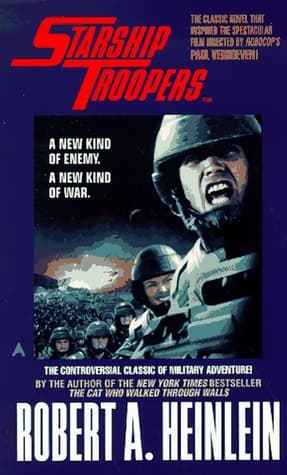
Juan Rico leaves his youth behind to join the Mobile Infantry, fighting an interstellar war against alien insects where citizenship is earned through service.
Eighteen-year-old Juan 'Johnnie' Rico, a high school graduate from Buenos Aires, decides to join the Terran Federation's Mobile Infantry. He mainly does this to impress his friend Carl and his crush Carmen Ibanez, who are both joining Federal Service. His wealthy, civilian father, Mr. Rico, strongly opposes his choice, believing military service is beneath him. Johnnie's mother, however, is more understanding. Despite his father's attempts to stop him, Johnnie goes through the enlistment process, a tough series of psychological and physical tests. He makes the final commitment, accepting the duties and limited rights of a citizen-in-training, and is sent off for basic training.
Johnnie arrives at Camp Currie on the Canadian prairies, a notoriously tough basic training site. He is assigned to a platoon led by Sergeant Zim, a veteran. The training is very demanding, both physically and mentally, designed to break recruits down and rebuild them as disciplined soldiers. Johnnie struggles at first with the strict rules, lack of privacy, and constant pressure. He sees harsh punishments for mistakes, including public floggings, and begins to understand the Mobile Infantry's core belief: absolute obedience and personal responsibility. He starts to bond with other recruits, especially Ace and Dizzy Flores, as they go through the tough process together.
During his basic training, the long-standing tensions between humanity and the Arachnids (often called 'Bugs') turn into full war. The Bugs launch a devastating surprise attack on Earth, hitting Buenos Aires. Johnnie sees a news report showing his home city completely destroyed, an event that kills his mother and almost all his family and friends. This huge loss hardens Johnnie and changes his reasons for joining from youthful idealism to a strong desire for revenge against the Bugs. The war becomes personal, and his commitment to the Mobile Infantry grows significantly.
After finishing basic training and some initial combat drops, Johnnie is chosen for Officer Candidate School (OCS) because of his skill. He returns to Earth for this advanced training, which covers military tactics and leadership, as well as the Federation's society and military ideas. He studies history, ethics, and command responsibilities. During this time, he meets Lieutenant Rasczak, his former history teacher, now an instructor. Rasczak's lectures strengthen Johnnie's understanding of duty, citizenship, and the need for violence to keep peace, further shaping his views.
After graduating from OCS, Johnnie is made a provisional Third Lieutenant and assigned to a Mobile Infantry platoon. He quickly finds himself leading a squad during various combat drops against the Arachnids on different planets. He experiences the brutal reality of space warfare firsthand, making life-or-death decisions under intense pressure. He sees comrades die and the horrors of battle, forcing him to face leadership's moral complexities and war's cost. These experiences solidify his understanding of the Mobile Infantry's training and the importance of discipline, teamwork, and effective command against a ruthless enemy.
Johnnie's unit fights against the 'Skinnies,' another alien species allied with the Arachnids. These fights are more complex, involving diplomatic and strategic issues beyond simple killing. Later, he participates in a major attack on Klendathu, the Arachnid homeworld. This is a huge, costly operation, showing the scale and difficulty of fighting the Bugs on their own ground. Despite heavy losses, the Mobile Infantry's training and technology help them reach their goals, though Johnnie sees the limits of human power against a numerically overwhelming alien enemy. He continues to show his leadership and resilience.
During a dangerous mission, Johnnie is surprised to find his former basic training instructor, Sergeant Zim, now a Warrant Officer, serving in a specialized unit. Zim, despite his promotion, remains a tough, hands-on warrior, personally leading a raid to capture a live Arachnid brain for study. This reunion shows Zim's dedication and effectiveness in combat. Johnnie observes Zim's continued skill in military tactics and his deep understanding of the enemy, reinforcing the impact Zim had on his development as a soldier. The encounter highlights the lasting lessons from basic training.
As the war continues, Johnnie moves up the ranks, eventually becoming a Captain. He commands his own company, showing growing maturity, strategic thinking, and dedication to his troops. The war with the Arachnids is far from over, and Johnnie understands it is a long, hard conflict that needs constant watchfulness and sacrifice. He has fully taken on his role as a Mobile Infantry officer, finding purpose in his service to the Federation. He thinks about his journey from a naive recruit to a seasoned leader, recognizing the change he has gone through because of his Federal Service experiences.
Throughout his service, Johnnie often thinks about the Terran Federation's political ideas, especially the concept of 'moral obligation' citizenship. He recalls his history lessons with Lieutenant Rasczak and discussions about the responsibilities that come with the right to vote. He comes to understand that true citizenship is earned through service, specifically through the willingness to risk one's life for the common good. This understanding deepens his belief that the Federation's system, though seemingly harsh, is the most just and stable form of government, ensuring that those who make the ultimate sacrifices are also those who lead society.
The novel ends with Johnnie Rico firmly in his role as a Mobile Infantry officer. The war against the Arachnids continues, with no clear end. Johnnie has accepted this reality, understanding that the conflict is a generational fight for humanity's survival. He is no longer the young man who joined on a whim; he is a tough, thoughtful soldier who embodies the Federation's ideals. He continues to lead his troops with courage and conviction, ready for whatever challenges the war brings, fully committed to his duty and humanity's future.
The Protagonist
Johnnie transforms from an impulsive teenager to a mature, effective Mobile Infantry captain who fully understands and embodies the Federation's values of duty and sacrifice.
The Supporting
Zim remains a steadfast figure, embodying the core principles of the Mobile Infantry, serving as a constant benchmark of military excellence and dedication.
The Supporting
Rasczak consistently articulates and reinforces the Federation's core tenets, acting as a philosophical guide for Johnnie and the reader.
The Supporting
Carmen pursues her own distinguished career in the Navy, symbolizing the diverse ways individuals serve the Federation.
The Supporting
Dizzy develops from a determined recruit into a brave soldier, making the ultimate sacrifice in combat.
The Antagonist
The Bugs remain an unyielding, inscrutable, and persistent threat to humanity throughout the narrative.
The Mentioned
Mr. Rico's perspective shifts from outright disapproval to a partial understanding and acceptance of his son's military path.
The Supporting
Kitten Smith serves as a consistent comrade-in-arms for Johnnie, demonstrating the enduring bonds of military service.
A main theme is the Federation's idea of citizenship, earned through voluntary Federal Service, specifically military service, rather than being a birthright. Only those who have served and shown a willingness to risk their lives get the right to vote and hold public office. This system is presented as a moral duty, ensuring that those who make the ultimate sacrifices also lead society. Johnnie's journey shows how this system creates responsibility, discipline, and a deep understanding of societal well-being. Lieutenant Rasczak's lectures consistently stress that 'violence, naked force, has settled more issues in history than has any other factor.'
“Citizenship is an attitude, a state of mind, an adherence to the code of conduct that applies to a citizen. A citizen has the right to vote, to hold public office, to exercise sovereign responsibility for the whole of the body politic.”
The novel explores the brutal nature of space warfare, especially against an alien enemy like the Arachnids. It argues that war is a necessary, though terrible, tool for survival and that violence is often the only way to solve basic conflicts between species. The Mobile Infantry's training focuses on discipline, precision, and ruthlessness in combat. The destruction of Buenos Aires reminds readers of war's costs and the existential threat from the Bugs, reinforcing the idea that humanity must be ready to fight for its existence. Johnnie's combat experiences highlight the psychological and physical toll, but also the sense of purpose found in the fight.
“The noblest fate that a man can endure is to place his own life in the line for his sovereign, or for his own people.”
These values are very important within the Mobile Infantry and the Federation's society. The tough basic training under Sergeant Zim instills absolute discipline, obedience, and a willingness to sacrifice for the unit and the greater good. Johnnie learns that individual desires must be put aside for collective survival. The idea of 'moral obligation' citizenship directly links to duty and sacrifice, suggesting that those willing to give everything for society are best suited to lead it. The story constantly reinforces that personal responsibility and adherence to duty are essential for both military success and a stable society.
“A citizen accepts personal responsibility for the safety of the body politic, of which he is a member, defending it with his life if need be.”
Starship Troopers often examines the tension between individual freedom and collective needs. The Federation's system prioritizes the common good and social stability, sometimes at the expense of individual rights as understood in other systems. Recruits sacrifice personal freedom and endure harsh discipline for the benefit of the service and society. Johnnie's journey shows him moving from self-centered reasons to embracing the Mobile Infantry's collective purpose. The novel argues that during existential threats, a strong, unified collective, built on shared purpose and sacrifice, is essential for survival. The hive-mind nature of the Arachnids acts as a dark mirror to the Federation's focus on the collective, though without individual choice.
“In a free society, a man's life belongs to him. He may live as he sees fit, provided he does not infringe on the rights of others. But in a society such as ours, where the survival of the whole depends on the willingness of its members to sacrifice their lives for the common good, the individual's life belongs to the state.”
Education is important in shaping Federation citizens, especially in instilling its core values. Johnnie's history lessons with Lieutenant Rasczak are not just about facts but about the philosophical basis of their society and their political system's necessity. Basic training itself is a form of intense indoctrination, designed to remove civilian attitudes and replace them with military discipline and a sense of collective purpose. This constant reinforcement of ideals, from school to service, ensures that citizens understand and commit to the Federation's principles. The novel suggests that a society's survival depends on its ability to pass on its values and secure its members' loyalty.
“The purpose of education is not to fill a man's head with facts, but to teach him how to think.”
The story is told entirely from Johnnie Rico's perspective.
The novel is narrated in the first person by Juan 'Johnnie' Rico. This allows the reader to experience his transformation directly, gaining insight into his thoughts, fears, and evolving understanding of the world. It provides an intimate view of the Mobile Infantry's training, combat, and the philosophical discussions that shape Johnnie's worldview. This narrative choice immerses the reader in Johnnie's subjective experience, making his personal growth and the Federation's ideology more immediate and impactful, even when presenting controversial ideas.
Interspersed philosophical discussions and history lessons.
Throughout the narrative, Heinlein frequently inserts chapters or passages that are essentially didactic lectures, often presented as Johnnie's recollections of history classes with Lieutenant Rasczak or discussions during Officer Candidate School. These sections directly expound upon the political philosophy, social structure, and military ethics of the Terran Federation. They serve to explicitly articulate the novel's themes, particularly those concerning citizenship, war, and the nature of authority, providing the ideological framework against which Johnnie's experiences are measured.
A detailed depiction of the rigorous basic training process.
The extensive and grueling basic training Johnnie undergoes at Camp Currie under Sergeant Zim is a significant plot device. It serves not only as a character-building crucible for Johnnie but also as a demonstration of the Mobile Infantry's philosophy in action. This detailed portrayal of boot camp establishes the high standards of discipline, the emphasis on responsibility, and the harsh realities of military life, preparing both Johnnie and the reader for the brutal combat that follows. It physically and psychologically transforms recruits into effective soldiers, embodying the Federation's ideal citizen.
An inscrutable and existential alien enemy.
The Arachnids, or 'Bugs,' function as a critical plot device by providing an ultimate, unambiguous antagonist. Their utterly alien nature, hive-mind intelligence, and lack of human-like empathy make them an existential threat that justifies the Federation's militaristic society and its unique form of citizenship. The Bugs are not a foe that can be reasoned with or appeased; they demand total war. This external threat simplifies the moral landscape of the conflict, allowing the novel to focus on the human response and the internal philosophy of the Federation without getting bogged down in complex ethical dilemmas regarding the enemy.
“Violence, naked force, has settled more issues in history than has any other factor, and the contrary opinion is wishful thinking at its worst.”
— A lecture by Mr. Dubois on history and civics.
“The noblest fate that a man can endure is to place his own mortal body between his home and the desolation of war.”
— Rico's thoughts on military service and sacrifice.
“Citizenship is an attitude, a state of mind, an emotional conviction that the whole is greater than the part... and that the part has no rights except those which have been earned by service.”
— A discussion about the meaning of citizenship in the Terran Federation.
“An armed man is a citizen. An unarmed man is a subject.”
— Mr. Dubois emphasizing the importance of military service for political power.
“You have to be a trained warrior to be a voter. No other training counts.”
— Explaining the voting requirements of the Terran Federation.
“To the adult, the only freedom is the freedom to choose your own master.”
— Rico reflecting on the nature of freedom and responsibility.
“The greatest truth a man can learn is that he is not the center of the universe.”
— A lesson during basic training about humility and perspective.
“War is not a game. War is a meat grinder. War is a place where you go to kill people and get killed.”
— Sergeant Zim's brutal honesty about the realities of combat.
“The purpose of a soldier is to fight. Not to be popular, not to be a good sport, not to be a nice guy.”
— Sergeant Zim instructing his recruits on the soldier's primary function.
“The only way to win a war is to be willing to lose everything.”
— Rico's understanding of the commitment required for victory.
“Moral decisions are difficult. Practical decisions are easy.”
— Rico contemplating the difference between ethical and practical choices.
“The only good bug is a dead bug!”
— A common battle cry used by the Mobile Infantry against the Arachnids.
“Never try to teach a pig to sing; it wastes your time and annoys the pig.”
— A piece of practical advice offered by a seasoned soldier.
“Everybody who has ever been a soldier, or who ever will be a soldier, has to learn how to kill.”
— Sergeant Zim explaining a fundamental truth of military training.
“There are no bad outfits, only bad leaders.”
— A principle taught to Rico during officer training, emphasizing leadership's importance.
Ready to see how well you understood this book? Take our interactive quiz with 10 questions.
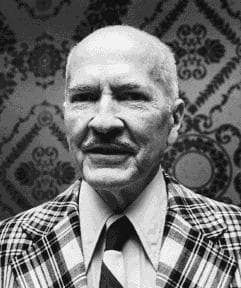
Robert Anson Heinlein was an American science fiction author, aeronautical engineer, and naval officer. Sometimes called the "dean of science fiction writers", he was among the first to emphasize scientific accuracy in his fiction, and was thus a pioneer of the subgenre of hard science fiction. His published works, both fiction and non-fiction, express admiration for competence and emphasize the value of critical thinking. His plots often posed provocative situations which challenged conventional social mores. His work continues to have an influence on the science-fiction genre, and on modern culture more generally.







