“There was once a young man who wished to gain his heart's desire.”
— Opening line of the story, introducing Tristran Thorn's quest.

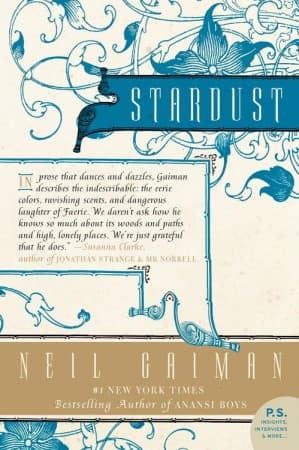
Neil Gaiman (1997)
Genre
Fantasy / Young Adult / Romance
Reading Time
250 min
Key Themes
See below
Sign in to track this book
To win his beloved, a young man crosses into a magical land to find a fallen star, only to discover it's a spirited young woman with her own celestial problems.
The story begins in the village of Wall, named for the stone wall bordering a magical realm. Every nine years, a market is held at the wall, where humans and fae creatures meet. John Thorn, Tristran's father, once crossed the wall and met a mysterious faerie woman; Tristran was born from this encounter. Years later, young Tristran Thorn is in love with Victoria Forester, the most beautiful girl in Wall. During a walk, they see a star fall from the sky. To win Victoria's affection, Tristran impulsively promises to retrieve the fallen star for her within a year and a day. Victoria half-heartedly accepts, thinking it impossible.
Tristran prepares for his journey, getting a silver chain and a Babylonian compass from an old man who guards the breach in the Wall. This guardian, who is not fully human, gives cryptic advice but allows Tristran passage. As Tristran steps through the gap, he finds himself in a landscape different from rural England—a land of ancient forests and strange enchantments. He is now in Faerie, a place both wondrous and dangerous, where the rules of the mundane world do not apply, and his quest for the fallen star truly begins, leaving behind the safety of Wall.
Following the star's path, Tristran finds its impact crater. To his surprise, the 'star' is not a celestial body but a young woman named Yvaine, lying injured in the crater with a broken leg. She is luminous and beautiful but not the inert object he expected. Tristran, still focused on his promise to Victoria, insists that Yvaine must come with him back to Wall. He tries to chain her with the silver chain, which causes her pain. He eventually secures her, reluctantly, and begins the difficult journey of leading her towards the Wall, much to Yvaine's indignation.
Unknown to Tristran and Yvaine, three ancient witch-queens, the Lilim, also want the fallen star. Their power is fading, and they believe that eating the heart of a fallen star will restore their youth and magic. The eldest, the Witch-Queen, personally hunts Yvaine, using dark magic to track her. Her sisters, Mormo and Empusa, stay at their castle, preparing the ritual. The Witch-Queen is ruthless, and her pursuit adds a dangerous urgency to Tristran and Yvaine's journey, making every stop potentially their last.
At the same time, the dying Lord of Stormhold, ruler of this part of Faerie, has tasked his surviving sons—Primus, Quintus, and Septimus (the others deceased)—with finding a magical ruby. This ruby, which fell to Earth with Yvaine, is the symbol of their lineage, and whoever possesses it, along with a fallen star, will inherit the throne. The brothers, ruthlessly eliminating each other, are also tracking Yvaine, though for a different reason than the Lilim. Primus, the eldest surviving, and Septimus, the youngest and most ambitious, are the main contenders, adding another layer of danger to Yvaine's situation.
As Tristran and Yvaine travel, they face fantastical challenges and characters. A capricious gnome briefly turns them into a bird and a dormouse; they are rescued by a flying ship captained by the jovial Captain Shakespeare. This encounter provides a brief break and a lesson in manners for Tristran. They also navigate dangerous forests, avoid magical traps, and experience the wonders and dangers of Faerie, slowly forming an unexpected bond amid their shared perils. Yvaine, initially resentful, begins to see Tristran in a new light, and he, in turn, starts to appreciate her beyond her 'star' status.
The Witch-Queen, through her dark magic, eventually corners Yvaine. She transforms a beautiful inn into a trap, luring Yvaine inside with promises of comfort. Tristran, separated from Yvaine and distracted, realizes the danger and rushes to her aid. The Witch-Queen manages to capture Yvaine, intending to perform the ritual to consume her heart. Tristran, armed with his wits and courage, must confront the ancient sorceress to save Yvaine, a task that seems impossible for a mortal from Wall. This confrontation forces Tristran to move past his initial selfish reasons.
Tristran arrives at the Witch-Queen's castle just in time to disrupt the ritual. A chaotic battle ensues, involving the Witch-Queen, Tristran, and surprisingly, Primus and Septimus, who also arrive, each seeking the ruby and Yvaine. During the struggle, Septimus kills Primus. Ultimately, Tristran, aided by the magic of the unicorn and the timely intervention of the remaining Lilim sisters, defeats the Witch-Queen. Afterward, it is revealed that Tristran is the son of Una, the Witch-Queen's enslaved servant, and also the son of the Lord of Stormhold's sister, making him the true heir to the Stormhold throne.
With the Witch-Queen defeated and his true lineage revealed, Tristran and Yvaine decide to return to Wall. Tristran, still bound by his promise, presents the now-healed Yvaine to Victoria Forester. Victoria, surprised by Yvaine's beauty and the sheer impossibility of Tristran's feat, is still engaged to another. By this point, Tristran's feelings for Victoria have faded, replaced by a deep affection and love for Yvaine. He realizes that his quest changed him and that his heart now belongs to the fallen star, not the girl from Wall. Victoria releases him from his promise, acknowledging his transformation.
Upon his return to Faerie, Tristran, now known as Tristan, embraces his true identity as the rightful heir to Stormhold. He possesses the magical ruby, which Yvaine had been carrying, and with Yvaine, the fallen star, by his side, he is acknowledged as the new Lord of Stormhold. Tristan and Yvaine are crowned King and Queen, bringing a new era of peace and prosperity to the magical kingdom. Their reign is long and happy, a symbol of their love and the extraordinary journey that brought them together, uniting the human and faerie worlds.
As years pass, Tristan rules Stormhold wisely and justly, always with Yvaine by his side. However, Yvaine, a fallen star, does not age. She remains eternally youthful and luminous, while Tristan slowly grows old. This creates a bittersweet reality for them, as they are deeply in love but bound by different lifespans. Yvaine watches Tristan age, knowing she will eventually outlive him, a poignant reminder of her celestial origins and the differences between mortals and stars. Their love, however, remains steadfast throughout his life.
After many happy years, Tristan, an old man, eventually passes away. Yvaine, heartbroken but eternal, continues to live. She lovingly places Tristan's heart, which still glows with the light of the fallen star, in a special place, ensuring his spirit remains intertwined with Stormhold. Yvaine then takes on the role of the kingdom's guardian, watching over it with the wisdom gained from her long life and the profound love she shared with Tristan. She becomes a living legend, a luminous presence embodying the heart of Stormhold, waiting for the day another star might fall.
The Protagonist
Transforms from a lovesick boy into a courageous, wise king, finding true love and his royal heritage in the process.
The Protagonist/Love Interest
Goes from an injured, resentful captive to a beloved queen, finding love and purpose on Earth.
The Supporting
Remains largely unchanged, serving as a catalyst for Tristran's journey and a benchmark for his transformation.
The Antagonist
Driven by a singular, destructive goal, she ultimately meets her demise, failing to achieve her desperate desire for youth.
The Supporting
Serves as a temporary mentor figure, offering guidance and a safe haven, but does not undergo a significant personal change.
The Supporting/Mentioned
His death is the catalyst for much of the plot, and his influence is felt even after he passes.
The Antagonist
His relentless pursuit of power ultimately leads to his demise, preventing him from achieving his goal.
The Supporting
After years of enslavement, she is freed and her true identity as a royal is revealed, reuniting her with her son.
The novel explores different kinds of love, contrasting superficial infatuation with deep affection. Tristran's initial 'love' for Victoria Forester is a childish ideal, based on her beauty and a desire for social validation. His journey forces him to confront real love, which he finds with Yvaine – a love born of shared experience, mutual respect, and genuine connection, not an idealized image. The bittersweet nature of Yvaine's immortality versus Tristan's mortality also highlights love's power against time.
“You know that a good man can never be truly lost. He may be gone, but he lives in the hearts of those who remember him. And what is love, if not a form of remembering?”
Tristran's quest is a journey of self-discovery. He begins as an unseasoned boy, unsure of himself and driven by external validation (Victoria's approval). His venture into Faerie, with its dangers and wonders, removes his naivete. He learns courage, resourcefulness, and empathy. The challenges he faces, from dealing with the Witch-Queen to navigating Stormhold's politics, shape him into a mature, responsible individual who ultimately discovers his true identity as a prince and finds his rightful place in the world, far beyond Wall.
“He had gone into Faerie a boy, and come out a man. And that was all there was to it.”
Faerie itself is a central theme, representing a world of both beauty and danger. The novel constantly reminds the reader that magic is unpredictable and often dangerous, as seen with the capricious gnome, the ruthless Lilim, and the deadly succession struggle in Stormhold. It shows the contrast between the mundane world of Wall and the dangerous reality beyond the stone barrier. This theme shows that beauty and wonder often come with risk and that the supernatural is not always benign.
“That which is beyond the Wall... is not for the faint of heart, nor for the overly curious.”
The story explores the interplay between destiny and choice. Tristran's birth is a product of his father crossing the Wall, and his royal lineage is predetermined. However, his actions and decisions throughout his quest, particularly his growing affection for Yvaine and his choice to protect her, shape his destiny and ultimately lead him to embrace his true heritage. The magical ruby also seems to guide events, yet the characters' responses to these mystical forces determine their outcomes. This suggests that while fate may lay a path, free will dictates how one walks it.
“A man must be a man, and a king must be a king. But what if one is both?”
A physical and symbolic barrier between the mundane and magical worlds.
The Wall serves as the primary gateway and demarcation point between the human village of Wall and the magical realm of Faerie. Physically, it's an ancient stone barrier with a single breach. Symbolically, it represents the boundary between the known and the unknown, the mundane and the fantastical. Crossing it signifies a transition from ordinary life into an extraordinary adventure, and it is the catalyst for Tristran's entire journey, separating him from his familiar world and forcing him into a realm of magic and peril.
The central MacGuffin and eventually the love interest.
The fallen star initially acts as a MacGuffin, the object Tristran must retrieve to win Victoria's hand. However, it quickly transcends this role when it is revealed to be Yvaine, a living, sentient being. This transformation from object to character subverts the traditional MacGuffin, making the 'prize' itself an active participant in the plot and the true heart of Tristran's eventual love. Her nature as a star also drives the motivations of both the Lilim (for her heart) and the Stormhold princes (for the ruby she carried).
A magical item that guides Tristran to the fallen star.
The Babylonian compass is a magical artifact given to Tristran by the old man at the Wall. It points not north, but towards 'that which you most desire,' which, for Tristran, is initially the fallen star. It functions as a plot device to propel Tristran directly to Yvaine, saving him from aimless wandering. It also subtly hints at Tristran's deeper, unconscious desires, as it leads him to his true love rather than just an inert object, reflecting his evolving understanding of what he truly wants.
A magical gemstone that signifies royal lineage and power.
The ruby is a powerful magical gemstone that is the symbol of the Stormhold royal family. Thrown into the sky by the dying Lord of Stormhold, its retrieval, along with a fallen star, is the condition for succession to the throne. It acts as a secondary MacGuffin, driving the murderous quest of the Stormhold princes. Its eventual resting place within Una, and then Tristran, confirms his royal heritage and provides the tangible proof needed for him to claim his rightful place as king.
“There was once a young man who wished to gain his heart's desire.”
— Opening line of the story, introducing Tristran Thorn's quest.
“A man might be a king, or a commoner, and if he loves you, he loves you.”
— Yvaine explaining the nature of love to Tristran.
“She was a star, and he was a mortal. It was a story as old as time itself.”
— Narrator reflecting on the fundamental difference between Yvaine and Tristran.
“The world is not a place where the good always prosper, or the wicked always fail.”
— The witch-queen's cynical view of morality and justice.
“It was a place where dreams were born, and where they died, sometimes side by side.”
— Describing the nature of Faerie, the magical land.
“Every man has his breaking point. Every man has his price.”
— Captain Shakespeare's observation on human nature, even within his crew.
“You can't go through life just wishing for things to happen. Make them happen.”
— Tristran's internal resolve to actively pursue his goals.
“The wind was a friend, a guide, a whisperer of secrets.”
— Tristran experiencing the magic of Faerie through natural elements.
“Some roads are not meant to be traveled alone.”
— A subtle hint about companionship and the journey Tristran undertakes.
“The stars are not alive, but they are not dead either. They are simply... different.”
— Yvaine explaining the nature of stars to Tristran.
“True love is a rare thing, and it has a way of showing itself in the most unexpected places.”
— A general reflection on the unpredictable nature of love, central to the story.
“She was a star, and he was a boy, and the world was a place of endless possibilities.”
— A hopeful summary of their unique relationship and the magical setting.
“Happiness is not a thing to be found, but a state to be created.”
— A philosophical musing on the nature of contentment, perhaps by the narrator.
“There are more things in heaven and earth, Horatio, than are dreamt of in your philosophy.”
— A subtle literary allusion used to emphasize the magical nature of Faerie.
“He felt a joy so profound it was almost a pain, a sharp, sweet ache in his chest.”
— Tristran experiencing intense emotion, likely related to Yvaine.
Ready to see how well you understood this book? Take our interactive quiz with 10 questions.
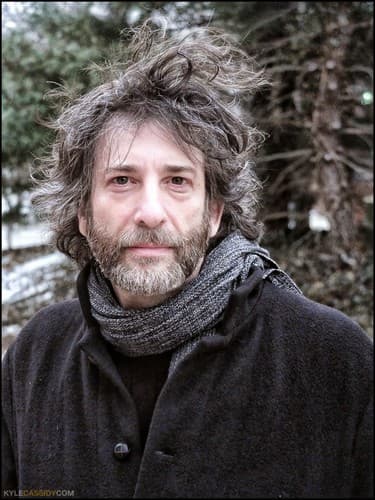
Neil Richard MacKinnon Gaiman is an English author of short fiction, novels, comic books, graphic novels, audio theatre, and a screenwriter. His works include the comic book series The Sandman and the novels Good Omens, Stardust, Anansi Boys, American Gods, Coraline, and The Graveyard Book. He has won numerous awards, including the Hugo, Nebula, and Bram Stoker awards, as well as the Newbery and Carnegie medals. He is the first author to win both the Newbery and the Carnegie medals for the same work, The Graveyard Book (2008). In 2013, The Ocean at the End of the Lane was voted Book of the Year in the British National Book Awards. It was later adapted into a critically acclaimed stage play at the Royal National Theatre in London.







