“The past is a foreign country; they do things differently there.”
— A general reflection on history and the past, though not a direct quote from a character within the narrative itself, it encapsulates the novel's spirit.

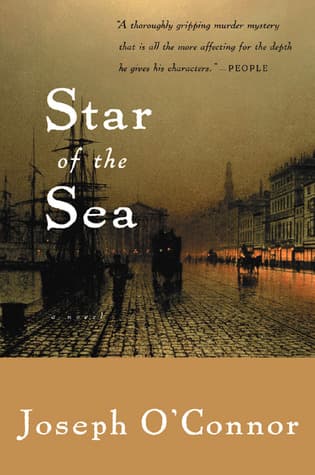
Joseph O'Connor (2004)
Genre
Historical Fiction / Mystery
Reading Time
12-14 hours
Key Themes
See below
Sign in to track this book
In 1847, a famine-stricken Ireland leads to a transatlantic journey on the Star of the Sea. Desperate refugees, a maid with a secret, a bankrupt lord, and a killer converge in a tale of tragedy, love, and a past that lingers.
In the winter of 1847, the famine ship 'Star of the Sea' leaves Queenstown (Cobh), Ireland, for New York. The ship is full of steerage passengers fleeing the Great Famine and a few wealthy cabin passengers. Among them are Lord Merridith and his family, bankrupt and disgraced. They seek to escape their ruined estate, Kilveagh. Mary Duane, a young maid with a dark past, is also on board, as is Pius Mulvey, a journalist disguised as a steerage passenger with a deadly mission. The ship's passengers include Irish, English, and American individuals, each with secrets, hopes, and resentments. All are on this dangerous transatlantic journey.
As the voyage continues, Pius Mulvey appears as a mysterious and menacing figure. His thoughts and observations show that Mulvey is not just a journalist. He is an assassin hired to kill a passenger. His target is unclear at first, but he often watches Lord Merridith and his family. This hints at a connection to their past. Mulvey plans his moves. He thinks about the injustices and suffering he has seen, especially those from the Anglo-Irish landlord class. This suggests his revenge comes from the despair of famine-stricken Ireland.
Flashbacks begin to show why Lord Merridith is emigrating. His estate, Kilveagh, is destroyed by the famine. His tenants are evicted, and his finances are ruined, forcing him to flee Ireland in disgrace. At the same time, Mary Duane's past is explored. She had an impoverished childhood on the Kilveagh estate. She was an orphan taken in by the Merridiths as a maid, where she had a complicated relationship with David Merridith, Lord Merridith's son. These histories connect the cabin passengers and some steerage passengers, showing the social divisions and resentments on the ship.
Pius Mulvey's identity becomes clear. He is a former tenant from the Merridith estate. He wants revenge for the injustices to his family and community during the famine. He knows the Merridiths' history and their role in their tenants' suffering. The story also shows a spectral figure, 'the ghost,' who appears to various characters, especially Mary. This ghost seems to show the past's lingering hold and the unresolved traumas of the passengers.
Life on the 'Star of the Sea' is shown in detail. The cramped, disease-ridden steerage contrasts with the first-class cabins. Tensions rise as supplies decrease and illness spreads. Mary Duane is drawn to David Merridith. They share a history of childhood affection and a passionate relationship. The dynamics between passengers, rich and poor, reveal class prejudices, developing romances, and the journey's anxiety. Mulvey continues his watch, his resolve strengthening each day at sea.
Pius Mulvey's full backstory is revealed through flashbacks. He was Liam Mulvey, a gifted child from a tenant family on the Kilveagh estate. His family suffered under the Merridiths' harsh rule. This led to the eviction and death of his loved ones during the famine. Liam saw the despair and injustice. He decided to seek revenge, becoming the formidable Pius Mulvey. His mission on the 'Star of the Sea' is not just for himself. It is for all who suffered under the Merridith family's neglect and cruelty. His assassination is a symbolic act of justice.
Mary Duane's deepest secret is revealed: she had a child with David Merridith, and she had to give it away. This adds tragedy to her character and explains her conflicted feelings about the Merridith family. David is a troubled young man, haunted by his own problems and his family's decline. As the ship nears its destination, the tension between Mary and David grows. Their shared past creates an emotional entanglement on the ship, complicated by Mulvey's presence.
Pius Mulvey carries out his planned assassination. His target is Lord Merridith, whom he blames for the ruin of his family and many others. The act is quick and brutal. It shocks the cabin passengers and creates fear and suspicion. Investigations begin by the ship's captain and officers. Mulvey, having achieved his goal, feels a mix of satisfaction and emptiness. He grapples with the moral weight of his actions, even as he believes he has brought justice.
After Lord Merridith's murder, the 'Star of the Sea' becomes paranoid. The crew and remaining cabin passengers want to find the killer. Mary Duane, burdened by her past, confesses to Father Corrigan. She reveals her affair with David and the child they had. This confession is a moment of vulnerability. It seeks absolution but also involves her further in the web of relationships and secrets that led to the tragedy. The ghost continues to appear, symbolizing the inescapable past.
In a twist, David Merridith, not Pius Mulvey, killed his father, Lord Merridith. Mulvey had intended to kill David, but David, driven by his own despair and hatred for his father, acted first. Mulvey saw David's act. He then took credit for the murder, allowing himself to be captured and accepting the role of the avenger. This changes the entire story. It shows the depths of family problems and the intertwined fates of the characters. Mary's confession, though true, was only part of the story.
The 'Star of the Sea' reaches New York. The surviving passengers leave the ship, each marked by the voyage and their pasts. Mary Duane finds a path to a new life, seeking to reconcile with her past and find her child. Pius Mulvey (Liam), having confessed to a murder he did not fully commit, faces an uncertain future. His act of self-sacrifice and commitment to justice leave a lasting impression. The Merridith family, shattered, disappears into the new world. The journey ends, but the famine's echoes and the ship's tragedies stay with them in their new lives.
The Antagonist/Vengeful Protagonist
From a traumatized victim, he transforms into a calculated avenger, ultimately sacrificing his freedom to ensure justice, even if it means taking credit for a murder he didn't fully commit.
The Protagonist/Supporting
From a secretive, guilt-ridden young woman, she slowly confronts her past and begins to find a path towards healing and a new life in America.
The Antagonist/Victim
His arc is one of decline, from a powerful landlord to a disgraced, bankrupt figure, culminating in his violent death aboard the ship.
The Supporting
Her arc is one of enduring quiet suffering and loss, as she navigates the destruction of her family's prestige and the tragedy aboard the ship.
The Supporting/Antagonist
His arc is one of self-destruction, culminating in the shocking act of patricide and ultimately revealing the depth of his internal turmoil.
The Supporting
He maintains his role as a spiritual guide, grappling with the moral complexities of the journey and the confessions he receives.
The Supporting
He maintains his professional duty amidst the chaos and tragedy, striving to deliver his passengers safely to their destination.
The Supporting/Mentioned
He remains an observer and chronicler, attempting to weave the disparate threads of the journey into a coherent narrative.
The novel explores justice and vengeance, especially through Pius Mulvey. He is driven by the wrongs Lord Merridith committed against his family and community. Mulvey believes his assassination is a just act for famine victims. However, the revelation that David Merridith committed the murder complicates this. It suggests that 'justice' can be found in unexpected, morally unclear ways. The theme asks if true justice comes from violence and if personal revenge can heal societal wounds. It shows the lasting impact of historical injustices.
“The past is a foreign country. They do things differently there. But it is also a present country, for it lives within us, shaping our every breath.”
Characters like Mary Duane and Pius Mulvey (Liam) deal with their identities. These identities are shaped by their past traumas and the roles they must play. Mary's identity is defined by her secret motherhood and her struggle for control in a restrictive society. Liam changes from a sensitive boy to the vengeful Pius Mulvey. He sheds his old self to complete his mission. The journey across the Atlantic helps characters discover themselves. It forces them to confront who they are, who they were, and who they might become in the new world. This shows how circumstances affect self-formation.
“How many selves do we have? How many lives do we live? How many names do we take on, only to shed them like old skin?”
The contrast between wealthy cabin passengers and poor steerage passengers shows the class divisions of 19th-century society, especially in famine-era Ireland. Lord Merridith's evictions and his tenants' suffering, like Liam Mulvey's, show the harshness of social inequality. On the ship, these divisions continue, with different access to food, space, and medical care. The novel argues that these class differences are not just economic. They are connected to power, justice, and the value placed on human life. This ultimately leads to violence and tragedy.
“There are two kinds of passengers on this ship, son. The ones who pay and the ones who pray.”
The novel shows how the past, especially the trauma of the Great Famine and Anglo-Irish relations, affects the characters. Flashbacks reveal their motivations and secrets. 'The ghost' symbolizes the inescapable nature of memory and unresolved grievances. No matter how far the 'Star of the Sea' travels, the characters are tied to their histories. They cannot escape the consequences and emotional scars of what came before. The past is always part of the present.
“The sea remembers. The wind remembers. And the living remember, too, though they try to forget.”
Amidst the tragedy, the novel explores different kinds of love and the impact of loss. Mary Duane's love for David Merridith and her lost child is a central emotional thread. It drives her actions and internal conflict. Liam Mulvey's lost love for his family fuels his vengeance. Even the strained love between Lord and Lady Merridith, though broken, speaks to a shared history. The journey itself shows the great loss suffered by the Irish people. It also shows the human capacity for affection, compassion, and the hope for connection in despair.
“Love is a voyage, and the heart a ship, and sometimes it sails into a storm from which there is no return.”
The story is told through various character viewpoints, letters, and a journalist's notes.
The novel employs a mosaic narrative structure, presenting events from the viewpoints of several characters, including Pius Mulvey, Mary Duane, and members of the Merridith family. This is augmented by excerpts from historical documents, newspaper articles, and the 'notes' of American journalist Nicholas Sparrow, who is depicted as the fictional compiler of the narrative. This technique creates a rich, multi-layered understanding of the complex events and motivations, allowing the reader to piece together the truth from conflicting and biased accounts, mirroring the challenge of understanding historical events.
Past events are continuously revealed, directly impacting the present journey.
The narrative constantly shifts between the present-day voyage of the 'Star of the Sea' in 1847 and extensive flashbacks to the characters' pasts in famine-stricken Ireland. These flashbacks are crucial for revealing the backstories of Pius Mulvey, Mary Duane, and the Merridith family, explaining their motivations, secrets, and the deep-seated grievances that culminate in tragedy aboard the ship. This interweaving of timelines emphasizes the idea that the past is not merely prologue but an active, inescapable force shaping the present.
A recurring supernatural element symbolizing guilt, memory, and the weight of the past.
Throughout the novel, a spectral figure or 'ghost' appears to various characters, particularly Mary Duane and sometimes Pius Mulvey. This entity is not explicitly defined but serves as a powerful symbol of the inescapable past, unresolved guilt, and the lingering presence of those lost to the famine and other tragedies. It functions as a psychological manifestation of the characters' internal struggles and the collective trauma carried aboard the ship, blurring the lines between reality and the spectral impact of memory.
The ship functions as a contained world reflecting broader societal divisions and conflicts.
The 'Star of the Sea' itself acts as a powerful plot device, serving as a microcosm of Irish society during the famine and the broader class structures of the 19th century. The confined space of the ship forces characters from vastly different social strata to interact, highlighting the stark inequalities, prejudices, and simmering resentments between the wealthy cabin passengers and the destitute steerage. The ship becomes a stage where personal dramas and historical injustices play out, intensifying conflicts and revealing profound truths about human nature under duress.
“The past is a foreign country; they do things differently there.”
— A general reflection on history and the past, though not a direct quote from a character within the narrative itself, it encapsulates the novel's spirit.
“There are some things you can't outrun, no matter how fast you go.”
— Refers to the inescapable nature of one's past and destiny, a recurring theme for many characters.
“A man’s heart is a dark forest.”
— A somber reflection on the hidden complexities and secrets within human nature.
“Hope is a thing with feathers – but sometimes those feathers are soaked in blood.”
— A grim twist on Emily Dickinson's famous line, reflecting the brutal realities faced by the emigrants.
“The sea takes what it wants, and gives back nothing.”
— Observing the unforgiving power of the ocean, a constant presence throughout the journey.
“Every man has his price, and every woman her secret.”
— A cynical observation about human venality and hidden lives.
“Memory is a cruel master, and a treacherous friend.”
— Reflecting on how the past haunts and shapes the characters, often painfully.
“The truth is a thing that changes, depending on who is telling it.”
— Highlights the subjective nature of truth and the unreliability of different narratives within the mystery.
“We are all ghosts, sailing on a ghost ship.”
— A poignant description of the emigrants, many of whom are leaving behind their old lives and identities, some literally marked for death.
“There is no justice, only consequences.”
— A bleak commentary on the outcomes of actions and the lack of true fairness in the world.
“Sometimes, the only way to save yourself is to lose everything you have.”
— Reflects the desperate choices made by characters fleeing famine and seeking new lives.
“The silence of the Atlantic was a different kind of loud.”
— Describes the overwhelming and often menacing quietness of the open ocean.
“A lie is a small thing, until it grows roots and chokes the life out of everything around it.”
— Illustrates the destructive power of deceit and how it unravels lives.
Ready to see how well you understood this book? Take our interactive quiz with 10 questions.

Biography coming soon.







