“To be, or not to be, that is the question.”
— Jack and Annie hear Hamlet's famous soliloquy during a rehearsal.

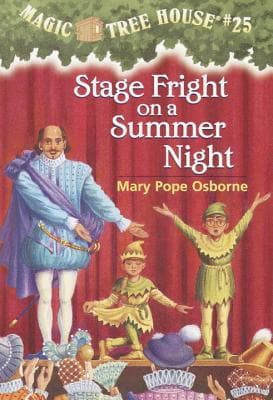
Mary Pope Osborne (2002)
Genre
Fantasy / Children's / Historical Fiction / Young Adult
Reading Time
30 min
Key Themes
See below
Sign in to track this book
Jack and Annie are whisked to Elizabethan England where they must help a struggling William Shakespeare save his play from theatrical disaster.
Jack and Annie are playing in the woods of Frog Creek, Pennsylvania, when they see the Magic Tree House. Inside, they find a note from Morgan le Fay, the magical librarian, asking them to go to Elizabethan England to help a 'great writer.' Annie wishes they could go there. The tree house spins, and they land on a busy London street filled with people in old clothes. The air smells and sounds like another time, and they realize they are in the past, ready to help a famous historical person.
Stepping out of the tree house, Jack and Annie find themselves near the Globe Theatre. A large crowd is gathering, and a play is about to start. They see a man, clearly the director, looking very stressed. Annie asks him what is wrong. The man, William Shakespeare, explains that his actors are arguing and refusing to perform. He fears his new play, 'A Midsummer Night's Dream,' will be ruined, and he will be shamed. Jack and Annie immediately understand that Shakespeare is the 'great writer' they were sent to help.
Jack and Annie watch as the actors, Bottom and Flute, argue backstage. Bottom, playing the lead, is a proud actor who wants to play every part, while Flute is a shy boy who does not want to play a female role. Their fighting stops the play from starting. Shakespeare tries to help, but they do not listen. He looks defeated, pacing, worried about his reputation and the play's success. Jack and Annie realize they need a plan to get the actors to cooperate before the audience gets impatient.
Annie, always thinking fast, has an idea. She tells Shakespeare that maybe the actors just need encouragement or a different view. She then tells Bottom, with her charm, that he might be even better with a 'special' and unique role. Jack is unsure at first, wondering what Annie is planning, but he trusts her. The audience is growing restless, and the play needs to start soon.
While Annie works with Bottom, Jack, who is more logical and practical, plans to help Flute. He sees that Flute is nervous about performing in front of a crowd and encourages him by suggesting he focus on just one person in the audience, or pretend he is only rehearsing. Jack also helps Shakespeare organize the props and make sure the stage is ready. His organized approach helps calm the chaotic backstage, giving Shakespeare a moment of relief and hope.
With Annie's encouragement, Bottom, feeling important, agrees to perform. Jack helps Flute overcome his stage fright by reminding him of his lines and telling him to speak up. Shakespeare, seeing the children's help, lets them keep assisting. They help with final costume adjustments and give the actors last-minute pep talks. The audience's whispers turn into applause as the actors finally take their places, ready for the play to begin, thanks to Jack and Annie.
The play, 'A Midsummer Night's Dream,' finally begins. Bottom, despite his earlier actions, delivers his lines with energy, captivating the audience. Flute, though nervous at first, gains confidence and performs his part well. Jack and Annie watch from the wings, relieved and proud. Shakespeare, standing beside them, smiles as his words come to life on stage. The audience laughs and claps, clearly enjoying the performance. The children realize they successfully helped the great writer.
After the play ends to loud applause, William Shakespeare approaches Jack and Annie. He thanks them, saying that without their quick thinking and help, his play would have failed. He is amazed by their insight and their ability to handle his difficult actors. He even gives them a small, beautifully carved wooden bird as a thank you. Jack and Annie feel proud, knowing they made a big difference to one of history's greatest playwrights.
With their task done and the play a success, Jack and Annie know it is time to go home. They quietly leave the busy Globe Theatre and go back to the Magic Tree House, which is waiting for them in the quiet alley. As they climb inside, Jack opens the book about Frog Creek, Pennsylvania. Annie wishes they could go home, and the tree house begins to spin, taking them away from Elizabethan England and back to their own time, with memories of their theater adventure.
The Magic Tree House lands softly in the woods of Frog Creek. Jack and Annie step out, blinking in the familiar sunlight. They look at each other, still excited from their adventure. Jack carefully puts away the Elizabethan England book and the wooden bird Shakespeare gave them. They talk about how amazing it was to meet William Shakespeare and help him. They realize the power of teamwork and how even small actions can have a big impact, especially when helping someone achieve their dreams. They look forward to their next adventure with Morgan le Fay.
The Protagonist
Jack learns to trust his instincts and the power of creative problem-solving, not just relying on facts.
The Protagonist
Annie further develops her leadership and diplomatic skills, using her empathy to solve complex social problems.
The Supporting
Shakespeare moves from despair to relief and gratitude, learning to accept help from unexpected sources.
The Supporting
Bottom, through Annie's manipulation, is convinced to perform his role, demonstrating how ego can be both a hindrance and a motivator.
The Supporting
Flute overcomes his stage fright with Jack's help, gaining confidence in his acting abilities.
The Mentioned
Not applicable as she does not appear, but her influence continues to shape Jack and Annie's growth.
The story shows how working together, even with different skills, can solve big problems. Jack's practical, organized way and Annie's kind, creative problem-solving are key to helping Shakespeare. They use each other's strengths to fix the actors' argument and make sure the play succeeds. This is clear when Jack helps Flute with stage fright while Annie convinces the difficult Bottom, showing that varied talents work better than individual efforts.
“Two heads are better than one, especially when one is good at facts and the other is good at people.”
A main theme is facing and overcoming personal and work challenges. William Shakespeare struggles with his actors not wanting to perform, which is a work problem. Flute's stage fright is a personal problem. Jack and Annie help with these issues directly. Jack helps Flute by giving him practical advice to manage his fear, while Annie's diplomatic skills help solve the conflict between the actors, allowing the show to continue. This highlights strength and the importance of encouragement.
“The show must go on!”
The book quietly shows the lasting value of art, especially theater and storytelling. William Shakespeare's play, 'A Midsummer Night's Dream,' is presented as something worth saving, not just for his fame but for the joy it brings the audience. Jack and Annie's mission to help Shakespeare ensures his story can be told. This theme celebrates the wonder and effect of creative works and how they connect people across time, making history real through performance.
“It was amazing to see his words come to life!”
Like all Magic Tree House books, a key theme is the experience of history. Jack and Annie go to Elizabethan England, where they see the customs, language, and social life of the time. They learn about the Globe Theatre, the difficulties of putting on a play, and even talk to a historical figure. This gives young readers an engaging way to learn about the past, making history feel real and exciting through a personal adventure, not just facts from a textbook.
“This is really Elizabethan England!”
A magical vehicle for time and space travel.
The Magic Tree House is the primary plot device that transports Jack and Annie to different historical periods and locations. It functions as a gateway, allowing them to embark on their missions from Morgan le Fay. In 'Stage Fright on a Summer Night,' it serves to whisk them to Elizabethan England, initiating the adventure and setting the historical context. Without the tree house, the children would not be able to interact with William Shakespeare or assist him with his play, making it essential for the narrative's premise.
A directive from Morgan le Fay guiding the children's adventure.
The mysterious note from Morgan le Fay, found in the Magic Tree House, acts as a catalyst for the plot. It provides Jack and Annie with their objective – to help a 'great writer' in Elizabethan England – without explicitly revealing the identity of William Shakespeare. This creates a sense of mystery and purpose, driving the children to investigate and discover their role. It structures the narrative by giving them a clear goal and a specific historical setting for their quest.
The complementary personalities of the protagonists.
The contrasting personalities of Jack (cautious, intellectual) and Annie (impulsive, empathetic) serve as a crucial plot device. Their different approaches to problem-solving allow them to tackle various aspects of the challenge presented by Shakespeare's play. Jack's research skills help them understand the historical context, while Annie's social intelligence enables them to directly engage with and influence the difficult actors. This dynamic ensures that a wide range of solutions can be explored, making their combined efforts effective in resolving the conflict.
“To be, or not to be, that is the question.”
— Jack and Annie hear Hamlet's famous soliloquy during a rehearsal.
“All the world's a stage, and all the men and women merely players.”
— The children witness a performance of 'As You Like It' and reflect on life's roles.
“Friends, Romans, countrymen, lend me your ears; I come to bury Caesar, not to praise him.”
— Jack and Annie observe a scene from 'Julius Caesar'.
“If music be the food of love, play on.”
— A line from 'Twelfth Night' that the children hear while exploring the Globe Theatre.
“Though she be but little, she is fierce!”
— Said about Hermia in 'A Midsummer Night's Dream', resonating with Annie's adventurous spirit.
“The play's the thing wherein I'll catch the conscience of the king.”
— A quote from Hamlet that highlights the power of theatre.
“What a piece of work is a man! How noble in reason! How infinite in faculty!”
— Hamlet's reflection on humanity's potential, overheard by Jack.
“There is a tide in the affairs of men, which, taken at the flood, leads on to fortune.”
— A line from 'Julius Caesar' about seizing opportunities.
“Double, double toil and trouble; Fire burn, and cauldron bubble.”
— The witches' chant from 'Macbeth', creating a spooky atmosphere for the children.
“The course of true love never did run smooth.”
— A quote from 'A Midsummer Night's Dream' that Jack and Annie ponder.
“We are such stuff as dreams are made on, and our little life is rounded with a sleep.”
— Prospero's words from 'The Tempest', adding a touch of wonder and melancholy.
“I will do my best, Master Shakespeare!”
— Annie's determined promise to help Shakespeare find a boy actor for his play.
“The magic tree house took them to a time when words were like music and plays were the greatest show on earth.”
— Narration describing the setting and the allure of Elizabethan theatre.
Ready to see how well you understood this book? Take our interactive quiz with 10 questions.

Biography coming soon.







