“Perhaps he was one of those people who are able to love only what they cannot have.”
— Reflecting on Kiyoaki's feelings for Satoko.


Yukio Mishima (2010)
Genre
Historical Fiction / Romance
Reading Time
420 min
Key Themes
See below
Sign in to track this book
In 1912 Tokyo, a young aristocrat's hidden love for his childhood friend turns into a tragic obsession when she is promised to a prince, disrupting their lives and the balance between duty and class.
The story begins in 1912 with Kiyoaki Matsugae, the handsome son of a newly rich marquis. Despite his family's new wealth, Kiyoaki grew up in the aristocratic Ayakura home, forming a strong bond with their daughter, Satoko. Kiyoaki is known for his sad beauty, his focus on dreams, and a fake indifference that hides his deep insecurities and wish to seem profound. His closest friend, Shigekuni Honda, a careful law student, watches Kiyoaki with admiration and analysis. Honda often shows logic and order against Kiyoaki's emotional and aesthetic leanings. Their lives involve high society, tennis, and talks about art and philosophy, all as Japan quickly modernizes in the Taisho era.
Satoko Ayakura, a beautiful young woman, clearly has strong feelings for Kiyoaki. Everyone around them, including their families and Honda, sees this. But Kiyoaki, wanting to control and perhaps make her desire him more, always treats her with calculated indifference and even cruelty. He avoids her, makes excuses, and dismisses her feelings, often escaping into his own world of dreams. This behavior partly comes from his aristocratic pride and his belief that showing emotion is weak. Satoko, at first hurt, keeps subtly pursuing him, her love for him always present, even as Kiyoaki pushes her away.
News of Satoko's engagement to Prince Toin, a member of the Imperial Family, shocks their social group and, most of all, Kiyoaki. This arranged engagement is a very prestigious match, putting Satoko forever out of Kiyoaki's reach. Only now, when Satoko is completely lost to him, does Kiyoaki's indifference break. He is suddenly overwhelmed by his deep love and desire for her. The upcoming marriage, which will make Satoko untouchable, sparks a desperate passion in Kiyoaki, changing his detached affection into a consuming obsession. He now sees how much he has lost.
After the engagement is announced, Kiyoaki changes greatly. He starts to pursue Satoko relentlessly, sending letters, making secret visits, and demanding her attention. Satoko at first resists, torn between her duty to her family and the Imperial House, and her feelings for Kiyoaki. She tries to keep up appearances, knowing the severe results of any mistake. However, Kiyoaki's fervent declarations of love and his constant presence start to break down her resolve. His desperation is clear, sharply contrasting his earlier coldness, and it creates a dangerous tension between them.
Despite the great risks, Satoko eventually gives in to Kiyoaki's pleas. Their affair begins, with secret meetings often helped by Satoko's maid, Takeda. These secret meetings are full of intense passion, forbidden excitement, and constant fear of discovery. Kiyoaki, now fully consumed by his love for Satoko, finds new purpose, leaving his earlier sadness. Satoko struggles with the guilt and thrill of defying society and her royal marriage. Their stolen moments are intensely desperate, as they both know their time is short and their actions have severe consequences.
The affair continues during a family trip to Nara, where the lovers find moments together, often during sightseeing. The old, peaceful setting of Nara contrasts with the turbulent emotions and forbidden nature of their relationship. But keeping it secret becomes harder. Subtle signs, unusual behaviors, and the heightened awareness of those around them, especially the Ayakura family and perhaps Prince Toin's group, start to raise suspicions. Pressure mounts on Satoko, who is constantly watched, and the risk of exposure grows with each secret meeting, threatening to ruin their lives and their families' reputations.
The affair is eventually discovered, likely from their carelessness and the vigilance of others. The revelation shocks both the Matsugae and Ayakura families, threatening to become a major scandal that could disgrace them and the Imperial Family. Satoko, found to be pregnant with Kiyoaki's child, must have a painful abortion to prevent further scandal and save her family's honor. This act is a devastating blow to Satoko, physically and emotionally. Kiyoaki, learning of the abortion and the destruction of his dream with Satoko, falls into deep despair, his world collapsing.
After the scandal and abortion, Satoko makes a drastic decision: she leaves the world and enters a Buddhist nunnery in Nara. This act is a strong rejection of her former life, her aristocratic status, and the societal expectations that ruled her. It is also a way for her to find peace after her trauma. Kiyoaki, desperate to see her one last time and perhaps rekindle their love, travels to Nara. He tries several times to visit her at the monastery, but Satoko, now committed to her spiritual path, refuses to see him. Her rejection is absolute, showing her complete separation from her past and their shared history.
Satoko's final rejection completely breaks Kiyoaki. His already fragile health, made worse by his emotional turmoil, travel, and perhaps an underlying illness, quickly declines. He becomes gravely ill with tuberculosis, a common and often fatal disease then. Despite Honda's devoted care, Kiyoaki's spirit is broken. He dies young, his last moments filled with longing for Satoko and a sense of great loss. His death marks the tragic end of a life consumed by unfulfilled passion and the clash between his idealized dreams and harsh reality.
After Kiyoaki's death, Honda is left to deal with the loss of his friend and the complex story of Kiyoaki's life. Honda, always the rational observer, is deeply affected by the tragic romance and Kiyoaki's dramatic end. He carefully records Kiyoaki's last dream, a recurring image suggesting reincarnation, in his diary. Honda continues his own life, pursuing his legal career and keeping his detached perspective. But Kiyoaki's memory—his beauty, his flaws, and his passionate pursuit of an impossible love—stays in Honda's mind, shaping his understanding of life, death, and the fleeting nature of beauty and desire. Honda's journey continues, carrying Kiyoaki's story as a lasting lesson.
The Protagonist
From a detached, emotionally repressed young man to a desperate lover consumed by passion, ultimately leading to his demise.
The Protagonist/Love Interest
From a hopeful, affectionate girl to a defiant lover, then a traumatized woman who finds solace in spiritual renunciation.
The Supporting
Remains largely consistent as a rational observer, but is deeply affected by Kiyoaki's dramatic life and death, which shapes his later philosophical outlook.
The Supporting
Remains a pragmatic and status-conscious patriarch throughout the story.
The Supporting
Remains a steadfast embodiment of aristocratic tradition and duty, forced to make difficult decisions to preserve family honor.
The Supporting
Remains a loyal and steadfast servant, her actions driven by devotion to Satoko.
The Mentioned
Remains a static, symbolic figure of duty and imperial authority.
The Supporting
Remains a consistent supporting character, part of Kiyoaki's social milieu.
The Supporting
Remains a watchful and observant servant.
Mishima explores how beauty and decadence pass, often linking them to the decline of the old aristocracy. Kiyoaki's beauty is shown as fragile and self-destructive, reflecting his fading world. His pursuit of an impossible love is an aesthetic choice as much as an emotional one, leading to a beautiful but ultimately ruinous affair. The novel contrasts the refinement of their world with the decay that happens when passion defies order, ending in Kiyoaki's death and Satoko's spiritual renunciation, both acts that destroy their worldly beauty.
“For Kiyoaki, beauty was always accompanied by a presentiment of its destruction. He could not conceive of beauty without an awareness of its perishability.”
A main theme is the destructive power of hidden or unfulfilled desire. Kiyoaki's initial coldness toward Satoko comes from deeply hidden feelings, a fear of being vulnerable, and an aristocratic dislike for open emotion. Only when Satoko is unreachable does his desire become a desperate passion. This repression, when finally broken, leads to reckless actions and tragedy. Satoko also hides her feelings for Kiyoaki, following duty, but her deep desire eventually overcomes her sense of propriety, leading her down a similar path.
“He knew that his love for Satoko was a beautiful, tragic thing, precisely because it was unattainable.”
The novel is set in the Taisho era, a time of big social and political change in Japan. This setting provides an important context for the characters' struggles. The 'old money' aristocracy, like the Ayakuras, holds to strict traditions, while the 'new money' Matsugaes navigate this world with ambition and insecurity. Kiyoaki and Satoko's affair directly challenges these traditions, especially the sacred Imperial Family. The tragic results of their actions show the unforgiving nature of a society still largely bound by old rules, even as it takes on Western influences and modern ideas.
“The past was a dream, the present a nightmare, and the future a void.”
Kiyoaki is deeply involved in his own world of dreams, often preferring them to reality. His initial indifference to Satoko partly comes from living in an idealized, internal world. He actively tries to make reality fit his romantic ideals, often not seeing the real consequences of his actions. Honda, in contrast, is grounded in reality, observing and analyzing. The novel questions perception and the line between subjective experience and objective truth, especially through Kiyoaki's prophetic dreams and his final, mysterious vision, which Honda carefully records.
“For Kiyoaki, reality was only a crude imitation of the dreams he inhabited.”
The theme of fate and reincarnation is subtly woven throughout the story, especially through Kiyoaki's recurring dreams. These dreams, which Honda notes, suggest a cyclical nature to existence and a predetermined destiny for Kiyoaki. The novel suggests that Kiyoaki's intense connection to Satoko and his dramatic life are part of a larger, recurring pattern. This theme becomes clearer in the later novels of 'The Sea of Fertility' tetralogy, but in 'Spring Snow,' it gives a mystical layer to the tragic romance, hinting that their story is not just an isolated event but part of a grander, perhaps fated, design.
“He had a sense that he had lived this life before, and that he would live it again.”
Honda's detached perspective shapes the reader's understanding of Kiyoaki's world.
Shigekuni Honda serves as a crucial narrative device, acting as an intellectual, rational, and somewhat detached observer of Kiyoaki's life. While the narrative is primarily third-person omniscient, much of our understanding of Kiyoaki's complex character, his motivations, and the unfolding events is filtered through Honda's analytical lens. Honda's role provides a contrast to Kiyoaki's emotional and aesthetic world, allowing the reader to both empathize with Kiyoaki's passions and critically evaluate his self-destructive tendencies. His meticulous record-keeping, especially of Kiyoaki's dreams, also sets the stage for the overarching theme of reincarnation in the larger tetralogy.
Kiyoaki's vivid dreams foreshadow events and hint at deeper spiritual connections.
Kiyoaki's dreams are not merely psychological insights but act as powerful plot devices, often foreshadowing events, revealing his subconscious desires, and hinting at a mystical dimension to his life. His recurring dreams, particularly those of a tropical, sun-drenched landscape, carry symbolic weight and are meticulously recorded by Honda. These dreams lend an air of premonition and inevitability to the unfolding tragedy, suggesting that Kiyoaki's fate is perhaps predetermined. They also serve to deepen his character, portraying him as someone attuned to a reality beyond the mundane, living partly in an ethereal, symbolic world.
A turning point that ignites Kiyoaki's passion and sets the tragic plot in motion.
The engagement of Satoko to Prince Toin is a pivotal plot device. It acts as the ultimate catalyst for Kiyoaki's transformation from a detached, indifferent youth to a desperately passionate lover. Before this announcement, Kiyoaki's feelings for Satoko were ambiguous and repressed. The sudden, irreversible loss of her to the Imperial Family makes her an object of intense, forbidden desire. This external event forces Kiyoaki to confront the true depth of his emotions and propels the narrative into the dangerous territory of the secret affair, directly leading to the scandal, Satoko's renunciation, and Kiyoaki's demise. It is the point of no return for both characters.
The 'spring snow' symbolizes fragile beauty, purity, and transient illusion.
The title itself, 'Spring Snow,' is a potent symbol. Snow in spring is beautiful but inherently transient, destined to melt quickly. It represents the fragile, fleeting nature of Kiyoaki and Satoko's love, their youthful innocence, and the dying world of the old aristocracy. It also evokes a sense of purity and beauty that is ultimately unsustainable in the face of harsh reality. The imagery of snow often appears in the novel, particularly in moments related to Kiyoaki's melancholic beauty or the delicate, almost ethereal quality of their forbidden romance, emphasizing its doomed and ephemeral nature.
“Perhaps he was one of those people who are able to love only what they cannot have.”
— Reflecting on Kiyoaki's feelings for Satoko.
“The world is an illusion, but it is an illusion that we must all take seriously.”
— A philosophical thought on the nature of existence and engagement.
“Beauty is a short-lived tyranny.”
— Kiyoaki's observation about the transient nature of physical attractiveness.
“He knew that the most dangerous thing in the world was to be too happy.”
— Kiyoaki's internal struggle with his own contentment and a premonition of loss.
“Every man has a right to his own death.”
— A reflection on individual autonomy and destiny.
“There are some women who are born to be loved, and others who are born to be used.”
— A cynical view on the roles of women in society, particularly in aristocratic circles.
“To be loved for oneself is a delusion. It is only for one's youth and beauty that one is loved.”
— Kiyoaki's pessimistic view on the nature of love and attraction.
“The past is a foreign country; they do things differently there.”
— A general reflection on the distance and difference of past eras, fitting the historical setting.
“He had a sense of impending doom, as if all his happiness were merely a prelude to disaster.”
— Kiyoaki's persistent feeling of unease despite moments of joy.
“What is love but a name for the feeling that one wishes to possess another?”
— Kiyoaki's cynical definition of love as a form of possession.
“It was as though the world, with all its solid reality, had suddenly been revealed as a fragile, shimmering illusion.”
— A moment of profound realization about the transient nature of life and reality.
“The truly beautiful things are those that do not last.”
— A recurring theme emphasizing the value of fleeting beauty and youth.
“He felt a strange, cold joy, the kind that comes from knowing that one has chosen one's own destruction.”
— Kiyoaki's complex emotions as he makes choices leading to his fate.
“Youth is a dream, a glorious dream, but it is a dream that passes too quickly.”
— A lament on the ephemeral nature of youth and its beauty.
Ready to see how well you understood this book? Take our interactive quiz with 10 questions.
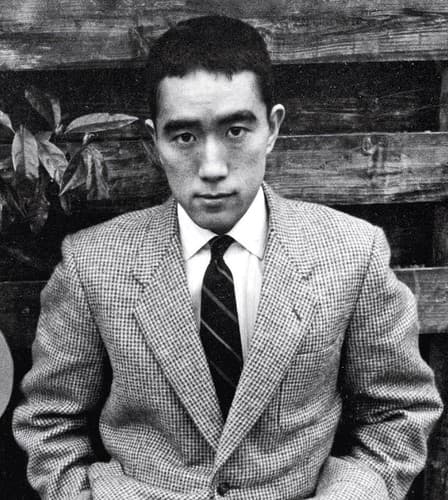
Kimitake Hiraoka , also known as Yukio Mishima , was a Japanese author, poet, playwright, actor, model, Shintoist, nationalist, and founder of the Tatenokai , an unarmed civilian militia. Mishima is considered one of the most important writers of the 20th century. He was considered for the Nobel Prize in Literature in 1968, but the award went to his countryman and benefactor Yasunari Kawabata. His works include the novels Confessions of a Mask and The Temple of the Golden Pavilion , and the autobiographical essay Sun and Steel . Mishima's work is characterized by "its luxurious vocabulary and decadent metaphors, its fusion of traditional Japanese and modern Western literary styles, and its obsessive assertions of the unity of beauty, eroticism and death", according to author Andrew Rankin.







