“The wind was a mischievous pickpocket, snatching at hats and scarves, and tugging at the skirts of anyone foolish enough to venture out without a good grip on their garments.”
— Describing the weather in London.

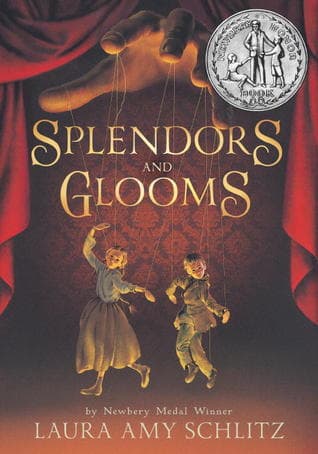
Laura Amy Schlitz (2012)
Genre
Fantasy / Children's / Historical Fiction / Mystery / Young Adult
Reading Time
600 min
Key Themes
See below
Sign in to track this book
After a wealthy girl vanishes post-puppet show, two orphaned assistants must uncover their master's dark secrets and a witch's curse to save her before they are trapped too.
In London, 1860, twelve-year-old Clara Wintermute, a lonely girl still sad about her younger sister Elsie's death, sees a puppet show by Gaspare Grisini. She is captivated by his lifelike puppets and invites him to perform at her birthday party. Grisini, a man with a hidden past and a love for drama, accepts, seeing a chance to gain from the wealthy Wintermute family. His two orphaned apprentices, Lizzie Rose and Parsefall, go with him, their lives tied to the demanding puppeteer. They are both excited and nervous about the grand house.
Grisini, Lizzie Rose, and Parsefall arrive at the large Wintermute residence. The birthday party is lavish, but Clara remains quiet, still mourning Elsie. Grisini's show is a hit, yet an odd, unsettling mood fills the evening. After guests leave, Grisini's caravan stays parked outside. The next morning, Clara Wintermute is found missing from her locked room. Suspicion immediately falls on Grisini and his assistants. Dr. Wintermute, desperate, calls the police, who start an investigation, focusing first on the puppeteer and his unusual group.
Lizzie Rose and Parsefall, despite their fear and loyalty to Grisini, are deeply troubled by Clara's disappearance. They believe Grisini is not a kidnapper, but they also know he can be deceitful. Feeling the police's scrutiny and their own sense of right and wrong, they decide to look for Clara themselves. They search the Wintermute house, hoping to find clues that might clear their names and Grisini's, or at least explain what happened to Clara. Their search reveals hidden passages and secrets within the large house.
During their secret search, Lizzie Rose and Parsefall discover a hidden room behind a tapestry in Clara's room. Inside, they find a small, well-made wooden doll that looks like Clara. This discovery deepens the mystery, suggesting something more complex than a simple kidnapping. They also learn about Elsie's tragic death by fire, a secret Clara's parents tried to keep from her. The doll seems to connect to Clara's past and the grief that still affects the Wintermute family, hinting at magic or something supernatural.
As the police investigation grows, Grisini, fearing arrest and exposure of his past, escapes London. Before leaving, he leaves a cryptic note for Lizzie Rose and Parsefall, mentioning a place called 'Winterdrop' and an old rival. The children, now alone and more vulnerable, realize they must follow Grisini's hint to find the truth about Clara and clear their names. They begin a dangerous journey, guided by the few clues and their growing resolve.
Following Grisini's vague directions, Lizzie Rose and Parsefall travel through the English countryside, eventually reaching a remote, snow-covered manor called Winterdrop. The journey is hard and dangerous, testing their strength and their bond. They face hunger, cold, and constant fear of being found. Winterdrop's atmosphere is immediately heavy and ominous, hinting at dark secrets and old magic. They sense they are close to the mystery's core, but also walking into a trap.
At Winterdrop, Lizzie Rose and Parsefall meet the unusual and solitary Dr. Bartholomeus, a scholar interested in ancient magic and alchemy. They also meet Cassandra, an ancient and powerful witch, Grisini's former mentor and rival. Cassandra immediately recognizes the children's link to Grisini and reveals her long-held resentment against him. She explains that Grisini betrayed her years ago, stealing a powerful magical object — a wooden doll — and setting her on a path of revenge and a desperate search for an heir to her magic.
Cassandra explains the true nature of the wooden doll Lizzie Rose and Parsefall found: it holds dark magic and a curse that lets the witch transfer her life force and magic into a new body. She reveals that Grisini, in his greed, first planned to use the doll to transfer his own life into a younger body, but failed. Now, Cassandra seeks an heir to inherit her magic and escape her own coming death. She believes Clara Wintermute, because of her sadness and vulnerability, is the perfect vessel for this transfer, having lured her to Winterdrop.
Just as Cassandra prepares her ritual, Grisini dramatically reappears at Winterdrop. He had followed the children, determined to reclaim the magical doll for his own selfish reasons. A tense confrontation occurs between Grisini and Cassandra, fueled by their old rivalry and differing desires for the doll's power. Lizzie Rose and Parsefall are caught in the middle, realizing Grisini's full wickedness and the great danger Clara is in. They must decide where their loyalties lie and how to protect Clara.
During the chaotic confrontation, Lizzie Rose and Parsefall bravely step in. Lizzie Rose, using her quick thinking and Dr. Bartholomeus's knowledge, manages to interrupt Cassandra's ritual. Parsefall, showing unexpected courage, helps distract Grisini. Their actions, along with the unstable nature of the old magic, lead to Cassandra's end. The witch's power, unable to transfer correctly, consumes her, and she dies, ending the doll's curse. Clara is freed from the enchantment, safe but shaken.
With Cassandra defeated, Grisini tries one last desperate grab for the doll's power. However, the remaining magic of Winterdrop and Cassandra's final curse turn against him. He is magically transformed, trapped within one of his own puppets, a fitting and ironic punishment for his lifelong manipulation of others. He becomes a living puppet, forever controlled by unseen strings, a fate suiting his cruel nature. This magical justice ensures he can no longer harm anyone.
Clara Wintermute, shaken but alive, is eventually reunited with her relieved parents, though the experience leaves her changed. Lizzie Rose and Parsefall, having faced great danger and found their own strength, decide to make a new life for themselves. They choose not to return to their old lives of servitude. Dr. Bartholomeus, impressed by their courage and kindness, offers them a home and an education at Winterdrop, where they can learn and grow, finally free from Grisini and Cassandra's shadows, looking forward to a future full of hope.
The Protagonist
Clara transforms from a passive, grieving child into a survivor who confronts her past and emerges stronger, though forever changed.
The Protagonist
Lizzie Rose evolves from a subservient apprentice to an independent, brave young woman who finds her own voice and purpose.
The Protagonist
Parsefall transforms from a naive, dependent boy into a courageous and self-reliant young man, capable of independent thought and action.
The Antagonist
Grisini's arc is one of escalating villainy, culminating in his ironic magical punishment.
The Antagonist
Cassandra's arc is defined by her desperate attempt to avoid death, which ultimately fails and leads to her demise.
The Supporting
Dr. Bartholomeus shifts from a passive observer to an active helper, finding his own moral courage.
The Supporting
Dr. Wintermute experiences the anguish of a parent's worst nightmare, ultimately finding relief and a renewed appreciation for his surviving daughter.
The Supporting
Mrs. Wintermute endures the terror of her daughter's disappearance, ultimately finding peace with Clara's safe return and perhaps a new understanding of honesty.
The Mentioned
Elsie's arc is entirely in her impact; her death serves as the catalyst for much of the story's emotional and plot development.
The theme of grief and loss deeply affects the characters, especially Clara Wintermute. Her profound sadness over her younger sister Elsie's death leaves her vulnerable and isolated, making her an easy target for Grisini and Cassandra. The Wintermute family is surrounded by this grief, keeping secrets and a somber atmosphere that prevents true healing. Lizzie Rose and Parsefall also experience loss as orphans, which shapes their resilience and their desire for belonging. The story shows how unaddressed grief can make one vulnerable and how facing it is vital for healing, as seen when Clara begins to process Elsie's death after her ordeal.
“Grief was a thing with teeth. It would tear you apart.”
Manipulation is central to Grisini's character and the plot. As a puppeteer, he literally manipulates figures, but he also expertly manipulates people, especially Lizzie Rose and Parsefall, through charm, fear, and dependency. Cassandra is also a master manipulator, using magic and psychological tactics to lure Clara to Winterdrop for her own sinister goals. The theme explores how easily people can be controlled when vulnerable, and how selfish motives can hide the truth. The children's journey involves understanding and resisting these manipulations.
“Grisini had a way of making you feel as if you were the only one who understood him, even as he was pulling your strings.”
The novel shows different kinds of evil through its antagonists. Grisini embodies a more human, though supernaturally tinged, evil driven by greed, vanity, and a ruthless desire for power and immortality. He is a betrayer and an abuser. Cassandra, however, represents an ancient, more primal evil rooted in a desperate fear of death and a willingness to exploit innocence to prolong her own life. The story illustrates how evil can be both openly malicious and subtly insidious, corrupting those it touches and preying on the vulnerable. The children's confrontation with these forces defines their moral growth.
“Some evil was like a deep, cold well, and others like a bright, sharp knife.”
For the orphaned Lizzie Rose and Parsefall, the search for family and belonging is a key motivation. Initially, they are tied to Grisini out of necessity, but their bond with each other grows into a true sibling relationship. Their journey away from Grisini's cruel teaching helps them discover what a true family means – not just blood, but loyalty, protection, and love. Their eventual acceptance by Dr. Bartholomeus at Winterdrop symbolizes finding a safe, caring home where they are valued, a stark contrast to their previous life of servitude and uncertainty. This theme highlights the human need for connection and a place to belong.
“We're all we've got, you and me.”
The novel sharply contrasts childhood innocence with the dark forces trying to exploit it. Clara's innocence, clouded by grief, is exactly what makes her a target for Cassandra's ritual. Lizzie Rose and Parsefall, though hardened by their difficult lives, still have an inherent goodness and a sense of justice that Grisini's corrupting influence constantly threatens. The story explores how children's purity and vulnerability can be twisted for selfish ends, and the resilience needed to maintain one's moral compass in the face of such darkness. Ultimately, the children's courage helps them protect and restore some of that lost innocence.
“Children were like tender shoots, easily bent, easily broken.”
A seemingly innocent toy that is actually a vessel for dark magic and a means of transferring life force.
The wooden doll is a crucial magical artifact. Initially discovered by Lizzie Rose and Parsefall in Clara's secret chamber, it appears to be a mere toy resembling Clara. However, it is imbued with ancient, dark magic by Cassandra, designed to facilitate the transfer of her life force and magical abilities into a new, younger body. The doll acts as a magical conduit and a symbol of the corruption of innocence, as it is intended to steal Clara's life. Its destruction is key to breaking Cassandra's spell and saving Clara, highlighting its central role in the magical conflict.
Architectural features that reveal hidden truths and facilitate clandestine activities.
Both the Wintermute mansion and Winterdrop manor feature hidden passages and secret rooms. In the Wintermute house, a hidden chamber behind a tapestry in Clara's room leads to the discovery of the wooden doll, exposing a deeper mystery than simple kidnapping. At Winterdrop, the ancient manor's labyrinthine structure aids in the children's exploration and their attempts to evade Cassandra and Grisini. These architectural elements serve as metaphors for the hidden truths and secrets within the story, allowing characters to move unseen and uncover concealed information, driving the investigative aspects of the plot.
Grisini's mastery of puppetry, mirroring his ability to manipulate people and blurring the lines between art and dark magic.
Grisini's skill as a puppeteer is more than just entertainment; it is a profound plot device. His ability to make puppets seem alive directly foreshadows and symbolizes his supernatural powers and his desire to control and manipulate actual human beings, particularly Clara. The lifelike quality of his puppets hints at the dark magic he employs, blurring the line between artistic illusion and genuine magical animation. Ultimately, his fate of being trapped within a puppet serves as an ironic and poetic justice, directly linking his manipulative art to his punishment.
A vague message left by Grisini that serves as a breadcrumb leading the children to the next stage of the mystery.
After Grisini escapes London, he leaves behind a cryptic note for Lizzie Rose and Parsefall, mentioning 'Winterdrop' and an old rival. This note is a classic plot device, acting as a crucial clue that propels the children from London into the heart of the magical conflict. Without this specific, albeit vague, direction, Lizzie Rose and Parsefall would have no clear path to follow, and the story would stall. It serves to maintain the narrative momentum and guide the protagonists towards the ultimate confrontation, demonstrating Grisini's lingering influence even in his absence.
“The wind was a mischievous pickpocket, snatching at hats and scarves, and tugging at the skirts of anyone foolish enough to venture out without a good grip on their garments.”
— Describing the weather in London.
“Children, like moths, are drawn to flame, and like moths, they sometimes get burned.”
— A general observation about children and danger.
“Magic, like any other skill, requires practice, patience, and a willingness to look foolish.”
— A thought about the nature of magic.
“There are some things in this world that are best left undisturbed, even if they gleam with the promise of treasure.”
— A warning about temptation and the unknown.
“A good story, like a good meal, should be savored, not rushed.”
— A reflection on storytelling.
“Gloom, like a persistent shadow, followed her everywhere, even into the brightest corners of her imagination.”
— Describing Clara's constant sadness.
“The heart, like a locked box, can hold many secrets, some of them beautiful, some of them terrible.”
— A thought about human nature and secrets.
“Sometimes the bravest thing you can do is to ask for help.”
— A lesson learned by one of the characters.
“Even the most ordinary objects can hold extraordinary power, if only you know how to look.”
— A hint at the hidden magic in the world.
“Fear has a way of twisting everything, making shadows seem like monsters and whispers sound like screams.”
— Describing the effects of fear.
“The past, like a haunting melody, can follow you, no matter how far you try to run.”
— A reflection on the inescapable nature of the past.
“True courage isn't the absence of fear, but the willingness to act despite it.”
— A character's realization about courage.
“A lie, once told, can unravel a whole tapestry of truth.”
— A warning about the consequences of deceit.
“The world is full of wonders, if only you open your eyes to see them.”
— An encouraging thought about appreciating life.
Ready to see how well you understood this book? Take our interactive quiz with 10 questions.

Biography coming soon.







