“You think you want to die for a cause. But you really want to live for a cause.”
— Harry Barnes reflecting on his life and the meaning of heroism/sacrifice.

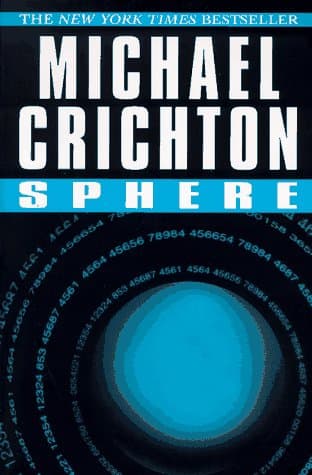
Michael Crichton (1980)
Genre
Thriller / Fantasy / Mystery / Science Fiction
Reading Time
371 min
Key Themes
See below
Sign in to track this book
Beneath the crushing pressure of the Pacific, a team of scientists unearths a colossal, centuries-old spaceship, only to discover its true terror lies not in its alien origins, but in the dark reflections it casts upon their own minds.
Dr. Norman Johnson, a psychologist, is unexpectedly called by the U.S. Navy for a classified mission. He is flown to a remote location in the South Pacific and briefed by Captain Harold Barnes. Norman learns that a massive, unknown object, possibly an alien spaceship, has been discovered on the ocean floor. The Navy has assembled a team of experts based on a theoretical 'first contact' scenario Norman himself devised years ago. The team includes Dr. Beth Halpern, a biochemist and Norman's former lover; Dr. Harry Adams, a brilliant but socially awkward mathematician; and Dr. Ted Fielding, an astrophysicist. They are transported to a massive underwater habitat, the Habitat, which has been quickly built around the object.
The team descends to the Habitat, a sophisticated underwater base. They learn that the 'spaceship' is enormous, about a quarter-mile long, and appears to be made of an unknown, metallic substance. After extensive preparation and a tense journey through a connecting tunnel, they enter the ship. Inside, they find a vast, empty interior, with no discernible technology or life forms. Their exploration eventually leads them to a massive cargo bay, where a perfectly smooth, featureless golden sphere, roughly 15 feet in diameter, is found. The sphere appears to be made of an unknown material and reflects nothing, absorbing all light. It is clearly the focal point of the entire vessel.
As the team studies the sphere, strange things begin. Ted Fielding discovers a control panel that activates a viewscreen, showing star charts and complex mathematical equations. During a routine dive, Jerry, one of the Habitat's technicians, is killed by a giant squid. This is initially dismissed as an accident, but then another technician, Fletcher, is found dead, seemingly crushed by an unseen force. The team also deciphers the ship's logbook, which reveals a shocking truth: the ship is not alien, but American, and it traveled back in time through a black hole, crashing 300 years in the past. Its original designation was 'CSN Event Horizon'.
The deaths continue, escalating in their bizarre nature. Beth is attacked by a swarm of jellyfish that appear out of nowhere. Harry, increasingly withdrawn and agitated, eventually tells Norman that he has been entering the sphere and interacting with 'it'. He describes 'it' as a sentient entity that communicates through images and ideas, and that it can grant wishes. Norman initially dismisses this as psychological stress, but the mounting evidence and increasingly impossible events force him to reconsider. They realize the sphere is a device that can make thoughts and fears real, and that Harry, having spent the most time inside, is unknowingly causing the phenomena.
Under the immense pressure and psychological strain, Beth begins to unravel. She becomes paranoid and aggressive, eventually attempting to destroy the sphere with explosives. Her actions are stopped, but her mental state deteriorates further. Meanwhile, the manifestations become more direct and terrifying. A massive, multi-tentacled sea serpent, seemingly from Harry's subconscious fears, attacks the Habitat, causing significant damage and threatening to breach the integrity of the base. The remaining crew struggles to defend themselves against these increasingly real and deadly threats.
As the Habitat is battered by the sea serpent and other manifestations, the remaining team members – Norman, Harry, and Beth – try to understand the sphere's power better. They discover a complex numerical code embedded within the sphere's communications, which they believe is a key to controlling or disabling its abilities. With the Habitat failing and their lives in immediate danger, Captain Barnes, from the surface, orders the Habitat's self-destruct sequence to be initiated, hoping to contain the threat and prevent the sphere's power from reaching the surface. The countdown begins, adding a new layer of urgency.
Driven by his escalating paranoia and the sphere's influence, Harry begins to actively use its power to manifest destructive scenarios, including creating a series of explosions within the Habitat. Norman tries to reason with him, but Harry is beyond reach. During a desperate confrontation, Norman suddenly realizes that he, too, has been inside the sphere, albeit for a much shorter time. He understands that the power isn't exclusive to Harry, but rather a latent ability within anyone who enters the sphere, activated by their deepest thoughts and fears. This revelation shifts the dynamic of their struggle.
With the Habitat on the verge of imploding and the self-destruct countdown nearing zero, Norman understands that he, Beth, and Harry all possess the power to make reality. He tries to explain this to Beth, who is still reeling from her own mental struggles. They realize that their collective unconscious fears and desires are fueling the chaos. They must escape the Habitat before the sphere's influence, and their own uncontrolled thoughts, destroy them. They make a frantic attempt to reach the escape pods, battling against the physical manifestations of their anxieties and Harry's destructive will.
Norman finally confronts Harry, who is now fully consumed by the sphere's power, manifesting a full-scale hurricane within the Habitat. Norman, using his own newfound ability, manages to create a temporary shield to protect himself and Beth. He desperately tries to make Harry understand the shared nature of their power and the danger they all face. In a moment of clarity amidst the chaos, Harry, Norman, and Beth reach a terrifying understanding: the only way to survive and prevent the sphere's destructive potential from reaching the surface is to collectively wish away their memories of the sphere and its powers. They make a pact to forget.
As the Habitat finally gives way and collapses, Norman, Beth, and Harry manage to reach the escape pods. They ascend rapidly towards the surface. As they breach the water, a profound sense of peace washes over them. The memories of the sphere, its powers, the terrifying manifestations, and their agreement to forget, all begin to fade. They emerge with only vague recollections of a mission and a sense of profound relief, but no conscious memory of the extraordinary abilities they briefly possessed or the pact they made. The sphere's secret, and their own potential, is once again locked away in their subconscious.
The Protagonist
Norman evolves from a detached observer to an active participant, discovering his own capacity for both fear and extraordinary power, ultimately choosing to forget for survival.
The Supporting
Beth's mental stability deteriorates under pressure, leading to a breakdown and violent acts, before she ultimately participates in the collective decision to forget.
The Supporting/Antagonist
Harry transforms from a timid genius into a powerful, destructive force, ultimately realizing the danger of his power and agreeing to relinquish it.
The Supporting
Ted's arc is cut short as he becomes an early victim, serving as a catalyst for the team's realization of the inherent danger.
The Supporting
Barnes maintains his pragmatic, military focus throughout, ultimately making a difficult decision for the greater good, unaware of the sphere's true nature.
The Supporting
Jerry's arc is brief, serving as an early victim that raises the stakes and introduces the supernatural element.
The Mentioned
Fletcher's brief appearance and death contribute to the growing body count and the team's realization of the sphere's dangerous influence.
The novel explores how the human subconscious, particularly fears and desires, can become real when exposed to an external catalyst like the sphere. Harry's initial innocent wishes, and later his escalating paranoia, directly create the monsters and dangers that plague the Habitat. Norman's own hidden anxieties, such as his fear of not being taken seriously or his unresolved feelings for Beth, also subtly influence the environment. The book suggests that our inner world holds immense, often destructive, power if left unchecked. This is evident when Harry, in a fit of rage, manifests a hurricane inside the Habitat.
“What if the sphere was a mirror, reflecting their own minds back at them? What if it wasn't alien at all?”
Fear is a pervasive theme, driving much of the plot. The isolation of the deep-sea environment, the unknown nature of the sphere, and the escalating deaths quickly erode the team's mental stability. Beth's descent into paranoia and aggression, and Harry's transformation into a destructive force, are direct consequences of their inability to cope with their fears. The novel illustrates how fear, when given an outlet like the sphere, can become a self-fulfilling prophecy, creating the very dangers one dreads. The constant threat of manifestations keeps the characters, and the reader, in a state of high anxiety.
“The greatest danger here wasn't the sphere. It was themselves.”
The sphere grants its users god-like power, but without understanding or control, this power becomes catastrophic. Harry, initially intrigued, quickly becomes overwhelmed and corrupted by the ability to make his thoughts real. The consequences are dire: death, destruction, and psychological torment. The book suggests that humanity is ill-equipped to handle such immense power, as our inherent flaws, fears, and aggressions would inevitably lead to misuse and self-destruction. The collective decision to forget their powers highlights the wisdom in relinquishing what they cannot responsibly wield.
“They had glimpsed true power, and it had nearly destroyed them.”
The novel pits scientific rationality against an utterly inexplicable phenomenon. The team, composed of highly intelligent scientists, attempts to apply logical frameworks to understand the sphere, but its nature defies all known laws of physics and psychology. Their initial theories—alien contact, time travel—are all eventually superseded by the terrifying reality of its wish-granting power. This theme explores the limits of scientific understanding and the humbling realization that some phenomena may lie beyond our current comprehension, requiring an entirely different approach, or perhaps no approach at all. The scientific method breaks down in the face of the sphere.
“It was beyond science. Beyond understanding. It just… was.”
The central mystery and catalyst for all events, granting wishes and manifesting thoughts.
The golden sphere is the primary plot device, serving as both the MacGuffin and the source of conflict. It is a perfectly smooth, featureless object that appears to be alien, but is later revealed to be an artifact from the future, capable of manifesting the thoughts and fears of anyone who enters it. It drives the plot by introducing the unknown, causing the deaths, driving the characters to madness, and ultimately forcing them to confront their own subconscious. Its true nature as a 'wish-granting' device, albeit a dangerous one, is the core revelation that propels the final act.
The isolated, claustrophobic setting that amplifies psychological tension.
The Habitat serves as a crucial setting and a plot device to intensify the psychological thriller aspects of the story. Its deep-sea location creates an extreme sense of isolation and claustrophobia, cutting the characters off from the outside world and amplifying their fears. The constant threat of structural integrity failure, combined with the manifestations, makes the Habitat a character in itself, actively contributing to the rising tension and trapping the characters in a deadly environment. Its eventual self-destruction adds a ticking clock to the climax.
A theoretical framework that ironically leads to a terrifying, internal conflict.
Norman's theoretical 'first contact' scenario, which outlines the ideal team composition for encountering alien life, is the initial justification for assembling the diverse group of scientists. This device serves as an ironic setup, as the 'first contact' they experience is not with an external alien intelligence, but with the terrifying power of their own collective subconscious, mediated by the sphere. It highlights the hubris of humanity in believing they can control or predict such encounters, ultimately leading to a far more dangerous, internal conflict than anticipated.
A ticking clock that forces the characters into a desperate final decision.
The Habitat's self-destruct sequence is a classic ticking clock device. Initiated by Captain Barnes from the surface, it places an immediate and undeniable deadline on the characters' efforts to understand and escape the sphere's influence. This impending doom forces them to make desperate decisions, accelerates the climax, and ultimately pushes them towards the drastic measure of collectively wishing away their memories of the sphere and its powers, as the only viable escape before total annihilation.
“You think you want to die for a cause. But you really want to live for a cause.”
— Harry Barnes reflecting on his life and the meaning of heroism/sacrifice.
“The greatest danger in space is the unknown.”
— Early in the book, the team discusses the inherent risks of deep-sea exploration, often paralleled with space.
“The mind is its own place, and in itself can make a heaven of hell, a hell of heaven.”
— Quoting John Milton's 'Paradise Lost,' used by the characters to explain the power of the mind and perception.
“What is reality? Is it what we see, or what we imagine?”
— Norman contemplating the nature of the events unfolding and the subjective experience of the crew.
“Fear is a powerful motivator. It can make you do things you never thought possible.”
— The crew members are increasingly driven by fear as the incidents become more dangerous.
“We create our own monsters.”
— A realization by one of the characters about the origin of the threats they face.
“You can't solve a problem until you understand it.”
— Norman trying to make sense of the mysterious occurrences and urging for a scientific approach.
“The human mind is capable of anything, given enough pressure.”
— The characters observe how extreme stress and isolation affect their mental states and abilities.
“There's no such thing as a free lunch. Everything has a price.”
— Discussing the consequences of their actions and the powers they've encountered.
“The deepest part of the ocean is the most alien place on Earth.”
— Describing the initial setting and the profound isolation of their deep-sea habitat.
“We are what we pretend to be, so we must be careful about what we pretend to be.”
— Harry reflecting on the roles and identities people adopt, and their impact.
“Power corrupts, and absolute power corrupts absolutely.”
— The team discusses the implications of the power they've gained and its potential for abuse.
“Sometimes the only way to win is not to play.”
— A strategy considered by the characters when facing an overwhelming and dangerous force.
“It's not what you know, it's what you can prove.”
— Norman's scientific training coming to the forefront as he tries to gather evidence for the strange events.
Ready to see how well you understood this book? Take our interactive quiz with 10 questions.

Biography coming soon.







