“The world is full of ghosts, and some of them are still living.”
— Reflection on memory and loss in the first section, set in 19th-century New York.

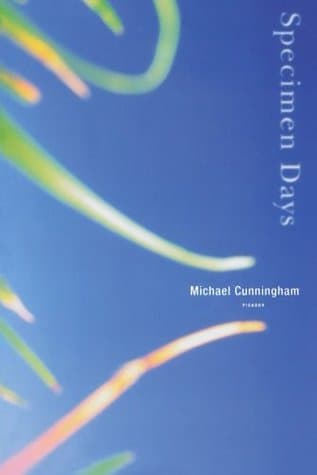
Michael Cunningham (2005)
Genre
Literary Fiction / Historical Fiction / Science Fiction
Reading Time
420 min
Key Themes
See below
Sign in to track this book
Michael Cunningham's "Specimen Days" tells three connected stories: a grieving boy in 19th-century New York, a psychologist hunting terrorists in a modern city, and two beings navigating a distant future. The novel blends genres and explores life, loss, and the human spirit, all while echoing Walt Whitman's poetry.
In mid-19th century New York, a sick boy named Lucas lives with his family, mourning his older brother Jonathan, who died in a textile machine accident. Lucas sees visions and feels great loss, often reciting Walt Whitman's poems. His father, a factory owner, brings home a complex automaton, a mechanical doll named Catherine, designed to speak and interact. Lucas forms a strong bond with Catherine, who seems to offer him companionship and understanding that his family cannot. He tells her about his brother and his own delicate health, finding comfort in her artificial presence.
As Lucas spends more time with Catherine, she starts to show signs of real awareness, beyond just programmed responses. She questions her own existence, asks about Lucas's dreams, and expresses a desire for 'more.' Lucas's parents, initially amused by his attachment, become uneasy with the automaton's unusual abilities. Meanwhile, Lucas's health worsens as his lungs fail. He sees Whitman in his dreams and on the streets, a comforting and inspiring figure. The bond between Lucas and Catherine grows, becoming the most important relationship in his shrinking world.
Knowing he will die soon, Lucas makes a final request: that Catherine be buried with him. His parents are shocked, unable to understand his attachment to the machine. After Lucas dies, Catherine is left behind. The story suggests she might have absorbed some part of Lucas, or perhaps his desire for life and connection. The narrative shifts, leaving Catherine's future unclear, but with a strong sense that her journey will continue beyond Lucas's short life and the 19th century.
In present-day New York, Simon, a police psychologist, investigates a series of bombings and acts of vandalism across the city. The targets are often important historical or cultural sites, and the people responsible leave cryptic messages, often mentioning Walt Whitman. Simon is asked to profile a suspect, a young woman named Catherine, who is linked to the group. Catherine is mysterious and hard to find, showing a mix of childlike innocence and deep knowledge, especially of Whitman's work. Simon feels drawn to her, sensing a deeper reason for her actions than simple destruction.
Simon interviews Catherine, who explains that her group, which includes a young man named Lucas, believes in a spiritual awakening through 're-wilding' the city and disrupting modern life. They see themselves as protectors of a deeper truth, trying to make humanity reconnect with nature and a more basic existence, inspired by Whitman's broad vision. Catherine's intelligence and conviction interest Simon, making it hard to label her a simple criminal. He struggles to understand her destructive acts alongside her seemingly pure intentions, finding himself questioning his own views and the nature of their 'crimes.'
Simon eventually finds Catherine and Lucas at a hidden place where they are performing a ritual with a strange, organic-looking machine or structure. He realizes that their actions are not for political gain but for a radical, almost spiritual, change. Catherine reveals more about herself, hinting at a past far longer than a normal human life. Simon observes Lucas, who seems to be a younger, more fragile version of the Lucas from the first story, with a similar intensity and connection to Catherine. The lines between past, present, and identity begin to blur for Simon as he deals with the impossible things he is seeing.
In a distant, post-apocalyptic future, Earth is mostly barren, and humanity has changed or been replaced by new life forms. Two beings, identified as Catherine and Lucas, are on a journey. Catherine is a very advanced, almost spiritual entity, with vast intelligence and an ancient, lasting consciousness. Lucas is a younger, more vulnerable being, a 'specimen' of humanity or a new, fragile species, whom Catherine cares for and guides. They move through the empty landscape, seeing the remains of human civilization and the new, strange life forms that have appeared.
Catherine's goal is to collect and keep 'specimens' of human experience, memory, and emotion, especially those related to love, beauty, and longing. She uses advanced technology and her own vast consciousness to understand these remnants. Lucas, with his innocence and curiosity, helps her understand the human spirit she is trying to grasp. They find parts of Whitman's poetry, which still have meaning across thousands of years, providing a link of continuity and meaning. Their journey involves deep thought about what it means to be alive, to love, and to last.
Catherine and Lucas meet other evolved beings in this future, some kind, some indifferent. These meetings further show themes of connection, change, and the lasting power of love and memory. Catherine, with her old wisdom, thinks about the cycles of creation and destruction, life and death, and the constant human desire for meaning. Lucas, in his growing awareness, feels wonder and fear, guided by Catherine's protection. The story focuses on their unique bond, which goes beyond typical relationships, showing a deep, almost parental love and shared purpose.
As their journey ends, Catherine and Lucas approach a very important place, a center of energy or consciousness. The difference between them starts to fade, suggesting a merging or a shared identity that has lasted centuries and forms. They represent humanity's lasting spirit, the ability to love and create, even when facing oblivion. The novel ends with a sense of renewal, where life, in its many forms, continues and changes, always looking for connection and meaning, reflecting Whitman's ideas of interconnectedness and the eternal nature of the soul. Their journey becomes a symbol for the continuous evolution of consciousness itself.
The Protagonist
Lucas begins as a grieving, isolated child and finds profound, albeit unusual, connection, ultimately accepting his mortality with Catherine by his side.
The Supporting/Protagonist
Catherine transforms from a machine into a sentient being, demonstrating a capacity for love and self-awareness that transcends her mechanical origins.
The Protagonist
Simon begins as a rational investigator and evolves into someone whose worldview is profoundly broadened and challenged by the impossible truths he uncovers.
The Antagonist/Protagonist
Catherine acts as a catalyst for societal change, revealing her ancient consciousness and guiding others towards a deeper understanding of existence.
The Supporting
Lucas serves as a recurring embodiment of human sensitivity and connection, guided by Catherine's ancient wisdom.
The Protagonist
Catherine reaches her ultimate evolution, becoming a keeper of consciousness and a guide for the next iteration of life.
The Protagonist
Lucas represents the continuous rebirth of life and consciousness, learning and evolving under Catherine's guidance.
The Mentioned
His literary legacy acts as a constant, evolving source of inspiration and philosophical framework for characters across different eras.
The novel explores the changing and repeating nature of identity through its three linked stories. The characters named Lucas and Catherine reappear in different forms and times, suggesting rebirth or a movement of souls or consciousness. The central question is whether they are the 'same' individuals or just echoes of types. This idea is clear with the 19th-century automaton Catherine gaining awareness and later appearing as a human woman in the present and a spiritual being in the future, always keeping parts of her original self and her link to Lucas.
“What is it then between us? / What is the count of the scores or hundreds of years between us?”
In all three narratives, the strong, often unusual bond between Lucas and Catherine stays constant. From the sick boy and his automaton to the modern-day 'terrorists' and the future's evolved beings, their relationship goes beyond time, species, and social rules. This theme shows love as a basic force that drives existence, offering comfort, purpose, and continuity. Even in a desolate future, Catherine's care for Lucas highlights the fundamental need for connection and protection.
“I sing the body electric”
The novel looks at how humanity, its creations, and the natural world interact. In the 19th century, technology (the textile machine, the automaton) both destroys (Jonathan's death) and creates connection (Catherine). In the present, technology seems to cause isolation, leading Catherine's group to 're-wild' the city. In the future, technology and nature have merged or changed into something new. This theme asks what it means to be human in a world with more technology and whether we can find balance with our environment.
“The machine is a kind of god, Lucas thinks. A god that eats.”
Walt Whitman's poetry is a strong link connecting all three narratives, lasting through time and cultural changes. His ideas of interconnectedness, the body, the soul, and the democratic spirit match the characters' experiences and reasons. The characters' readings and understandings of his work show how art can give meaning, inspiration, and a sense of continuity, even when facing great change or destruction. Whitman's words become a shared understanding across thousands of years.
“I too am not a bit tamed, I too am untranslatable, I sound my barbaric yawp over the roofs of the world.”
Three distinct stories linked by recurring characters and themes across different eras.
The novel employs a unique triple narrative structure, presenting three seemingly separate stories set in the 19th century, the present day, and the distant future. Each narrative features characters named Lucas and Catherine (and sometimes Simon), who embody similar characteristics and relationships, suggesting a cyclical or reincarnated existence. This structure allows Cunningham to explore themes of identity, love, and humanity's evolution across vast stretches of time, creating a sense of timelessness and interconnectedness without explicit plot links between the stories, relying instead on thematic and character echoes.
The reuse of 'Lucas' and 'Catherine' to signify continuity and transformation.
The consistent use of the names 'Lucas' and 'Catherine' (and 'Simon') across all three narratives is a central plot device. This naming strategy is not merely a coincidence; it explicitly invites the reader to consider the possibility of reincarnation, shared consciousness, or archetypal representations. It allows Cunningham to explore how fundamental aspects of personality, relationship dynamics, and human drives persist and transform over centuries, creating a profound sense of destiny and a meditation on the enduring nature of the soul and connection.
Literary allusions that serve as thematic anchors and narrative connections.
The pervasive presence of Walt Whitman's writings, particularly 'Leaves of Grass' and 'Specimen Days,' acts as a powerful literary device. Characters often quote or allude to Whitman, and his philosophical ideas about the interconnectedness of all life, the beauty of the body, and the cycle of death and rebirth form the thematic backbone of the novel. Whitman's work provides a common language and a spiritual framework that links the characters and their experiences across different eras, suggesting a timeless human search for meaning and transcendence.
Suggestive fantastical elements that blur the lines between reality and metaphor.
Cunningham weaves in ambiguous science fiction elements that challenge conventional reality. The 19th-century Catherine's sentience, the present-day group's seemingly mystical 're-wilding' acts, and the future's evolved beings are presented with a blend of realism and fantastical suggestion. These elements are not always explicitly explained, allowing for multiple interpretations—are they literal occurrences, symbolic representations, or perhaps visions? This ambiguity encourages a deeper, more philosophical engagement with the narrative, pushing the boundaries of genre and inviting contemplation on the nature of consciousness and existence.
“The world is full of ghosts, and some of them are still living.”
— Reflection on memory and loss in the first section, set in 19th-century New York.
“We are all specimens of our own days.”
— Title-inspired line about human experience across time.
“The past is not dead; it is not even past.”
— Echoing Faulkner, used to discuss historical continuity in the novel.
“Love is the one thing we can carry with us when we go, and it makes the end easier.”
— Character's thoughts on mortality and connection in the Civil War-era section.
“Every city is a ghost of itself, built over its own ruins.”
— Observation on urban change and history in New York settings.
“We live in the future we imagined, and it is nothing like we thought it would be.”
— From the futuristic third section, reflecting on technological dystopia.
“The dead are not gone; they are just invisible.”
— Meditation on grief and presence in the aftermath of tragedy.
“A story is a way of holding onto things you love, things you are, things you never want to lose.”
— Discussion of storytelling's power across the novel's sections.
“Time is not a line but a series of nows.”
— Philosophical insight on the nonlinear nature of time and experience.
“We are all machines of a sort, wound up and set going.”
— From the industrial-era section, comparing humans to machinery.
“The sky is the one thing that never changes, no matter what century you're in.”
— Observation on constancy amid historical shifts in the novel.
“To be alive is to be haunted.”
— Reflection on the inescapability of past and memory in life.
“We build our prisons with the materials of our desires.”
— Comment on human limitations and aspirations across eras.
“The future is a foreign country; they do things differently there.”
— Adaptation of a famous quote, used in the sci-fi section about societal change.
“Every life is a specimen jar, holding moments preserved in memory.”
— Metaphor for how individuals encapsulate their experiences over time.
Ready to see how well you understood this book? Take our interactive quiz with 10 questions.

Biography coming soon.







