“Everything is temporary. Even the stars burn out.”
— Jakub contemplating the vastness and transient nature of the universe during his journey.

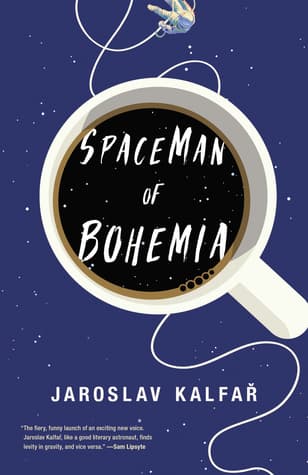
Jaroslav Kalfar (2017)
Genre
Literary Fiction / Fantasy / Science Fiction
Reading Time
360 min
Key Themes
See below
Sign in to track this book
A lonely Czech astronaut on a solo mission to Venus confronts his past, his ambition, and the unraveling of his marriage with the help of a philosophical, possibly imaginary, giant alien spider.
Jakub Procházka, a Czech astrophysicist, is chosen for a dangerous solo mission to investigate the mysterious 'Chopin' cloud of intergalactic dust near Venus. Orphaned young and raised by his grandparents, Jakub carries the weight of his father's past as a Communist informer. This legacy drives his desire for heroism and redemption. His decision to take on the mission, however, strains his relationship with his wife, Lenka, who is worried about his departure and the long isolation. Despite her pleas and his own doubts, Jakub's ambition and perceived duty push him forward, setting the stage for his solitary journey into space. He sees this mission as his chance to rewrite his family's story and earn a place in history.
Jakub successfully launches aboard the JanHus 1, leaving Earth and Lenka behind. The first days of the mission are marked by the harsh realities of space travel: confined quarters, monotonous routine, and crushing solitude. He meticulously performs his scientific duties, taking samples of the mysterious purple dust, but the isolation begins to wear on him. Jakub often thinks about his relationship with Lenka, replaying their final moments together and recognizing the emotional distance that had grown between them even before he left. He struggles with the guilt of leaving her and the fear that their bond might not survive his absence, intensifying his feelings of loneliness.
One day, Jakub discovers a large, intelligent, arachnid-like alien creature in his ship's cargo bay. Initially terrified and disbelieving, Jakub eventually communicates with the creature, who introduces himself as Hanuš. Hanuš explains that he is a survivor of a species that travels the cosmos and boarded Jakub's ship out of curiosity. The alien's presence shatters Jakub's solitude and forces him to confront the bizarre reality of his situation. Hanuš, with his insights and philosophical thoughts, quickly becomes Jakub's only companion, offering a strange comfort and intellectual challenge that the astronaut desperately needs in the vast emptiness of space.
Hanuš, with ancient wisdom and a unique view of existence, engages Jakub in long philosophical discussions. They talk about the nature of time, the meaning of life, the complexities of human emotions, and the concept of love, especially Jakub's relationship with Lenka. Hanuš acts as a therapist and confessor, prompting Jakub to reflect deeply on his past actions, his motivations, and the sacrifices he made for his ambition. Through these conversations, Jakub begins to understand himself and the true value of his connection with Lenka, realizing his emotional neglect and the depth of his regret.
During one of his scheduled communications with Earth, Jakub receives a devastating message from his mission control. It is not Lenka, but a psychologist who tells him that Lenka has left their home and is no longer communicating with anyone from the mission. The psychologist delivers a prepared statement from Lenka, expressing her deep unhappiness, her feeling of abandonment, and her decision to separate from Jakub, at least for now. This news shatters Jakub, confirming his worst fears and increasing his guilt. The full cost of his ambition becomes painfully clear, leaving him heartbroken and desperate to understand her pain.
Hanuš encourages Jakub to confront the lingering trauma of his father's past as a Communist informer. Jakub recounts the ostracization his family faced after the fall of communism, the shame he felt, and how this history shaped his drive for public recognition and heroism. Hanuš helps Jakub to see that his father's actions, while morally ambiguous, were complex, and that Jakub's relentless pursuit of glory was, in part, an attempt to erase a perceived stain on his family name. This introspection allows Jakub to begin to forgive his father and, more importantly, to forgive himself for allowing that past to dictate his present and future.
As Jakub approaches the Chopin cloud, he discovers anomalies that suggest the presence of another spacecraft. Hanuš reveals that a rival Russian mission, dispatched secretly, is also targeting the cloud, potentially seeking to claim its resources or disrupt the Czech mission. Jakub finds evidence of tampering with his ship's systems, suggesting that the Russians might have attempted to sabotage his mission or gather intelligence. This revelation adds geopolitical tension and danger to his already perilous journey, forcing Jakub to be even more vigilant and questioning the true motives behind his mission and the space race.
Jakub finally reaches and enters the Chopin cloud, a shimmering, purple cosmic phenomenon. He discovers that the cloud is not merely dust but a vast, living organism, a cosmic nursery for Hanuš's species. Hanuš reveals that his people are not just travelers but also cultivators of these clouds, which are essential for their life cycle and the spread of their kind throughout the galaxy. Jakub witnesses the beauty and complexity of this alien ecosystem, gaining a deep appreciation for the interconnectedness of life in the universe. He collects samples, fulfilling his scientific objective, but also understands that his mission has unearthed something far more significant than he could have imagined.
During their return journey, the JanHus 1 encounters critical system failures, likely worsened by the Russian sabotage. Hanuš, recognizing the dire situation and Jakub's longing for Lenka, makes a selfless decision. He reveals that his species can merge with and repair technology, but doing so would mean his permanent integration into the ship's systems, effectively sacrificing his individual consciousness. Despite Jakub's protests and his deep emotional bond with his alien friend, Hanuš insists, understanding that Jakub's return to Earth and his second chance with Lenka are most important. Hanuš merges with the ship, saving Jakub's life and ensuring his journey home.
With Hanuš's sacrifice, the JanHus 1 is stabilized, allowing Jakub to begin his perilous re-entry into Earth's atmosphere. The journey is difficult, but the repaired systems hold. Jakub lands safely, but he is a deeply changed man. The isolation, the philosophical dialogues with Hanuš, and the alien's ultimate sacrifice have reshaped his understanding of himself, his past, and his priorities. He emerges from the spacecraft not as the celebrated hero he once sought to be, but as a humbled individual, burdened by the loss of his friend and acutely aware of the preciousness of human connection, especially with Lenka.
Upon his return, Jakub faces the public and the media, but his main focus is on Lenka. He learns that she has been living quietly, trying to rebuild her life. Jakub, now stripped of his former ambition and filled with remorse, seeks her out. He doesn't expect immediate forgiveness but hopes for a chance to explain, to apologize, and to show the deep change he has undergone. Their reunion is tentative, filled with unspoken hurt and the weight of his past choices. Jakub understands that he must earn back her trust and love, not through grand gestures, but through genuine presence and commitment.
Jakub and Lenka slowly begin the difficult process of reconciliation. Jakub shares his experiences in space, his conversations with Hanuš, and the deep lessons he learned about love, sacrifice, and the true meaning of connection. He confesses his past mistakes and his misplaced priorities. Lenka, though still hurt, sees a changed man, one who is finally present and vulnerable. They start to communicate openly, addressing the long-standing issues in their relationship. The novel concludes with them taking the first, hesitant steps towards rebuilding their life together, not as the famous astronaut and his wife, but as two individuals committed to a future shaped by understanding and genuine affection.
The Protagonist
Jakub transforms from an ambitious, emotionally distant man seeking external validation to a humbled, introspective individual who values genuine connection and love above all else.
The Supporting
Lenka moves from a supportive but increasingly distressed wife to a woman who asserts her own needs and boundaries, eventually opening herself to the possibility of reconciliation with a changed Jakub.
The Supporting
Hanuš serves as a catalyst for Jakub's growth, culminating in a selfless sacrifice that ensures Jakub's return, cementing their profound bond.
The Mentioned
Though deceased, his character arc is completed posthumously as Jakub comes to terms with his father's actions, finding forgiveness and understanding.
The Supporting
They remain consistent figures of love and support in Jakub's memory, representing a stable foundation he eventually returns to appreciate.
The Supporting
Petr remains a loyal friend, providing a consistent, grounding presence from Earth.
The Supporting
The psychologist's role is purely functional, serving to deliver a pivotal message without personal development.
This theme explores the destructive nature of unchecked ambition and its conflict with personal relationships. Jakub's relentless pursuit of heroism, fueled by a desire to make up for his father's past, leads him to neglect his devoted wife, Lenka. His journey in space, particularly his conversations with Hanuš, forces him to confront the true cost of his ambition – the potential loss of the most important human connection in his life. The novel suggests that true fulfillment lies not in external glory but in the deep bonds of love and presence. For instance, Lenka's departure is the ultimate consequence of Jakub's misplaced priorities, forcing him to re-evaluate everything.
“Perhaps that is what it means to be a man, to make mistakes and then to choose to forgive yourself, so you can move on and do with your life what you were meant to do.”
The novel explores how the past, particularly the actions of one's ancestors, can deeply shape an individual's life. Jakub is driven by a strong need to atone for his father's controversial past as a Communist informer, believing that becoming a national hero will erase the 'stain' on his family name. This theme examines the burden of inherited guilt and the often-futile attempts to rewrite history through personal achievement. Hanuš helps Jakub understand that true atonement comes not from external validation but from internal acceptance and self-forgiveness, allowing him to finally break free from the shadow of his father. This is clear in Jakub's internal monologues about his father's choices and the societal repercussions.
“Your father was not a monster. He was a man, caught in a machine larger than himself. Just as you are, now.”
The vast emptiness of space is a literal and metaphorical backdrop for exploring the human need for connection. Jakub's extreme isolation onboard the JanHus 1 initially highlights his emotional detachment and the loneliness he experienced even before his mission. The unexpected arrival of Hanuš breaks this solitude, turning it into a unique form of connection that ultimately saves Jakub's sanity and helps him grow. The theme emphasizes that even in the most extreme circumstances, sentient beings crave companionship and that shared experience, even with an alien, is fundamental to understanding oneself and the universe. The deep bond between Jakub and Hanuš, culminating in Hanuš's sacrifice, shows this theme.
“Loneliness, I learned, was not the absence of company, but the absence of understanding.”
This theme questions what is real, especially in the context of extreme isolation and the encounter with the unknown. Jakub initially doubts Hanuš's existence, wondering if the alien is a figment of his imagination. Hanuš's presence forces Jakub to expand his understanding of reality beyond human perception. The novel also explores how individual perception shapes personal truths, particularly regarding Jakub's memories of Lenka and his father. The 'Chopin' cloud itself, initially seen as mere dust, is revealed to be a complex, living entity, challenging conventional scientific understanding and expanding the boundaries of what is possible. This theme is central to the philosophical discussions between Jakub and Hanuš.
“Perhaps the universe is not so much a collection of things, but a collection of connections.”
The novel uses the grand scale of space travel to reflect on fundamental aspects of the human condition: our fears, our aspirations, our capacity for love and cruelty. Jakub's journey places human concerns – ambition, love, political history – against the backdrop of an indifferent, yet awe-inspiring, universe. It highlights humanity's smallness yet also our unique capacity for introspection, connection, and even interstellar friendship. The contrast between the vastness of space and the intimacy of Jakub's emotional struggles emphasizes that even amidst cosmic wonders, the most profound journeys are often internal. The entire narrative, from Jakub's personal struggles to his encounter with Hanuš and the Chopin cloud, explores this theme.
“We are all just specks of dust, trying to find our way home.”
An intelligent alien spider who serves as a philosophical guide and emotional catalyst.
Hanuš functions as a classic 'wise alien' trope, but with a unique, endearing personality. He is a sounding board for Jakub's inner turmoil, providing an external, non-human perspective that allows Jakub to confront his deepest insecurities, regrets, and motivations. Hanuš's philosophical discussions drive Jakub's character development, forcing him to re-evaluate his values and priorities. His presence also alleviates Jakub's profound loneliness, making the unbearable solitude of space manageable and ultimately transformative. Hanuš is both a plot device for introspection and a source of fantastical wonder.
A mysterious cosmic phenomenon that is the objective of the mission and a key to alien life.
The Chopin cloud serves multiple functions: it is the scientific objective of Jakub's mission, providing external motivation for his journey. Initially presented as a scientific enigma, it later reveals itself to be a living, cosmic nursery for Hanuš's species, transforming from a mere scientific target into a symbol of the universe's hidden wonders and interconnectedness. Its mysterious nature fuels both scientific curiosity and existential wonder, pushing the boundaries of human understanding and hinting at a much larger, stranger universe.
Jakub's memories and inner thoughts that reveal his past and emotional state.
The narrative heavily relies on Jakub's extensive internal monologues and vivid flashbacks to convey his past, particularly his childhood, his father's legacy, and the evolution of his relationship with Lenka. These devices are crucial for building his character, explaining his motivations, and illustrating the emotional toll of his ambition. They allow the reader deep access into Jakub's psyche, creating empathy for his struggles and highlighting the profound changes he undergoes during his isolated journey in space. They are essential for understanding the psychological dimensions of the story.
Jakub's solitary journey into deep space, emphasizing isolation and introspection.
The decision to send Jakub on a solo mission is not just a plot point but a central narrative device. It isolates him completely, stripping away all external distractions and forcing him into an intense period of self-reflection. This extreme solitude is what makes the arrival of Hanuš so impactful and allows for the deep philosophical dialogues that drive Jakub's transformation. Without the enforced isolation, Jakub would likely not have undergone such profound personal growth, making the solo nature of the mission critical to the story's themes of connection and self-discovery.
“Everything is temporary. Even the stars burn out.”
— Jakub contemplating the vastness and transient nature of the universe during his journey.
“Solitude is not an absence of company, but an absence of understanding.”
— Jakub reflecting on his isolation in space and the deeper meaning of loneliness.
“A nation that forgets its past is condemned to repeat it, but a nation that remembers it too well is condemned to never move forward.”
— Jakub's internal struggle with his family's past and the history of his country.
“Love, it turns out, is not a feeling, but a decision.”
— Jakub's reflections on his relationship with Lenka, particularly during their separation.
“The universe doesn't care about your feelings. It just is.”
— Jakub grappling with the indifference of the cosmos to his personal struggles.
“We are all just particles, dancing to the tune of gravity and time.”
— A philosophical observation by Jakub on the fundamental nature of existence.
“Sometimes, the most important journey is the one you take within yourself.”
— Jakub's internal growth and self-discovery during his long space mission.
“Fear is a powerful motivator, but hope is a more enduring one.”
— Jakub considering the forces that drive humanity and himself.
“To be truly free, you must first acknowledge your chains.”
— Jakub's journey to confront his past and the burdens he carries.
“What is the point of conquering the stars if we cannot conquer our own hearts?”
— A poignant question Jakub poses regarding humanity's ambitions versus its internal struggles.
“The greatest mysteries are not out in space, but right here, in the human soul.”
— Jakub realizing that the deepest unknowns are often within ourselves.
“Even in the darkest void, there is always a faint echo of home.”
— Jakub's persistent longing and connection to his past and his wife, even light-years away.
“We build monuments to our past, but we live in the present, always reaching for the future.”
— Jakub's thoughts on how societies deal with history and progress.
Ready to see how well you understood this book? Take our interactive quiz with 10 questions.







