“All at once, Elisabeth felt an overwhelming urge to laugh. What a ridiculous, wonderful, terrifying world this was.”
— Elisabeth reflects on her journey and the magical world she inhabits.

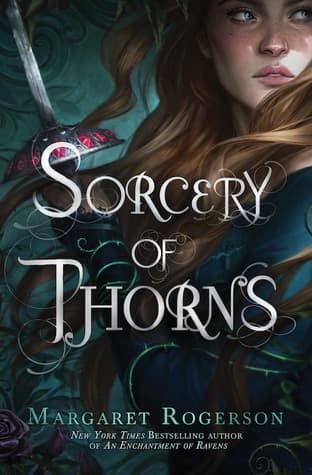
Margaret Rogerson (2019)
Genre
Fantasy / Young Adult / Romance
Reading Time
540 min
Key Themes
See below
Sign in to track this book
A sheltered librarian-in-training, raised to believe all sorcerers are evil, must forge an unlikely alliance with a charming sorcerer and his demonic servant to save her beloved magical grimoires and the world from a looming, ancient conspiracy.
Elisabeth Scrivener, an orphan raised at the Great Library of Summershall, wants to be a Warden. She believes magical grimoires are dangerous. One night, a powerful grimoire, the 'Manuscript of Sorrow,' is released from its vault. Elisabeth tries to contain the demon it unleashes, using an unknown ability to destroy it. Her actions are seen as complicity in the sabotage. Silas, a demonic servant, takes her into custody and delivers her to the sorcerer Nathaniel Thorn in Austermeer.
Elisabeth is brought before Nathaniel Thorn, a sorcerer from a prominent magical family, and his demonic servant, Silas. Initially hostile, Elisabeth maintains her innocence. Nathaniel, though skeptical, is intrigued by her unusual power. He offers her a temporary reprieve from execution, believing she might help uncover the true saboteur. Elisabeth, taught that all sorcerers are evil, struggles with Nathaniel's complex demeanor and Silas's human-like loyalty. This alliance makes her question everything she thought she knew.
As Elisabeth and Nathaniel begin their investigation, they find that the attack on Summershall was not isolated. Other Great Libraries across Austermeer have suffered similar sabotages. Their investigation points to a larger conspiracy, possibly orchestrated by a powerful figure within the sorcerous community or the Wardens themselves. During this time, Elisabeth learns more about Nathaniel's family history, particularly his parents' tragic deaths, which are shrouded in mystery. This further complicates her understanding of sorcerers and their world.
Nathaniel takes Elisabeth to the Great Library of Austermeer's archives, a vast repository of knowledge, to research the history of grimoires and past attacks. Here, Elisabeth meets the Archon, the head of the Library. While researching, Elisabeth finds old texts and forgotten lore that hint at a deeper connection between grimoires and the human world than she imagined. She also starts to piece together clues about her own origins, suggesting she might possess a unique heritage tied to the libraries themselves, a power that allowed her to destroy the demon at Summershall.
Through their research, Elisabeth and Nathaniel identify the antagonist: Lorelei, a disgraced and seemingly deceased sorceress who was once a protégé of Nathaniel's father. Lorelei is manipulating powerful grimoires and demons, seeking to unleash a devastating magical cataclysm. Her motives stem from a desire to avenge perceived injustices against sorcerers and to reshape the balance of power between magic and humanity. Her plan involves using a legendary and destructive grimoire, the 'Grimoire of Chaos,' threatening not just the libraries but all of Austermeer.
As Lorelei's plans escalate, Elisabeth and Nathaniel face increasing danger. During a confrontation with Lorelei and her summoned demons, Silas, Nathaniel's demonic servant, makes a sacrifice. He uses his essence to create a powerful ward, protecting Elisabeth and Nathaniel from a deadly magical attack, but at the cost of his own existence. Silas's death impacts Elisabeth, who had grown to care for him, and Nathaniel, who loses his oldest companion. This fuels Nathaniel's determination to stop Lorelei.
Following Silas's sacrifice, Elisabeth experiences a surge in her dormant abilities. She learns that she is a 'child of the library,' a rare individual born from the magic of the Great Libraries themselves. This heritage gives her an innate connection to grimoires, allowing her to understand and influence them in ways no one else can. This revelation explains her power to destroy the demon at Summershall and her empathy for the books. It makes her a crucial player in the fight against Lorelei, as she possesses the only power that might counter the Grimoire of Chaos.
Lorelei launches her final assault, targeting the heart of Austermeer and its Great Library, intending to unleash the full power of the Grimoire of Chaos. Elisabeth, Nathaniel, and a contingent of Wardens and sorcerers rally to defend the city. The confrontation is fierce, with powerful magic clashing and grimoires transforming into monstrous entities. Elisabeth uses her abilities, guided by her connection to the libraries, to contain the chaos. Nathaniel battles Lorelei directly, seeking to avenge Silas and protect the world from her ambition.
In the battle, Elisabeth confronts the Grimoire of Chaos itself, a sentient and powerful artifact that Lorelei has awakened. The grimoire tries to overwhelm her with its magic and ancient knowledge. Elisabeth, drawing upon her heritage as a child of the library, does not try to destroy the grimoire. Instead, she reasons with it, soothing its rage and restoring its balance. She uses her empathy and understanding of grimoires to connect with its core, ultimately bringing it back under control and preventing its catastrophic release. This shows a power beyond mere destruction.
With the Grimoire of Chaos contained and Lorelei defeated, the immediate threat is averted. The Great Libraries, though damaged, begin recovery. Elisabeth is hailed as a hero, her true identity and power revealed. She chooses to remain at the Great Library of Austermeer, embracing her role as a child of the library and a protector of grimoires. Her relationship with Nathaniel Thorn deepens, evolving from an alliance into a loving partnership. The world, once divided by fear, begins to heal, with Elisabeth and Nathaniel leading a new era of understanding between sorcerers and the libraries.
The Protagonist
Elisabeth transforms from a prejudiced foundling into a powerful 'child of the library,' embracing her unique heritage and challenging societal norms.
The Protagonist
Nathaniel learns to trust and open himself to others, finding healing and purpose through his relationship with Elisabeth.
The Supporting
Silas, a seemingly emotionless demon, displays profound loyalty and self-sacrifice, proving his capacity for love and protection.
The Antagonist
Lorelei descends further into villainy, driven by revenge and a twisted vision of justice, ultimately leading to her downfall.
The Supporting
The Archon, initially rigid in her beliefs, learns to trust in new forms of power and leadership.
The Mentioned
Her past actions and death shape the present narrative, revealing the true nature of the pact with Silas and Lorelei's motivations.
The Supporting
Master Finch's faith in Elisabeth remains, and he eventually accepts the changing landscape of magic and libraries.
The novel explores prejudice, especially the animosity between Wardens (who view all sorcerers as evil) and sorcerers. Elisabeth's journey challenges her ingrained beliefs as she learns to see individuals like Nathaniel and Silas beyond their labels. This is clear when Elisabeth, raised to fear sorcerers, forms a deep bond with Nathaniel and Silas, realizing that 'evil' is not inherent but a choice. The climax shows different factions working together, highlighting the power of acceptance over bias.
“All sorcerers are evil. Elisabeth had known that as long as she had known anything.”
Sorcery of Thorns explores the dual nature of power and knowledge, as seen in the grimoires. These magical books are sources of knowledge and power, but they are also dangerous. The story questions whether power itself is good or evil, or if it is the wielder's intent that defines it. Elisabeth's ability to 'calm' grimoires, rather than destroy them, reflects a nuanced understanding of power — one that values empathy and connection over brute force. This is evident in her interaction with the Grimoire of Chaos.
“Books were not dangerous. The humans who wrote them were the ones to fear.”
Elisabeth, an orphan, struggles with belonging throughout the story. Raised in a library, she initially finds her identity as a future Warden. However, when she is cast out, she discovers a 'found family' in Nathaniel and Silas, who offer her acceptance and loyalty. This theme is shown through Silas's devotion to Nathaniel, and later, to Elisabeth. The revelation of Elisabeth's heritage as a 'child of the library' gives her a true sense of belonging, not just to a place, but to a magical lineage, reinforcing that family can be chosen or discovered in unexpected ways.
“Libraries were not just buildings; they were living things, and they chose their people.”
Sacrifice is important in the narrative, particularly through Silas's actions. His selfless act of using his essence to save Elisabeth and Nathaniel shows that true love and loyalty can lead to self-sacrifice. Nathaniel's journey, burdened by guilt over his parents' deaths and his reliance on Silas, is also a quest for redemption as he strives to protect others and correct past wrongs. Lorelei's actions, while destructive, are also driven by a twisted sense of redeeming sorcerers from perceived oppression, highlighting the complex motivations behind such acts.
“Some sacrifices were not just for others, but for the world.”
Magical books that possess consciousness and can transform into monstrous entities.
Grimoires are central to the world-building and plot. They are not merely books but living beings with their own consciousness, capable of whispering, reacting to emotions, and, if provoked or corrupted, transforming into terrifying demons made of ink and leather. This device establishes the inherent danger and power of magic within the libraries, providing the initial conflict and the constant threat. Elisabeth's unique connection to them allows for a more empathetic understanding of these 'monsters,' ultimately proving crucial in containing the Grimoire of Chaos.
A magical contract binding a human and a demon, granting power in exchange for service.
The demonic pact, specifically the one between Nathaniel Thorn and Silas, is a key plot device. It provides Nathaniel with a powerful, loyal, and morally ambiguous ally, but also serves as a source of emotional burden and mystery. The nature of the pact, its origins (made by Nathaniel's mother), and its consequences are gradually revealed, adding depth to Nathaniel's character and contributing to the central conflict. Silas's ultimate sacrifice, stemming from the pact's underlying loyalty, is a pivotal moment in the story.
Elisabeth's discovery of her unique, innate magical connection to the Great Libraries.
This plot device is a classic 'chosen one' trope, but with a unique twist. Elisabeth's true heritage as a 'child of the library' explains her unusual power to destroy the demon at Summershall and her profound empathy for grimoires. This revelation elevates her from a mere Warden-in-training to a central figure in the fight against Lorelei, providing her with the unique ability to counter the ultimate magical threat. It also solidifies her sense of belonging and empowers her to embrace her destiny.
Vast, magical repositories of knowledge and the primary setting of the story.
The Great Libraries function as more than just settings; they are characters in themselves. They are living, breathing entities, housing immense power and ancient knowledge. Their vulnerability to sabotage drives the plot, and their protection is the central motivation for many characters. They represent tradition, order, and the preservation of knowledge, contrasting with the chaotic forces unleashed by Lorelei. The libraries are where Elisabeth finds her purpose and ultimately her true identity.
“All at once, Elisabeth felt an overwhelming urge to laugh. What a ridiculous, wonderful, terrifying world this was.”
— Elisabeth reflects on her journey and the magical world she inhabits.
“Books, she had always been taught, were dangerous. They could be cursed or demon-possessed, but even the ordinary ones were a hazard. They contained ideas, and ideas were like a plague.”
— Elisabeth's initial upbringing in the library, where books are viewed with suspicion.
“She had always believed that books were meant to be handled with reverence, to be protected. But she was beginning to understand that some books were meant to be broken.”
— Elisabeth's evolving understanding of books and their true nature.
“Every grimoire was once a tree. Every demon, once a star. And every human, once a story waiting to be told.”
— A philosophical reflection on the origins of magical beings and humanity.
“I’m not a hero. I’m just a girl who loves books, and I’m tired of seeing them hurt.”
— Elisabeth's self-description and motivation for her actions.
“The greatest sorcerers, it was said, did not command demons; they befriended them.”
— A proverb about the true nature of powerful magic and demon interaction.
“There was no such thing as a perfect choice, only a necessary one.”
— Elisabeth facing a difficult decision.
“Silence was a powerful thing, a weapon and a shield. It could conceal, or it could reveal.”
— Elisabeth observing the power of silence in a tense situation.
“She was not a monster. She was a library assistant. And she was going to save the world.”
— Elisabeth's internal declaration of purpose and identity.
“Some stories, once started, refused to end. They simply kept going, weaving themselves into the fabric of the world.”
— A reflection on the enduring nature of certain narratives and events.
“Love was a dangerous thing, a weapon that could be wielded for good or ill. But it was also the most powerful magic of all.”
— Elisabeth's thoughts on the nature of love and its power.
“The world was full of monsters, but it was also full of heroes. And sometimes, the line between them was very thin indeed.”
— A contemplation on the duality of good and evil in the world.
“A good librarian was a guardian of knowledge, not a censor.”
— Elisabeth's firm belief about the role and responsibility of a librarian.
“It was one thing to read about magic, and quite another to feel it hum beneath your skin.”
— Elisabeth experiencing magic firsthand, contrasting it with theoretical knowledge.
Ready to see how well you understood this book? Take our interactive quiz with 10 questions.







