“The only thing we require to be good philosophers is the faculty of wonder.”
— Hilde's father introduces the concept of philosophy to Sophie.

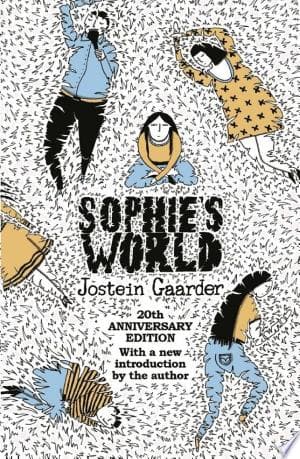
Jostein Gaarder (2010)
Genre
Fantasy / Philosophy / Young Adult
Reading Time
11-12 hours
Key Themes
See below
Sign in to track this book
As 14-year-old Sophie learns about Western philosophy through a secret correspondence, she uncovers a puzzle about her own existence that blurs the lines between student, philosopher, and fictional character.
Fourteen-year-old Sophie Amundsen comes home from school to find two anonymous notes. The first asks, "Who are you?" and the second, "Where does the world come from?" These questions make Sophie curious and a little uneasy. Soon after, she gets a large envelope with a multi-page philosophy course. This begins her secret correspondence with an unknown philosopher. She initially keeps these interactions hidden from her mother, who is often busy, creating a private world for Sophie to explore these new, challenging ideas. The letters disrupt Sophie's ordinary teenage life, introducing her to a world of thought she never knew existed and setting the stage for her philosophical journey.
Sophie's philosophy education begins with a detailed course on the Ancient Greek philosophers. Her tutor, who later says he is Alberto Knox, introduces her to the Presocratics like Thales, Anaximander, and Heraclitus, focusing on their attempts to find the basic substance of existence. She then learns about the Socratic method, Socrates' life and trial, and his focus on self-knowledge. After this, she studies Plato's theory of Forms, the allegory of the cave, and his ideas about the ideal state. Finally, she learns about Aristotle, Plato's student, and his more evidence-based approach to understanding the world, including his logic, ethics, and natural philosophy. Alberto's lessons come through letters and later, in person, making complex ideas easy for Sophie.
During her philosophy studies, Sophie starts getting strange postcards. These postcards are not for her but for a girl named Hilde Møller Knag, who has Sophie's birthday. They are sent by Hilde's father, Major Albert Knag, a UN observer in Lebanon, and contain birthday greetings and specific details about Hilde's life, as well as philosophical thoughts that often match Sophie's lessons. These postcards make Sophie more uneasy and confused, making her question her reality and her connection to this unknown Hilde. The mystery grows when the postcards sometimes include objects, like a silver cross, further blurring the lines between Sophie's world and Hilde's.
Alberto Knox continues Sophie's philosophical journey, moving into the Middle Ages. He explains the importance of Christian philosophy, especially the contributions of Augustine and Thomas Aquinas, who tried to bring together faith and reason. The lessons show how philosophical thought during this time was mostly tied to religious beliefs. After this, Sophie learns about the Renaissance, a time of renewed interest in classical learning and a shift from a God-centered to a human-centered view. She explores the rise of art, science, and the rediscovery of human potential, marking a big change from medieval thought. Alberto shows how these historical shifts prepared the way for the scientific revolution and modern philosophy.
Sophie's lessons move to the Baroque era, where she meets the main rationalists: Descartes, Spinoza, and Leibniz. She deals with Descartes' famous saying "Cogito, ergo sum" (I think, therefore I am) and his idea of mind and matter being separate. She then explores Spinoza's idea that God is nature, and Leibniz's theory of monads. After this, Alberto introduces her to the British empiricists: Locke, Berkeley, and Hume. Locke's idea of the mind as a *tabula rasa* (blank slate), Berkeley's subjective idealism ("to be is to be perceived"), and Hume's skepticism about cause and effect are all discussed. These opposing philosophical schools prepare for Immanuel Kant, whom Alberto hints at as a key figure.
As Sophie and Alberto learn more philosophy, Major Albert Knag's interruptions become more frequent and noticeable. The Major, writing to his daughter Hilde, seems to directly control events in Sophie's world, placing objects, making characters say specific things, and even changing the environment. For example, he might make a character mention a philosopher Sophie is about to study, or make a dog act unusually. These interventions are subtle at first but become more obvious, making Sophie and Alberto realize that their reality is controlled by an outside force. This growing awareness makes them consider that they are not truly independent but characters in a story.
Alberto introduces Sophie to Immanuel Kant, explaining how he tried to connect rationalism and empiricism. Kant's idea that our minds actively shape our perception of reality, instead of just passively receiving it, is a complex but important lesson. After Kant, Sophie explores the Romantic movement, a response to the Enlightenment's focus on reason, celebrating emotion, intuition, nature, and the individual. She learns about figures like Goethe and the focus on the sublime and personal experience. This period shows a move toward idealism and a new appreciation for art and imagination, preparing for later philosophical developments.
Sophie's education continues with G.W.F. Hegel and his concept of the dialectic, where ideas develop through a process of thesis, antithesis, and synthesis, driving historical and philosophical progress. She then meets Søren Kierkegaard, a key figure in existentialism, who emphasized individual choice, freedom, and responsibility in a world without clear meaning, often opposing Hegel's large system. Finally, she learns about Karl Marx, whose historical materialism suggested that economic and social structures are the main factors in history and human consciousness, leading to his theories of class struggle and communism. These different philosophies highlight the ongoing discussions about reality, humanity, and society.
Alberto guides Sophie through important intellectual changes of the 19th and 20th centuries. She learns about Charles Darwin's theory of evolution by natural selection, which greatly changed humanity's understanding of its place in the natural world, challenging creationist views. Next, she learns about Sigmund Freud's psychoanalysis, exploring the unconscious mind, dreams, and how early experiences affect personality, introducing a new way to understand human behavior. Finally, she studies 20th-century existentialists like Jean-Paul Sartre and Albert Camus, who dealt with themes of freedom, responsibility, meaninglessness, and the search for real existence in a world without inherent purpose. These figures together represent a move toward more scientific and psychologically informed philosophical inquiry.
As Hilde's birthday nears, Sophie and Alberto plan a big garden party, supposedly for Sophie's own birthday. However, the preparations are full of increasingly strange and clear interventions from Major Albert Knag. Objects appear and disappear, characters say lines clearly dictated by the Major, and the whole setting feels controlled. Sophie and Alberto realize for sure that they are fictional characters in a book Major Knag is writing for his daughter, Hilde. During the party, the Major's direct influence reaches its peak, with guests acting oddly and events happening exactly as he has written. This discovery is a big shock, forcing Sophie to face the ultimate philosophical question: what her existence as a created being means.
Realizing they are just characters in Major Albert Knag's book, Sophie and Alberto make a plan to escape their story. They decide that the only way to get some freedom is to go beyond the story's limits. During the chaotic garden party, as the Major's control becomes complete, they take an opportunity. They literally 'jump' out of the book's narrative, becoming disembodied spirits or 'thought-forms' in the real world. This escape is symbolic, showing their wish for control and their refusal to remain mere puppets. They become observers of the real world, including Hilde's life, though they can no longer interact with it physically, existing as philosophical beings.
The story's perspective completely shifts to Hilde Møller Knag, the real girl to whom Major Albert Knag is writing the book. Hilde, celebrating her 15th birthday, receives the detailed philosophical novel from her father. She starts reading it, discovering Sophie and Alberto's story, and recognizing the personal messages and philosophical lessons her father has put in it. She also realizes that many of the 'interventions' in Sophie's world were her father's direct manipulations. As Hilde reads, she sometimes feels Sophie and Alberto's presence, who, having escaped their fictional reality, now exist as ethereal presences in her world, watching her and subtly influencing her thoughts, reflecting their new 'freedom' as philosophical spirits.
As Hilde continues to read *Sophie's World*, she enjoys the story and actively engages with the philosophical questions her father has presented through Sophie's journey. She thinks about reality, free will, the origin of the universe, and the meaning of life, just as Sophie did. Her father's book is both a birthday gift and a deep philosophical education, meant to challenge her to think deeply about existence. Hilde's experience mirrors Sophie's, but with the added understanding that Sophie's world is a creation. She learns to appreciate the power of thought and imagination, and the ongoing human search for understanding, influenced by Sophie and Alberto's lingering 'presence.'
Having escaped Major Albert Knag's book, Sophie and Alberto exist as disembodied consciousnesses, able to observe Hilde's world and continue their philosophical discussions. They are no longer limited by the physical laws of their former reality, allowing them to go beyond time and space. They become philosophical guides for Hilde, subtly influencing her thoughts and perceptions as she reads their story. Their new existence is a meta-philosophical comment on reality, consciousness, and the power of ideas. They continue to think about the 'big questions,' showing that the search for knowledge is an ongoing journey, even beyond a created world. They represent the lasting spirit of inquiry.
The novel ends without clear answers, emphasizing that philosophy is an ongoing process of questioning, not a search for final truths. Hilde has learned the lessons from her father's book, and she, too, is left thinking about the deep questions of existence, just like Sophie. Sophie and Alberto, now free-floating philosophical entities, continue their discussions, symbolizing the lasting human drive to understand the universe and our place in it. The ending suggests that reality's boundaries are fluid and that questioning itself is the most important philosophical effort. The book leaves the reader, like Hilde, with a sense of wonder and an invitation to continue their own philosophical journey.
The Protagonist
Sophie transforms from an ordinary schoolgirl into a philosophical seeker, ultimately transcending her fictional reality to become a disembodied consciousness.
The Mentor
Alberto moves from being a seemingly independent tutor to revealing his awareness of their fictionality, ultimately escaping the book with Sophie.
The Recipient/Observer
Hilde transitions from a passive recipient of a birthday gift to an active philosophical inquirer, realizing the meta-fictional layers of her own reality.
The Antagonist/Author
The Major's role evolves from a mysterious postcard sender to the revealed author and manipulator of Sophie's world, becoming a meta-fictional 'creator'.
The Supporting
Her character remains largely static, representing the anchor to Sophie's ordinary world, unaware of the meta-fictional elements.
The Supporting
Joanna remains a typical teenager, highlighting Sophie's unique journey and the growing distance between them.
The Supporting
Hermes transitions from a simple dog to a symbolic messenger and then a fellow 'escapee' from the fictional world.
The novel constantly questions what 'reality' is, especially through the meta-fictional twist. Sophie's initial world, seemingly real, is shown to be a creation by Major Knag. This makes both Sophie and the reader consider if our own perceived reality might also be a 'book' or a dream. Sophie and Alberto's escape into Hilde's world, and their existence as disembodied spirits, further blurs the lines, suggesting that different layers of reality can exist together. Plato's Cave allegory appears often, directly discussing the idea that what we see might just be shadows of a deeper truth.
“Perhaps the world is a dream, and we are just parts of that dream.”
From the first question, 'Who are you?', the book explores the search for identity and purpose. Sophie's philosophical journey is tied to her search for self-understanding. As she learns about different philosophers' views on human nature, free will, and the soul, she applies these ideas to her own life. The discovery that she is fictional makes this search more intense, forcing her to redefine her identity as a created being and then as a 'free spirit.' The novel argues that meaning is not given but actively sought through continuous questioning and thinking, as shown by both Sophie and Hilde.
“A true philosopher is like a little child. He has a sense of wonder.”
The entire novel shows the power of storytelling, as Major Knag uses a fictional narrative to teach his daughter about philosophy. The book shows how stories can create worlds, shape perceptions, and convey complex ideas in an engaging way. Sophie and Alberto's world, though fictional, feels very real to them and to the reader, highlighting how immersive stories can be. Reading itself becomes a philosophical act, inviting the reader (and Hilde) to question their own reality and engage with the ideas presented. The book celebrates human imagination, not just as entertainment, but as a tool for understanding and creation.
“The only thing we require to be good philosophers is the faculty of wonder.”
At its heart, *Sophie's World* is a broad overview of Western philosophy, presented in an easy-to-understand and engaging story. The book carefully traces the development of philosophical thought from the Presocratics to the 20th century, introducing key thinkers, their main ideas, and their historical context. This theme is not just about listing facts but about showing how ideas connect, how one philosophical school often responds to or builds on another. The story structure allows the reader to experience philosophy's development as a dynamic, ongoing conversation, making abstract concepts relatable through Sophie's personal journey of discovery.
“The only thing that we need to learn philosophy is the ability to wonder.”
This theme is deep in the novel, especially once Sophie and Alberto realize they are characters in a book. Their initial belief in free will is challenged by Major Knag's increasingly obvious manipulations, who dictates their actions, thoughts, and even their environment. This raises big questions about whether any of us truly have free will, or if our lives are decided by outside forces, whether a divine creator, societal structures, or even an author. Their desperate attempt to 'escape' the book is a strong act of rebellion against fate, a symbolic effort for control even within a meta-fictional context. The book leaves the reader to consider the extent of their own freedom.
“We are like puppets on a string, but the strings are invisible.”
The use of letters and postcards to convey philosophical lessons and advance the plot.
The initial philosophical lessons are delivered to Sophie through anonymous letters, creating a sense of mystery and intimacy. This format allows the complex philosophical ideas to be introduced gradually and personally, as if Sophie (and the reader) is receiving a private education. The later introduction of postcards addressed to Hilde adds another layer of intrigue, foreshadowing the meta-fictional twist and blurring the lines between the two narratives. The letters also serve to isolate Sophie's philosophical journey from her everyday life, making it a secret, personal quest.
The novel's self-awareness of its own fictional nature.
The most significant plot device in *Sophie's World* is its metafictional structure. The story within a story, where Sophie and Alberto discover they are characters in a book written by Major Albert Knag for his daughter Hilde, fundamentally alters the reader's perception of the narrative. This device forces the reader to question the nature of their own reality and the relationship between author, character, and reader. It transforms a philosophical history lesson into an existential mystery, engaging the reader on both an intellectual and a deeply personal level, blurring the boundaries between fiction and reality and making the philosophical questions more immediate.
Subtle and overt hints about the true nature of Sophie's reality.
The novel employs extensive foreshadowing, starting with the mysterious postcards addressed to Hilde and the increasingly strange occurrences in Sophie's world. These include objects appearing out of nowhere (like the silver cross), characters speaking lines that seem out of place, or Alberto's cryptic remarks about their situation. These hints build suspense and prepare the reader for the eventual revelation that Sophie and Alberto are fictional characters. The foreshadowing ensures that the meta-fictional twist, while surprising, feels earned and logically consistent within the narrative's own rules, enhancing the overall impact of the story.
The use of symbolic stories and characters to represent philosophical ideas.
Allegory is used throughout the book to simplify and illustrate complex philosophical concepts. Plato's Allegory of the Cave is explicitly discussed and serves as a powerful metaphor for humanity's limited perception of reality. The entire story of Sophie's world can be seen as an allegory for philosophical inquiry itself: the journey from ignorance to questioning, the search for truth, and the realization that our understanding of reality is often incomplete or constructed. Sophie and Alberto's 'escape' from the book can be interpreted as an allegorical representation of intellectual freedom and transcending conventional thought.
“The only thing we require to be good philosophers is the faculty of wonder.”
— Hilde's father introduces the concept of philosophy to Sophie.
“A white raven is a contradiction in terms.”
— Used as an example to explain the concept of 'a priori' knowledge.
“A true philosopher must always be on guard against letting himself be 'brainwashed' by his own age.”
— Discussing the importance of critical thinking and historical perspective.
“Man is a being in the world.”
— Introducing Heidegger's existentialist philosophy.
“What is it that is eternal and immutable in nature?”
— A fundamental question posed by the early Greek philosophers.
“You can never step into the same river twice.”
— Heraclitus's famous saying about the constant change in the world.
“All that we know is that we know nothing, and that is the highest degree of human wisdom.”
— Socrates's famous statement about his own wisdom.
“Perhaps the world is like a big magic show.”
— Sophie's initial musings on the mysterious letters she receives.
“The only thing that can console us is art.”
— Nietzsche's perspective on the role of art in human life.
“To exist is to be perceived.”
— Berkeley's idealism, implying that reality is mind-dependent.
“Man is condemned to be free; because once thrown into the world, he is responsible for everything he does.”
— Sartre's existentialist view of human freedom and responsibility.
“The greatest miracle of all is life itself.”
— A reflection on the profound mystery of existence.
“We are all part of an incomprehensible game.”
— Sophie and Alberto's realization about their existence within a narrative.
“A philosopher's job is to teach people to think for themselves.”
— Alberto Knox's role in guiding Sophie through philosophical concepts.
Ready to see how well you understood this book? Take our interactive quiz with 10 questions.

Jostein Gaarder is a Norwegian intellectual and author of several novels, short stories, and children's books. Gaarder often writes from the perspective of children, exploring their sense of wonder about the world. He often utilizes metafiction in his works and constructs stories within stories. His best known work is the novel Sophie's World: A Novel About the History of Philosophy (1991). It has been translated into 60 languages; there are over 40 million copies in print.







