“Say thankya, big-big.”
— Spoken by Mia and Susannah, a recurring phrase of gratitude.


Stephen King (1999)
Genre
Fantasy / Science Fiction
Reading Time
9-10 hours
Key Themes
See below
Sign in to track this book
Susannah, possessed by a demon, races to give birth to Roland's destined enemy in 1999 New York, while the group is scattered across dimensions to fight gangsters, save a magical rose, and meet their own creator: Stephen King.
After the fight with the Wolves of the Calla, Susannah Dean, now fully controlled by the demon Mia, uses the powerful Black Thirteen orb to open a door to another place and time. Mia's goal is to reach New York City in 1999 to give birth to her 'chap,' a demon-human child fathered by Roland and the Crimson King. Roland Deschain, Eddie Dean, Jake Chambers, and Father Callahan are left confused but determined. They talk with the Manni, a group of mystical beings, who explain the need to protect the Rose in the vacant lot, a central point for all realities. The group decides to split: Roland and Eddie will follow Susannah through the Unfound Door to New York, while Jake and Father Callahan will go to Maine to find Calvin Tower, the lot's owner, to keep the Rose safe. However, destiny has other plans, changing their intentions.
Instead of their planned destinations, destiny intervenes greatly. Jake Chambers, Father Callahan, and Oy, Jake's loyal animal friend, are suddenly sent to New York City in 1999, directly into Susannah/Mia's path. Meanwhile, Roland Deschain and Eddie Dean are unexpectedly placed in East Stoneham, Maine, in 1977. This sudden change makes them rethink their immediate goals. In Maine, Roland and Eddie quickly find themselves in danger, meeting Enrico Balazar, a powerful gangster and Eddie's former boss, who holds a strong grudge against Eddie. Balazar's men immediately recognize Eddie, leading to a tense and violent fight that tests Roland's gunslinging skills in a familiar but foreign time.
In 1999 New York, Susannah Dean, her body heavily pregnant with Mia's 'chap,' fights against Mia's strong will. Mia, a former succubus, has an intense maternal drive to birth and protect her unborn child, whom she believes will save her. She uses Susannah's body to move through the city, looking for a safe place for the birth, all while avoiding the 'Low Men' and other agents of the Crimson King who are also tracking her. Susannah, trapped in her own mind, sometimes surfaces, talking with Mia and trying to gain some control, but Mia's determination is absolute. Mia's journey through New York is full of danger, as she senses hostile presences and the growing urgency of her coming delivery.
Jake Chambers, Father Callahan, and Oy find themselves in the busy and unfamiliar setting of 1999 New York City. Their immediate task is to find Susannah Dean before Mia can give birth to the chap. They quickly realize the city is full of dangers, both ordinary and supernatural. They find hints of the Low Men, agents of the Crimson King, who are also hunting Susannah. Callahan's knowledge of the city's hidden parts from his past life is somewhat helpful, but they are mostly out of their element. Jake's mind-reading abilities and Oy's sharp senses become important tools in their desperate search, as they navigate the large city, knowing time is running out and Susannah's life is at risk.
After the violent encounter with Balazar's men in 1977 Maine, Roland Deschain and Eddie Dean receive mysterious guidance from a 'todash' creature, a being from another dimension. This creature, a thinny-ghost, tells them to find a 'writer' named Stephen King, suggesting that he holds the key to their journey and the fate of the Dark Tower. They learn that King is not just a storyteller, but a central figure in their own existence, a 'beam-breaker' who writes their adventures. This news deeply disturbs Eddie, who struggles with the idea of their lives being fiction. Roland, however, accepts it with his usual practicality, seeing the importance of understanding the author's role in their quest to save the Tower.
Roland and Eddie eventually find Stephen King in his home in Center Lovell, Maine, in 1977. King is at first confused and scared by their sudden appearance, thinking he is hallucinating. Roland, using his gunslinger's persuasive stare, convinces King of their reality and the truth of their quest. They explain his vital role as the 'author' of their story and the 'Beams' supporting the Dark Tower. King talks about his own struggles with addiction, a recent accident, and the feeling that his stories are not entirely his own, hinting at the Crimson King's subtle influence on his creative process. Roland and Eddie stress the urgency of him continuing to write their tale, as his work directly affects their survival and the Tower's fate.
Mia, still controlling Susannah's body, finds shelter in a deserted, run-down restaurant in New York City. Her labor is intense and painful, and Susannah's consciousness is overwhelmed. With no medical help, Mia gives birth to the 'chap,' a monstrous, spider-like baby with a human face. This child, named Mordred Deschain, is revealed to be the son of both Roland and the Crimson King, and Mia's own 'son.' The birth is immediately followed by the arrival of the Low Men, agents of the Crimson King, who have been tracking Mia. They are there to claim Mordred, recognizing his great power and importance as a possible destroyer of the Beams and the Tower. Mia, despite being weak, fiercely tries to protect her newborn.
Jake Chambers, Father Callahan, and Oy finally find Susannah/Mia in the abandoned restaurant, arriving just as Mia gives birth to Mordred. They witness the terrifying birth and the immediate appearance of the Low Men. A desperate fight follows, with Callahan using his faith and Jake his quick thinking to fight off the Crimson King's agents. However, Mordred, even as a baby, shows frightening abilities, including changing into a bat-like creature. In the confusion, Mordred escapes with the Low Men, leaving Susannah in shock and physically exhausted. The group is reunited, but their mission to secure Susannah and prevent the birth has failed, and a new, powerful enemy has been unleashed.
After the terrible events of Mordred's birth and escape, the Manni suddenly appear in the New York restaurant, having followed the group. They give important information about Mordred Deschain, explaining his dual parents and his destiny as Roland's enemy and the possible destroyer of the Dark Tower. They also reveal that Susannah's possession by Mia was part of a larger, complex plan by the Crimson King. The Manni then guide the reunited group, including a recovering Susannah, on their next steps. They explain that Roland and Eddie's journey to Stephen King was necessary for the story to continue, and now the entire group must prepare for a direct fight with the forces against the Tower, with Mordred as a new, terrifying threat.
Roland and Eddie, having successfully influenced Stephen King in 1977 and ensured their story's continuation, are brought back to the present. Their immediate task is to meet up with the rest of the group and complete their original mission regarding the Rose. They discuss with Jake, Callahan, and Susannah the importance of finding Calvin Tower, the owner of the vacant lot in New York where the Rose, the physical form of the Dark Tower, grows. Securing the deed to this land is most important to protect the Rose from developers who are unknowingly working for the Crimson King. The group, though shaken by their recent trials and Mordred's appearance, decides to complete this vital step before continuing their ultimate quest to the Tower itself, understanding how all their actions are connected.
The Protagonist/Possessed
Susannah endures a harrowing physical and mental ordeal, completely losing control to Mia, only to be left deeply traumatized but ultimately reunited with her ka-tet.
The Antagonist/Possessor
Mia successfully births Mordred and briefly experiences motherhood before he is taken by the Low Men, leaving her fate uncertain.
The Protagonist
Roland accepts the metanarrative of his existence and continues to lead his ka-tet, adapting to the emergence of Mordred as a new, personal threat.
The Protagonist
Eddie confronts and largely accepts the meta-fictional nature of his existence, reaffirming his commitment to the quest and his love for Susannah.
The Protagonist
Jake matures further, demonstrating leadership and bravery in New York, and witnesses the birth of Mordred, cementing his understanding of the stakes.
The Protagonist
Callahan continues to fight the forces of darkness in New York, proving his worth as a member of the ka-tet and a man of action.
The Supporting
Oy remains a steadfast and crucial companion to Jake, demonstrating his unwavering loyalty and intelligence in the face of new dangers.
The Supporting/Meta-character
King is forced to confront the reality of his creations and accepts his responsibility as the chronicler of the Dark Tower, agreeing to continue writing.
The Antagonist
Mordred is born and immediately demonstrates his terrifying power, escaping with the Low Men to begin his path as Roland's ultimate adversary.
The Mentioned/Minor Antagonist
Balazar briefly resurfaces as a threat from Eddie's past, quickly dispatched by Roland, serving as a reminder of the dangers of their temporal displacement.
'Song of Susannah' explores the blurred lines between fiction and reality, especially with Stephen King's introduction as a character. The group, particularly Eddie, struggles with the idea that their lives are being written, questioning their free will and existence. This idea is strongest when Roland and Eddie meet King in 1977 Maine, and Roland must convince the author to keep writing their story. It suggests that stories have real power, able to create and maintain worlds, and that creating itself is a form of godhood or beam-breaking. The characters' understanding of their own story affects their choices and their belief in their quest.
“You are the author, Sai King, but you are also a character, like us. It's a grand riddle, isn't it? A grand ka-tet.”
This idea is central to Mia's character and her control of Susannah. Mia, a former succubus, is driven by an overwhelming, almost sick maternal urge to birth and protect Mordred. This instinct takes over Susannah's consciousness and drives Mia's actions throughout the book, from her escape to New York to her fierce protection of the newborn child. The theme explores the dark and desperate side of motherhood, where love becomes obsession, and the lengths one will go to for a child, even a monstrous one. It also contrasts with Susannah's own internal struggles and her desire to regain control of her body and her sense of self.
“He is my son! My chap! I will not give him up to you!”
The book continues to explore the question of whether the characters' actions are set by 'ka' (destiny) or if they have true free will. The group's unexpected split, their arrival in different times and places than planned, and the revelation of Stephen King's role as their author all strongly suggest that their path is mostly set. However, the characters, especially Roland, still make choices, fight for their lives, and work towards their goals. The meeting with King highlights this tension: while he writes their story, his own free will is influenced by outside forces, and their choices in turn influence his writing. It is a complex interaction where destiny guides, but individual will still matters.
“Ka is a wheel, and the wheel always turns, but the hand that turns it is often our own.”
Beyond the meta-fictional aspect, the idea of storytelling itself is important. Stephen King's role as the 'author' shows that stories are not just entertainment but hold great power, able to shape reality and influence events. The group's very existence depends on King continuing to write their tale. This idea also appears in the characters' own view of their quest as a 'story' or a 'legend,' giving their journey a mythic quality. The continuation of the story becomes a matter of survival.
“If the story stops, Sai King, then we stop. And if we stop, the Tower falls.”
A sentient, cursed orb that acts as a portal to other worlds and times.
Black Thirteen is a powerful, malevolent 'bends the rainbow' orb, one of the thirteen magical spheres linked to the Dark Tower. It is sentient and capable of opening doors to other wheres and whens, but it is also cursed and dangerous to wield. In 'Song of Susannah,' Mia steals Black Thirteen and uses it to transport herself (and Susannah's body) to 1999 New York, initiating the ka-tet's scattered pursuit. It acts as the primary catalyst for the plot's initial division and temporal displacements, driving the characters into unforeseen circumstances and locations. Its power is immense but unstable, making it a perilous tool.
A magical portal to another world/time, often unstable and unpredictable.
The Unfound Door is a general term for the various magical portals that allow travel between different worlds and times. Unlike stable doors, these are often unpredictable, opening to unexpected destinations. In this novel, Black Thirteen facilitates an Unfound Door that leads Mia to New York. Later, the ka-tet attempts to use another such door, but ka intervenes, sending Jake, Callahan, and Oy to New York, and Roland and Eddie to 1977 Maine. This device serves to separate the ka-tet and introduce the element of temporal displacement, complicating their mission and leading to crucial encounters, particularly with Stephen King.
The literary device where the author of the story becomes a character within it.
This is a prominent plot device in 'Song of Susannah,' as Stephen King, the real-life author, is introduced as a character within his own narrative. Roland and Eddie meet him in 1977 Maine, where he is revealed to be the 'beam-breaker' who writes their story. This device breaks the fourth wall, blurring the lines between fiction and reality and directly addressing the reader's relationship with the narrative. It allows for commentary on the creative process, the nature of storytelling, and the idea that characters can have an influence on their creator, making the act of writing a co-creation between author and muse/characters.
The child born of two fathers, one good and one evil, destined to be a powerful, conflicted antagonist.
Mordred Deschain's unique parentage – sired by both Roland Deschain and the Crimson King – is a crucial plot device. This dual paternity imbues him with immense power and positions him as Roland's ultimate, prophesied nemesis. His existence immediately raises the stakes for the ka-tet, as they now face not just the Crimson King, but a personal, monstrous threat directly linked to Roland. Mordred's nature as a child of both light and darkness sets up a complex moral and narrative conflict for the final books, suggesting a being of immense power with a deeply conflicted destiny, central to the fate of the Tower.
“Say thankya, big-big.”
— Spoken by Mia and Susannah, a recurring phrase of gratitude.
“The world had moved on.”
— A realization by Roland as he navigates a changed New York City.
“Ka is a wheel. Its turnings are infinite. Its lessons are hard. And ka-tet is a thread woven within the wheel. It is not an escape from the wheel; it is a part of it.”
— A reflection on the nature of ka and ka-tet, central to the series' philosophy.
“There are other worlds than these.”
— A fundamental truth of the multiverse, often repeated.
“The greatest truths are the simplest.”
— A general observation about understanding complex situations.
“He understood what it was like to be a puzzle piece that didn't fit, a cog that didn't mesh.”
— Roland's feeling of being out of place in a modern world.
“Sometimes the quickest way to get there is to go the long way around.”
— A strategic thought, reflecting on indirect approaches to problems.
“Fear makes the wolf bigger than he is.”
— A saying about the nature of fear and its exaggerations.
“The world was a web, and they were caught in it, struggling to understand its design.”
— A metaphor for the complex and interwoven nature of events.
“There's no point in being a hero if you're dead.”
— A pragmatic view on survival and the limits of heroism.
“Sometimes, when you least expect it, something good happens.”
— A glimmer of hope amidst the often grim journey.
“The past is a wheel that turns and turns, always coming back to the beginning.”
— A reflection on the cyclical nature of history and personal experience.
“What do you want? What do you really want?”
— A probing question, often directed at the characters' core motivations.
“He had learned that the only way to deal with the impossible was to break it down into a series of possible tasks.”
— Roland's approach to overcoming overwhelming obstacles.
Ready to see how well you understood this book? Take our interactive quiz with 10 questions.
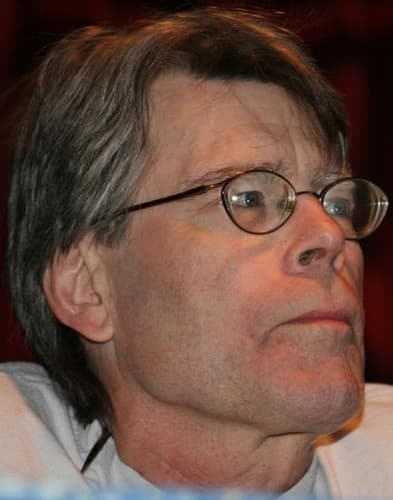
Stephen Edwin King is an American author of horror, supernatural fiction, suspense, crime, science-fiction, and fantasy novels. Described as the "King of Horror", his books have sold more than 350 million copies as of 2006, and many have been adapted into films, television series, miniseries, and comic books. King has published over 65 novels/novellas, including seven under the pen name Richard Bachman, and five non-fiction books. He has also written approximately 200 short stories, most of which have been published in book collections.







