“The wind carried the smell of pine and something else, something she couldn't quite name, but it made her shiver.”
— Early in the story, as Milada is being taken from her home.

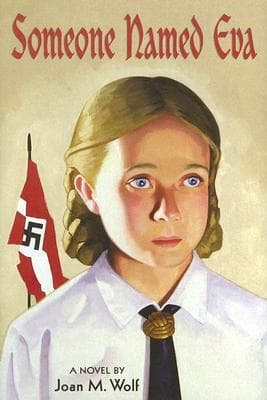
Joan M. Wolf (2007)
Genre
Children's / Historical Fiction / Young Adult
Reading Time
240 min
Key Themes
See below
Sign in to track this book
Torn from her Czech village and forced into a Nazi 're-education' camp, Milada fights to hold onto the echoes of her true identity against the relentless tide of Germanization.
Eleven-year-old Milada lives with her parents, older sister Hanka, and younger brother Jirka in the small, close-knit village of Lidice, Czechoslovakia, in 1942. Life is simple, with school, chores, and playing with friends like Karel. Despite the war, its direct impact on Lidice feels distant, though German soldiers are a common sight and their presence creates an underlying tension. Milada's father, a shoemaker, occasionally works for the Germans, a necessity for survival. The family is deeply connected to their Czech heritage, which will soon become a source of both pride and danger. Milada cherishes her family and the familiar routines of her village life.
One night, German soldiers storm Lidice, forcing all residents from their homes. Milada and her family are herded into the village square. The men are separated from the women and children. Milada sees the terror as her father and other men are taken away, never to be seen again. The women and younger children, including Jirka, are loaded onto trucks and taken to a different location, a concentration camp. Milada, along with other children deemed racially suitable for Germanization, is separated from her mother and sister Hanka. This brutal separation marks the end of her life in Lidice and the beginning of her forced transformation.
Milada and the other selected children, mostly blond and blue-eyed, are transported to a Lebensborn center in Puszczykowo, Poland. There, they are stripped of their clothing, their heads are shaved, and they are given new clothes and new names. Milada is given the name 'Eva'. The children are subjected to strict discipline and forced to speak only German. Any attempt to speak Czech or remember their past is met with severe punishment. Milada clings to the memory of her real name and her family, whispering 'Milada' to herself as a form of rebellion and a desperate attempt to retain her identity.
At the Lebensborn center, the children undergo training to erase their Czech heritage and instill German values. They are taught German history, culture, and propaganda, and are constantly told their previous lives were inferior. Physical appearance is emphasized, and they are taught proper German manners and hygiene. 'Eva' struggles with the language, but her intelligence helps her adapt quickly. She learns to hide her true feelings and memories behind a mask of compliance. Despite the harsh environment, she finds small acts of quiet defiance, like secretly practicing Czech words or recalling details of her family, to maintain a connection to her past self.
During her time at the center, 'Eva' forms a friendship with another girl, Irma, who also struggles with her forced identity. They share moments of quiet understanding and support each other through the difficult training. However, the harsh conditions and emotional toll affect some children. 'Eva' sees her younger friend, Marta, become frail and succumb to illness and psychological strain, eventually dying. This loss deeply affects 'Eva', reinforcing the brutality of their situation and solidifying her resolve to survive and remember, not just for herself, but for those who couldn't.
After months of training, 'Eva' is deemed ready for adoption. She is chosen by the Hartmann family, a childless couple living in Munich. Frau Hartmann is kind but stern, dedicated to raising 'Eva' as a perfect German daughter. Herr Hartmann is often away on war-related duties. 'Eva' moves into their comfortable home, a stark contrast to the barracks of the Lebensborn center. She learns to navigate the expectations of her new family, striving to be the 'Eva' they want while secretly battling to keep Milada alive inside. The fear of being discovered as 'not German enough' is a constant anxiety.
In Munich, 'Eva' attends school, where she excels, further cementing her 'German' identity in the eyes of others. She learns about German history and culture, always filtering it through her suppressed Czech memories. The war, which felt distant in Lidice, is a reality in Munich, with air raids and rationing becoming part of daily life. 'Eva' experiences the fear of bombs and the disruption they cause, further complicating her sense of belonging. She observes Frau Hartmann's patriotism and commitment to Germany, creating an internal conflict as 'Eva' tries to reconcile her past with her present.
Despite her outward conformity, 'Eva' finds her memories of Lidice resurfacing. A scent, a song, a phrase, or a familiar type of food can trigger a vivid recollection of her former life. These moments are both painful and precious, serving as anchors to her true self. She secretly writes her real name, Milada, on scraps of paper and hides them, a silent act of defiance and a way to ensure she never forgets. She also remembers the faces of her parents, Hanka, and Jirka, clinging to these images as proof of her original identity. These internal battles intensify as the war progresses.
As the war turns against Germany, the atmosphere in Munich shifts. Air raids become more frequent and devastating. News of German defeats spreads, and the initial enthusiasm for the Nazi regime wanes. 'Eva' observes the fear and disillusionment among the German population, including the Hartmanns. With the collapse of the Third Reich, the truth about programs like Lebensborn begins to surface. The secrecy and propaganda that once shrouded 'Eva's' origins start to unravel, creating uncertainty about her future and potentially offering a path back to her past, if one still exists.
After Germany's surrender, Allied forces begin the task of identifying and reuniting children displaced by the war. 'Eva' is taken to a camp for displaced children, where officials try to ascertain her true identity. She is questioned about her past, and for the first time in years, she is encouraged to speak Czech and recall her original name. The process is difficult, as years of suppression have made her memories fragile. She must actively fight to recall the details of Lidice, her family, and her true name, Milada, to prove who she is.
Through diligent efforts and 'Eva's' resolve to remember, her true identity as Milada Horáková from Lidice is confirmed. She is eventually reunited with her mother and sister, Hanka, who survived the concentration camp. The reunion is bittersweet; while joyous, it is also tinged with the loss of her father and Jirka, and the devastation of Lidice itself. Milada returns to Czechoslovakia, to a land scarred by war and a village that no longer exists in its original form. She carries the trauma of her experiences but also the strength of her survival and the enduring love for her family and heritage.
The Protagonist
Milada transforms from a carefree village girl into a survivor who navigates forced identity, ultimately reclaiming her true self while bearing the scars of her experience.
The Supporting
Endures immense suffering and loss, but ultimately reunites with two of her children, embodying hope and perseverance.
The Supporting
Survives the atrocities of the concentration camp and is reunited with her mother and sister, representing continuity of family.
The Supporting
His life is tragically cut short, becoming a symbol of the innocent victims of the Lidice massacre and the Nazi regime.
The Mentioned
His life is tragically cut short, representing the devastating loss of innocent lives during the Holocaust.
The Supporting
Begins as an eager adoptive mother, but as the war ends, her world collapses, and her role in 'Eva's' life ends, highlighting the transient nature of forced identities.
The Supporting
Serves as a temporary companion for 'Eva', providing mutual support during their time in the Lebensborn center.
The Mentioned
Her life is tragically cut short, serving as a poignant reminder of the innocent lives lost and the harsh realities of the Lebensborn program.
The central theme is Milada's forced erasure of her Czech identity and her fight to retain her true self. From the moment she is renamed 'Eva' and forbidden to speak Czech, her identity is under attack. She clings to memories of her family, her name, and her village as lifelines. This theme is evident in her secret whispers of 'Milada' and her attempts to recall details of Lidice, even as she outwardly conforms to her German persona. The story explores the psychological impact of having one's identity stolen and the resilience required to reclaim it.
“I will not forget. I am Milada. I am Milada. I am Milada.”
The novel shows the impact of World War II and the Nazi regime's policies, particularly the destruction of Lidice and the Lebensborn program. The peace of Lidice is shattered by violence, leading to the murder of men, the imprisonment of women, and the abduction of children. The Lebensborn center, though presented as a 're-education' facility, is a horror of cultural genocide. The constant fear, separation from family, and the death of innocent children like Marta show the cruelty of war and ideological extremism.
“Lidice was gone. The village of Lidice no longer existed. It was as if it had never been.”
Despite trauma and loss, Milada shows incredible resilience. She adapts to the harsh conditions of the Lebensborn center, learns a new language, and navigates her new life with the Hartmanns, all while secretly preserving her true self. Her survival is not just physical but also psychological, as she refuses to let her memories be erased. This theme is also evident in the survival of her mother and sister, Hanka, who endure concentration camps. Their ability to persevere through adversity highlights the strength of the human spirit and the will to live and remember.
“She would not cry. Crying was for babies. She was Milada. She would remember.”
Memory is Milada's most potent weapon against the forces attempting to erase her identity. Her ability to recall details of Lidice, her family's faces, and Czech words is what keeps 'Milada' alive within 'Eva'. The novel emphasizes the importance of cultural heritage and personal history in defining who we are. The desperate efforts to make the children forget their past show its power. Ultimately, Milada's fragmented but persistent memories enable her to be identified and reunited with her surviving family, proving that heritage and memory can endure even the most brutal attempts at annihilation.
“Every time she whispered 'Milada,' a small part of her old self came back, like a tiny spark in the dark.”
The act of giving Milada a new name ('Eva') and forbidding her native language.
This device is central to the theme of identity loss. By stripping Milada of her name and forcing her to speak German, the Nazis aim to systematically dismantle her Czech identity. The name 'Eva' represents the desired German persona, while 'Milada' symbolizes her true self and heritage. Milada's secret practice of her old name and Czech words becomes a powerful act of resistance, highlighting the connection between language, name, and identity. It creates an internal conflict that drives much of her character development and the plot.
A real-life Nazi program for 'racially pure' children.
The Lebensborn program serves as the primary setting for Milada's transformation and a chilling representation of Nazi ideology. It is a historical plot device that grounds the fiction in reality, making the atrocities more impactful. The program's goal of creating a 'master race' through abduction and re-education directly drives Milada's journey. It functions as the instrument of her identity theft and the crucible of her resilience, providing the specific historical context for her ordeal and the narrative's central conflict.
Milada's recurring memories of Lidice and her inner thoughts.
As Milada is forced to become 'Eva', her internal monologues and fragmented flashbacks to her life in Lidice are crucial for the reader to understand her struggle. These devices allow the reader access to Milada's true self, contrasting it with the compliant 'Eva' she presents to the world. They serve to reinforce her original identity and heritage, providing emotional depth and demonstrating her unwavering resolve to remember. Without these internal glimpses, the profound loss and the fight for self would be less apparent.
The village of Lidice as a symbol of lost innocence and national identity.
Lidice is not just a place; it's a powerful symbol. Its complete destruction by the Nazis represents the brutality of war, the attempted erasure of a people's history, and the loss of innocence. For Milada, Lidice embodies her entire past, her family, her culture, and her true self. The memory of Lidice becomes her anchor, a physical manifestation of everything she is fighting to remember. Its destruction reinforces the scale of the tragedy and the profound meaning of her eventual return to her homeland, albeit to a place irrevocably changed.
“The wind carried the smell of pine and something else, something she couldn't quite name, but it made her shiver.”
— Early in the story, as Milada is being taken from her home.
“They told her she wasn't Milada anymore. She was Eva. A new name for a new life, they said.”
— When Milada arrives at the Lebensborn home and is forced to change her identity.
“The mirror showed her a stranger. A girl with braids and a smile that didn't quite reach her eyes.”
— Eva (Milada) looking at her reflection after her transformation.
“Every night, she whispered her real name into the darkness, a secret prayer against forgetting.”
— Eva trying to hold onto her true self while living at the Lebensborn home.
“The German language was a rough blanket, scratchy and unfamiliar, but she learned to wrap herself in it.”
— Eva's struggle and eventual adaptation to speaking German.
“She learned to walk with her chin up, to smile when expected, to bury the small girl named Milada deep inside.”
— Describing Eva's outward conformity to the Lebensborn expectations.
“Sometimes, when she closed her eyes, she could still hear the chickens clucking, the sound of her mother's lullabies.”
— Eva's longing for her past life and family.
“The truth was a fragile thing, easily broken, easily lost, but she held onto it with all her might.”
— Eva's internal struggle to remember her true identity and past.
“A tiny act of defiance, a stolen moment of her true self, was sometimes all she had.”
— Eva finding small ways to resist her forced identity.
“The uniforms, the rules, the constant watch—they were meant to erase who she was, but they couldn't erase what she felt.”
— Eva reflecting on the oppressive environment of the Lebensborn home.
“Hope was a tiny ember, flickering in the dark, but it was enough to keep her warm.”
— Eva maintaining hope for the future and her eventual return home.
“The war had taken so much, but it couldn't take away the memories, not entirely.”
— Eva's reflection on the impact of the war on her life and her connection to her past.
“She was Milada, and she was Eva. Two parts of the same girl, forever changed, but still whole.”
— Eva's realization about her dual identity towards the end of the story.
“The hardest part wasn't forgetting; it was remembering enough to know what had been lost.”
— Eva grappling with the trauma of her experience and the blurred lines of her past.
Ready to see how well you understood this book? Take our interactive quiz with 10 questions.

Biography coming soon.

Dan Gemeinhart
4.5

Kate O'Hearn
4.4

Jeanne Birdsall
4.4

Jen Wang
4.4
Wendelin Van Draanen
4.3

John Marsden
4.3

Chris Van Allsburg
4.3
Jennifer A. Nielsen
4.2