“I was a soldier, but I was also a boy. The two didn't fit together very well.”
— Erik Brandt reflecting on his dual identity as a teenage German soldier.

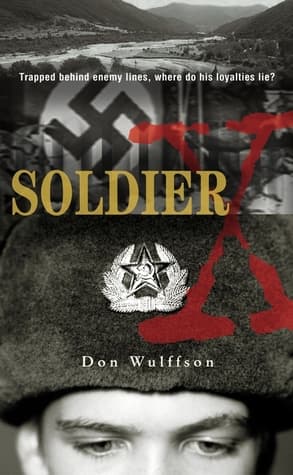
Don L. Wulffson (2001)
Genre
Historical Fiction / Young Adult
Reading Time
240 min
Key Themes
See below
Sign in to track this book
Trapped in the brutal Eastern Front, a young German soldier fakes his death to escape Hitler's war, only to become entangled in a new, equally dangerous deception.
In 1944, sixteen-year-old Erik Brandt, a naive German boy, is drafted into the Wehrmacht. He understands little of the war's true nature, only a vague sense of duty. After brief and inadequate training, Erik is deployed to the Eastern Front, a place known for its extreme brutality and high casualties. He is immediately thrown into the chaos of combat against Soviet forces. The initial shock of the trenches, constant shelling, the sight of dead comrades, and relentless cold quickly replace any romantic notions he had about soldiering with a stark realization of the war's grim reality. Erik's unit is constantly under threat, and survival becomes his only goal.
Erik finds himself in a ferocious battle against a Soviet assault. The fighting is intense and chaotic, with heavy losses on both sides. Amidst the explosions and gunfire, Erik is struck by shrapnel, sustaining a severe head injury. The impact knocks him unconscious, and he collapses onto the frozen ground. In the confusion and retreat, his comrades overlook him, assuming he is dead. He awakens later, alone and disoriented, covered in blood and mud, surrounded by the bodies of German and Soviet soldiers. His uniform is tattered, and his identification tags are missing or obscured. The sheer number of dead around him is overwhelming, and he realizes he is in a dangerous situation, deep behind enemy lines.
Struggling with his injuries and the freezing cold, Erik stumbles upon the body of a young Soviet soldier. A desperate idea forms: to survive, he must shed his German identity. He meticulously switches uniforms with the deceased Russian, taking the dead soldier's papers and discarding his own. He smears mud and blood on his face, trying to alter his appearance and hide his German features. This act comes from pure, instinctual survival. He is no longer Erik Brandt, German soldier, but an unknown, nameless Soviet 'Soldier X,' hoping to avoid capture or execution by blending in with the enemy.
His disguise works partially, as a patrol of Soviet soldiers eventually discovers him. They find him gravely wounded and unconscious, dressed in a Soviet uniform. Assuming he is one of their own, they take him to a makeshift Soviet field hospital. Erik's injuries are severe, and he remains unconscious for a long time, allowing him to avoid immediate interrogation. The Soviet medical staff, including a compassionate nurse named Tamara, tend to his wounds, unaware of his true identity. This recovery period is important, as it allows him to observe and learn about his captors without revealing his deception, buying him precious time.
As Erik slowly regains consciousness and strength, he faces the challenge of keeping his charade. He understands only a few Russian words, making communication difficult and risky. He must constantly pretend to suffer from amnesia or shock to explain his silence and confusion. Despite constant fear of exposure, he begins to form a tentative connection with Tamara, the nurse who cares for him with kindness. He also observes other Soviet soldiers and learns about their lives, realizing they are not the faceless monsters he was taught to believe. However, a doctor, Dr. Rostoff, grows suspicious of Erik's unusual behavior and lack of memory regarding specific Soviet military details.
Dr. Rostoff's suspicions eventually lead to Erik being interrogated by a Soviet intelligence officer. The officer, a shrewd and cynical man, presses Erik for details about his unit, his name, and his past. Erik, still feigning amnesia and shock, struggles to provide convincing answers, using vague generalities and the few Russian phrases he has learned. He is about to break down and confess when Tamara, sensing his distress and perhaps believing in his amnesia, intervenes on his behalf, vouching for his genuine confusion. Her intervention, combined with Erik's convincing act, buys him more time, but the experience leaves him shaken and aware of the constant danger he is in.
During his time at the field hospital, Erik sees moments that challenge his ideas about the 'enemy.' He sees Soviet soldiers mourning fallen comrades, sharing meager rations, and showing kindness to each other and even to him. He observes their shared suffering and their longing for peace, realizing they are not so different from his own people. A particularly moving moment occurs when he sees Tamara comforting a dying Soviet soldier. These experiences begin to weaken the propaganda he was fed in Germany, forcing him to confront the war's moral complexities and the shared humanity that goes beyond national differences. He starts to feel growing guilt and confusion about his deception.
As the war continues and the front lines shift, the field hospital prepares to move. Erik overhears conversations suggesting his true identity is close to being uncovered, or that he might be sent to a more secure facility for further interrogation. Realizing his time is running out, he decides to escape. Under cover of darkness, he slips away from the hospital, once again a man without a country, carrying only the Soviet uniform he wears and the few possessions he has acquired. He no longer tries to be a German or a Russian soldier, but simply a survivor seeking to escape the war entirely and find a place where he can be safe and free from constant threat of death and discovery.
Erik ventures into the vast, war-torn Russian countryside, surviving on his wits and whatever he can find. He meets displaced civilians, some wary, some sympathetic, and sees firsthand the devastating impact of the war on ordinary people. He witnesses acts of cruelty and kindness, further blurring the lines between 'good' and 'evil.' He struggles with hunger, cold, and loneliness, but also with the moral weight of his deception and the violence he has witnessed. He makes difficult choices, sometimes stealing to survive, other times offering help to those in need, constantly navigating the dangerous world consumed by conflict.
During his solitary journey, Erik stumbles upon a group of Soviet partisans, resistance fighters operating behind German lines. They are suspicious of him, a lone 'Soviet' soldier with no unit identification. They interrogate him, demanding to know his story and allegiance. Erik is forced to create an elaborate lie, using his acquired Russian knowledge and the details he observed at the hospital. His ability to mimic a Soviet soldier is put to the ultimate test. He is given a task that requires him to actively participate in their operations, forcing him to choose between maintaining his deception and potentially harming German soldiers, or revealing his true identity and facing certain death. This encounter represents the peak of his internal conflict and the ultimate test of his new, fabricated identity.
As the war nears its end, news of Germany's defeat slowly filters through the ravaged landscape. Erik, still with the partisans or having moved on, learns the fighting has stopped. The end of hostilities brings relief but also a deep sense of disorientation. He has survived, but at the cost of his original identity. He is no longer Erik Brandt, German, nor fully a Soviet soldier. He is a 'Soldier X,' a ghost of the war, carrying the trauma of his experiences and the burden of his deception. The future is uncertain; he doesn't know where he belongs, who he is, or if he can ever truly return to a normal life. He is left to ponder the ultimate price of survival in a world irrevocably changed by war.
The Protagonist
Erik transforms from an innocent, reluctant German soldier into a hardened survivor who loses his original identity and questions the nature of war and allegiance.
The Supporting
She remains a consistent figure of compassion and care, embodying the human spirit in wartime.
The Supporting
His character serves as a catalyst for Erik's heightened paranoia and eventual escape.
The Supporting
A static character whose role is to challenge Erik's deception directly.
The Mentioned
Their collective fate illustrates the common soldier's experience and the high cost of war.
The Supporting
They serve as a final test of Erik's ability to live as 'Soldier X' and his internal conflict.
The Mentioned
A static figure whose death enables the protagonist's survival and transformation.
The novel explores how war forces individuals to shed their original identities for survival. Erik Brandt, a German boy, literally exchanges his uniform and papers to become 'Soldier X,' a nameless Soviet. This act is a primal response to imminent death, but it leads to a deep internal struggle. He must constantly maintain his deception, fearing exposure, while questioning who he truly is without his original name and nationality. His journey shows how extreme circumstances can strip away an individual's sense of self, leaving them adrift in a fabricated identity.
“He was no longer Erik Brandt, German soldier. He was a ghost, a nameless X, and he would do anything to stay that way.”
Wulffson portrays the Eastern Front as a place of brutality and dehumanization. Soldiers on both sides are just cogs in a killing machine, their lives cheap and their deaths common. Erik witnesses horrific violence, starvation, and the psychological toll of constant fear. The propaganda he was fed about the 'enemy' quickly crumbles when faced with shared suffering and the realization that soldiers on both sides are simply human beings caught in a devastating conflict. The war strips away individual value, reducing people to targets or casualties.
“The trenches were a butcher's shop, and the men, no matter their uniform, were just meat.”
Despite the widespread violence, the novel highlights moments of unexpected empathy and shared humanity that go beyond national differences. Erik, disguised as a Soviet, experiences kindness from Nurse Tamara and observes the grief and camaraderie among Soviet soldiers. These interactions challenge his indoctrinated beliefs about the 'enemy,' making him recognize their shared fears, hopes, and suffering. This theme suggests that beneath uniforms and political ideologies, common human experiences connect people, even in the most brutal conflicts. Through these moments, Erik begins to question the war's purpose.
“He saw their faces, not as enemies, but as men, just like him, tired and afraid.”
Erik's journey is a story of lost innocence. He begins as a naive teenager with little understanding of war beyond propaganda. The Eastern Front quickly shatters his illusions, exposing him to horrors, death, and moral compromises. His act of deception, though necessary for survival, marks an irreversible step away from his youthful innocence. He learns that survival often demands brutal choices and that the world is far more complex and morally ambiguous than he ever imagined. By the end, he is a hardened survivor, but one burdened by trauma and the loss of his former self.
“The boy who had been drafted was gone, replaced by someone he barely recognized.”
Narrative told through Erik's eyes, immersing the reader in his subjective experience.
The story is told entirely from Erik Brandt's first-person point of view. This narrative choice provides immediate and intimate access to Erik's thoughts, fears, and internal struggles. Readers experience the horrors of the Eastern Front, the constant paranoia of maintaining his deception, and his growing moral conflicts directly through his subjective lens. This perspective allows for a deep exploration of his psychological transformation and makes his desperate choices and internal conflicts feel incredibly personal and immediate, fostering strong empathy for his predicament.
Erik's adoption of a dead Soviet soldier's identity as the central conflict driver.
Erik's decision to switch uniforms and impersonate a Soviet soldier is the primary plot device that drives the entire narrative. This act creates constant external tension (fear of discovery) and internal conflict (moral dilemma, loss of identity). It forces Erik into situations where he must constantly lie, observe, and adapt, shaping his interactions with Soviet characters and his understanding of the 'enemy.' The disguise is not just a uniform; it's a new persona that challenges every aspect of his being and dictates his every move and thought, making his survival dependent on its maintenance.
Erik's strategic use of memory loss to explain his lack of Russian knowledge and identity.
Erik's feigned amnesia is a crucial plot device that allows him to navigate his deception within the Soviet hospital. By pretending to have lost his memory due to his head injury, he can explain his inability to speak fluent Russian, his confusion about Soviet military details, and his general disorientation. This gives him time to learn about his surroundings and pick up enough Russian to sustain his charade. It's a clever survival tactic that buys him precious time and deflects immediate suspicion, though it eventually draws the attention of Dr. Rostoff and the interrogation officer.
The brutal, unforgiving environment that shapes the characters and plot.
The Eastern Front of World War II is more than just a backdrop; it is a character in itself, a plot device that dictates the extreme conditions and moral choices faced by Erik. Its legendary brutality, extreme weather, vastness, and the merciless nature of the fighting between German and Soviet forces create the crucible in which Erik's transformation occurs. The constant threat of death, the lack of resources, and the pervasive destruction are integral to the plot, forcing Erik into his desperate act of survival and shaping his cynical worldview. The setting itself is a force that strips away humanity and forces adaptation.
“I was a soldier, but I was also a boy. The two didn't fit together very well.”
— Erik Brandt reflecting on his dual identity as a teenage German soldier.
“In war, the truth is the first casualty.”
— Erik observing the propaganda and lies surrounding World War II.
“Sometimes survival means becoming someone you never thought you'd be.”
— Erik after assuming a Russian identity to stay alive.
“The uniforms changed, but the fear in the eyes was always the same.”
— Erik noticing the common humanity among soldiers on both sides.
“I learned that in war, there are no winners, only survivors.”
— Erik's realization after witnessing the devastation of battle.
“A name is just a label. It's what you do that defines you.”
— Erik contemplating his new identity as a Russian soldier.
“The hardest battles are the ones fought inside your own head.”
— Erik struggling with guilt and trauma from his experiences.
“War doesn't care how old you are. It takes everyone.”
— Erik reflecting on the youth of soldiers on both sides.
“I traded my childhood for a rifle, and I never got it back.”
— Erik lamenting the loss of his youth to the war.
“In the end, we're all just people trying to make it home.”
— Erik recognizing the shared desire for survival among soldiers.
“The line between enemy and friend is thinner than you think.”
— Erik after forming unexpected bonds with Russian soldiers.
“Memories are the only things the war couldn't take from me.”
— Erik holding onto his past amidst the chaos.
“Sometimes the bravest thing you can do is not fight.”
— Erik choosing to hide his true identity to survive.
“War teaches you that home isn't a place, it's a feeling.”
— Erik longing for safety and belonging during the conflict.
Ready to see how well you understood this book? Take our interactive quiz with 10 questions.







