“When you have a dream, you can't just let it sit there. You have to make it real.”
— Michael's grandfather imparting life wisdom.

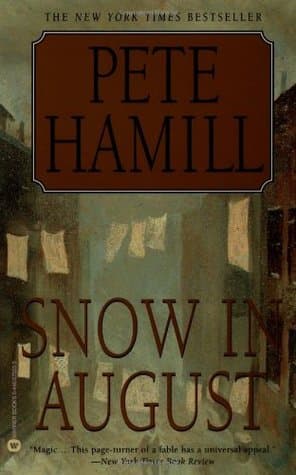
Pete Hamill (1997)
Genre
Fantasy / Historical Fiction
Reading Time
8-10 hours
Key Themes
See below
Sign in to track this book
In 1947 Brooklyn, an 11-year-old Irish Catholic boy and a Czech rabbi form an unexpected friendship, navigating the daily life and harsh realities of their working-class neighborhood, where faith and old stories intertwine.
In 1947, eleven-year-old Michael Devlin lives in his working-class Irish Catholic neighborhood in Brooklyn, filled with street games and memories of World War II. His father, a merchant marine, is often away, leaving Michael with his mother and the influence of local toughs like Frankie McCarthy. The neighborhood changes with the arrival of the Hirsch family, Eastern European Jewish refugees. Michael first meets the elderly Rabbi Judah Hirsch, a man with a quiet manner and a mysterious past, and his young grandson, Jacob. This first meeting carries curiosity and unspoken tensions from their different backgrounds.
Despite initial hesitation and the antisemitism of some in the neighborhood, Michael feels drawn to Rabbi Hirsch. They find common ground through baseball, specifically their shared love for the Brooklyn Dodgers. Rabbi Hirsch, new to American culture, quickly understands the game, impressing Michael with his knowledge. Their talks go beyond baseball, with the Rabbi sharing stories from his European past, full of folklore and old wisdom. Michael finds a new mentor and confidant in the wise old man, a contrast to his peers' rough world and his own father's frequent absence.
As their friendship grows, Rabbi Hirsch shares stories from Jewish mysticism and folklore with Michael. One tale particularly captures Michael's imagination: the legend of the Golem of Prague, a clay creature brought to life to protect the Jewish community from harm. The Rabbi describes the Golem's power and its connection to Hebrew letters and old rituals. Michael, who reads many comic books and adventure stories, is fascinated by the idea of a protector, especially as he sees the subtle and open acts of prejudice directed at the Hirsch family and other Jewish residents by Frankie McCarthy and his gang. The Golem becomes a strong symbol in Michael's mind, a possible answer to the injustices he observes.
The arrival of the Hirsch family and other Jewish refugees fuels existing antisemitic feelings in the neighborhood, especially among Frankie McCarthy's gang. Frankie, a charismatic but cruel bully, sees the newcomers as outsiders and targets them with increasing hostility. His pranks and taunts grow from verbal abuse to physical threats, often aimed at Jacob Hirsch and other Jewish children. Michael, torn between his loyalty to Rabbi Hirsch and the unspoken rules of his peer group, struggles with how to respond to Frankie's aggression. The tension in the neighborhood becomes noticeable, creating fear and division.
Watching the growing bullying and the pain it causes the Hirsch family, especially Rabbi Hirsch and Jacob, troubles Michael deeply. He feels a growing sense of responsibility and a desire to protect his friends. The stories of the Golem, which Rabbi Hirsch shared, begin to take on new meaning for Michael. He starts to think about bringing the Golem to life himself, believing it could stop Frankie McCarthy and his gang. This internal conflict pits his moral sense against the practical dangers and the fantastical nature of the Golem legend, pushing him to consider extreme measures for justice.
Driven by his wish to protect the Hirsch family and inspired by the Rabbi's tales, Michael begins to experiment with the Golem legend. He remembers the details Rabbi Hirsch shared about the Golem's creation: using clay, inscribing Hebrew letters, and speaking sacred words. In secret, Michael gathers clay and tries to mold a figure, carefully attempting to recreate the old ritual. He spends hours looking at the few Hebrew letters he knows, trying to give his creation life and purpose. These attempts are clumsy and childlike, but they are driven by strong belief and a desperate need for a protector.
Tensions in the neighborhood peak with a devastating act of antisemitism: the local synagogue is set on fire. This arson, carried out by Frankie McCarthy and his gang, deeply traumatizes the Jewish community and enrages Michael. In the chaos and fear after the fire, a figure of great size and strength appears, seemingly from nowhere, confronting Frankie McCarthy's gang. This mysterious entity, appearing to be made of clay and with an otherworldly presence, defends the synagogue and its members. Michael witnesses this event, and for him, it is proof that his attempts to awaken the Golem have succeeded, or that the true Golem has awakened.
After the synagogue fire and the Golem's appearance, Michael confronts Rabbi Hirsch, convinced that the Rabbi's stories were not just legends but a guide to a powerful reality. Rabbi Hirsch, seeing Michael's belief and the seriousness of the situation, finally tells the full truth about his own past. He admits that he himself brought a Golem from Prague, a protector he created to safeguard his family during the Holocaust. The Golem, a silent and powerful guardian, has been with him since, a sign of his faith and his will to survive. This revelation deepens Michael's understanding of the Rabbi's spiritual strength and the weight of his history.
The Golem, now a visible and active force, seeks out Frankie McCarthy. In a dramatic confrontation, the Golem corners Frankie, not to harm him physically, but to instill deep fear and a sense of consequences. The Golem's silent, imposing presence and its otherworldly power break Frankie's bravado, forcing him to face the terror he has caused others. This encounter changes Frankie, who, for the first time, truly understands his cruelty and the power he has provoked. The Golem's actions are a form of justice, not through violence, but through an overwhelming display of righteous power that leaves a lasting psychological impact.
After confronting Frankie McCarthy and ensuring the safety of the Jewish community, the Golem's purpose is complete. Rabbi Hirsch explains to Michael that the Golem is not meant to stay in the world permanently, but to be a temporary protector, activated only when greatly needed. With the immediate threat gone and some peace restored to the neighborhood, the Golem slowly begins to fade, returning to its inactive state. Michael witnesses this powerful and moving departure, understanding that true protection often comes from within and from community strength, even as he marvels at the reality of the ancient legend he helped awaken.
After these events, Michael Devlin is changed. His experiences with Rabbi Hirsch and the Golem have broadened his understanding of the world, teaching him about prejudice, courage, faith, and the power of stories. The neighborhood also subtly shifts. Frankie McCarthy is humbled, and open hostility towards the Jewish community lessens. Michael has gained a deeper appreciation for human nature and the importance of standing up for what is right. He carries the lessons learned, the wisdom shared by Rabbi Hirsch, and the memory of the Golem into his adolescence, marked by his summer of wonder and moral awakening.
The Protagonist
Michael transforms from an impressionable boy into a young man with a strong moral compass, learning to stand against prejudice and understanding the power of faith and stories.
The Supporting/Mentor
Rabbi Hirsch finds a new purpose in sharing his wisdom with Michael and reactivating his Golem to protect his new community, ultimately finding a measure of peace and a renewed sense of hope.
The Antagonist
Frankie's arc involves a dramatic fall from power and a humbling confrontation with the Golem, forcing him to face the consequences of his prejudice and cruelty.
The Supporting
Jacob's arc is less about personal development and more about representing the impact of prejudice, ultimately finding a safer, more accepting environment.
The Supporting
Mrs. Devlin's arc is largely static, serving as a pillar of stability and love for Michael.
The Mentioned
Mr. Devlin's arc is not explored, as his role is primarily to define Michael's home life and his need for a male mentor.
The novel shows the widespread antisemitism in post-WWII Brooklyn, from casual insults to violent acts. Frankie McCarthy and his gang represent this prejudice, targeting Jewish refugees like the Hirsch family. The burning of the synagogue clearly shows the destructive power of hatred. Michael's struggle to understand and fight this prejudice forms a central moral conflict, showing how deeply ingrained and illogical such hatred can be. The theme highlights the importance of empathy and standing up against injustice, even when it is unpopular.
“''Why do they hate us so much?' Jacob asked, his voice barely a whisper, echoing the unspoken question in Michael's own heart.”
Faith appears in several forms: Michael's early understanding of his Catholic upbringing, Rabbi Hirsch's deep, mystical Jewish faith, and a simple belief in the impossible. Rabbi Hirsch's strong faith despite great suffering and his connection to old traditions are central. Michael's belief in the Golem, first from stories, grows into a strong conviction that something extraordinary can happen to fix wrongs. The novel suggests that belief, whether religious or in the power of stories, can provide strength, meaning, and even cause change in the world, blurring the lines between the spiritual and the physical.
“''Faith, Michael,' the Rabbi had said, 'is not seeing with your eyes, but with your heart.'”
Stories, both old myths and current tales, are important to the novel. Rabbi Hirsch's tales of the Golem of Prague are not just bedtime stories; they are living histories, full of spiritual meaning and the power to shape reality. Michael's love for comic books and adventure stories prepares him to accept the fantastical parts of the Golem legend. The narrative itself acts as a powerful story, showing how myths can offer ways to understand the world, process trauma, and inspire action. It suggests that stories connect us to the past, teach moral lessons, and can, in unusual situations, influence the present.
“''Stories,' Rabbi Hirsch whispered, 'are how we remember what we are, and what we might become.'”
Michael Devlin's journey is a coming-of-age story, set against post-war social tensions. He changes from a naive boy to one who understands the complexities of good and evil, prejudice and acceptance. His friendship with Rabbi Hirsch and his involvement with the Golem's legend force him to face difficult moral choices and to develop a strong sense of personal responsibility. He learns to question his community's biases and to stand up for those who are marginalized. This awakening is not just intellectual but deeply emotional, shaping his character and his future understanding of the world.
“He knew, with a certainty that hummed in his bones, that some things were bigger than baseball, bigger than gangs, bigger even than the fear that tried to hold him back.”
The novel explores how people and communities define themselves and seek belonging. Jewish refugees, like the Hirsch family, are outsiders in the Irish Catholic neighborhood, constantly fighting for acceptance and safety. Michael also deals with his identity as he balances his loyalty to his friends with the expectations of his peers and community. The Golem itself represents a collective identity and a protector of a threatened heritage. The theme highlights the challenges of integration, the pain of being 'othered,' and the search for a place where one can truly belong and be safe.
“''To be a stranger in a strange land,' Rabbi Hirsch often said, 'is a test of the soul.'”
An ancient Jewish myth brought to life as a literal and symbolic protector.
The Golem legend serves as the central magical realism element and a powerful symbol. Initially introduced as a story told by Rabbi Hirsch, it slowly blurs the line between myth and reality. It functions as a literal protector against anti-Semitism and a symbolic representation of the Jewish people's resilience and their deep-seated need for defense against persecution. For Michael, it's a vehicle for his growing moral consciousness and his desire to right wrongs. The Golem embodies the idea that ancient wisdom and faith can manifest powerful, tangible effects in the modern world, offering hope and justice where human systems fail.
An older, wiser character who guides the protagonist.
Rabbi Judah Hirsch serves as the classic mentor figure for Michael Devlin. He provides Michael with knowledge, wisdom, and a moral compass that transcends the limited worldview of his immediate neighborhood. The Rabbi introduces Michael to the world of Jewish mysticism, history, and a deeper understanding of faith and justice. He acts as a surrogate father figure, offering the emotional and intellectual guidance that Michael's often-absent father cannot. His role is crucial in Michael's coming-of-age, as he broadens Michael's horizons and encourages him to think critically about prejudice and the nature of good and evil.
Hints and clues about future events, particularly the Golem's appearance.
The detailed stories Rabbi Hirsch tells Michael about the Golem of Prague, its creation, its purpose, and its powers, serve as significant foreshadowing. These narratives aren't just background; they are explicit instructions and descriptions of what is to come. Every detail the Rabbi shares about the Golem's construction and activation builds anticipation and prepares both Michael and the reader for its eventual manifestation. This device makes the Golem's appearance feel earned and logical within the story's magical realist framework, rather than a sudden, unexplained event, strengthening the connection between myth and reality.
A unifying cultural element representing hope, community, and American identity.
Baseball, specifically the Brooklyn Dodgers, acts as a powerful symbol throughout the novel. For Michael, it represents childhood innocence, community, and a shared passion. For Rabbi Hirsch, it's a gateway into understanding American culture and a point of connection with Michael. The Dodgers' struggles and triumphs mirror the broader challenges and hopes of the characters and the neighborhood. It symbolizes a common ground that transcends ethnic and religious divides, suggesting the possibility of unity and shared experience even amidst prejudice. The game offers a temporary escape from hardship and a source of collective joy and identity.
“When you have a dream, you can't just let it sit there. You have to make it real.”
— Michael's grandfather imparting life wisdom.
“The past is never dead. It's not even past.”
— A recurring theme about the lingering impact of history and prejudice.
“Sometimes you have to break the rules to do what's right.”
— Michael grappling with his conscience and loyalty.
“A story is a way of remembering. A way of keeping things alive.”
— Rabbi Judah reflecting on the importance of narratives.
“Fear is a powerful thing. It can make good men do bad things.”
— Observing the community's reaction to perceived threats.
“There are miracles all around us, if only we open our eyes to see them.”
— Highlighting the wonder in everyday life and the supernatural.
“Baseball is more than just a game. It's life itself.”
— Michael's passion for baseball reflecting larger life lessons.
“Hate is a sickness. It eats away at you from the inside.”
— Discussing the destructive nature of bigotry.
“Even in the darkest times, there is always hope.”
— A message of resilience amidst adversity.
“Friendship knows no boundaries, no religion, no color.”
— The bond between Michael and Rabbi Judah's family.
“Sometimes the greatest strength is found in forgiveness.”
— A character choosing reconciliation over vengeance.
“The world is full of wonders, both seen and unseen.”
— Emphasizing the magical realism and hidden depths of reality.
“A true hero isn't afraid to stand up for what's right, even when it's hard.”
— Michael's development into a courageous young man.
“Language is a bridge. It connects us, or it can divide us.”
— The importance of communication and understanding between cultures.
“The greatest battles are often fought within ourselves.”
— Characters struggling with internal conflicts and moral choices.
Ready to see how well you understood this book? Take our interactive quiz with 10 questions.

Biography coming soon.







