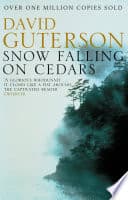
David Guterson is an American novelist, short story writer, poet, journalist, and essayist. He is best known as the author of the bestselling Japanese American internment novel Snow Falling on Cedars.

David Guterson (2009)
Genre
Literary Fiction / Historical Fiction / Mystery / Romance
Reading Time
12 Minutes
Key Themes
See below
Sign in to track this book
On an island shrouded in mist and prejudice, a murder trial unearths a buried wartime secret and the tragic echoes of a forbidden love affair between a white boy and a Japanese girl.
In December 1954, on the fictional San Piedro Island in Puget Sound, the body of local fisherman Carl Heine Jr. is discovered tangled in his gill net aboard his fishing vessel, the 'Susan Marie.' He died from a severe blow to the head. Sheriff Art Moran and his deputy, Abel Nordsen, investigate. Suspicion quickly falls on Kabuo Miyamoto, a Japanese-American fisherman who had a long-standing dispute with Carl over land. Kabuo is known for his calm nature and his skill with a Kendo sword, making him a likely suspect to many islanders. He is arrested and charged with Carl Heine's murder, setting the stage for a racially charged trial.
Ishmael Chambers, a local newspaper editor who lost an arm fighting in World War II, covers the murder trial. Ishmael has a deep, unrequited love for Hatsue Miyamoto, Kabuo's wife. This love began in their childhood before the war. Hatsue was Ishmael's first love, and their relationship ended when Hatsue and her family, along with all Japanese-Americans on the island, were sent to internment camps during the war. Covering Kabuo's trial forces Ishmael to face his unresolved feelings for Hatsue, his own wartime trauma, and the island's prejudiced history, all while trying to act professionally.
The prosecution, led by Alvin Hooks, presents a case based on the land dispute between the Heine and Miyamoto families. Kabuo's father had been buying a strawberry field from Carl Heine Sr. on an installment plan. When the Miyamotos were interned during the war, the elder Heine broke the agreement, selling the land to another party. After the war, Kabuo tried to buy the land back from Carl Heine Jr., but Carl refused to sell it for the original price. This unresolved grievance, the prosecution argues, gave Kabuo a strong motive to kill Carl Heine Jr. The trial brings these deep-seated resentments into the open.
The trial takes place in the small San Piedro courthouse, with Judge Lew Fielding presiding. The prosecution calls witnesses who testify to Kabuo's strength, his expertise with a Kendo stick (which could be the murder weapon), and the animosity over the land. Witnesses also describe Carl Heine Jr. as a strong, respected fisherman. The defense, led by Nels Gudmundsson, an aging, respected lawyer, tries to create reasonable doubt by pointing out inconsistencies in the prosecution's timeline and the lack of definite physical evidence linking Kabuo to the murder weapon. The courtroom reflects the island's racial and social divisions.
Hatsue Miyamoto takes the stand, a key moment in the trial. She testifies about her husband's character, describing him as a diligent, honorable man incapable of murder. She also recounts the history of the land dispute, explaining the Miyamoto family's deep emotional connection to the strawberry fields and their sense of injustice regarding its loss. Her testimony, delivered with quiet dignity, offers insight into the Japanese-American community's perspective and the lasting pain of the internment. Ishmael, watching from the press box, is deeply affected by her presence and words, reawakening his long-suppressed feelings.
Throughout the trial, Ishmael's thoughts often return to his youth and his secret romance with Hatsue. He vividly remembers their clandestine meetings in the cedars, their shared innocence, and their blossoming love. He recalls the deep connection they shared, a bond that went beyond the racial prejudices of the time. The painful memory of Hatsue ending their relationship with a letter from the internment camp, choosing her own people and traditions over him, still haunts him. These memories color his view of the trial, making it hard for him to remain an objective observer.
The novel frequently uses flashbacks to the World War II internment of Japanese-Americans, a period that deeply scarred the San Piedro community. These sections detail the forced relocation, the loss of homes and livelihoods, and the deep sense of betrayal and injustice felt by those interned. The camps are shown as desolate, dehumanizing places where families struggled to maintain their dignity and cultural identity. This historical background is important to the trial, showing the systemic prejudice that underlies many of the island's interactions and influencing the jury's potential biases.
Nels Gudmundsson, Kabuo's defense attorney, systematically works to dismantle the prosecution's largely circumstantial case. He emphasizes the lack of direct evidence, such as eyewitnesses or a definite murder weapon. He cross-examines witnesses to expose inconsistencies and biases, especially regarding racial prejudice. Gudmundsson also suggests an accidental death, proposing that Carl Heine Jr. could have fallen and hit his head, or that another vessel could have struck his boat. His strategy is to sow enough doubt in the minds of the jury to prevent a conviction, arguing that the evidence does not meet the burden of proof.
While reviewing the court transcripts and his notes, Ishmael Chambers has a sudden realization. He remembers a detail about the weather on the night Carl Heine Jr. died: a rare, heavy fog. Combining this with Carl's medical history of a head injury from the war, which could have led to dizziness, and the specific location of Carl's body on the boat, Ishmael deduces a plausible alternative scenario. He theorizes that Carl, working in the dense fog, might have lost his balance due to a dizzy spell, fallen backward, and struck his head on a cleat on his boat, causing his death.
Ishmael now faces a difficult moral problem. He has information that could clear Kabuo Miyamoto, the man married to the woman he still loves. Freeing Kabuo means Hatsue would stay with him, ending any lingering hope Ishmael might have had. His personal feelings of jealousy and resentment conflict with his journalistic integrity and sense of justice. He struggles with the temptation to keep the information to himself, allowing Kabuo to be convicted. This internal conflict forces him to confront his own prejudices, his past, and the kind of man he truly wants to be.
Ishmael chooses to follow his conscience. He gives his findings to Judge Fielding, who then instructs the jury to consider the possibility of Carl Heine Jr.'s accidental death. The jury, which had been deadlocked, now has a new perspective to consider. After more deliberation, they return a verdict of not guilty for Kabuo Miyamoto. Kabuo is freed, returning to his wife and family. The island community is left to deal with the implications of the trial, the lingering prejudices, and the complex history that binds them. While justice is served, a sense of uneasy peace settles over San Piedro.
The Protagonist
Ishmael begins as a bitter, emotionally walled-off man, but through the trial, he confronts his past and ultimately makes a moral choice that redeems him.
The Supporting
Hatsue remains steadfast in her loyalty and love for her family, embodying resilience in the face of injustice and personal hardship.
The Protagonist/Accused
Kabuo endures the trial with quiet dignity, his steadfastness emphasizing the injustice of his situation and the resilience of his spirit.
The Victim
Carl's arc is cut short by his death, but his life and the circumstances of his passing drive the entire narrative and expose the island's complex history.
The Supporting
Nels consistently upholds the principles of justice, serving as a moral anchor in a racially charged trial.
The Antagonist
Hooks remains focused on securing a conviction, representing the legal system's potential for bias and ambition.
The Supporting
Art Moran maintains his role as a diligent law enforcement officer, striving for objectivity within a biased community.
The Supporting
Etta remains steadfast in her belief of Kabuo's guilt and her attachment to the land, representing the entrenched prejudices of the island.
The novel examines justice in a community deeply scarred by racial prejudice, particularly against Japanese-Americans. Kabuo Miyamoto's trial is not just about guilt or innocence, but about whether a fair trial can happen when historical biases and wartime resentments are so widespread. The story shows how easily 'justice' can be twisted by fear, ignorance, and a desire for revenge, contrasting the ideal of legal fairness with the reality of human bias. Ishmael's internal struggle shows this theme.
“Accusation was a weapon, and guilt or innocence was a matter of cultural pride.”
Love, both romantic and familial, and the impact of loss are central to the story. Ishmael's lifelong, unrequited love for Hatsue is a driving force, shaping his actions and internal conflicts. The love between Kabuo and Hatsue, tested by internment and the murder trial, shows resilience and loyalty. The loss of loved ones, land, and innocence (both personal and communal) leaves deep, lasting scars on the characters and the island. The novel explores how these strong emotions dictate choices and shape lives.
“Love was a country he had visited as a child, and he had forgotten the way home.”
The past constantly affects the present in San Piedro. Memories of the Japanese-American internment during World War II, the land disputes, and the childhood romance between Ishmael and Hatsue are not just background; they are active forces shaping the characters' views and actions. The novel argues that history, especially unacknowledged or unresolved injustices, casts a long shadow, influencing current events and making true objectivity difficult. The trial itself is a reliving and reinterpretation of these layered memories.
“Memory is a stranger to itself, a country where the past is always present.”
The rugged, beautiful San Piedro Island, with its cedars, fog, and stormy seas, is more than just a setting; it is an active presence in the story. The natural world witnesses human events, both tender and tragic, and often mirrors the characters' internal states or the unfolding drama. The fog, in particular, becomes a crucial part of the plot, hiding truth and then revealing it. The island's isolation and harsh beauty highlight the resilience and vulnerability of its inhabitants.
“The fog was like a white ocean, and the island was just a ship adrift.”
Unveiling past events to explain present motivations and biases.
Guterson extensively uses flashbacks to reveal the intricate history of San Piedro Island and its inhabitants. These non-linear narrative elements transport the reader to Ishmael and Hatsue's childhood romance, the harrowing experience of the Japanese-American internment camps, and the origins of the land dispute between the Heine and Miyamoto families. These flashbacks are crucial for understanding the deep-seated prejudices, motivations, and emotional complexities that drive the characters and influence the murder trial, providing essential context that current events alone cannot convey.
Providing insight into multiple characters' thoughts and the island's collective consciousness.
The novel is primarily told from a third-person omniscient perspective, allowing the narrator to delve into the minds and histories of various characters, including Ishmael, Hatsue, Kabuo, and even minor figures like Nels Gudmundsson. This narrative choice provides a panoramic view of the island's community, revealing not only individual thoughts and feelings but also the collective conscience, biases, and historical memory of San Piedro. It allows the author to explore themes of prejudice and justice from multiple angles, creating a rich and complex tapestry of human experience.
Representing enduring love, hidden secrets, and the island's steadfast nature.
Cedar trees are a powerful recurring symbol throughout the novel. They represent the enduring, deep-rooted nature of the island itself, as well as the hidden secrets and profound memories held within its landscape. The cedars are the setting for Ishmael and Hatsue's secret childhood romance, making them a symbol of their young love and the clandestine nature of their connection. Later, they come to symbolize the quiet strength and resilience of the Japanese-American community, as well as the silent witness of nature to human events, both beautiful and tragic.
Obscuring truth and complicating human perception.
Fog is a recurring motif that plays a crucial role in the narrative, both literally and metaphorically. Literally, the dense fog on the night of Carl Heine Jr.'s death becomes a key element in Ishmael's eventual theory of accidental death, obscuring vision and making navigation treacherous. Metaphorically, the fog represents the obfuscation of truth by prejudice, the difficulty of seeing clearly through personal biases and historical resentments, and the uncertainty surrounding human events. It highlights how easily facts can be misinterpreted or unseen, impacting justice.
Ready to see how well you understood this book? Take our interactive quiz with 10 questions.
David Guterson is an American novelist, short story writer, poet, journalist, and essayist. He is best known as the author of the bestselling Japanese American internment novel Snow Falling on Cedars.