“Until a man is twenty-five, he still thinks, every so often, that under the right circumstances he could be the baddest motherfucker in the world.”
— Hiro Protagonist reflecting on youthful confidence and ambition.


Neal Stephenson (2003)
Genre
Fantasy / Science Fiction
Reading Time
12-15 hours
Key Themes
See below
Sign in to track this book
In a future Los Angeles where pizza delivery is a sword fight and the internet is a fully realized virtual world, a legendary hacker and a fearless skateboard courier must uncover the secrets of an ancient Sumerian language to stop a digital drug that threatens to collapse reality itself.
Hiro Protagonist, a hacker and freelance samurai, works as a pizza delivery driver for the Mafia in a corporatized Los Angeles. After a failed delivery to the Kourier compound, involving a high-speed chase and a near-total loss of his cargo, Hiro is fired. With his job gone, he spends more time in the Metaverse, a virtual reality internet. There, he finds a new digital drug called 'Snow Crash' which looks like a bitmap image. When his friend and hacker, Da5id, is exposed to Snow Crash in the virtual club 'The Black Sun,' he suffers a brain-deadening 'infocalypse' in the Metaverse and a vegetative state in the real world, showing the drug's effects.
Hiro, now unemployed and affected by Da5id's state, investigates Snow Crash. He meets Y.T., a resourceful teenage Kourier who delivers data and packages on her high-tech skateboard. Y.T. helps Hiro with transport and information, and they form an alliance. Their investigation quickly points to L. Bob Rife, a powerful media mogul who owns many ancient Sumerian texts and runs a cult. Rife's connection to the drug is a red flag, and Hiro suspects a deeper plot involving language.
Hiro accesses The Librarian, an artificial intelligence in the Library of Congress's Metaverse counterpart, to research Snow Crash. The Librarian says Snow Crash is a 'linguistic virus' from ancient Sumerian. It explains the 'ur-language' and the Tower of Babel myth, suggesting a primal language once existed that could directly program the human brain. The Librarian explains that Sumerian was one of the last languages to keep direct brain-programming capabilities and that the goddess Asherah was linked to this power. This links Snow Crash to an ancient form of mind control.
While Hiro researches linguistic theory, Y.T. continues her Kourier work, which takes her to the 'Raft' – a large collection of ships and refugee camps off the coast of Los Angeles. She discovers that L. Bob Rife recruits people from these camps, offering them shelter and food for their loyalty and participation in his cult. Y.T. sees that many refugees are exposed to Snow Crash, or a similar substance, which seems to make them more open to Rife's influence. She realizes Rife is building an army of 'gargoyles' – individuals whose minds have been damaged by the virus.
Through research with The Librarian and his hacking skills, Hiro finds that the Snow Crash virus is a modern form of an ancient linguistic weapon. He learns about the Sumerian Enki, who created the ur-language, and the goddess Asherah, who supported its use. The story connects to the biblical Tower of Babel, suggesting that the confusion of tongues was a deliberate act by Enki to prevent humanity from being controlled by a single, powerful linguistic virus. Snow Crash is an attempt to reverse this ancient safeguard and re-establish a single, brain-programming language, turning its victims into programmable drones.
Hiro tracks down Vitaly Chernobyl, a former hacker and one of the original Metaverse developers, who had a disagreement with L. Bob Rife. Chernobyl, living in a fortified bunker, gives Hiro information about Rife's plans. He says Rife uses a combination of the digital Snow Crash virus and a biological variant, spread through tainted blood and religious ceremonies, to control his followers. Chernobyl explains that Rife wants to use the virus to create a global religion and control the minds of the population, turning them into a unified, programmable entity.
Y.T.'s investigations lead her to find a hidden nuclear bomb, meant for Rife's organization. In her attempt to get it, she is captured by Rife's henchmen, including Raven, a large Aleut hitman with a nuclear bomb on his motorcycle. Y.T. is taken to the Kourier compound, which Rife plans to use to spread his virus. Her capture puts her in danger and shows the urgency of Hiro's mission to stop Rife.
Hiro, using his hacking skills, infiltrates the Metaverse to confront Rife's forces and rescue Y.T. He fights a virtual battle, showing his skill as a samurai avatar. During this fight, he meets Raven, who is also in the Metaverse. Raven explains his personal motivation: revenge against the United States for the injustices to his Aleutian ancestors, specifically atomic testing on Amchitka Island. Raven believes Rife's plan to destroy American society fits his goal of retribution.
The climax happens on the Raft, where Rife prepares to broadcast the full Snow Crash virus. Hiro, Y.T. (having escaped or been rescued), and their allies, including the Mafia and a group of 'Rat Thing' hackers, gather to stop Rife. A battle takes place, combining real-world combat with Metaverse hacking. Hiro confronts Rife, trying to stop the broadcast of the linguistic virus. The fight is intense, with high stakes for human consciousness and free will. Raven, despite his initial alliance with Rife, turns against him because of his own moral code.
Hiro and Y.T., with their allies, stop L. Bob Rife's plan to unleash the Snow Crash virus and establish global mind control. Rife is defeated, and the immediate threat is gone. However, the novel ends with the understanding that linguistic programming and the potential for similar viruses still exist. The world remains fragmented and chaotic, but a major catastrophe has been avoided. Hiro and Y.T.'s partnership works, and they become heroes in a world on the brink of infocalypse, with the future of human consciousness uncertain.
The Protagonist
From a disillusioned pizza delivery driver, Hiro evolves into a world-saving hero, embracing his past skills to combat a global threat.
The Protagonist/Supporting
Y.T. grows from an independent, self-serving Kourier into a crucial partner in preventing global mind control, developing a sense of responsibility beyond her immediate survival.
The Antagonist
Rife's arc is one of escalating ambition and malevolence, culminating in his attempted global takeover and ultimate defeat.
The Antagonist/Supporting
Raven's arc involves a gradual shift from Rife's loyal enforcer to an unexpected ally, driven by his own sense of justice and cultural loyalty.
The Supporting
Uncle Enzo remains a consistent source of pragmatic wisdom and power, representing a stable force in a destabilized world.
The Supporting
The Librarian remains a static, omniscient source of information, crucial for Hiro's understanding of the plot.
The Supporting/Mentioned
Da5id's arc is cut short, serving as a tragic warning and a powerful motivator for Hiro.
The Supporting
Chernobyl serves as a crucial information source, a 'prophet' of the infocalypse, whose warnings are validated by the unfolding events.
The Supporting
Ng remains a consistently reliable and skilled technical ally for Y.T. and Hiro.
The novel explores the connection between language, thought, and reality. Snow Crash suggests that language is an operating system for the human mind. The ancient Sumerian language is an 'ur-language' that can directly program the brain, with the Tower of Babel myth reinterpreted as an act to 'crash' this primal language and prevent universal mind control. The digital virus, Snow Crash, is a modern attempt to re-establish this linguistic control, turning victims into programmable 'gargoyles.' This theme shows the power of words to shape perception and behavior, and the implications of losing linguistic autonomy.
““The Sumerians believed that the brain was a computer, and that language was its operating system.””
In a future with corporate franchises, autonomous enclaves, and virtual reality, the novel examines how individuals create and keep their identities. Hiro Protagonist struggles with his dual identity as a Metaverse hacker and a pizza delivery driver. Y.T. protects her independence as a Kourier, resisting being part of any system. The Snow Crash virus attacks this theme by threatening to erase individual consciousness, reducing victims to a collective, programmable state. The story questions what it means to be a unique 'self' when external forces try to define, control, or erase personal identity.
““In the beginning was the Word. And the Word was Snow Crash.””
Stephenson shows a near-future America where the federal government has mostly collapsed, replaced by corporate-owned franchises and sovereign enclaves. This is shown through the strip malls, the Mafia's pizza delivery, and the Kourier system that fills gaps in traditional services. While seemingly chaotic, this world is still run by powerful corporate entities like L. Bob Rife's media empire. The novel critiques unchecked capitalism and the loss of public infrastructure, showing how such a fragmented society can become a place for cults and totalitarian control, even disguised as 'freedom.'
““The United States is no longer a country, it's a collection of franchises.””
Snow Crash combines ancient mythology, especially Sumerian and biblical stories, with technology. The Metaverse is a technological 'heaven' and 'hell,' while the Snow Crash virus comes from the ancient myth of the Tower of Babel and the Sumerian goddess Asherah. Hiro's quest is a mythological journey, comparing ancient linguistic programming and modern computer viruses. This theme suggests that human desires for control, meaning, and connection stay the same, appearing through different technological or spiritual means over time. It blurs the lines between science fiction and fantasy, suggesting that all technology may have mythic roots.
““The Metaverse is a world in which hackers are gods.””
A shared virtual reality world, serving as both a refuge and a battleground.
The Metaverse is a persistent, shared virtual reality environment that serves as a successor to the internet. Users interact through customizable avatars and can access information, entertainment, and social spaces. It functions as a central setting for much of the novel's action, particularly for Hiro's investigations and battles against the Snow Crash virus. The Metaverse is not just a backdrop but an integral part of the plot, as the digital virus originates and spreads within it, directly impacting real-world consciousness. It highlights the blurring lines between virtual and physical realities and the psychological impact of digital existence.
A unique virus that exploits the brain's innate language processing, acting as both digital and biological threats.
Snow Crash is the central plot device, a dual-nature virus that is both digital (a bitmap image in the Metaverse) and biological (a drug in the real world). Its unique aspect is its function as a 'linguistic virus,' exploiting the brain's innate language processing capabilities. It is theorized to be a modern manifestation of an ancient Sumerian 'ur-language' that could directly program human minds. This device drives the entire plot, as Hiro and Y.T. race to understand its origins and prevent its global dissemination, which would effectively turn human beings into programmable drones, erasing their individuality and free will.
The story follows two distinct but converging protagonists, Hiro and Y.T., each contributing unique perspectives and skills.
The novel employs a dual protagonist structure, alternating between Hiro Protagonist's Metaverse-focused, intellectual investigation into the linguistic virus and Y.T.'s real-world, street-level adventures as a Kourier. This device allows Stephenson to explore both the abstract, theoretical aspects of the infocalypse and its concrete, physical manifestations in the fragmented, corporatized world. Their narratives, initially separate, gradually interweave and eventually converge, demonstrating how different skill sets and perspectives are necessary to combat a multifaceted threat. This structure enriches the world-building and provides a comprehensive view of the conflict.
A massive, floating refugee camp and a symbol of societal collapse and exploitation.
The Raft is a vast, floating collection of ships and makeshift structures off the coast of Los Angeles, inhabited by millions of refugees and the disenfranchised. It serves as a stark symbol of societal collapse and the desperate conditions outside the privileged enclaves. For the plot, the Raft is crucial as L. Bob Rife uses it as a recruiting ground for his cult, exploiting the vulnerable population and disseminating the biological variant of the Snow Crash virus among them. It's where Y.T. uncovers the extent of Rife's manipulation and where a major confrontation ultimately takes place, highlighting the social and economic inequalities of the dystopian future.
A satirical commentary on corporate power and the breakdown of traditional governance.
The Mafia operating a highly efficient, quality-obsessed pizza delivery service is a satirical plot device that highlights the novel's themes of corporatization and the breakdown of traditional government. In a world where nation-states have fragmented, the Mafia functions as a legitimate, if extralegal, corporate entity with its own strict rules, justice system, and even employee benefits. It provides Hiro with a temporary job and a connection to a powerful, organized force, ultimately becoming an unexpected ally against L. Bob Rife. This device uses humor to critique the absurdities of extreme capitalism and the vacuum of power in a post-governmental society.
“Until a man is twenty-five, he still thinks, every so often, that under the right circumstances he could be the baddest motherfucker in the world.”
— Hiro Protagonist reflecting on youthful confidence and ambition.
“The Deliverator belongs to an elite order, a hallowed subcategory. He's got esprit up to here.”
— Introduction of Hiro's job as a pizza delivery driver in a dystopian future.
“When you are wrestling for possession of a sword, the man with the handle always wins.”
— Hiro's practical advice during a fight scene.
“The only thing that matters is the information. The rest is just packaging.”
— Hiro discussing the importance of data in the Metaverse.
“It's not a world, it's a platform. A platform for the delivery of pizza.”
— Satirical commentary on corporate control and consumerism.
“The Metaverse. His computer-generated universe. His own private universe.”
— Description of the virtual reality world central to the plot.
“Bad news travels fast. Good news takes the scenic route.”
— A cynical observation on human nature and communication.
“He is a warrior for hire, a freelance hacker, a pizza delivery driver. He is the Deliverator.”
— Hiro's multifaceted identity in a fragmented society.
“The Raft is a floating city, a nation of refugees, a place where the rules are different.”
— Description of a key setting where societal norms break down.
“Language is a virus from outer space.”
— A central theme exploring the idea that language can infect and control minds.
“In the beginning was the Word, and the Word was God, and the Word was a virus.”
— A riff on biblical language to tie into the novel's linguistic themes.
“He's not just a hacker; he's a swordfighter. In the Metaverse, that's what counts.”
— Highlighting the blend of physical and virtual skills in Hiro's character.
“The world is full of things that are more interesting than you are.”
— A blunt reminder of human insignificance in a vast, chaotic world.
“Pizza delivery is a sacred trust. You don't fuck with the Deliverator.”
— Emphasizing the absurd seriousness given to mundane tasks in the dystopia.
Ready to see how well you understood this book? Take our interactive quiz with 10 questions.
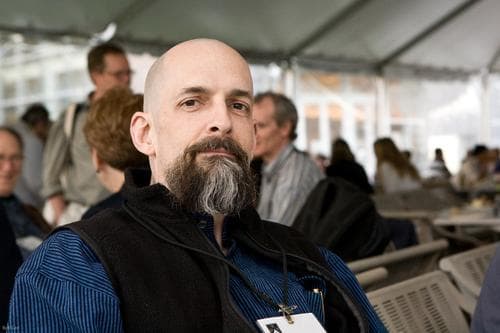
Neal Town Stephenson is an American writer known for his works of speculative fiction. His novels have been categorized as science fiction, historical fiction, cyberpunk, postcyberpunk, and baroque.







