“Fear is a story you tell yourself.”
— Ollie reflects on facing the scarecrows in the mist.

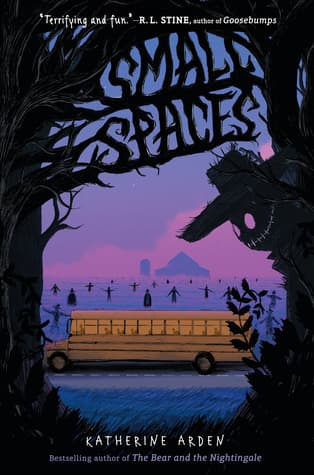
Katherine Arden (2018)
Genre
Fantasy / Children's / Mystery / Young Adult
Reading Time
240 min
Key Themes
See below
Sign in to track this book
After stealing a cursed book, a grieving girl and her classmates must outrun a sinister smiling specter and its scarecrow minions, heeding the chilling advice to 'avoid large places, keep to small' as night falls.
Eleven-year-old Ollie, still grieving her mother's death, finds comfort in books. One day, by the river, she meets a distraught woman threatening to throw a book into the water. Ollie snatches the book and runs away. The old, leather-bound book tells the story of a girl named Beth, two brothers (Jonathan and Caleb), and a sinister 'smiling man' who grants wishes for a terrible price. The story hints at a dark bargain and a tragic fate. Ollie is drawn into the eerie narrative, unaware of how closely its events will soon mirror her own life.
The next day, Ollie's class goes on a field trip to Smoke Hollow, a local historical farm known for its apple orchards and a haunting past. While exploring, Ollie finds an old, overgrown graveyard. To her shock, she sees headstones with the names of Beth, Jonathan, and Caleb, the characters from the book she stole. This discovery makes her question if the story is true. The coincidence unnerves her, suggesting a sinister connection between the book and Smoke Hollow.
On the way home from Smoke Hollow, the school bus breaks down on a desolate road. Ms. Read, the teacher, decides to walk back to the farm for help, leaving the children with the bus driver, Mr. Volkov. Before she leaves, Ollie’s broken digital watch, a memento from her mother, suddenly shows a countdown and the word 'RUN.' Mr. Volkov, in a calm voice, warns the children that 'at nightfall they'll come for the rest of you' and advises them to 'avoid large places. Keep to small.' The sun begins to set.
Following the bus driver's urgent warning, Ollie, along with classmates Coco and Brian, decides to run into the surrounding woods. Most of the other children stay on the bus, thinking the warning is a joke. As the trio enters the tree line, they look back to see the scarecrows from the nearby fields, which were previously still, turning their heads and moving, their burlap smiles fixed on the bus. The chilling sight confirms their decision to flee was correct, and they run deeper into the dark, unfamiliar woods, the bus driver's words echoing in their minds.
As night fully descends, Ollie, Coco, and Brian realize they are being hunted. The smiling man, a shadowy, grinning figure, appears to them, his presence radiating cold and malice. He is with his scarecrows, who now move with agility, their straw bodies rustling. The children are forced to navigate the dense, dark woods, constantly hiding and running, trying to 'keep to small' spaces as Mr. Volkov instructed. The smiling man's whispers and the rustling of the scarecrows become a terrifying presence, pushing the children to their limits.
The children find an abandoned farmhouse, a 'small space' that offers temporary refuge from their pursuers. Inside, they find old journals and clues that explain the story of Beth, Jonathan, and Caleb, revealing the full extent of the smiling man's curse. They learn that the smiling man is a malevolent entity that preys on sorrow and makes deals, granting wishes for souls. The journals explain that the original farmer, Jonathan, made a deal with the smiling man to bring Beth back to life, cursing the land and everyone on it. The house provides a brief rest, but the danger outside is always there.
Through clues in the book and their harrowing experiences, Ollie understands the truth about Mr. Volkov. She realizes he is Caleb, the second brother from the story, who was not taken by the smiling man but bound to the land, forever trying to warn others and protect them from the curse. He appears as the bus driver, a silent guardian, unable to directly intervene but able to offer cryptic guidance. His advice to 'keep to small' spaces and 'run' was his way of helping them evade the smiling man and his scarecrows, who cannot enter truly small, hidden places.
The children are eventually cornered at an old mill, a large, open space where the smiling man has the advantage. Ollie realizes that the smiling man feeds on fear and sorrow, and that the only way to defeat him is to deny him these emotions. She remembers from the book that the smiling man cannot tolerate genuine happiness or true courage. The final confrontation is tense, with the smiling man trying to lure them with false promises and prey on their fears. Ollie, drawing on her own grief and resilience, understands that she must find her own strength.
In a climactic moment, Ollie confronts the smiling man directly. Remembering her mother's love and the happy memories they shared, she refuses to give in to despair. She understands that the smiling man is defeated not by violence, but by denying him the very emotions he craves. She asserts her will and the power of love and memory against his malevolence. The smiling man, unable to withstand such genuine emotion, begins to unravel and dissipate. His scarecrows collapse, and the oppressive atmosphere lifts, signaling his defeat and the breaking of his hold over Smoke Hollow.
As dawn breaks, Ms. Read returns with help, finding Ollie, Coco, and Brian safe but exhausted. The other children are found on the bus, unharmed but confused, with no memory of the terrifying night. The bus driver, Mr. Volkov/Caleb, is gone, his mission fulfilled. Ollie realizes that the smiling man's curse is broken, and Smoke Hollow is free. While the others remain oblivious to the night's horrors, Ollie, Coco, and Brian share a silent understanding of what they endured. Ollie, though still grieving, finds a new sense of strength and courage, changed by her encounter with the small spaces and the smiling man.
The Protagonist
From a grieving and withdrawn girl, Ollie transforms into a courageous and strong leader who faces her fears and finds a new sense of self.
The Supporting
Coco overcomes her initial timidity, displaying courage and loyalty in the face of extreme danger.
The Supporting
Brian learns to accept the inexplicable and use his intellect in a new, more adaptable way when faced with true supernatural horror.
The Supporting
Caleb's arc is largely in the past, but in the present, he fulfills his duty and finds a measure of peace after the smiling man's defeat.
The Antagonist
The smiling man's arc is static; he is a force of evil who is ultimately defeated but not destroyed, simply banished for a time.
The Supporting
Ms. Read remains largely unchanged, serving as a foil to the children's supernatural experiences.
The Mentioned
Beth's arc is entirely in the past, where her death and subsequent 'resurrection' set the stage for the book's conflict.
The Mentioned
Jonathan's arc is in the past, where his desperate act leads to the curse.
Grief is a central theme, particularly through Ollie's character, who is mourning her mother's death. This personal experience makes her attuned to the smiling man's predatory nature, as he feeds on sorrow. The historical narrative of Beth, Jonathan, and Caleb also involves grief and the desperate measures it can lead to, such as Jonathan's deal with the smiling man. The book explores how processing grief, rather than suppressing it, is essential for healing and survival.
“Grief was a house, and you lived in it. Sometimes it was a mansion, sometimes it was a hovel. But it was always there.”
The children, particularly Ollie, show courage and resilience in the face of supernatural terror. Despite their fear, they continue to run, hide, and confront the smiling man. Ollie's journey from a withdrawn, grieving girl to a brave leader shows her inner strength. The theme emphasizes that courage is not the absence of fear, but the ability to act despite it, especially when protecting others and oneself from malevolent forces.
“Fear was a thing, a live thing, and it wanted to eat you.”
The mysterious book is a plot device, and it also embodies the power of stories and history. The narrative within the book mirrors and explains the events unfolding, giving Ollie clues to understand and defeat the smiling man. It suggests that history, if paid attention to, can offer warnings and solutions for problems, and that stories are not just entertainment but can hold truths and even magical properties.
“Some stories, you feel them with your bones.”
This theme is a literal and metaphorical motif throughout the book, stemming from Mr. Volkov's warning: 'Avoid large places. Keep to small.' Physically, small spaces offer refuge from the smiling man and his scarecrows, who cannot enter them. Metaphorically, it speaks to finding safety and strength in the intimate, hidden, and personal aspects of life – like cherished memories, close friendships, and inner resilience – rather than being exposed and vulnerable in the vast 'large places' of fear and despair.
“Small spaces. That was where the safety was. Where the smiling man couldn't go.”
A magical, prophetic book that details the curse and its origins.
The old, leather-bound book that Ollie steals is the central plot device. It contains the historical narrative of Beth, Jonathan, Caleb, and the smiling man, directly foreshadowing and explaining the events that unfold. It acts as a guide for Ollie, providing crucial information about the smiling man's nature, weaknesses, and the history of Smoke Hollow. Its pages literally come to life, mirroring the present, making it a powerful tool for both narrative exposition and driving the plot forward.
A broken keepsake that offers supernatural warnings and a countdown.
Ollie's broken digital wristwatch, a memento from her mother, mysteriously reactivates to display cryptic warnings like 'RUN' and a countdown timer. This device serves as an urgent, supernatural alarm, signaling the onset of danger and the limited time the children have. It connects Ollie directly to the magical world, suggesting her unique sensitivity to it, and provides a tangible, ticking clock that heightens the suspense and urgency of their escape.
Animated minions of the smiling man, symbolizing his pervasive threat.
The scarecrows, initially inanimate figures in the fields of Smoke Hollow, become animated and terrifying minions of the smiling man. They serve as his eyes and hands, pursuing the children and acting as a physical manifestation of his pervasive, unsettling presence. Their fixed, burlap smiles mirror the smiling man's own grin, making them a chilling symbol of the malevolent entity's reach and the way he perverts ordinary farm objects into instruments of terror.
A guiding principle for survival against the smiling man.
The advice given by Mr. Volkov, 'Avoid large places. Keep to small,' functions as a critical survival rule. It's a literal plot device that dictates the children's movements and hiding strategies, forcing them into confined, often claustrophobic, environments. This rule not only provides practical guidance but also reinforces the thematic idea that safety, and even strength, can be found in modesty and hiddenness, rather than exposure or grandiosity, when facing overwhelming evil.
“Fear is a story you tell yourself.”
— Ollie reflects on facing the scarecrows in the mist.
“Small spaces are safe. Big spaces are dangerous.”
— Ollie's initial belief about hiding from the Smiling Man.
“Sometimes you have to be brave even when you're scared.”
— Ollie encourages Coco during their escape.
“The mist doesn't just hide things. It changes them.”
— Describing the supernatural mist in the woods.
“Stories are like seeds. They grow inside you.”
— Ollie thinks about the book 'Small Spaces' she read.
“Don't look at their faces. Look at their hands.”
— Advice on how to avoid the scarecrows' influence.
“Home isn't a place. It's the people who miss you.”
— Ollie realizes the importance of her father and friends.
“The Smiling Man doesn't just want to scare you. He wants to own you.”
— Revealing the villain's true intentions.
“Courage isn't about not being afraid. It's about what you do anyway.”
— Ollie's internal monologue during a tense moment.
“In small spaces, you can hear your own heart beating.”
— Describing the quiet moments of hiding.
“Some doors are better left unopened.”
— Warning about the mysterious barn in the woods.
“Friends are the light in the dark.”
— Ollie and her friends sticking together.
“The past is a ghost that follows you.”
— Referring to Ollie's grief over her mother's death.
“Every story has an ending, but not all endings are happy.”
— Reflecting on the book and their own situation.
Ready to see how well you understood this book? Take our interactive quiz with 10 questions.

Biography coming soon.







