“The Turtle Moves.”
— The rallying cry of the Omian rebellion, signifying the slow, inevitable progress of change.

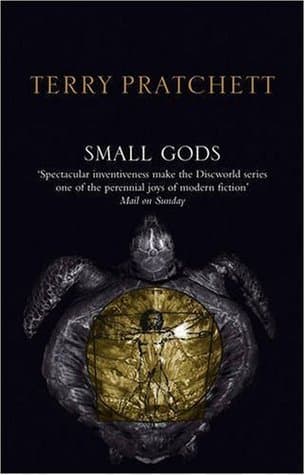
Terry Pratchett (1992)
Genre
Fantasy / Spirituality / Science Fiction
Reading Time
8-10 hours
Key Themes
See below
Sign in to track this book
A cynical, disillusioned god, shrunken to tortoise form, must rely on an honest and unwitting monk to restore his faith and influence in a desert world teeming with forgotten deities and dangerous dogma.
In the desert kingdom of Omnia, ruled by the tyrannical Exquisitor Vorbis and the Omnian church, the simple, uneducated novice Brutha tends to the temple's melon patch. Brutha has a photographic memory for scriptures but often questions the church's dogma. One sweltering day, while searching for water, Brutha finds a small tortoise. To his astonishment, the tortoise speaks, identifying itself as the Great God Om, the very deity the Omnian church worships. Om, now reduced to this humble form, reveals that his power has waned because no one truly believes in him anymore; they only fear the church. He desperately needs Brutha's help to restore his former glory.
Om, the tortoise, explains to a bewildered Brutha that the Omnian church, through centuries of rigid dogma and brutal inquisitions, has choked off true faith. People no longer believe in Om out of devotion, but out of terror of the Quisition and its tortures. This fear-based 'belief' offers Om no spiritual sustenance, causing him to shrink from a mighty god into a mere reptile. He recounts his past grandeur, his thunderous voice, and his legion of prophets, all now just fading memories. Om sees Brutha as his last hope, the only person left in Omnia who genuinely believes in him, even if that belief is still somewhat naive.
Exquisitor Vorbis, a shrewd and ruthless leader, decides to send an envoy to Ephebe, a more liberal, philosophical city-state, to demand tribute and assert Omnian dominance. He chooses Brutha, viewing him as a simpleton who will be easily controlled, and forces him to take a giant, ornate, but empty, tortoise shell as a gift, symbolizing Om. Unbeknownst to Vorbis, the real Om is hidden inside the shell with Brutha. Their journey across the desert is full of danger and philosophical debates, as Om tries to explain the true nature of divinity and belief to Brutha, while Brutha struggles to reconcile Om's humble form with the church's teachings.
Upon arriving in Ephebe, Brutha and Om experience a stark contrast to Omnian rigidity. Ephebe is a hub of philosophy, science, and diverse religious practices, where gods are numerous and often discussed with academic detachment. Brutha is overwhelmed by the libraries and the free exchange of ideas, while Om is both fascinated and frustrated by the Ephebians' intellectual approach to divinity. They meet various philosophers, including Urn, a cynical scholar, and the blind librarian, Dios, who possesses vast historical knowledge. Brutha's simple faith and photographic memory of scriptures, however, prove useful in philosophical debates, earning him unexpected respect.
Exquisitor Vorbis, impatient with Brutha's progress, arrives in Ephebe with Omnian soldiers, including the fearsome Sergeant Simony. Vorbis's true intention is not diplomacy, but conquest. He publicly humiliates Brutha, who is forced to carry the enormous tortoise shell, and demands Ephebe surrender to Omnian rule and adopt the worship of Om. The Ephebians, proud of their independence and intellectual freedom, refuse. Vorbis uses this refusal as a pretext for war, positioning his army for an imminent invasion, believing that Om desires the spread of his faith through force.
Seeking guidance amidst the escalating tensions, Brutha, accompanied by Om, visits the Oracle of Ephebe. The Oracle, a cryptic figure, delivers a prophecy that speaks of a 'chosen one' who will save Om, and refers to a time when Om's voice will be heard again. The prophecy also hints at the true nature of belief and the dangers of a god's dependence on human worship. Brutha struggles to interpret the prophecy, but Om realizes its implications for his own existence and the future of his faith. The encounter further solidifies Om's realization that his salvation lies not in conquest, but in a return to genuine, heartfelt belief.
As war looms, Brutha and Om manage to escape Ephebe, aided by some sympathetic Ephebians. They journey back towards Omnia, but take a detour through ancient, forgotten ruins. Here, Om reveals more of his past, including details about a previous prophet, a man named Cenobi, who had a true, personal relationship with him before the church's rise to power. Om also confesses his own past mistakes, admitting that he once enjoyed the fear he inspired and allowed his followers to commit atrocities in his name. This self-reflection marks a turning point for the god, as he begins to understand the destructive nature of his former glory.
The Omnian army, under Vorbis's command, launches a brutal assault on Ephebe. The Ephebians, though outmatched in military might, fight bravely, using their ingenuity and understanding of the terrain. Brutha, carrying the empty tortoise shell, is caught in the thick of the battle, witnessing the horrific consequences of religious zealotry and war. Om, inside the shell, experiences the battle firsthand, feeling the fear and faith of the soldiers, and the terrible cost of his 'glory'. The battle is fierce, with heavy casualties on both sides, and it becomes clear that Vorbis's ambition knows no bounds.
In the chaos of battle, Brutha, guided by Om, makes a desperate stand. He confronts Exquisitor Vorbis, challenging his perversion of Om's teachings and his tyrannical rule. Brutha, using his incredible memory, recites scripture and argues for a compassionate, loving god, directly contradicting Vorbis's doctrine of fear and conquest. Vorbis, enraged, tries to silence Brutha, but Brutha's unwavering conviction, fueled by his true belief in Om, gives him unexpected strength. Om, witnessing Brutha's courage, begins to feel a surge of true belief, a power he has not felt in centuries.
As the battle rages, Brutha, with Om's guidance, performs a seemingly impossible feat. He uses his knowledge of the desert and his innate goodness to bring water to the dying soldiers, both Omnian and Ephebian, in a moment of compassion. This act of selfless love, a true miracle born of genuine faith, causes Om to manifest his power. The desert itself seems to respond, providing aid. This event, witnessed by both armies, shatters the fanaticism of many Omnian soldiers and exposes Vorbis's cruelty. Om's power is significantly restored, not through fear, but through Brutha's pure belief and action.
In a surreal sequence, Vorbis and Brutha both die in the aftermath of the battle and find themselves in the afterlife. Vorbis, confident in his righteousness, expects a glorious reward, but is instead confronted by many gods, including a now fully restored Om. Brutha, humble and apologetic, faces judgment for his actions. Om, no longer a tortoise, but a magnificent bull, acts as Brutha's advocate, arguing for the purity of his belief and condemning Vorbis's manipulation of faith. The gods of the afterlife ultimately judge Vorbis for his cruelty and Brutha for his goodness, highlighting the true nature of divine justice.
After his experience in the afterlife, Brutha returns to the mortal world, now recognized as the Eighth Prophet of Om. With Om's renewed presence and Brutha's gentle guidance, the Omnian church undergoes a radical transformation. The Quisition is disbanded, torture is abolished, and the focus shifts from fear and conquest to compassion, education, and genuine faith. Brutha, despite his newfound status, remains humble, preferring to tend his melon patch and guide his flock with kindness rather than dogma. Om, now a powerful but benevolent deity, continues to exist, his power sustained by the true belief of his followers, a belief fostered by Brutha's gentle leadership.
The Protagonist
Brutha transforms from a timid, unquestioning novice into the Eighth Prophet of Om, guiding his church towards genuine faith and compassion.
The Deuteragonist/God
Om devolves from a powerful, feared deity to a weak tortoise, then evolves into a more benevolent and understanding god, sustained by true faith.
The Antagonist
Vorbis remains unrepentant in his fanaticism, ultimately facing divine judgment for his atrocities.
The Supporting
Simony's blind loyalty erodes as he witnesses Vorbis's cruelty and Brutha's goodness, leading him to question his faith.
The Supporting
Didactylos remains a steadfast advocate for reason and freedom of thought, contributing to Ephebe's resistance against Omnia.
The Supporting
Urn's cynicism about human nature is reinforced by the impending war, yet he still contributes to Ephebe's defense.
The Supporting
Dios serves as a wise, static source of historical perspective and wisdom for Brutha and Om.
The Mentioned
The Oracle remains a mysterious, prophetic figure, offering guidance without explicit instruction.
The novel explores the relationship between gods and their worshippers. It states that a god's power is not inherent but directly proportional to the genuine belief of its followers. Om, reduced to a tortoise, shows this, having been starved of true faith by the Omnian church's fear-based dogma. The Ephebians, with their many minor gods, show a different, less intense form of belief. Brutha's pure, unquestioning faith, despite the church's perversion, is what ultimately sustains and restores Om. The book argues that true belief is an act of love and trust, not fear or blind obedience, and that gods are, in essence, a reflection of their worshippers.
“A god needs a worshipper. Just one. But a real one. That’s the difference. You don’t get what you want, you get what you get.”
Pratchett contrasts the rigid, brutal fanaticism of the Omnian church with the concept of true, personal faith. Exquisitor Vorbis and the Quisition embody the dangers of institutionalized religion when it prioritizes power, control, and dogma over compassion and genuine spirituality. Their actions, including torture and conquest, are carried out in Om's name but contradict the god's true desires, ultimately weakening him. Brutha, on the other hand, represents uncorrupted faith—a simple, compassionate belief that sees the good in people and acts with kindness. The novel argues that true faith should lead to empathy and understanding, not violence and intolerance, and that strict adherence to doctrine can kill the very spirit it claims to serve.
“Just because you can't explain it, doesn't mean it's a miracle.”
The narrative shows how power, especially religious power, can corrupt both institutions and individuals. The Omnian church, initially founded on genuine belief, transformed into a totalitarian regime under the guise of serving Om. Exquisitor Vorbis is the epitome of this corruption, wielding immense power through fear and torture, believing himself to be an instrument of divine will. Even Om himself, in his earlier, more powerful incarnations, admits to enjoying the fear he inspired, showing that power can corrupt even a god. The book suggests that unchecked power, regardless of its source, leads to tyranny and the perversion of original ideals, highlighting the constant need for humility and accountability.
“A man who knows he is right because the Voices inside his head tell him so is a madman. A man who knows he is right because Om tells him so is a prophet. The difference is a long, thin, bloody line.”
The contrast between Omnia and Ephebe highlights the importance of knowledge, reason, and free thought. Omnia suppresses education, burns books, and punishes any deviation from its rigid dogma, fearing that independent thought will undermine its authority. Ephebe, conversely, is a hub of philosophy, science, and diverse ideas, where debate and inquiry are encouraged. Brutha's journey exposes him to the liberating power of knowledge and the dangers of ignorance. The novel champions intellectual freedom, suggesting that progress and true understanding can only flourish where ideas can be openly explored and challenged, rather than dictated by authority.
“The only thing that burns in hell is the part of you that won't let go of your life: your memories, your attachments. They burn them all away. But they're not punishing you, they're freeing you.”
The literal embodiment of a god's diminished power.
The transformation of the mighty Great God Om into a small, talking tortoise is the central plot device. It visually and metaphorically represents his loss of power due to the Omnian church's perversion of true belief. This humble form forces Om to experience the world from a mortal perspective, stripping him of his divine arrogance and compelling him to learn humility and the true meaning of faith. It also serves as a source of dramatic irony and humor, as the all-powerful deity is dependent on a simple novice.
A miraculous recall of scripture that challenges institutional dogma.
Brutha's perfect, photographic memory of every word of Omnian scripture is a key device. It allows him to quote chapter and verse to challenge Vorbis's interpretations and expose the church's deviations from its own sacred texts. This ability makes him both invaluable to Om (who needs someone to remember his true words) and a dangerous anomaly to the Quisition, who rely on controlling information. It highlights the idea that the 'spirit' of the law can be lost even when the 'letter' is preserved, and that true understanding goes beyond mere recitation.
A physical and philosophical journey to a contrasting culture.
The journey to Ephebe acts as a classic 'fish out of water' narrative, exposing Brutha and Om to a world entirely different from rigid Omnia. It serves as a crucible for Brutha's character development, introducing him to free thought, diverse philosophies, and alternative ways of life. For Om, it's a sobering encounter with intellectual detachment from divinity. The contrasting societies allow Pratchett to satirize religious extremism and champion intellectual freedom, providing the necessary external conflict and internal reflection for the protagonists.
A fanatical religious police force that enforces dogma through terror.
The Quisition, the Omnian church's secret police and torture arm, is a primary plot device representing the dangers of religious extremism and institutionalized terror. It is the mechanism by which Vorbis maintains control and suppresses dissent, directly contributing to Om's weakening by replacing true faith with fear. Its actions drive much of the initial conflict and Brutha's moral awakening. The Quisition acts as a constant threat, illustrating the brutal consequences of a society where dogma is enforced through violence, and freedom of thought is brutally suppressed.
“The Turtle Moves.”
— The rallying cry of the Omian rebellion, signifying the slow, inevitable progress of change.
“It is a brave man who is not afraid to look the Devil in the face and tell him he is a fool.”
— Brother Brutha reflecting on the nature of courage and confronting established beliefs.
“Gods don't need to be true. They only need to be believed.”
— Urn, the prophet of Om, explaining the nature of divinity to Brutha.
“A man is not a man until he is a man of his word.”
— Brutha's internal reflection on the importance of integrity and promises.
“The opposite of a profound truth may be another profound truth.”
— A philosophical observation about the complexity of truth.
“People think that it's the right thing to do to make the world a better place. But the world is not a place. It's a process.”
— Om, in his tortoise form, discussing the dynamic nature of existence.
“Ignorance is not bliss. Ignorance is ignorance.”
— Brutha's straightforward dismissal of the idea that not knowing is better.
“If you don't know where you're going, any road will take you there.”
— A common saying quoted in the book, highlighting the importance of direction.
“The trouble with having an open mind, of course, is that people will insist on coming along and trying to put things in it.”
— A witty observation on the challenges of intellectual openness.
“There are no atheists in foxholes, but there are a lot of them in the officer's mess.”
— A cynical but insightful remark on faith and power dynamics.
“It's a strange thing, but when you are dreading something, and would give anything to postpone it, then you suddenly find that you have a tremendous desire to get it over with.”
— Brutha's internal monologue about confronting difficult situations.
“He didn't want to be a hero. He just wanted to be a man.”
— Describing Brutha's humble aspirations despite his extraordinary circumstances.
“Wisdom is knowing when to stay silent.”
— A lesson learned by Brutha throughout his journey.
“The universe is not obliged to make sense to you.”
— A humbling thought about the vastness and indifference of the cosmos.
Ready to see how well you understood this book? Take our interactive quiz with 10 questions.
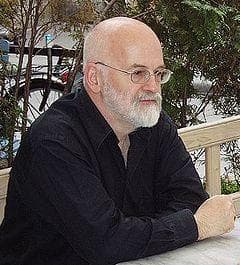
Sir Terence David John Pratchett was an English humorist, satirist, and author of fantasy novels, especially comical works. He is best known for his Discworld series of 41 novels.







