“The wind was a playful ghost, tugging at her hair, whispering secrets in her ear.”
— When Maggie first arrives at the campground, feeling a mix of apprehension and excitement.

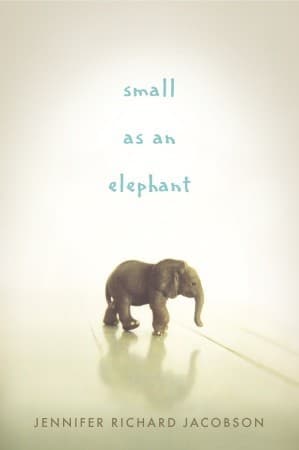
Jennifer Richard Jacobson (2011)
Genre
Children's / Young Adult
Reading Time
275 min
Key Themes
See below
Sign in to track this book
Stranded in the Maine wilderness with only a toy elephant, ten-year-old Jack must outwit authorities and navigate a journey back to Boston, all while dealing with his mother's unpredictable love and her abandonment.
Ten-year-old Jack wakes up alone in their tent at Seawall Campground in Acadia National Park, Maine. He realizes his mother, a woman prone to 'spinning' episodes, has left him. He finds a note from her saying she needs to 'find herself' and will meet him in Boston, but no specific date or contact. Jack, used to his mother's unpredictable behavior, knows he cannot alert authorities or Social Services (DSS). He fears being placed in foster care. He has only a few dollars, a small toy elephant named Peanut, and an urgent need to get back to Boston before anyone realizes he is unsupervised. His immediate goal is to find food and a way out of the park.
Jack leaves his campsite and meets Molly, a kind, older woman camping nearby. Molly notices his hunger and disheveled appearance and offers him food. Jack, careful not to reveal his abandonment, makes up a story about his mother being sick in the tent. Molly, a retired schoolteacher, is observant but respects his privacy. She shares her knowledge of the park and gives him a ride to Southwest Harbor, where he can buy a map and supplies. Jack feels a flicker of trust but remains protective of his secret, always planning his next move to avoid suspicion.
After getting a map and some basic food, Jack begins his journey south, trying to hitchhike. He quickly learns the dangers and difficulties of solo travel. A man in a pickup truck offers him a ride but becomes suspicious of Jack's answers and drops him off, warning him about hitchhiking alone. Jack realizes he needs a more discreet and safer way to travel. He decides to walk and try to blend in, aiming for larger towns where he might find a bus or train, all while managing his dwindling money and food supply.
Back at the campground, Molly becomes more concerned about Jack. She returns to his campsite multiple times, finding it still empty. She notices the lack of a car and the general disarray, confirming her fears that Jack is alone and in trouble. Molly, remembering her own past with a runaway brother, feels a strong need to help him. She decides to report her concerns to the park rangers, giving them a description of Jack and details of their interactions, hoping they can find him before something bad happens.
As Jack continues his journey, mostly on foot along roadsides and through small towns, he has several close calls. He sees a police car searching for a child matching his description. He also sees Molly's car, realizing she is looking for him. These encounters make him more afraid of being caught and strengthen his resolve to stay hidden. He learns to be more resourceful, finding abandoned sheds for shelter and foraging for food, all while tracking his progress on the map towards Boston, his destination and hope for reunion with his mother.
While resting by a stream, Jack meets Hannah, a girl a few years older than him. Hannah, perceptive and empathetic, quickly realizes Jack is alone and running away, though he does not explicitly confirm it. She offers him food from her backpack and shares stories about her own family, creating a brief, comforting connection. Hannah, seeing his need for a safe place, leads him to an abandoned cabin in the woods, giving him temporary shelter. This encounter offers Jack a rare moment of companionship and a practical solution to his immediate need for shelter.
Alone in the cabin, Jack's emotional state begins to change. He misses his mother, despite her unpredictable nature, and feels the heavy weight of her abandonment. He talks to his toy elephant, Peanut, telling him his fears and frustrations. He remembers past 'spinning' episodes and his mother's promises, feeling both loyalty and resentment. The isolation and constant fear of being caught start to affect him, but his determination to reach Boston and find his mother, believing she will eventually be there, keeps him moving.
Molly, still worried about Jack, continues her search. She uses her network of friends and contacts in various towns along the likely route south, sharing Jack's description and asking them to look out for him. She visits local libraries and general stores, posting flyers and talking to people. Her determination comes from a strong sense of responsibility and empathy, seeing in Jack a reflection of past vulnerabilities. She believes that finding him is not just about alerting authorities but about ensuring his safety and well-being, whatever his circumstances.
Jack makes it to a larger town and, using the last of his money, buys a bus ticket to a city closer to Boston. On the bus, he feels a temporary sense of relief, believing he is finally making good progress. However, his relief lasts only a short time as he overhears conversations about a missing boy and realizes the search is still active. He knows he cannot go directly to the Boston bus terminal without risking detection. He plans to get off the bus early, a few stops before the main terminal, and navigate the rest of the way on foot or by local transport.
Jack successfully gets off the bus early and makes his way into Boston. He navigates the city streets, heading towards his familiar neighborhood, hoping to find his mother. Meanwhile, Molly, having followed a series of leads and tips, arrives in Boston. Through her persistent efforts and a tip, she narrows down Jack's possible location to his home neighborhood. The story builds tension as both Jack and Molly go to the same area, unaware of how close they are.
Jack reaches his apartment building in Boston. He finds his mother there, but she is disoriented and agitated, clearly in the midst of another 'spinning' episode. Her apartment is a mess, and she seems barely aware of his long absence. The reunion is heartbreakingly anticlimactic for Jack, as his mother cannot provide the comfort or stability he wanted. At this moment, Molly arrives, having tracked Jack to his home. She sees the scene, confirming her fears about Jack's unsupported situation and his mother's mental health.
Molly, seeing Jack's mother's condition and Jack's exhaustion and distress, knows she must act. Gently but firmly, she intervenes, explaining to Jack that his mother needs help and that he cannot continue to care for himself. She assures him that she will help him and that he is not alone. Molly contacts the proper authorities, ensuring Jack's safety and his mother's access to care. The story ends with Jack being taken into temporary care, not as an abandoned child but as a child with a supportive advocate in Molly, who promises to be part of his 'herd' and help him with the challenges ahead, showing a hopeful, if uncertain, future.
The Protagonist
Jack transforms from a child burdened by secret independence into one who learns to trust and accept help, realizing the value of a supportive 'herd'.
The Supporting/Antagonist (unintentionally)
Her arc is more static, representing the ongoing struggle with mental illness, though her eventual contact with authorities suggests a potential for future help.
The Supporting/Deuteragonist
Molly's arc involves moving from initial concern to active, unwavering intervention, ultimately becoming a pivotal figure in Jack's life.
The Supporting/Symbolic
Peanut remains a constant, unchanging source of comfort and symbolism for Jack.
The Supporting
Hannah's role is largely static, serving as a catalyst for a brief period of safety and companionship for Jack.
The Mentioned
His arc is limited to the initial investigation phase.
The Mentioned
His arc is limited to a single, brief encounter that highlights Jack's vulnerability.
The Antagonist (abstract)
DSS remains a feared entity throughout, until the end when its involvement is framed as a necessary step for Jack's safety.
Jack's journey explores his identity, formed through his forced self-reliance. Abandoned by his mother, he must depend on his own wits and resourcefulness to survive. His constant internal monologues and conversations with Peanut show his struggle to define himself apart from his mother's erratic behavior. He learns to navigate a dangerous world alone, making difficult decisions about food, shelter, and travel. This builds his sense of capability, even as it shows his vulnerability. His journey shows the resilience of a child forced to grow up too soon.
“He knew he had to be his own herd now. He was the protector, the one who found the water, the one who led the way.”
The novel examines what a family is, especially through Jack's understanding of the 'herd' concept his mother taught him about elephants. Initially, his 'herd' is just him and his mother, and his loyalty to her, despite her abandonment, is strong. As his journey continues, he starts to question this definition. Molly, Hannah, and even the kindness of strangers begin to broaden his understanding of who can be part of his supportive 'herd.' The ending suggests that a 'herd' is not just biological family but a community of caring people who look out for each other, offering a more expansive and hopeful view of belonging.
“Elephants always stay with their herd. They protect each other. Even when one of them is sick, the others stay close.”
The book shows the effects of a parent's mental illness on a child. Jack's mother's 'spinning' episodes and her abandonment are central to the plot. They show the unpredictable and often heartbreaking reality of living with an untreated mental health condition. The story shows how a child like Jack develops coping mechanisms, secrecy, and a skewed sense of normalcy. It shows the loneliness and burden placed upon him, while also showing his enduring love and loyalty, even when neglected. The story quietly argues for understanding and help for both the mentally ill person and their affected family.
“Sometimes her mind would spin. Like a top, she'd get faster and faster, talking a mile a minute, not making sense. And then, just as fast, she'd crash.”
Jack's journey involves issues of trust. His mother's unreliability has taught him to be careful, and his fear of DSS makes him secretive. He struggles with whom to trust, taking calculated risks with people like Molly and Hannah. His initial refusal to confide in Molly comes from a deep fear of vulnerability and the possible results. The novel explores the balance between self-preservation and the human need for connection and help. It suggests that true safety often requires a leap of faith and accepting vulnerability in trusted relationships.
“He wanted to tell her everything. He wanted to just fall apart. But he couldn't. He knew what would happen if he did.”
A symbolic object representing family, comfort, and the 'herd' concept.
Peanut, Jack's small toy elephant, serves as a powerful symbol throughout the novel. It represents Jack's connection to his mother, his childhood innocence, and the 'herd' concept (elephants sticking together) that she taught him. Jack frequently talks to Peanut, using the toy as a sounding board and a source of comfort, especially during moments of fear and loneliness. Peanut's small size contrasts with the vastness of Jack's predicament, highlighting his vulnerability while simultaneously representing a tangible piece of home and a constant reminder of his primary goal: to find his 'herd' (his mother).
Narrative told from Jack's viewpoint, emphasizing his isolation and internal struggle.
The story is primarily told from Jack's limited third-person perspective, staying closely attuned to his thoughts, fears, and observations. This narrative choice immerses the reader directly into Jack's isolated world, allowing for a deep understanding of his internal struggles, his resourcefulness, and his constant calculations to avoid detection. It amplifies the tension and empathy as readers experience every close call and emotional toll through his eyes. The limited perspective also ensures that the reader only knows what Jack knows, building suspense around his mother's fate and Molly's intentions.
Alternating perspectives between Jack's flight and Molly's pursuit, creating dramatic irony and suspense.
While primarily focused on Jack, the narrative occasionally shifts to Molly's perspective, particularly as she begins her search. This dual narrative creates dramatic irony, as readers know both Jack's precarious situation and Molly's benevolent intentions, while the characters remain unaware of each other's immediate actions. It builds suspense by showing the parallel efforts to either evade or find Jack, increasing the tension with every close call. This device also allows for the development of Molly's character and her motivations, adding depth to the story and reinforcing the theme of community and intervention.
A literal and symbolic guide for Jack's journey and his desire for control.
The map Jack acquires early in his journey is both a practical tool and a powerful symbol. Literally, it guides his physical progress from Maine to Boston, allowing him to track his distance and plan his route. Symbolically, it represents Jack's desperate attempt to exert control over his chaotic situation. By marking his progress, he gains a sense of agency and purpose. The map becomes a tangible representation of his hope and determination, a visual reminder of his goal, even as the realities of his journey often force him off the planned path.
“The wind was a playful ghost, tugging at her hair, whispering secrets in her ear.”
— When Maggie first arrives at the campground, feeling a mix of apprehension and excitement.
“She imagined her mother as a wild bird, free and soaring, but also fragile, easily startled.”
— Maggie reflecting on her mother's unpredictable nature and sudden departure.
“A secret is like a seed. You plant it, and it grows, sometimes into something beautiful, sometimes into something thorny.”
— Maggie pondering the nature of the unknown and her mother's hidden reasons.
“The world felt bigger, more dangerous, and yet, she also felt a strange kind of bravery blooming inside her.”
— Maggie's feelings as she navigates being alone in the campground.
“Sometimes, the quietest places hold the loudest stories.”
— Maggie observing the seemingly ordinary campground residents, realizing everyone has a past.
“Being small didn't mean you couldn't be strong. An elephant was big, but a mouse could still cause a stir.”
— Maggie drawing a parallel between her size and her ability to make an impact.
“Home wasn't just a place; it was a feeling, a warmth that settled in your heart when you were with the right people.”
— Maggie beginning to find a sense of belonging with the campground community.
“Grief was a tricky thing. It didn't just go away. It changed, like the tide, sometimes calm, sometimes crashing.”
— Maggie processing her feelings of loss and abandonment.
“She learned that kindness could be found in unexpected places, like a forgotten corner of a dusty general store.”
— Maggie experiencing the unexpected generosity of others.
“The best way to find something you've lost is to stop looking so hard and let it come to you.”
— A piece of advice given to Maggie about finding her mother, which also applies to other lost things.
“Every goodbye held a little bit of hello, a promise of what might come next.”
— Maggie reflecting on departures and the potential for new beginnings.
“Sometimes, the bravest thing you can do is ask for help.”
— Maggie struggling with her independence and learning to rely on others.
“The stars above the campground were vast and indifferent, yet somehow comforting in their unchanging presence.”
— Maggie gazing at the night sky, finding solace in nature's constancy.
“It wasn't about being perfect; it was about trying, about showing up, even when you were scared.”
— Maggie's realization about overcoming challenges and fears.
Ready to see how well you understood this book? Take our interactive quiz with 10 questions.

Biography coming soon.

Dan Gemeinhart
4.5

Kate O'Hearn
4.4

Jeanne Birdsall
4.4

Jen Wang
4.4

Wendelin Van Draanen
4.3

John Marsden
4.3

Chris Van Allsburg
4.3

Jennifer A. Nielsen
4.2