“The Isle of Mulch was a small island, shaped a bit like a giant, half-eaten biscuit.”
— Describing the setting of the story.

Sign in to track this book
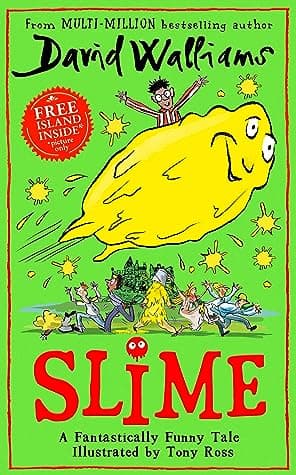
On the miserable Isle of Mulch, a boy named Ned discovers his 'slimepower' is the only hope against awful grown-ups, including the island's owner, Aunt Greta Greed.
Ned, a young boy who uses a wheelchair, introduces the reader to his home, the Isle of Mulch. He says the island is overrun by awful grown-ups who enjoy making children unhappy. From the headmaster, Mr. Grubb, to Mrs. Grot, who runs the toy shop, and the ice-cream man, Mr. Nosey, every adult seems dedicated to misery. The worst is Aunt Greta Greed, who owns most of the island. Ned, despite his physical challenges, dreams of a world where children are happy and free from adult control. This sets the stage for his rebellion.
One day, while experimenting in his shed, Ned accidentally mixes various household liquids and unusual ingredients. The mixture bubbles, glows, and then transforms into a green, sentient slime. This is 'Slimepower.' Ned quickly realizes the slime can move, stretch, and follow his mental commands. This discovery gives him an idea: this slime can fight the oppressive adults of Mulch Island. He decides to keep his new friend a secret, knowing the adults would try to destroy it.
Ned decides to test his Slimepower on Mr. Grubb, the headmaster of Mulch Island Primary School. Mr. Grubb is known for his strict rules, bland school dinners, and making children write lines for small mistakes. Ned, with Slimepower hidden in his backpack, goes to the school. During assembly, Ned secretly commands the slime to escape and cause chaos. The slime fills Mr. Grubb's trousers, squirts from his nose, and humiliates him in front of the school, to the children's delight. This mission boosts Ned's confidence and confirms his plan to tackle more awful adults.
With success against Mr. Grubb, Ned and Slimepower target other despicable adults. Next is Mrs. Grot, the toy shop owner, who famously stops children from touching toys and only sells boring, educational items. Ned orchestrates Slimepower to cover Mrs. Grot and the entire toy shop in sticky, green goo, stopping her from enforcing her rules. After this, they target Mr. Nosey, the island's ice-cream man, who only sells disgusting, vegetable-flavored ice cream. Slimepower infiltrates his van, covering him and his creations in green, causing him to flee. The children are happy to be free from his awful treats.
After several successful 'slimings,' Ned knows his biggest challenge is Aunt Greta Greed, the wealthiest and most powerful adult on Mulch Island. Aunt Greta is known for her greed, her mansion, and her disregard for children's happiness. She owns most of the island's businesses and properties, including Ned's home, making her a formidable foe. Ned understands that tackling her will be more dangerous and difficult than any previous mission, but he believes defeating her could free the island from adult control. He starts planning to infiltrate her mansion.
Ned, with Slimepower concealed, begins his most dangerous mission: infiltrating Greed Manor, Aunt Greta Greed's fortified residence. The manor has high walls, security cameras, and guard dogs. Using Slimepower's flexibility and stealth, Ned navigates the grounds and slips inside. He wants to reach Aunt Greta's private chambers and use Slimepower on her, hoping to end her rule over Mulch Island. The tension is high as Ned, in his wheelchair, and his slimy companion creep through the opulent corridors of Greed Manor.
Ned finds Aunt Greta Greed in her study, surrounded by her treasures. Aunt Greta, at first dismissive of a child, is horrified when Ned reveals Slimepower. A chase begins through the mansion, with Aunt Greta trying to capture or destroy the slime. But Slimepower is too agile. In the end, Slimepower engulfs Aunt Greta, filling her clothes, hair, and mouth, turning her into a squirming, green mess. The shock and humiliation are too much for Aunt Greta, who collapses in disgust, her rule ended.
With Aunt Greta Greed slimed and defeated, a transformation begins on Mulch Island. The other adults, seeing their leader's fate and a shift in power, become much kinder. Mr. Grubb starts serving delicious school dinners and allows playtime, Mrs. Grot fills her toy shop with fun toys, and Mr. Nosey begins selling sugary ice cream. The children of Mulch Island are free to play, laugh, and enjoy their childhoods without constant adult interference. Ned becomes a quiet hero, his Slimepower having brought about a revolution.
Ned, having liberated Mulch Island from its awful adults, thinks about his journey. He realizes that while Slimepower was important, his courage and determination truly made a difference. The island is now a happier place, and children can thrive. Slimepower, having fulfilled its purpose, doesn't disappear. It remains Ned's loyal companion, sometimes appearing for a prank or to remind grumpy adults of its presence. Ned knows the fight for children's happiness continues, but he has given Mulch Island a symbol of rebellion and joy, ensuring a brighter future for its young inhabitants.
The Protagonist
Ned transforms from a frustrated observer of adult tyranny into a courageous leader who liberates his island, proving that physical limitations do not define one's power.
The Supporting
Slimepower evolves from an accidental creation into a powerful force for good, ultimately becoming the symbol of children's liberation on Mulch Island.
The Antagonist
Aunt Greta Greed starts as the unchallenged ruler of Mulch Island and ends up utterly humiliated and defeated by a child and his slime.
The Supporting
Mr. Grubb is initially a tyrannical headmaster but is forced to change his ways after being slimed, becoming a kinder educator.
The Supporting
Mrs. Grot goes from a joy-killing toy shop owner to someone who allows children to experience the delight of actual toys after her encounter with Slimepower.
The Supporting
Mr. Nosey is initially a purveyor of disgusting ice cream but is compelled to sell delicious treats after being slimed.
The main theme is children rising against adult authority. Ned, a child with challenges, uses a unique power (Slimepower) to challenge and defeat the adults who make children's lives miserable on Mulch Island. This theme celebrates the ingenuity, courage, and spirit of children when faced with injustice, showing that even the smallest can make a difference. It emphasizes the importance of preserving childhood joy against adult cynicism.
“Something needed to be done about them. But who could be brave enough? Meet Ned – an extraordinary boy with a special power. SLIMEPOWER!”
Ned's discovery of Slimepower is a result of his imaginative experimentation, and the slime embodies playful, chaotic creativity. The adults are rigid, boring, and lack imagination (e.g., Mrs. Grot's toy shop, Mr. Grubb's school). The slime's ability to take various forms and cause unexpected mayhem shows how creative thinking and unconventional solutions can overcome established, dull routines. It suggests that imagination is a strong force for positive change.
“This wasn't just any slime. This was alive. This was SLIMEPOWER!”
Ned's motivation comes from a sense of injustice about how adults treat children on Mulch Island. He wants to restore balance and fairness, where children can be children and experience joy. Each 'sliming' is a form of justice, directly addressing the adults' cruelties. The defeat of Aunt Greta Greed means fairness wins over greed and tyranny, leading to a more equal and happy society for everyone on the island.
“He wanted to make the island a fun place for children, not a miserable place for horrible grown-ups.”
Ned, as a wheelchair user, faces physical challenges that could lead to him being underestimated. However, the story shows his perceived 'weakness' is not relevant to his strength of character and ingenuity. His wheelchair does not stop his adventures; he adapts and uses his intelligence to navigate obstacles. This theme shows that true strength comes from within and that physical differences do not limit one's capacity for heroism or making a significant impact.
“And Ned, despite being in a wheelchair, was the bravest boy on the whole island.”
A sentient, magical green slime that acts as Ned's weapon and companion.
Slimepower is the central magical realism element and the primary plot device. It is a sentient, malleable, and mischievous green slime that Ned creates. It allows Ned, a boy in a wheelchair, to directly confront and humiliate the powerful adult antagonists. Slimepower is essentially a wish-fulfillment device for children, giving them the means to fight back against unfair adult rules. Its unpredictable nature adds humor and excitement to the narrative, enabling fantastical scenarios that drive the plot forward and serve as the catalyst for change on Mulch Island.
Over-the-top, comically evil adult characters representing various forms of childhood misery.
The adults on Mulch Island (Aunt Greta Greed, Mr. Grubb, Mrs. Grot, Mr. Nosey) are deliberately exaggerated to be comically horrible. They are caricatures of typical adult authority figures who make children's lives difficult, each specializing in a specific form of misery (greed, strictness, denying fun, bad food). This exaggeration serves several purposes: it makes them clear targets for Ned, amplifies the humor of their 'sliming,' and makes their eventual defeat more satisfying. This device clearly delineates good (children) from evil (horrible adults) in a child-friendly way.
A contained, exaggerated setting that acts as a microcosm of childhood struggles.
The Isle of Mulch functions as a self-contained, fantastical setting where the rules of adult-child dynamics are amplified. Its isolation allows for the complete dominance of horrible adults and, subsequently, for Ned's revolution to have a profound, island-wide impact without external interference. The name 'Mulch' itself suggests something unpleasant and overlooked, mirroring the children's initial state. This contained environment allows the story to explore themes of rebellion and empowerment in a focused and impactful way, creating a clear 'before and after' scenario.
The primary method of defeating antagonists through public embarrassment and discomfort.
Instead of violence, Ned and Slimepower's main 'weapon' is public humiliation. Each horrible adult is defeated by being covered in slime, causing them immense personal discomfort and public embarrassment. This plot device is perfectly suited for a children's book, offering a non-violent yet highly effective way for the protagonist to overcome his oppressors. It's funny, satisfying, and highlights that sometimes, simply making a bully look ridiculous is the most powerful form of resistance, especially in a world where adults typically hold all the power.
“The Isle of Mulch was a small island, shaped a bit like a giant, half-eaten biscuit.”
— Describing the setting of the story.
“Ned was a boy who loved slime. He loved it more than anything in the world.”
— Introducing the main character's defining passion.
“It was the sort of smell that made your nose hairs curl up and beg for mercy.”
— Describing a particularly pungent smell.
“Auntie Beastly was not just beastly by name, but beastly by nature too.”
— Introducing the antagonist, Auntie Beastly.
“She had a face like a bulldog chewing a wasp.”
— Another vivid description of Auntie Beastly's appearance.
“The slime was alive! Not alive in a 'walking around and talking' way, but alive in a 'wobbling and oozing' way.”
— Ned's realization about the magical properties of the slime.
“Never underestimate the power of a good burp.”
— A moment of unexpected heroism involving flatulence.
“The only thing worse than being bored was being bored and covered in glitter.”
— Ned's thoughts during a particularly dull moment.
“Every villain thinks they're the hero of their own story.”
— A reflective observation about Auntie Beastly's motivations.
“Sometimes, the best adventures start with a squelch.”
— A concluding thought about the nature of Ned's adventures.
“The world needs more wobbly, gloopy, magnificent slime!”
— Ned's ultimate message and love for slime.
“If you want to make an omelette, you have to break a few eggs. If you want to make a mess, you have to break a lot of rules.”
— Ned's philosophy on creating chaos and fun.
“A true friend is someone who will share their last piece of sticky, green goo with you.”
— Ned's definition of friendship.
“Just because something is disgusting, doesn't mean it isn't brilliant.”
— Ned's perspective on the appeal of slime.
Ready to see how well you understood this book? Take our interactive quiz with 10 questions.

David Walliams is a celebrated British author, comedian, and television personality, best known for his hugely popular children's books. His works, including "Gangsta Granny," "Mr Stink," and "The World's Worst Teachers," are characterized by humor, heart, and often a touch of the absurd. Walliams's distinctive storytelling has made him a household name in children's literature.

Dan Gemeinhart
4.5

Kate O'Hearn
4.4

Jeanne Birdsall
4.4

Jen Wang
4.4

Wendelin Van Draanen
4.3

John Marsden
4.3

Chris Van Allsburg
4.3
Jennifer A. Nielsen
4.2