“The only difference between a rut and a grave is their dimensions.”
— Spoken by Wiggs Dannyboy, reflecting on stagnant lives.

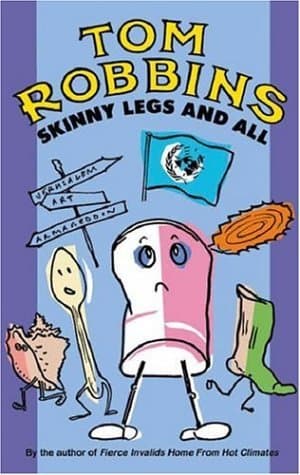
Tom Robbins (1990)
Genre
Literary Fiction / Fantasy
Reading Time
10-12 hours
Key Themes
See below
Sign in to track this book
A philosophical bean can and a mystical dessert spoon hold court with a spirited waitress and a boisterous welder in an absurd adventure through the New York art scene and the forgotten history of a Palestinian god.
The novel begins with Ellen Cherry Charles, a young waitress from Seattle, and her husband, Boomer Petway, a welder, driving across America in a converted school bus called 'The Road Hog.' They are going to New York City, where Ellen hopes to start her art career. Boomer, who at first doubts Ellen's art goals, made a sculpture for her. It is a large, rotating scene of the Last Supper, but with a difference. Instead of the usual figures, Boomer's version has inanimate objects: a can of beans, a conch shell, a dessert spoon, a dirty sock, and a condom. These objects later become alive and talk. Their trip includes philosophical thoughts and growing tension between Ellen's art ambition and Boomer's practical, but odd, view.
In New York, Ellen and Boomer have trouble settling in. They get a showing for Boomer's Last Supper sculpture at The Chicken Skin, a SoHo gallery. The gallery owner, Salome, a flamboyant and mysterious person, immediately likes the sculpture's originality. Ellen tries to make her own art, often feeling overshadowed by Boomer's accidental talent. The New York art scene is chaotic and often pretentious, full of critics, collectors, and performance artists drawn to Boomer's unusual work. The objects in the Last Supper sculpture start to show signs of being alive, watching and commenting on the human world, though Ellen first thinks this is her artistic vision.
The inanimate objects in Boomer's Last Supper—the can of beans (Can o' Beans), the conch shell (Conch), the dessert spoon (Spoon), the dirty sock (Dirty Sock), and the condom (Rubber)—become fully alive and talk. They have discussions about reality, God, life's meaning, and the human condition. Each object has a distinct personality: Can o' Beans is an atheist and a materialist, Spoon is a mystic and a romantic, Dirty Sock is a cynical pragmatist, Conch is a historian and storyteller, and Rubber is a hedonist. Their conversations, which humans do not hear at first, comment on the events happening around them, offering unique views on human foolishness, love, and spiritual longing.
While Boomer's Last Supper gets more attention, Ellen struggles to find her own artistic voice. She constantly fights self-doubt and the pressure to fit into the art world's expectations. She tries different art projects, but none feel truly authentic. Meanwhile, Boomer becomes more interested in the spiritual ideas in his accidental masterpiece. He starts to research ancient religions and myths, especially those from the Middle East. His journey changes unexpectedly when he meets Wiggs Dannyboy, a mysterious old man who knows ancient secrets and hints at a lost goddess in Palestine. Boomer's search for spiritual understanding starts to differ from Ellen's art goals.
Wiggs Dannyboy, a mysterious person with deep knowledge of history and mysticism, becomes a key mentor for Boomer. He tells Boomer the legend of a forgotten goddess of Palestine. Her essence is scattered, and finding her again is important for bringing balance to the world. Wiggs believes the goddess's spirit lives in various 'sacred shanks' (legs) of women around the world. Boomer, at first doubtful, is slowly convinced by Wiggs's stories and the strange coincidences he experiences. This search for the goddess becomes Boomer's main focus, leading him away from the art world and into a deeper, spiritual journey, which at first confuses and frustrates Ellen.
Salome, the owner of The Chicken Skin gallery, skillfully uses the New York art world's interest in Boomer's Last Supper. She organizes events, creates excitement, and makes sure the sculpture becomes a sensation. The sentient objects in the tableau continue their philosophical discussions. They offer sharp and often humorous comments on the absurdity of human ambition, the changing nature of fame, and the superficiality of the art scene. They note the irony of their inanimate forms causing such human drama. Salome, with her own mysterious past and reasons, becomes a central figure in the human story. Her actions often influence Ellen and Boomer's paths.
As Boomer goes deeper into his spiritual quest, Ellen starts her own self-discovery. She questions her first art goals and her relationship with Boomer. She realizes her art needs to come from true passion, not from wanting outside approval or needing to compete with Boomer. She begins to explore different ways to express herself, moving away from traditional painting and performance art. Her interactions with various eccentric people in New York, and the philosophical thoughts of the sentient objects (which she still sees as her own imaginative creations), help her understand her identity and what she truly wants from life and art.
Guided by Wiggs Dannyboy and his clues, Boomer eventually travels to Palestine. He believes this ancient land holds the key to finding the goddess. He thinks a 'sacred shank' (leg) in Jerusalem is an important part of the goddess's scattered essence. His journey is an adventure, spiritual thought, and unexpected meetings. He navigates the complex political and religious Middle East, searching for the specific woman whose leg holds the divine spark. This trip is a turning point for Boomer, solidifying his change from a simple welder to a seeker of ancient truths.
In Palestine, Boomer finally meets the woman whose leg is believed to be the goddess's 'sacred shank.' This woman, a dancer, performs an ecstatic dance that ends with the goddess appearing. The revelation is not a single, still image, but a dynamic, unifying force that goes beyond traditional religious images. It is a celebration of the feminine, the earthly, and the sacred together. This event starts a cosmic dance, involving humans and the sentient objects from Boomer's Last Supper. They, through their philosophical journey, have also arrived at this moment. The dance shows the integration of spirit and matter, the sacred and the everyday, and how everything connects.
After the goddess's revelation and the cosmic dance, Ellen and Boomer find themselves on new, separate paths. Boomer, having finished his spiritual quest, is deeply changed, understanding the world more. Ellen, having lost her art insecurities, finds her true artistic calling in a unique form of performance art. This art includes parts of her past and her new understanding of beauty and spirituality. Their relationship, though changed, is stronger because of their individual journeys. The sentient objects, having finished their role as philosophical commentators, find their own endings. Some return to being inanimate, others continue their metaphysical existence. The novel ends with a sense of renewal and the lasting mystery and magic of existence.
The Protagonist
Transforms from an insecure aspiring artist seeking external validation to a confident woman who finds her unique artistic voice and personal truth.
The Protagonist/Supporting
Evolves from a skeptical, blue-collar worker into a spiritual pilgrim, driven by a quest for ancient truths and a lost goddess.
The Supporting
Remains largely enigmatic, serving as a catalyst for the plot while subtly revealing glimpses of her own ancient, timeless nature.
The Supporting
Serves as a consistent, guiding force, revealing ancient wisdom and facilitating Boomer's spiritual awakening.
The Supporting
Remains largely consistent in his cynical, materialist worldview, providing a philosophical anchor throughout the objects' debates.
The Supporting
Maintains her mystical and romantic perspective, providing a consistent counterpoint to the more pragmatic objects and yearning for deeper meaning.
The Supporting
Serves as the repository of history and myth, consistently providing ancient context to the objects' contemporary debates.
The Supporting
Maintains his pragmatic and somewhat cynical outlook, anchoring the philosophical discussions in a tangible reality.
The Supporting
Consistently embodies the pursuit of pleasure and the celebration of life's sensual aspects.
The novel explores self-discovery through Ellen Cherry's art struggles and Boomer Petway's spiritual quest. Ellen works to find her real artistic voice amid the commercialism and pretense of the New York art world. She learns that true art comes from within. Boomer, at first a simple welder, becomes a seeker of ancient truths, finding a spiritual side he did not know he had. Their individual paths, though different, lead them to a deeper understanding of themselves and their purpose. The sentient objects also deal with their 'identities' as philosophical commentators.
“What is art if not an attempt to make sense of the world, to find meaning where there is none, to impose order on chaos?”
A main theme is the discussion between spiritual belief and materialistic doubt. This is mostly shown by the sentient objects in Boomer's Last Supper. Can o' Beans strongly argues for a purely material view, while Spoon supports mysticism and the unseen. Conch offers historical and mythical views, linking the two. This theme also shows in Boomer's change from a practical welder to a spiritual traveler looking for a lost goddess. This contrasts with the often superficial and commercially driven New York art scene. The book suggests that both material and spiritual realities hold valid truths.
“A bean can is a bean can is a bean can. There is no 'spirit' in it, nor in anything else.”
Tom Robbins examines the art world and the act of creation. The novel questions what 'art' is, showing how critical praise and commercial success can be arbitrary. Boomer's accidental masterpiece, the Last Supper tableau, becomes popular, while Ellen struggles to be taken seriously. The sentient objects, first seen as just parts of art, become the real commentators on its meaning. The book suggests that art can come from unexpected places. Its true value is not its commercial worth, but its ability to make people think, inspire wonder, and show deeper truths about existence.
“Art, like love, is a leap into the unknown, a willingness to be ridiculous.”
The search for the lost goddess of Palestine is an important theme. It emphasizes the importance of the sacred feminine. The novel suggests that suppressing the goddess figure has caused imbalance in the world, and finding her again is important for harmony. The 'sacred shanks' (legs) of women symbolize this scattered divine essence, connecting the physical and the spiritual. This theme celebrates female power, sensuality, and intuition as vital forces. It contrasts with patriarchal religious stories and supports a more complete understanding of divinity.
“The goddess is not a statue. She is a dance. She is in the blood and bone of every woman.”
The novel explores different parts of love and human connection, from Ellen and Boomer's unusual marriage to Spoon's longing for intimacy. Sex is shown as a powerful, often sacred, force, linked to both pleasure and spiritual enlightenment, as shown by Rubber. The connection between people, whether romantic, artistic, or philosophical, is portrayed as essential for growth and understanding. The book explores the complexities of relationships, showing how shared experiences and individual journeys can strengthen bonds, even if they change unexpectedly.
“Love is not a thing to be found. It is a thing to be created.”
A literary device using everyday objects as philosophical commentators.
The most prominent plot device is the sentience of the inanimate objects in Boomer's Last Supper tableau: a can of beans, a conch shell, a dessert spoon, a dirty sock, and a condom. These objects not only observe the human drama but engage in profound philosophical debates, offering a meta-commentary on themes of existence, spirituality, art, and human nature. Their distinct personalities and arguments serve to deconstruct human pretension and provide diverse perspectives, often with humor and biting wit, making abstract concepts accessible and entertaining. They are initially perceived as Ellen's artistic creations, blurring the line between reality and imagination.
A symbolic art piece that acts as a central catalyst and metaphor.
Boomer's 'Last Supper' sculpture, featuring inanimate objects instead of biblical figures, is more than just a piece of art; it's a central catalyst for the entire plot. It draws Ellen and Boomer to New York, becomes a sensation in the art world, and, most importantly, houses the sentient objects that drive much of the philosophical discourse. It serves as a powerful metaphor for the intersection of the sacred and the profane, the ordinary and the extraordinary, and the unexpected places where profound meaning can be found. Its unconventional nature challenges traditional religious and artistic interpretations.
Boomer's journey to find the lost goddess of Palestine.
The narrative employs a classic quest motif, specifically Boomer Petway's search for the lost goddess of Palestine. Guided by Wiggs Dannyboy, Boomer embarks on a physical and spiritual pilgrimage that takes him from New York to the Middle East. This quest provides the underlying structure for Boomer's character arc and allows the novel to explore themes of spirituality, ancient myths, and the sacred feminine. The 'sacred shanks' (legs) serve as the tangible, yet symbolic, objectives of his journey, leading to a profound revelation rather than a simple discovery.
Integration of fantastical elements into a realistic setting.
The novel seamlessly blends realistic settings and character struggles with elements of the fantastical, characteristic of magical realism. The most obvious example is the sentience and philosophical debates of the inanimate objects. Other elements include the mysterious, possibly ancient, nature of Salome and Wiggs Dannyboy, and the literal manifestation of the goddess through a dance. These magical elements are presented without extensive explanation, treated as part of the world's fabric, which allows the novel to explore profound themes in a whimsical and thought-provoking manner without losing its grounding in human experience.
Extensive use of dialogue to explore complex philosophical ideas.
Much of the novel's thematic depth is conveyed through extensive philosophical dialogue, primarily among the sentient inanimate objects. Their debates cover a wide range of topics, including the existence of God, the nature of reality, the meaning of life, and the human condition. This device allows Robbins to present multiple viewpoints on complex issues in an engaging and often humorous way, without resorting to didacticism. The dialogue serves not only to advance the themes but also to develop the distinct personalities of the objects themselves, making them compelling characters in their own right.
“The only difference between a rut and a grave is their dimensions.”
— Spoken by Wiggs Dannyboy, reflecting on stagnant lives.
“There are two kinds of people in this world: those who are always looking for something, and those who are always looking for someone.”
— A general observation on human motivations.
“It's never too late to have a happy childhood.”
— A recurring theme, often associated with the idea of self-reinvention.
“There are no solutions, only trade-offs.”
— A pragmatic view of problem-solving.
“The longest journey is the journey inward.”
— Emphasizing the importance of self-discovery.
“We are not our bodies. We are the stories we tell ourselves about our bodies.”
— A reflection on perception and identity, particularly in relation to physical form.
“Art is a way of understanding the world. It is not an escape from it.”
— A definition of art's purpose.
“Most people don't know what they want, but they know what they don't want.”
— An observation on human desires and aversions.
“The past is a ghost, the future a dream, and all we ever have is now.”
— A reminder to live in the present moment.
“There's a fine line between fishing and standing on the shore like an idiot.”
— A humorous take on taking action versus inaction.
“The only way to get rid of a temptation is to yield to it.”
— A slightly subversive take on dealing with desire.
“Life is not a journey to the grave with the intention of arriving safely in a pretty and well preserved body, but rather to skid in broadside, thoroughly used up, totally worn out, and loudly proclaiming 'Wow! What a ride!'”
— A famous quote encapsulating a philosophy of living life to the fullest.
“Everything is pregnant with its own opposite.”
— Reflecting on the dualistic nature of existence.
“Only when we are brave enough to explore the darkness will we discover the infinite power of our light.”
— A message about confronting fears and finding inner strength.
Ready to see how well you understood this book? Take our interactive quiz with 10 questions.

Biography coming soon.







