“It was in the spring that the soldiers came.”
— The opening line, establishing the beginning of the Navajo's forced relocation.

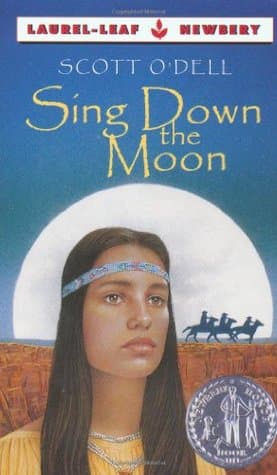
Scott O'Dell (1991)
Genre
Children's / Historical Fiction / Young Adult
Reading Time
120 min
Key Themes
See below
Sign in to track this book
Fourteen-year-old Bright Morning's peaceful spring day herding sheep in Canyon de Chelly ends when Spanish slavers arrive, changing her Navaho world forever.
Fourteen-year-old Bright Morning, a Navajo girl, is herding her family's sheep in Canyon de Chelly with her friend Running Bird when Spanish slavers attack. The slavers kill their sheepdog, Black Dog, capture the two girls, and take them on a long journey south. They are brought to a Spanish village and sold to a wealthy woman. Bright Morning and Running Bird are forced into domestic work, facing harsh treatment and longing for home. After several months, Bright Morning plans an escape. During a storm, they slip away from their captors, steal horses and supplies, and begin their dangerous journey back north towards their homeland, guided by the stars and Bright Morning's resolve.
Bright Morning and Running Bird endure a difficult journey through the desert and mountains. They face hunger, thirst, and constant fear of recapture. Running Bird, weaker than Bright Morning, struggles with the physical demands and emotional toll. They encounter dangers like wild animals and other hostile groups. Bright Morning's resourcefulness and knowledge of the land, though far from home, are vital for their survival. She finds water, forages for food, and navigates the tough landscape. Running Bird's spirit weakens, and her health declines, slowing their progress, but Bright Morning remains determined to reach home.
After months of travel, Bright Morning and Running Bird finally reach the familiar red walls of Canyon de Chelly, tired but hopeful. Their joy is brief. The canyon is silent and empty. Their hogans are deserted, fields untended, and there is no sign of their family or tribe. Bright Morning realizes the Long Walk, the forced relocation of the Navajo by the U.S. Army, happened while they were gone. Running Bird, weakened by the journey and disappointment, dies shortly after their arrival, leaving Bright Morning alone in her once lively home.
Alone and without hope, Bright Morning finds faint but clear signs of her people's forced journey: discarded items, footprints, and evidence of suffering. She realizes they were driven south, towards what she later learns is Fort Sumner, or Hwelte. With a heavy heart, Bright Morning decides to follow the trail to reunite with her family. She joins the stragglers and sick at the back of the column, seeing the brutality and despair of the Long Walk firsthand. The journey is marked by hunger, disease, and the soldiers' cruelty, similar to her earlier abduction but on a larger, more devastating scale for her entire people.
Bright Morning arrives at Fort Sumner, known as Hwelte by the Navajo, a barren and crowded reservation in eastern New Mexico. Conditions are terrible: not enough food, bad water, widespread disease, and a constant fight for survival. The Navajo, used to freedom and their traditional life, are confined and disheartened. Bright Morning searches tirelessly for her family among thousands of displaced Navajos, facing constant threats of starvation and illness. She sees her people's spirit and culture eroding under military rule, but also notes their strength and attempts to keep their traditions alive in secret.
Against all odds, Bright Morning finds her family at Fort Sumner. Her mother, father, and younger brother, Little Rainbow, are alive, though scarred by the experience. The reunion is bittersweet, filled with tears of relief and sorrow for what they lost. At Hwelte, Bright Morning also reconnects with Tall Boy, a young man from her tribe she admired before her abduction. Tall Boy, despite losing an arm in a fight with soldiers, remains strong and determined. They fall in love and marry in a quiet ceremony amid the reservation's despair, finding hope and continuity in their union.
Life at Fort Sumner remains unbearable. The land is barren, crops fail, and the promised return to their homeland seems far off. Bright Morning and Tall Boy, with many other Navajos, grow restless and desperate to escape Hwelte. They long for the freedom of Canyon de Chelly and their traditional way of life, which is slowly disappearing. Despite the dangers of desertion and the long, risky journey, Bright Morning and Tall Boy decide to leave Fort Sumner and try to return to their ancestral home. They begin gathering what little supplies they can, preparing for another hard trek.
Under cover of darkness, Bright Morning, Tall Boy, and a small group of other determined Navajos secretly leave Fort Sumner. They move carefully, avoiding patrols and soldiers' eyes. Tall Boy, despite his injury, is a resourceful and brave leader, guiding their small party through unfamiliar land. Bright Morning's knowledge of the land, honed during her earlier escape and journey, also proves valuable. They face the constant threat of discovery, which would mean punishment and forced return to the reservation. The escape shows their steady spirit and deep connection to their homeland.
After another difficult journey, Bright Morning and Tall Boy, with their small group, finally reach the familiar red walls of Canyon de Chelly. This return is filled with triumph and deep relief. Though the canyon is still mostly empty, it is their home. They find a hidden cave high in the canyon walls, giving them shelter and security. Here, they begin to rebuild their lives, away from oppression. Bright Morning, now a wife and a survivor of great hardship, finds strength and renewed purpose in establishing a new home with Tall Boy, determined to preserve their Navajo heritage.
Bright Morning and Tall Boy make their home in the hidden cave, high above the canyon floor. They work together, Tall Boy's strength helping Bright Morning's resourcefulness. They cultivate a small garden, tend a few sheep they manage to get, and live off the land, like their ancestors. Bright Morning learns to weave, creating beautiful blankets that show their traditions and hopes. Despite the hardships and scars of their past, they find peace and contentment in their secluded life. They are free, living on their own terms, and raising a new generation of Navajo in their sacred land, singing down the moon as their people always have.
The Protagonist
Bright Morning transforms from an innocent girl into a hardened survivor and a symbol of her people's enduring spirit, finding love and a renewed purpose in rebuilding her life.
The Supporting
Running Bird's arc is one of decline, as she cannot overcome the trauma and physical demands of her ordeal, ultimately succumbing to her suffering.
The Supporting
Tall Boy adapts to his injury and finds new strength and purpose in his love for Bright Morning and their shared goal of returning to their ancestral lands.
The Supporting
Her arc is primarily one of endurance and reunion, maintaining her cultural identity despite immense suffering.
The Supporting
His arc is one of enduring leadership and cultural preservation amidst devastating loss.
The Antagonist
They serve as an initiating force of conflict and are not individually developed, but represent a persistent threat.
The Antagonist
They are a collective, oppressive force, not individuals with arcs, representing the dominant power structure.
The Mentioned
His death marks the end of Bright Morning's innocent childhood and the beginning of her harrowing journey.
Despite great suffering—abduction, forced relocation (The Long Walk), and confinement at Fort Sumner—the Navajo people, through Bright Morning and Tall Boy, show strong resilience and a refusal to be broken. Their resolve to return to Canyon de Chelly, their homeland, and rebuild their lives by tradition, shows an unbreakable spirit. Bright Morning's repeated escapes and her steady commitment to her culture, as well as Tall Boy's continued strength despite his injury, demonstrate this theme. Even in despair at Hwelte, they secretly keep their customs and hope for freedom.
“We would return to the Canyon de Chelly. This was the hope that had kept us alive.”
Canyon de Chelly is more than a place; it is the spiritual and cultural core of the Navajo people. The longing for home drives Bright Morning's every action, from her escape from slavers to her decision to leave Fort Sumner. The land provides identity, food, and belonging. Its loss is a deep trauma for the Navajo, and finding it again brings healing and hope. Descriptions of the canyon highlight its beauty and sacredness, sharply contrasting with Fort Sumner's barrenness. Bright Morning's return to the canyon, where she builds a new life, symbolizes the lasting connection between the Navajo and their ancestral lands.
“My canyon was home, and it was the most beautiful place in the world.”
Bright Morning starts the story as an innocent fourteen-year-old girl, enjoying a peaceful, traditional life. Her abduction by Spanish slavers ends this innocence, forcing her into a world of violence, fear, and hardship. Each challenge—the journey home, the discovery of the Long Walk, the suffering at Fort Sumner, and the final escape—removes her naiveté but also builds her strength, wisdom, and resourcefulness. She learns to survive, trust her instincts, and lead. Her journey is a coming-of-age story where suffering shapes her into a strong, resilient woman.
“I was no longer a child. I had seen too much, done too much, to be a child again.”
The Long Walk and imprisonment at Fort Sumner are central to the novel's historical context and its look at human suffering. The book clearly shows the harsh realities of this historical event: the forced march, starvation, disease, and the destruction of a people's way of life. It highlights the cultural trauma caused by the US government's policies on the Navajo. The contrast between the lively life in Canyon de Chelly and the desolate, controlled existence at Hwelte emphasizes the deep loss experienced by an entire nation, showing the injustice and dehumanization in such policies.
“They had taken everything from us—our land, our sheep, our corn, our freedom.”
The story is told entirely from Bright Morning's perspective.
The use of first-person narration allows the reader to experience Bright Morning's journey directly through her eyes, thoughts, and emotions. This creates a strong sense of empathy and immediacy, drawing the reader into her personal struggles and triumphs. We feel her fear during the abduction, her determination during the escapes, and her profound connection to her homeland. This perspective also limits the reader's knowledge to only what Bright Morning perceives, enhancing the suspense and mirroring her own isolated experience of uncertainty and discovery throughout her ordeal, especially concerning the fate of her people.
The narrative is structured around multiple arduous journeys.
The story is built around a series of physical and metaphorical journeys. Bright Morning's initial abduction is a forced journey away from home. Her escape and return with Running Bird is a perilous journey back. The Long Walk to Fort Sumner is a devastating forced migration for her entire people. Finally, her escape from Fort Sumner with Tall Boy and their return to Canyon de Chelly is a journey of reclaiming freedom and identity. These journeys are not merely physical movements but represent Bright Morning's internal transformation, her search for belonging, and the Navajo people's struggle for survival and self-determination.
The moon guides and comforts Bright Morning throughout her travels.
The moon serves as a constant, comforting presence and a guiding light for Bright Morning, particularly during her darkest times. It is a symbol of hope, continuity, and the enduring spirit of her people, who 'sing down the moon' in their traditions. During her first escape, she uses the moon to navigate. Even at Fort Sumner, the moon reminds her of home and the possibility of return. It represents a connection to her ancestors and her culture, a celestial beacon that remains unchanged despite the turmoil on Earth, reinforcing her belief in eventual freedom and reunion with her land.
The stark differences between Canyon de Chelly and Fort Sumner highlight the story's themes.
The novel effectively uses contrasting settings to underscore its central themes. Canyon de Chelly is depicted as a beautiful, fertile, and sacred ancestral home, representing freedom, cultural identity, and a harmonious connection with nature. In stark contrast, Fort Sumner (Hwelte) is portrayed as a desolate, barren, and oppressive reservation, symbolizing confinement, suffering, and the systematic destruction of the Navajo way of life. This juxtaposition emphasizes the profound loss experienced by the Navajo people and highlights the value of their homeland and traditional existence, making Bright Morning's ultimate return to the canyon even more poignant and triumphant.
“It was in the spring that the soldiers came.”
— The opening line, establishing the beginning of the Navajo's forced relocation.
“Our valley was a green world, a world of sun and trees and grass, where the river ran and the eagles flew.”
— Bright Morning's loving description of her homeland before the soldiers arrive.
“The wind was our friend, and the sun was our friend. The earth was our mother, and the sky was our father.”
— Bright Morning describes the deep spiritual connection the Navajo have with nature.
“We were like the deer, driven from our feeding grounds.”
— Bright Morning reflects on the forced march and the feeling of being hunted.
“I sang to the moon, and the moon sang back to me.”
— Bright Morning finds solace and connection in nature, particularly the moon, during her journey.
“My heart was a stone, heavy and cold.”
— Bright Morning describes her emotional state after experiencing profound loss and hardship.
“I had seen enough of the white men to know that they did not see the world as we did.”
— Bright Morning observes the cultural differences and misunderstandings between the Navajo and the white settlers.
“They called it the Long Walk. For us, it was the Walk of Death.”
— Bright Morning's stark contrast between the official name of the forced march and the reality for her people.
“Hope is a small bird, but it sings a sweet song.”
— Bright Morning holds onto hope despite her difficult circumstances.
“I would rather die free in my own land than live a slave in theirs.”
— Bright Morning's fierce determination to return home and live with dignity.
“The mountains were old, and they remembered everything.”
— Bright Morning feels a deep connection to her ancestral lands and their enduring spirit.
“I learned that even in the darkest night, there is always a star to guide you.”
— Bright Morning reflects on finding guidance and hope during her arduous journey.
“My heart was singing, a song of home, a song of the river, a song of the eagles.”
— Bright Morning's joy and relief upon finally returning to her homeland.
Ready to see how well you understood this book? Take our interactive quiz with 10 questions.

Dan Gemeinhart
4.5

Kate O'Hearn
4.4

Jeanne Birdsall
4.4

Jen Wang
4.4

Wendelin Van Draanen
4.3

John Marsden
4.3

Chris Van Allsburg
4.3
Jennifer A. Nielsen
4.2