“The wind, as everyone knows, is the breath of the world. And sometimes, the world breathes secrets.”
— An early musing on the natural world and its hidden knowledge.

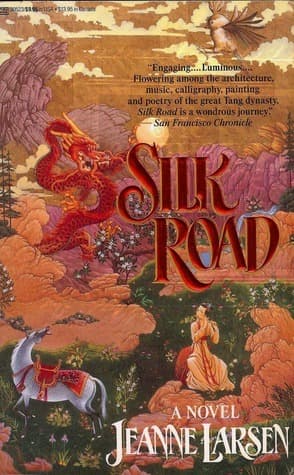
Jeanne Larsen (1989)
Genre
Fantasy / Historical Fiction
Reading Time
12 hours 30 min
Key Themes
See below
Sign in to track this book
In Tang Dynasty China, a woman guided by spirits and her own will goes from courtesan to swordswoman, navigating a world where history meets myth.
The story begins with Xuanzang, an orphaned girl whose parents are killed by bandits. A mysterious, ethereal woman finds and adopts her, becoming her spirit-mother. This spirit-mother trains her in various arts and shares wisdom beyond the everyday world. Appearing as a goddess or nature spirit, she guides Xuanzang's early life, giving her a deep connection to the supernatural and a sense of destiny. Xuanzang learns about the balance between human and spirit realms, and the importance of poetry and music for deeper truths. This period establishes Xuanzang's unique view and her reliance on non-human mentors, setting the stage for her life in Tang Dynasty China.
As Xuanzang grows, her spirit-mother leads her to the capital, Chang'an, where she ends up in a courtesan house. There, under Auntie Jade's guidance, Xuanzang improves her music skills, especially the pipa, and becomes a poet. She learns how to entertain powerful men and navigate the social world of the Tang court. Despite her job, Xuanzang keeps a certain distance, often observing the human drama with a wisdom beyond her years, a result of her supernatural upbringing. She forms complex relationships with other courtesans and patrons, experiencing both the appeal and limits of this life, with occasional cryptic advice from her spirit-mother.
Xuanzang develops a deep affection for Master Li, a brilliant scholar and poet who visits the courtesan house. Their bond grows through a shared love for poetry and intellectual discussion. However, Xuanzang senses a hidden sadness or secret in him. Using her supernatural insights and observations, she discovers that Master Li is involved in political plots or a personal tragedy that threatens his safety and their relationship. This discovery forces Xuanzang to face the dangers of her world and the vulnerability of human connections. Her spirit-mother's warnings about the temporary nature of earthly attachments become relevant as she deals with her feelings for Master Li and the risks involved.
Because of Master Li's secrets or political unrest, Xuanzang finds herself in danger and must flee Chang'an. This is a major turning point, changing her from a sheltered courtesan into a runaway. She leaves her old identity and begins a journey across the vast landscapes of Tang China. During this time, she relies on her intelligence, resilience, and occasional subtle help from her spirit guides. She meets various people from different backgrounds, gaining a broader understanding of the empire's cultures and challenges. This journey is both a physical escape and a spiritual search for self-discovery beyond her past.
During her travels, Xuanzang meets a martial arts master, or perhaps a master's ghost, who teaches her sword fighting skills. Taking on this new role, she becomes a protector of the innocent and a giver of justice in a land often troubled by bandits and corrupt officials. Her sword becomes an extension of her poetic spirit, a tool for balance and rightness. This phase of her life tests her physical and moral strength, forcing her to make hard choices and confront direct violence. While she performs heroic acts, she also struggles with the ethics of using force, always guided by her spirit-mother's wisdom and her own developing sense of purpose.
Throughout her journey, Xuanzang often meets and interacts with various supernatural beings beyond her spirit-mother. These include benevolent dragons offering ancient wisdom or help, mischievous spirits testing her resolve, and powerful deities revealing deeper truths about the cosmos. These meetings are not just fantasy moments but important times of spiritual growth and discovery. They often give her critical information, magical items, or direct help that allows her to overcome difficult obstacles. These interactions strengthen her connection to the spirit world and her role as a bridge between human and supernatural realms, solidifying her understanding of the universe's magic.
Xuanzang's reputation as a talented poet grows, and her verses, full of insight and beauty, eventually reach the Tang Emperor. She is called back to the capital, not as a courtesan, but as a respected poetess, a position that gives her influence and a way to subtly affect court matters. She uses her art to convey messages of justice, compassion, and wisdom, often subtly challenging the powerful or offering guidance through her verses. This period shows her navigating the political complexities of the imperial court with her mix of earthly wisdom and spiritual intuition, demonstrating art's power to cross social boundaries and bring about change.
After years apart and many changes, Xuanzang eventually reunites with Master Li. Their reunion is full of unspoken history and renewed affection. However, their paths have changed, and both are different. Through their interactions, deeper truths about Master Li's past, his connection to the spiritual world, and his role in the broader political and cosmic story are revealed. It becomes clear that their destinies are linked, perhaps even predetermined. This reunion is not just romantic but a moment of deep revelation, clarifying many mysteries that have shadowed Xuanzang's life, and possibly setting the stage for a shared, deeper purpose or a final, bittersweet goodbye.
A key turning point involves Xuanzang undertaking a dangerous search for a mythical scroll, perhaps one with ancient knowledge, a prophecy, or a way to balance the human and spirit worlds. This search often takes her along the Silk Road, a network of trade routes connecting East and West. Her journey has many challenges, including difficult landscapes, meetings with diverse cultures, and confrontations with those who want the scroll for bad reasons. This search symbolizes her full integration of all her identities – courtesan, musician, swordswoman, poet – into a single, purposeful being, embodying the multicultural and mystical nature of the Silk Road itself.
As her journey continues, Xuanzang identifies and confronts a powerful enemy, often a shadowy figure or a force that wants to disrupt the balance between human and spirit realms, or to use the Silk Road scroll's power. This enemy might be a corrupt official, a dark sorcerer, or a malevolent spirit. The confrontation is climactic, testing all of Xuanzang's skills and beliefs. She must use all her training, her connections to the supernatural, and her understanding of poetry and music to defeat this threat. This struggle highlights the constant battle between light and darkness, order and chaos, in the world.
After overcoming her final challenges, Xuanzang does not settle into a normal life. Instead, she fully accepts her role as a guardian of ancient knowledge and a protector of the balance between the human and spirit worlds. She might continue to travel, perhaps creating a hidden sanctuary for scholars and mystics, or she might become a legendary figure whose influence lasts for generations. Her journey ends in a state of deep wisdom and spiritual enlightenment, where she fully combines her human experiences with her supernatural heritage. She ensures that the lessons from the Silk Road, both everyday and magical, are preserved for future generations.
Xuanzang's life story, full of adventure, poetry, and magic, becomes a legend. Her tales are passed down, changing and adapting, showing how history becomes myth. She becomes a symbol of resilience, artistic expression, and the lasting power of the human spirit connected to the divine. The narrative often concludes by reflecting on how Xuanzang's legend intertwines with the Silk Road and the Tang Dynasty, showing her impact on both the everyday and supernatural worlds. Her story reminds us that the line between truth and fiction is often blurred, especially when extraordinary lives are recounted.
The Protagonist
Xuanzang evolves from a sheltered, supernaturally-guided orphan into a multifaceted, self-reliant woman who masters various arts and ultimately becomes a guardian of ancient wisdom and a bridge between worlds.
The Supporting
The Spirit-Mother's role remains consistent as a guiding force, her influence shaping Xuanzang's path without directly controlling it, eventually receding as Xuanzang fully embraces her own power.
The Supporting
Master Li's arc involves navigating personal and political dangers, his journey often mirroring Xuanzang's in its search for truth and meaning, eventually finding a form of peace or resolution through his connection with her.
The Supporting
Auntie Jade's arc is largely static as a mentor figure, her wisdom and experience providing a foundation for Xuanzang's early development before Xuanzang embarks on her independent journey.
The Mentioned
The Emperor's arc is less about personal development and more about representing the shifting political landscape and the challenges Xuanzang faces in navigating imperial power.
The Antagonist
These characters serve as episodic antagonists, their defeat or circumvention marking Xuanzang's progress and demonstrating her evolving capabilities.
The Supporting
These beings largely serve as catalysts or guides, their roles defined by their interactions with Xuanzang, often remaining static in their inherent nature.
The Mentioned
These characters provide episodic interactions, their impact primarily on Xuanzang's expanding worldview rather than having individual arcs.
The novel blurs the lines between historical events and fantasy, showing history as a living story shaped by imagination and spiritual belief. Xuanzang's journey, set in the Tang Dynasty, includes dragons, goddesses, and ghosts, suggesting the supernatural is key to understanding the past. The story often reflects on how tales become legends over time, like Xuanzang's own, highlighting how truth changes when passed through generations. This theme is in the book's structure, which uses different prose styles to show how history becomes 'something not quite true, yet not entirely false.'
“Larsen has used a dazzling diversity of prose styles to adroitly demonstrate how history is transmuted through the centuries into something not quite true, yet not entirely false...”
Art, especially poetry and music, is a central and transformative force in Xuanzang's life and her world. Her pipa playing and poems are not just entertainment but ways to gain spiritual insight, political influence, and emotional connection. As a courtesan, her art is her living and her power; as a poet, it allows her to subtly challenge authority and share deep truths with the Emperor. Art is shown as a universal language that crosses social barriers and connects individuals to deeper realities, sometimes even affecting the supernatural realm. Through her art, Xuanzang often finds her voice and shapes her destiny.
“A joyful blend of scholarship and fancy and an appreciation of the simple, strong, lyrical line of Chinese verse.”
Xuanzang changes many times throughout the novel, taking on new identities – courtesan, musician, runaway, swordswoman, poet. This theme explores how the self changes and how identity is shaped by experience, circumstance, and choice. Each new role allows Xuanzang to develop different parts of her character and learn new skills, yet she always keeps a core spiritual essence guided by her spirit-mother. Her journey is a continuous process of self-discovery and integration, showing that true identity is not fixed but a dynamic mix of all one's experiences. Her ability to adapt to these changes is key to her survival and growth.
“Aided by ghosts, goddesses, dragons, and her own determination, the heroine becomes a courtesan, a musician, a runaway, a wandering swordswoman, a poet, and more.”
The novel constantly explores the connection between the human world and the widespread supernatural realm. Xuanzang's life shows this balance, as she navigates the political plots and social customs of Tang Dynasty China while interacting with spirits, dragons, and goddesses. The supernatural elements are not just fantasy additions but forces that guide, challenge, and shape human events. The theme suggests that understanding the world fully requires acknowledging both visible and invisible forces, and that harmony is achieved when these two realms exist in a delicate, respectful balance. Xuanzang often acts as a bridge between these two worlds.
“Aided by ghosts, goddesses, dragons, and her own determination...”
Xuanzang's travels across Tang Dynasty China and along the Silk Road are linked to her spiritual and personal development. Each new place, meeting, and challenge on her journey helps her understand herself and the world better. From the courtesan houses of Chang'an to the desolate parts of the Silk Road, her movement is a metaphor for her inner growth. Wandering itself becomes a way of learning, forcing her to rely on her intelligence, adapt to new situations, and combine diverse experiences into her identity, leading her to a deep sense of purpose and wisdom.
“The heroine becomes... a runaway, a wandering swordswoman...”
Xuanzang's ethereal mentor who provides cryptic advice and subtle interventions.
The Spirit-Mother serves as a constant, albeit often indirect, source of guidance and foreshadowing for Xuanzang. She appears at critical junctures, offering wisdom that helps Xuanzang navigate difficult choices, understand deeper truths, or avoid peril. This device allows for the introduction of supernatural elements and ancient knowledge, linking Xuanzang's personal journey to a broader cosmic tapestry. The Spirit-Mother's interventions are typically subtle, ensuring Xuanzang's agency in her own development while still providing a magical safety net and a connection to the divine.
Supernatural insights that foreshadow future events or reveal hidden truths.
Xuanzang often experiences prophetic dreams or vivid visions that offer glimpses into the future, reveal hidden dangers, or provide clues to mysteries. This device builds suspense, allows for dramatic irony, and reinforces Xuanzang's unique connection to the spiritual realm. These visions are not always clear, often requiring interpretation, which adds to the narrative's mystical quality and highlights Xuanzang's developing intuition. They serve to guide her decisions, warn her of impending threats, or reveal the true nature of individuals and situations, blurring the line between reality and the supernatural.
The ancient trade route symbolizing connection, cultural exchange, and personal journey.
The Silk Road itself functions as more than just a setting; it is a powerful metaphor for Xuanzang's journey and the novel's themes. It represents the intersection of diverse cultures, the exchange of goods and ideas, and the perilous path of discovery. For Xuanzang, traveling the Silk Road symbolizes her own transformation and the integration of her various identities. It is a physical manifestation of the interconnectedness of the human and spiritual worlds, and a conduit through which history, myth, and individual destinies intertwine. The road facilitates encounters that challenge and enrich her, mirroring the complexity of her inner world.
Xuanzang's musical instrument and poetic verses as tools for expression, power, and magic.
The pipa, a traditional Chinese lute, and Xuanzang's poetry are central plot devices. They are not merely artistic talents but potent tools she uses for survival, influence, and even subtle magical effects. Her music can soothe, enchant, or convey messages where words fail. Her poetry, infused with spiritual insight, can sway powerful figures or reveal profound truths. These artistic expressions serve as a bridge between the mundane and the magical, allowing Xuanzang to exert influence, express her deepest emotions, and connect with both human and supernatural beings. They are extensions of her character and her unique way of interacting with the world.
The use of diverse prose styles to reflect the subjective nature of history and storytelling.
The novel employs a shifting narrative voice and diverse prose styles, sometimes adopting a historical chronicler's tone, other times a more lyrical or mythical one. This device directly supports the theme of history and myth intertwining, demonstrating how stories are retold and transformed over time. It allows the author to present events from various angles, blurring the line between objective truth and subjective interpretation. This narrative flexibility mirrors the multifaceted nature of Xuanzang's identity and the fluid reality of the world she inhabits, encouraging the reader to consider the different lenses through which history and legend are perceived.
“The wind, as everyone knows, is the breath of the world. And sometimes, the world breathes secrets.”
— An early musing on the natural world and its hidden knowledge.
“Dust. Always dust. It clung to everything, a memory of what had been, and a promise of what would become.”
— A recurring observation about the omnipresent dust of the Silk Road.
“There are more ways to be lost than simply by not knowing the path.”
— A character reflecting on different forms of being lost, beyond just physical location.
“A story, once told, belongs to the air and the ears that hear it. It changes with each retelling, growing new leaves.”
— A reflection on the nature of storytelling and oral tradition.
“The gods do not always speak in thunder. Sometimes, they whisper in the rustle of silk.”
— A character contemplating the subtle ways divine or supernatural influence manifests.
“To carry beauty is to carry a burden, for all who see it will desire it, and few will appreciate its weight.”
— A thought on the double-edged sword of possessing great beauty.
“The desert teaches patience, or it teaches death. There is no middle ground.”
— An observation about the harsh realities and lessons of the desert environment.
“Every knot tied holds a wish, a memory, or a fear. Unraveling them is not always wise.”
— A metaphorical reflection on the significance of small, intricate details in life.
“We are all travelers on paths we did not choose, but we may yet choose how we walk them.”
— A character's philosophical take on free will versus destiny.
“Gold glitters, but it cannot warm a cold heart, nor quench a true thirst.”
— A commentary on the limitations of material wealth.
“The past is a tapestry woven with threads of truth and invention. To pull one thread is to risk unraveling the whole.”
— A metaphor for the complexity and fragility of historical narratives.
“Even the smallest stone can shift the course of a river, given enough time and the right current.”
— A thought on the power of small actions and their long-term impact.
“Silence is not always empty. Sometimes, it is filled with all the words that cannot be spoken.”
— An insight into the unspoken emotions and thoughts that exist in silence.
“The world is a loom, and we are but threads. What pattern we make is not always ours to see.”
— A reflection on the interconnectedness of life and the unknown larger design.
Ready to see how well you understood this book? Take our interactive quiz with 10 questions.

Biography coming soon.







