“If you build it, he will come.”
— The mysterious voice that compels Ray Kinsella to build a baseball field.

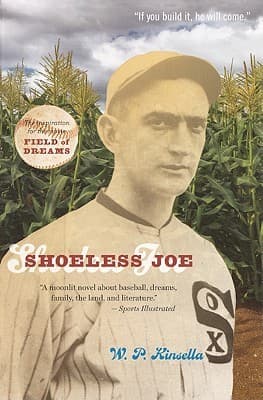
W.P. Kinsella (1992)
Genre
Fantasy / Historical Fiction
Reading Time
240 min
Key Themes
See below
Sign in to track this book
An Iowa corn farmer, guided by a mysterious whisper, plows under his livelihood to build a baseball field, conjuring the ghosts of America's pastime and confronting his own fractured past.
Ray Kinsella, an Iowa corn farmer, walks through his fields one evening when he hears a mysterious voice whisper, "If you build it, he will come." He initially dismisses it, but the voice becomes more insistent. Ray eventually understands it means he must build a baseball field in his cornfield. Despite the financial strain and his wife Annie's initial doubts, Ray begins to clear a section of his corn crop and build a baseball diamond. He feels an inexplicable urge, a deep belief that something important will happen once the field is complete. Local townspeople are puzzled by his actions, some thinking him mad, but Ray continues, driven by the enigmatic promise.
After the baseball field is finished, Ray waits. One evening, as dusk falls, a figure emerges from the cornfield and walks onto the diamond: Shoeless Joe Jackson, the legendary White Sox outfielder banned from baseball for his alleged role in the 1919 Black Sox Scandal. Joe is just as Ray imagined him, a ghost from baseball's past, and he asks Ray if it's 'heaven' here. Ray, awestruck, watches Joe play alone under the lights. Eventually, other ghostly players from the 1919 White Sox team join Joe, and they play exhibition games on Ray's field, visible only to Ray and, later, his family. These legendary figures bring Ray great joy.
The mysterious voice returns, this time telling Ray to 'ease his pain.' After much thought and a cryptic clue about 'Moonlight' Graham, Ray realizes the voice refers to the reclusive author Terrence Mann, a radical writer from the 1960s whom Ray admired. Ray travels to Boston, where he finds Mann, now a bitter and cynical recluse who dislikes baseball and public life. Ray, with Annie's encouragement and a strong sense of purpose, convinces Mann to attend a Red Sox game at Fenway Park, believing this will somehow 'ease his pain.' Mann is hesitant at first but eventually gives in to Ray's persistent, almost spiritual, requests.
At Fenway Park, during the game, Ray and Terrence Mann share a vision. On the scoreboard, alongside the game's statistics, they see a message: 'Go the distance.' This cryptic instruction, combined with the magic they both feel, strengthens Ray's belief in the supernatural events. Mann, seeing the ghostly players on Ray's field through Ray's eyes and now this shared vision, begins to lose his cynicism. He acknowledges the unexplainable nature of what they are experiencing, marking a change in his character and his acceptance of Ray's quest. The message moves Ray into the next phase of his journey.
Following the 'Go the distance' instruction, the voice, or perhaps an intuitive understanding, tells Ray to search for Archibald 'Moonlight' Graham. Graham was a real-life baseball player who played only one inning in the major leagues in 1905 before becoming a doctor in Chisholm, Minnesota. Ray, accompanied by Terrence Mann, takes a road trip to Chisholm. They discover that the original 'Moonlight' Graham died long ago, but they encounter his younger self as a ghost, still dreaming of his chance to play professional baseball. The journey becomes a pilgrimage, connecting Ray and Mann to another piece of baseball's forgotten history.
In Chisholm, Ray and Mann meet the ghost of young Archibald 'Moonlight' Graham, who briefly joins their journey. However, they also meet an older version of Graham, Dr. 'Moonlight' Graham, who is still alive and practicing medicine in the town. The older Graham is content with his life as a doctor, having found fulfillment outside of baseball, though he holds a quiet nostalgia for his brief time in the majors. This meeting highlights missed opportunities and the different paths lives can take. The younger ghost of Graham eventually crosses onto Ray's field, fulfilling his dream of playing more baseball.
Ray's brother-in-law, Mark Kinsella, a practical businessman, arrives in Iowa with his partner, looking to buy Ray's farm. Mark sees Ray's baseball field as a financial disaster, a waste of valuable corn-growing land, and a sign of Ray's irresponsibility. He threatens to foreclose on Ray's mortgage, which would destroy the magical field and end the ghostly baseball games. This conflict introduces a real threat to Ray's spiritual journey, pitting the practical demands of the world against the fantastical events on his farm. Annie fiercely defends Ray and the field, understanding its importance.
During a tense confrontation with Mark and his partner, Ray's young daughter, Karin, falls from the bleachers and chokes on a hot dog. Panic spreads, and the ghostly players stand by helplessly. At this critical moment, the ghost of young 'Moonlight' Graham, who had finally joined the other players on the field, steps off the diamond and transforms back into the older Dr. Graham, a living man. He performs a tracheotomy, saving Karin's life. This sacrifice means Graham can never return to the field as a young player, having chosen to re-enter the mortal world to save a life, fulfilling his true calling as a healer.
After Karin's recovery, Terrence Mann, now fully embracing the magic, announces that he will travel the world, inviting people to come to Ray's field to see the games. Soon, cars and buses arrive, filled with people drawn by an unseen force or Mann's efforts, all eager to experience the field's enchantment. The field, once a private sanctuary for Ray and the ghosts, becomes a public spectacle, a place where dreams and reality mix. The crowd's arrival brings financial stability to Ray, as he charges admission, thus resolving the threat from his brother-in-law.
As crowds gather and the ghostly games continue, Ray notices a new player among the team, a catcher. He feels an inexplicable familiarity. During one game, the catcher removes his mask, revealing himself to be John Kinsella, Ray's deceased father. Ray is overwhelmed with emotion. His father, now young and strong, has come to play on the field, fulfilling the voice's ultimate promise: 'If you build it, he will come.' This reunion gives Ray a deep sense of peace and closure regarding his complicated relationship with his father, allowing him to reconnect with a past he thought was lost forever.
Ray finally plays catch with his father, John Kinsella, on the field. This simple act of throwing a baseball back and forth becomes a strong symbol of reconciliation and healing. Ray apologizes to his father for past grievances and misunderstandings, acknowledging the love and respect he always held for him. His father, in turn, expresses his pride in Ray. This moment is the emotional climax of the story, bringing closure to Ray's personal journey and fulfilling his deepest desires for connection and understanding with his father. The game of catch transcends time and regret, offering a perfect, poignant ending to their relationship.
The Protagonist
Ray transforms from a man burdened by regret into one who finds peace and reconciliation with his past, fully embracing the magic and wonder of his unique life.
The Supporting
Annie evolves from a somewhat skeptical observer to a full believer and protector of the magic on their farm.
The Supporting
Joe finds a measure of peace and redemption through the opportunity to play baseball again.
The Supporting
Mann transforms from a cynical recluse into an enthusiastic believer and advocate for the magic of the field.
The Supporting
Graham, as a ghost, fulfills his dream of playing, and as a doctor, makes a heroic sacrifice, confirming his life's true purpose.
The Supporting
John Kinsella, as a ghost, provides Ray with the opportunity for a final, healing connection.
The Supporting
Karin's near-death experience solidifies the reality of the magic and leads to Dr. Graham's heroic act.
The Antagonist/Mentioned
Mark remains largely unchanged, serving as a foil to Ray's belief system, but his financial threat is ultimately overcome.
The novel explores the power of dreams and human imagination. Ray Kinsella's belief in the mysterious voice and his decision to build a baseball field are acts of pure imagination, defying logic. The appearance of Shoeless Joe Jackson and other ghostly players directly shows these dreams. The story suggests that dreams, even impossible ones, can bring deep meaning and joy. This is clear in Ray's persistent pursuit of the voice's commands, ending in the magical reunion with his father, a dream he didn't even know he had.
“"The one constant through all the years, Ray, has been baseball. America has rolled by like an army of steamrollers. It has been erased like a blackboard, rebuilt and erased again. But baseball has marked the time. This field, this game: it's a part of our past, Ray. It reminds us of all that once was good and that could be again."”
A main theme is the healing power of reconciliation, especially between fathers and sons. Ray carries unresolved issues and regrets about his relationship with his deceased father, John Kinsella. The entire journey, from building the field to finding his father among the ghostly players, is a path toward healing this emotional wound. The final scene where Ray plays catch with his young father symbolizes forgiveness and understanding, allowing Ray to find peace with his past. Similarly, the appearance of Shoeless Joe Jackson and other banned players offers reconciliation for their tarnished legacies, allowing them to play the game they loved again.
““It was the most important thing I had ever done. It was more important than building the field. It was more important than finding Terrence Mann. It was more important than seeing my father again. It was the most important thing I had ever done, because it was about us.””
Baseball is a strong symbol of American innocence, history, and a simpler time. The novel romanticizes the game, presenting it as a sacred pastime that goes beyond generations and even death. The ghostly players, especially Shoeless Joe Jackson, represent the legends and forgotten heroes of baseball's past, whose stories still resonate. Building a field in a cornfield evokes classic Americana, connecting the sport to the heartland and a sense of timeless tradition. The story taps into a collective nostalgia for a perceived golden age, where baseball was pure and magical, a unifying force.
““I’m just a guy who loves baseball, Ray. I’m just a guy who wants to play.””
Ray Kinsella's journey is a search for meaning and purpose in his life. The mysterious voice acts as a divine, or at least supernatural, calling that pulls him out of his ordinary existence. His quest to build the field and then to 'ease his pain' (Terrence Mann) and 'go the distance' (Moonlight Graham) gives him a deep sense of direction. Terrence Mann's character arc also reflects this theme, as he rediscovers his purpose and connection to the world through his involvement in Ray's magical quest. The story suggests that true fulfillment comes from pursuing one's deepest, often irrational, callings.
““The one thing I know, Ray, is that you’re doing something good. Something important.””
The novel contrasts faith and skepticism. Ray Kinsella embodies strong faith, believing in the unseen and the impossible, even when it defies logic and financial sense. His wife, Annie, initially shows more skepticism but quickly embraces the magic. Characters like Ray's brother-in-law, Mark, and the initial Terrence Mann, represent cynicism and a rejection of anything outside rational explanation. The story ultimately champions faith and belief, showing that embracing the extraordinary can lead to deep rewards, while skepticism can blind one to life's wonders. The crowds arriving at the end signify a triumph of collective belief.
““Is this heaven?””
An unexplained auditory hallucination that guides Ray.
The mysterious voice, whispering phrases like "If you build it, he will come," serves as the primary inciting incident and a continuous source of guidance for Ray Kinsella. It acts as a supernatural catalyst, propelling the plot forward and dictating Ray's actions. The voice is never explained or attributed to a specific entity, adding to the magical realism and reinforcing the idea that some events simply transcend rational understanding. It represents a divine or intuitive calling, a force of destiny that Ray, and eventually the reader, learns to trust implicitly.
A magical portal and sacred space built in a cornfield.
The baseball field itself is more than just a setting; it's a powerful symbol and a magical plot device. Built in Ray's cornfield, it acts as a literal and metaphorical bridge between the living and the dead, the past and the present. It's a sacred space where the ghosts of baseball legends can manifest and play, finding redemption and joy. The field's existence is contingent on Ray's faith and represents the power of dreams to create reality. Its threatened destruction by Mark creates tangible conflict, highlighting its importance to the story's magical core.
Spectral figures of deceased baseball legends.
The ghostly players, including Shoeless Joe Jackson and other members of the 1919 Black Sox, are central plot devices that embody the themes of redemption, second chances, and the enduring spirit of baseball. Their presence on Ray's field fulfills the promise of the voice and brings the magic to life. They serve as a tangible link to a romanticized past and allow characters like Ray and Terrence Mann to confront their own histories and beliefs. The specific rules governing their appearance and interaction (e.g., they cannot leave the field without consequences) add to the magical realism of the narrative.
A physical journey that mirrors an internal transformation.
Ray's road trip with Terrence Mann to find 'Moonlight' Graham is a classic plot device, serving as both a physical journey across the country and a metaphorical journey of self-discovery and transformation for both characters. The journey allows Ray and Mann to bond, share their beliefs, and witness further evidence of the magic at play (like the scoreboard message). It expands the scope of the story beyond the farm, connecting the local magic to a broader, almost national, sense of wonder and shared American mythology, while also providing opportunities for character development and exposition.
“If you build it, he will come.”
— The mysterious voice that compels Ray Kinsella to build a baseball field.
“It was like walking into a dream I'd had often.”
— Ray describing his first vision of Shoeless Joe Jackson on the field.
“The one constant through all the years, Ray, has been baseball. America has rolled by like an army of steamrollers. It has been erased like a blackboard, rebuilt and erased again. But baseball has marked the time. This field, this game: it's a part of our past, Ray. It reminds us of all that once was good and that could be again.”
— Terence Mann explaining the enduring power and significance of baseball.
“I'm a farmer. I live in Iowa. I'm a baseball fan. That's all I am.”
— Ray Kinsella's humble self-description, despite his extraordinary experiences.
“We were all young once.”
— Shoeless Joe's simple reflection on the past and the players.
“It was like coming home to a place I'd never been before.”
— Ray's feeling upon finally seeing the completed baseball field.
“He's part of your past, Ray. He's part of all of our pasts.”
— Terence Mann referring to Shoeless Joe Jackson.
“A man's heart is a vast and mysterious territory.”
— A philosophical observation about human emotions and desires.
“Baseball is still the most beautiful game.”
— A general sentiment expressed about the sport.
“I looked at him, and I knew what he was thinking. He was thinking that the past was a beautiful place, and that we could go there again.”
— Ray observing Moonlight Graham and the shared longing for the past.
“It means if you build a baseball field, he will come. And if you build a baseball field, you will come. And if you build a baseball field, they will come.”
— Terence Mann interpreting the 'If you build it, he will come' message.
“I could hear the murmur of the crowd, the crack of the bat, the shouts from the dugout. It was the sound of summer, the sound of America.”
— Ray immersing himself in the atmosphere of the magical baseball game.
“People will come, Ray. They'll come to Iowa for reasons they can't even fathom.”
— Terence Mann foretelling the future popularity of Ray's baseball field.
“I was a ghost. I just lived in the shadows.”
— Moonlight Graham reflecting on his brief, almost forgotten baseball career.
Ready to see how well you understood this book? Take our interactive quiz with 10 questions.

Biography coming soon.







