“What is the opposite of a miracle? An India.”
— Spoken by Max Ophuls, reflecting on the complexities and contradictions of India.

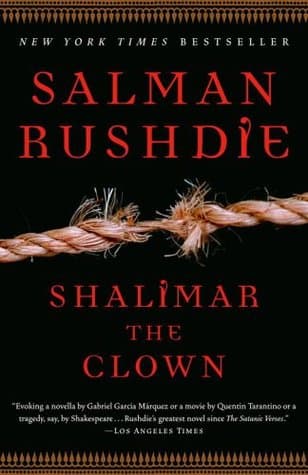
Salman Rushdie (1998)
Genre
Literary Fiction / Historical Fiction
Reading Time
12-15 hours
Key Themes
See below
Sign in to track this book
Rushdie's magical-realist epic follows the doomed romance of a Kashmiri clown and dancer, the assassination of an American counterterrorism chief, and the devastating clash of worlds across continents and generations.
The novel opens in Santa Monica, California, with the assassination of Maximilian Ophuls, a former U.S. ambassador to India and current counterterrorism chief. His killer is Shalimar the Clown, his Kashmiri Muslim driver, who had worked for Ophuls for several months. Shalimar, a mysterious figure, corners Ophuls in his home and kills him in front of Ophuls' daughter, India. Shalimar escapes, leaving India and the authorities to deal with the shocking act. This event sets up the investigation and the unraveling of the history connecting the victim and his assassin, hinting at a vendetta rooted in past betrayals and geopolitical trouble.
India Ophuls, an artist and Max's daughter, is devastated by her father's murder. She is the only witness and a central figure afterward, dealing with grief and the revelation of her father's secret life. The assassination draws significant media attention because of Max's role. As the investigation unfolds, India starts to piece together her father's past and Shalimar's true identity, who is first known only as a driver. Her journey leads her to confront truths about her father and the relationships that led to his death, especially the connection to Kashmir.
The story goes back decades to the Kashmiri village of Pachigam in the 1960s, a time when the region was called 'paradise.' Here, we meet a younger Shalimar, whose real name is Noman Sher Noman, a tightrope walker and clown. He is in love with Boonyi Kaul, a local dancer. Their love story is central to the early Kashmiri chapters, showing a culture where Hindu and Muslim communities live peacefully. Their romance blossoms against traditional village life, with festivals, performances, and the joys of a close community, contrasting sharply with the future violence and betrayal.
Maximilian Ophuls arrives in Kashmir as an American diplomat, tasked with observing the region's politics. He is charismatic and ambitious, captivated by Kashmir. During his stay, he meets Boonyi Kaul, the dancer, and becomes infatuated with her. His presence begins to subtly, then dramatically, unravel Pachigam's peace. Max represents an outside force, bringing global politics and Western influence that will shatter local harmony and start the tragic events leading to his assassination decades later.
Lured by Max Ophuls' charm, wealth, and promises of a glamorous life, Boonyi Kaul decides to leave Shalimar and her home in Pachigam. She becomes Ophuls' mistress, abandoning her traditional life and the man she was to marry. This betrayal is a moment that shatters Shalimar's world and starts his path of vengeance. Boonyi's departure symbolizes the corruption of innocence and the destructive power of ambition and outside influences on a traditional society. Her choice, driven by a desire for a different future, ultimately leads to a tragic end for herself and those she leaves behind.
Boonyi's leaving devastates Shalimar (Noman Sher Noman). The clown is consumed by grief and rage. He vows revenge against Max Ophuls and Boonyi. This emotional wound, with Kashmir's growing political instability, pushes him towards militancy. He joins a local resistance group, training and adopting a new, hardened identity. His change from a symbol of joy to a skilled killer is central to his story, showing how personal betrayal can mix with broader political conflicts to cause extreme actions. His quest for vengeance becomes his only purpose.
Boonyi's life with Max Ophuls is exciting at first but quickly sours. Max's interest fades, and she finds herself abandoned in London, pregnant with his child (India). Her dream of a glamorous life turns into loneliness and regret. She tries to return to Kashmir, but the village, especially Shalimar's family, rejects her for her betrayal. Isolated and shamed, Boonyi falls into poverty and despair, eventually becoming a prostitute. Her tragic path shows the destructive results of her choices and the harsh realities faced by women who defy norms in traditional communities, leading to her death.
While Boonyi suffers, Max Ophuls' career flourishes. He moves from India to France, then England, and back to the United States, rising in the diplomatic corps. He becomes a significant figure in international relations, known for his intellect and strategy, eventually becoming America's counterterrorism chief. His personal life, however, remains complicated, with many affairs and a distant relationship with his family. Max is a powerful, often morally compromised Western figure, whose actions, though seemingly separate from his past, plant the seeds of his future destruction.
Driven by his vow of vengeance, Shalimar (Noman Sher Noman) begins a long journey, changing from a Kashmiri militant into a global operative. He travels through various countries, honing his skills, adopting different identities, and patiently tracking Max Ophuls. His journey shows his determination. He eventually goes to America, where he gets a job as Ophuls' driver. This infiltration is the result of years of planning and the final step in his act of retribution, bringing him face-to-face with his target.
Through her investigation, fueled by grief and a desire for understanding, India Ophuls gradually uncovers the full story behind her father's assassination. She learns about Boonyi Kaul, her mother, and her tragic past in Kashmir, and the betrayal that started Shalimar's quest for revenge. The revelation that she is the daughter of the man who ruined Shalimar's life and the woman who betrayed him is a shock. This understanding forces India to re-evaluate her father's legacy and her own identity, placing her between victim and avenger, and between two conflicting stories of love and loss.
As the story moves between past and present, Kashmir, France, England, and America, the connections between the characters are fully revealed. Max Ophuls' ambition and disregard for others, Boonyi's longing for a different life and heartbreak, Shalimar's change from lover to avenger, and India's role as the product of this history are all linked. The novel details how choices, geopolitical events, and cultural clashes combine to create a chain reaction, ending in the violent present and showing the cyclical nature of vengeance.
The novel ends by highlighting the lasting legacy of violence and the cycle of revenge. Shalimar, having finished his mission, disappears, leaving India to deal with the disturbing truths she has found. The story suggests that the wounds from betrayal and conflict, both personal and political, are deep and last long, echoing across generations and places. The violence that took over Kashmir and the lives of its characters is not easily resolved, implying that retribution may continue, leaving a bitter taste and a warning about unchecked ambition and unresolved grievances.
The Antagonist/Protagonist
From a rising, self-serving diplomat, Ophuls' arc culminates in his violent death, a consequence of his past betrayals that he largely forgot.
The Protagonist/Antagonist
Shalimar transforms from a joyful performer into a relentless avenger, driven by a profound sense of loss and betrayal.
The Supporting/Tragic Figure
Boonyi's arc is a tragic descent from hopeful, ambitious dancer to a disgraced and desperate woman, culminating in her early death.
The Protagonist
India evolves from a grieving daughter to an enlightened, though burdened, individual who understands the complex, tragic history that shaped her life.
The Supporting
Pyarelal experiences a decline from a respected musician to a man burdened by shame and grief.
The Supporting
Abdullah endures the tragedy of his son's transformation and the decline of his village, maintaining his stoicism.
The Supporting
Kachhwaha remains a consistent symbol of state power and military force throughout the narrative.
The Mentioned/Historical Figure
His historical actions set the stage for the political conflicts central to the story.
Betrayal starts the novel's tragic events. Boonyi's leaving Shalimar for Max Ophuls is a personal betrayal that shatters Shalimar's innocence and turns him into a vengeful militant. Max Ophuls' seduction and abandonment of Boonyi is another betrayal, showing his moral flaws. These personal betrayals echo the political betrayals and broken promises that affect Kashmir, turning a paradise into a war zone. The theme shows how one act of betrayal can have devastating, far-reaching consequences, leading to cycles of violence and retribution across decades and continents.
“A man's life can be ruined by a woman's choice, and a country's destiny by a politician's whim.”
The novel shows Kashmir as a 'paradise' in its early chapters, a place of beauty and harmony between communities. This image contrasts with its later descent into conflict. The loss of innocence is seen in Shalimar's change from a joyful clown to a killer, and Boonyi's fall from a hopeful dancer to an outcast. The theme explores how outside forces—ambition, politics, and personal desires—can corrupt and destroy a pure state, both geographically and spiritually, leaving only violence and regret.
“Kashmir was the most beautiful place on earth, until it became the most dangerous.”
The novel weaves individual dramas with broader geopolitical conflicts. Shalimar's quest for vengeance against Max Ophuls is tied to the insurgency in Kashmir. His change into a militant is not only a response to Boonyi's betrayal but also a result of the political instability and violence in his homeland. Max Ophuls' diplomatic career, which brings him to Kashmir, directly contributes to the personal tragedies. This theme emphasizes that personal choices have political effects and that political turmoil deeply impacts individual lives, showing how large and small conflicts are connected.
“Every personal story is, in a way, a political story, and every political story contains a million personal ones.”
Vengeance drives the narrative, fueling Shalimar's decades-long pursuit of Max Ophuls. His determination to get retribution for Boonyi's betrayal and her tragic fate powers the main plot. The novel explores the destructive nature of this cycle, showing how violence creates more violence, and how past wounds continue to affect the present. Even after Shalimar achieves his goal, the lingering questions and the impact on India suggest that the cycle of retribution may not truly end, highlighting the difficulty of breaking free from past grievances and the pursuit of 'justice.'
“Vengeance is a dish best served cold, but it can freeze the heart in the serving.”
Many characters struggle with identity and belonging. Boonyi is displaced from her village and traditional life, an outcast in both the Western world and her home. Shalimar takes on multiple identities during his journey of vengeance, losing his original self. India, as a mixed-race, illegitimate daughter, deals with her heritage and the conflicting stories of her parents. The theme reflects the displacement of Kashmiris and the loss of cultural identity in a region torn by conflict. It questions what it means to belong when one's home and past are shattered.
“To lose your homeland is to lose a part of yourself, perhaps the most important part.”
The story jumps between different time periods and locations.
The novel employs a complex non-linear narrative, frequently shifting between the present-day assassination of Max Ophuls in California and the past events in Kashmir, France, and England. This structure allows Rushdie to gradually reveal the intricate connections between characters and events, building suspense and providing a comprehensive historical context for the central conflict. It mimics the fragmented nature of memory and history, forcing the reader to piece together the narrative, much like India Ophuls herself, ultimately revealing how past actions inevitably lead to present consequences.
The story is told through various viewpoints, some implicitly biased or incomplete.
While the primary narrative voice is omniscient, the story subtly incorporates elements of unreliable narration and shifts in perspective, particularly when recounting historical events or characters' motivations. This allows for a multifaceted understanding of the characters and their actions, preventing a simplistic 'good vs. evil' interpretation. The reader is often presented with different versions of events or character interpretations, reflecting the subjective nature of memory and the complexities of human motivation, especially in a conflict-ridden environment where truth itself becomes a casualty.
Kashmir represents an idealized state corrupted by external forces and conflict.
Kashmir functions as a powerful symbol throughout the novel. Initially depicted as a 'paradise on Earth,' a place of natural beauty, cultural harmony, and innocent love (between Shalimar and Boonyi), it gradually transforms into a symbol of paradise lost. Its descent into violence, militancy, and despair mirrors the corruption of innocence and the destruction of harmonious relationships among the characters. The physical and political degradation of Kashmir serves as a poignant metaphor for the broader themes of betrayal, loss, and the devastating impact of external interference on an otherwise idyllic land.
Characters associated with performance and disguise.
The motif of the clown and other performers (tightrope walkers, dancers) is central to the novel. Shalimar, literally a clown and tightrope walker, embodies a duality: the joyful entertainer and the deadly avenger. His transformation highlights the idea that appearances can be deceiving and that individuals can adopt new 'roles' out of necessity or vengeance. Boonyi, as a dancer, also performs. This motif underscores themes of illusion, transformation, and the masks people wear, both literally and figuratively, to survive or achieve their goals, blurring the lines between identity and performance.
“What is the opposite of a miracle? An India.”
— Spoken by Max Ophuls, reflecting on the complexities and contradictions of India.
“The past is a foreign country; they do things differently there.”
— A general reflection within the narrative, borrowing a famous literary line to emphasize the historical distance.
“Terrorism is the war of the poor, and war is the terrorism of the rich.”
— A philosophical observation made in the context of political violence and global power dynamics.
“Everywhere was the same, the everywhere of the everywhere, the nowhere of the nowhere.”
— Describing the feeling of displacement and loss of identity experienced by characters in exile.
“Love, it turns out, is not a victory but a surrender.”
— Reflecting on the nature of love and its demands, particularly in the tumultuous relationships in the book.
“To be born again, you must first die.”
— A metaphorical statement about transformation, loss, and the cycle of destruction and rebirth.
“History, like love, is mostly a matter of telling stories.”
— Highlighting the subjective and narrative nature of historical accounts and personal relationships.
“The greatest trick the devil ever pulled was convincing the world he didn't exist. The second greatest was convincing the world that Kashmir was a paradise.”
— A cynical twist on a famous quote, used to underscore the tragic reality beneath Kashmir's idyllic image.
“Memory is a kind of country, and you have to have a map to find your way around it.”
— A character contemplating the complexity and unreliability of memory, especially in recalling a fractured past.
“When you lose everything, you gain the freedom to do anything.”
— A paradoxical observation on the liberating effect of utter loss and desperation.
“The world is full of ghosts, and if you don't believe in them, they'll just have to believe in you.”
— A haunting remark about the lingering presence of the past and unresolved issues.
“The truth is a moving target, and sometimes it hits you when you least expect it.”
— Reflecting on the elusive nature of truth and its sudden, often painful, revelations.
“Every act of love is also an act of faith.”
— A profound statement about the vulnerability and trust inherent in loving someone.
“The mirror of history is broken, and everyone sees a different reflection.”
— Emphasizing the fragmented and subjective interpretations of historical events, particularly in contested regions.
Ready to see how well you understood this book? Take our interactive quiz with 10 questions.

Sir Ahmed Salman Rushdie is an Indian-born British-American novelist. His work often combines magic realism with historical fiction and primarily deals with connections, disruptions, and migrations between Eastern and Western civilizations, typically set on the Indian subcontinent. Rushdie's second novel, Midnight's Children (1981), won the Booker Prize in 1981 and was deemed to be "the best novel of all winners" on two occasions, marking the 25th and the 40th anniversary of the prize.







