“That's the secret to survival: never go anywhere, especially in an emergency.”
— Candace's father's advice about staying put during crises, which she recalls during the pandemic.

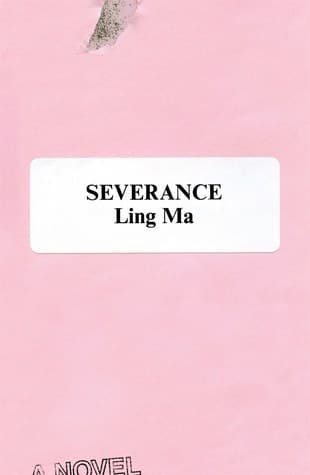
Ling Ma (2018)
Genre
Literary Fiction / Science Fiction
Reading Time
360 min
Key Themes
See below
Sign in to track this book
During a global pandemic that turns people into automatons, a secretly pregnant millennial office worker navigates the ruins of New York with a cult-like group of survivors, confronting the consumerism of her past life.
Candace Chen works as a production coordinator for a Bible manufacturing company in Manhattan, a job she took after college without clear goals. Her life is routine; she lives with her boyfriend Jonathan and navigates a city that feels both familiar and strange. A new fungal infection, Shen Fever, begins to spread, but Candace, like many New Yorkers, initially dismisses its seriousness. The fever causes victims to repeat mundane tasks until they die, seemingly trapped in muscle memory. Jonathan, wanting a more authentic life, decides to leave New York for Chicago as the pandemic grows, asking Candace to join him, but she stays, drawn by her job's stability and a sense of inertia.
As Shen Fever worsens, New York City quickly empties. Businesses close, public services stop, and the population shrinks. Candace's company, however, makes a deal with its Chinese factory to continue producing specialty Bibles, offering her a large bonus to stay. She is one of the few remaining employees, living in the deserted office building, ordering takeout, and watching the city's collapse from her window. During this time, she starts an anonymous blog called 'NY Ghost', posting photos of the abandoned city, its streets, stores, and landmarks, capturing the surreal emptiness and lingering traces of human life. This period is one of deep isolation, yet also a strange freedom.
Months into the pandemic, Candace, now pregnant with Jonathan's child, realizes her isolation is unsustainable. She meets a small group of survivors led by Bob, a former IT technician. Bob, a charismatic and authoritarian figure, takes charge, offering Candace a place in their convoy going to 'The Facility', a supposed safe place in Chicago. Candace, despite doubts about Bob's leadership and the group's dynamic, agrees to join, driven by her pregnancy and the realization she cannot survive alone. She keeps her pregnancy a secret from the group, fearing how Bob might react or use her vulnerability.
The group, including Candace, Bob, and several other survivors like Melissa, Ashley, and Gerald, travels cross-country in an SUV. They scavenge for supplies in abandoned malls and homes, and avoid the fevered, who are often repeating their last tasks. Bob enforces strict rules, including mandatory check-ins and the ritualistic burning of fevered bodies they find, believing it prevents further spread. Candace observes the group's increasing obedience to Bob's authority, and struggles to connect her past life with their new, harsh reality, all while secretly managing her growing pregnancy.
During their journey, the group faces its first direct encounters with the fever's danger. Gerald, an older member, gets the fever after a scavenging trip, endlessly re-folding clothes. Later, Melissa, another member, also gets sick, repeatedly applying makeup. These deaths, despite Bob's attempts to control the situation, show how fragile their lives are and how widespread the fever's threat is. Candace becomes more wary of Bob's methods and his seemingly arbitrary rules, questioning his true motives and the practicality of their journey to a mythical 'Facility'. Her secret pregnancy is a source of both hope and great fear.
As Candace's pregnancy progresses, she cannot hide it. The group discovers her condition, which changes their dynamic. Bob, initially surprised, starts to see Candace and her unborn child as a symbol for their new society, a 'founding mother.' He begins to emphasize procreation and rebuilding, subtly manipulating the group's view of Candace. This revelation makes Candace more central to the group, but also makes her feel more trapped and vulnerable, as her body and future become subject to Bob's control and the group's expectations for a new beginning.
After a long journey, the group arrives in Chicago, the supposed location of 'The Facility.' To Candace's dismay, 'The Facility' is Bob's childhood home, a suburban house, not the grand haven he described. This shows Bob's manipulation and the extent of his delusion. He tries to recreate a normal life in the house, assigning roles and enforcing his will, but the group quickly sees his promises are empty. Candace feels a deep sense of betrayal, and her situation grows more urgent as her due date nears.
Candace gives birth to a healthy baby girl at Bob's house. The birth, a moment of deep personal meaning, also strengthens her resolve to protect her child from Bob's influence. Bob, however, immediately tries to integrate the baby into his vision for their 'new society,' attempting to control Candace's motherhood. This overreach prompts Candace's defiance. She realizes she cannot let her daughter be raised under Bob's authoritarian rule. She begins to subtly plan her escape, watching Bob's patterns and looking for a chance to leave with her daughter, even if it means going back into the uncertain, fever-ridden world.
Candace's defiance leads to a direct confrontation with Bob. She challenges his authority and the fabricated reality he has imposed on the group. The tension grows, and Candace, with help from Ashley, who also doubts Bob, creates a diversion. In a crucial moment, Candace takes the chance to escape the house with her newborn daughter. Her departure is a desperate act of rebellion, choosing an unknown future over Bob's false security and control. She leaves the group behind, venturing into the deserted suburban landscape of Chicago.
After escaping Bob, Candace and her daughter settle in an abandoned house in the Chicago suburbs. She scavenges for supplies, learns to care for her baby independently, and adapts to a solitary existence again, but this time with a strong sense of purpose and agency. She continues to document her surroundings, now from the perspective of motherhood and survival, even resuming her 'NY Ghost' blog, though with a new focus. Candace finds peace and self-sufficiency, having cut ties with her past life and Bob's cult-like group, choosing to build a future on her own terms, free from societal expectations and the lingering presence of Shen Fever.
The Protagonist
From passive observer and follower, Candace evolves into an independent, resourceful mother who actively shapes her own destiny.
The Antagonist
Bob's character remains largely static, driven by his desire for control and his flawed vision of a new society, which is ultimately exposed as self-serving.
The Supporting
Jonathan's arc is largely off-screen; he represents the path Candace did not take, a choice that ultimately leads to her unique survival.
The Supporting
Her brief arc emphasizes the fever's impact and the group's fragility.
The Supporting
Ashley develops from a quiet follower to an active participant in Candace's liberation.
The Supporting
His arc is brief, serving to illustrate the fever's impact on the group.
The Mentioned
Her influence is retrospective, shaping Candace's internal narrative rather than developing as a character.
The novel explores how identity is shaped by work, routine, and societal expectations, and how it changes during collapse. Candace, initially defined by her mundane job and passive acceptance, finds a new sense of self through her 'NY Ghost' blog and, more deeply, through motherhood. The pandemic removes external identity markers, making characters confront who they are. Candace's journey is one of shedding societal roles to find her own agency and purpose.
“What was the point of these objects, these markers of a life, if there was no one left to witness them?”
Severance satirizes contemporary capitalist society and its reliance on routine, consumerism, and meaningless work. Candace's job in Bible production, a commodified religious text, shows the absurdity of her pre-pandemic life. The Shen Fever itself is a metaphor for this critique, as victims are trapped in endless loops of mundane, often consumer-driven tasks. The abandoned malls and product-filled homes the survivors scavenge show the emptiness of material possessions in a post-apocalyptic world, questioning modern life's value systems.
“We were all Severance, in a way. We had all severed ourselves from the past, from our former lives, and now we were trying to build something new.”
Motherhood is a strong theme, especially in Candace's change. Her pregnancy and her daughter's birth provide a strong reason for survival and a cause for her defiance against Bob. It shifts her focus from passive observation to active protection and building a future. Bringing new life into a desolate world gives her existence meaning, contrasting sharply with her earlier aimlessness and the fevered's repetitive futility. Her daughter represents hope and a real reason to rebuild.
“I was a mother now. The world could end, but I had to keep going.”
The novel often explores Candace's memories of her past, her family, and her relationship with Jonathan, contrasting them with the current desolation. Shen Fever is a disease of memory, trapping victims in repetitive, ingrained behaviors. Candace's blog, 'NY Ghost', preserves memory, documenting a city that once was. This theme explores the human tendency to hold onto the past, both consciously and unconsciously, and how memory shapes our understanding of loss and the possibility of new beginnings.
“The fevered were caught in a loop, reliving their last days, their last gestures. We were all doing it, in our own ways.”
Through Candace's thoughts on her immigrant parents and her own post-college aimlessness, the novel critiques the contemporary American Dream. Her parents pursued tangible success, while Candace finds herself in a meaningless job. Society's collapse shows how fragile this dream is and forces a re-evaluation of what 'success' or a 'good life' means. The immigrant experience of building a new life from nothing connects with the survivors' attempts to rebuild after the pandemic, showing themes of displacement and resilience.
“My parents had worked so hard to get here, to build a life. And for what? For this?”
A fungal plague that causes victims to endlessly repeat mundane tasks until death.
The Shen Fever is the central catastrophic event and a powerful symbolic device. It acts as a literal manifestation of the novel's critique of routine, consumerism, and the emptiness of modern life. By trapping its victims in repetitive, often meaningless actions (like folding clothes or applying makeup), the fever highlights the automated, unthinking nature of many pre-pandemic lives. It serves as both a literal plot driver, emptying the cities and forcing survivors together, and a metaphorical commentary on the 'severance' from authentic living that characterizes Candace's world.
Candace's anonymous blog documenting the abandoned New York City.
The 'NY Ghost' blog is a crucial narrative device for Candace's character development and for illustrating the desolate landscape of post-apocalyptic New York. It provides Candace with an outlet for observation, reflection, and a sense of purpose during her initial isolation. The blog's photographs serve as visual evidence of the world's collapse, while Candace's accompanying text offers her internal monologue, revealing her thoughts and feelings. It's a way for her to process trauma, maintain a connection to the world, and subtly assert her own identity outside of her corporate job.
Interspersed memories of Candace's pre-pandemic life, particularly her relationship with Jonathan.
The novel uses a non-linear narrative structure, weaving Candace's present-day journey with Bob's group and her solitary time in New York with extensive flashbacks to her past. These flashbacks detail her relationship with Jonathan, her job, and her family history. This device allows for a deeper exploration of Candace's character, contrasting her pre-pandemic passivity with her post-pandemic agency. It also provides context for the societal critique, showing the routines and expectations that were severed by the fever, and allows readers to understand the emotional weight of her losses and transformations.
Bob's mythical destination for survivors, revealed to be his childhood home.
The 'Facility' is a significant plot device that drives the survivor group's journey and serves as a symbol of false hope and manipulation. Bob uses the promise of this organized, safe haven to exert control over the group, creating a shared delusion that motivates their arduous trek. Its eventual revelation as Bob's mundane childhood home exposes his true intentions and the hollowness of his grand vision, marking a turning point for Candace and the group. It represents the collapse of grand narratives and the harsh reality of rebuilding in a broken world.
“That's the secret to survival: never go anywhere, especially in an emergency.”
— Candace's father's advice about staying put during crises, which she recalls during the pandemic.
“Before the end, people were already ghosts.”
— Reflecting on how modern life and routine made people feel disconnected even before the pandemic.
“The apocalypse is not an event. It's a feeling.”
— Candace's realization about the slow, creeping nature of societal collapse.
“We are all fevered, we are all Shen Fevered, in our own way.”
— Comparing the pandemic-induced Shen Fever to the mindless routines of pre-apocalypse life.
“Nostalgia is the only true home.”
— Candace's thoughts on how memories and longing provide comfort in a broken world.
“The end of the world is just another day at the office.”
— Satirical observation about how corporate culture persists even during societal collapse.
“You can't mourn what you never had.”
— Candace reflecting on her immigrant parents' losses and her own sense of displacement.
“We were all waiting for something to happen, and then it did.”
— Describing the collective anticipation before the pandemic outbreak.
“The past is a country we can never return to.”
— Candace's musing on the irreversible nature of time and memory.
“Survival is just another form of waiting.”
— Philosophical take on the passive nature of enduring in a post-apocalyptic world.
“In the end, we are all just stories we tell ourselves.”
— Candace contemplating how narratives shape identity and reality.
“The fevered don't know they're fevered. That's what makes them dangerous.”
— Explaining the insidious nature of Shen Fever, which causes people to repeat routines mindlessly.
“Home is not a place. It's a collection of things you can't forget.”
— Candace's definition of home, tied to memories rather than physical location.
“We were all already dead, we just didn't know it yet.”
— Bleak observation about the inevitability of the pandemic's impact.
Ready to see how well you understood this book? Take our interactive quiz with 10 questions.







