“It is a terrible thing to be a great lady, because one is then, if one is truly great, no longer a human being.”
— From 'The Deluge at Norderney', spoken by Miss Malin

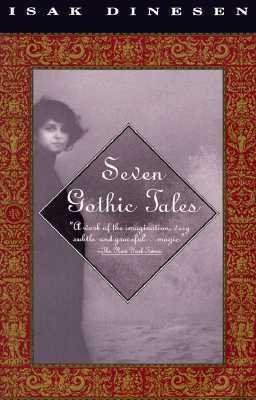
Isak Dinesen (1934)
Genre
Fantasy
Reading Time
420 min
Key Themes
See below
Sign in to track this book
Dinesen's debut collection blends aristocratic boredom with the macabre, telling stories of doomed romance, supernatural events, and deep psychological insight, all in a 19th-century Gothic style.
During a great flood on the Danish coast, various people find shelter in a hayloft on Cardinal Hamilcar von Sehestedt's estate. The group includes the young Miss Malin, her fiancé Jonatan M. M. M. M. M., the mysterious Baron von Blixen, and the unusual Miss Nat-og-Dag. As the water rises, trapping them, their closeness leads to confessions and philosophical talks. Cardinal von Sehestedt, a figure of authority and wisdom, oversees their confinement, subtly guiding their interactions and showing his understanding of human nature and fate, as the flood outside reflects the inner turmoil and secrets within the loft.
In a dimly lit Parisian salon, an elderly French chevalier, a remnant of an earlier time, tells a group of listeners about an important experience from his youth. He describes a moonlit night in a forest, where he met a beautiful and mysterious young woman. Their brief, intense connection, full of passion and a sense of timelessness, was with a woman who was already married and having a secret meeting. The chevalier, through his nostalgic story, thinks about love, memory, and the fleeting beauty of youth, stressing how this single, forbidden encounter affected his entire life, even decades later.
The story is about the elderly and strict cousins, Baroness Christine and Baron von Standish, who want to arrange a good marriage for their innocent young relative, Athena. Their chosen groom is the handsome and somewhat naive Boris. However, their plans are complicated by an ancient, mischievous monkey, which the Baroness keeps as a pet. This monkey, with its strange intelligence and ability to understand people, causes trouble. It intercepts a letter from Athena to Boris, replacing it with a scandalous one, thus ruining the carefully planned engagement and revealing the hidden desires and social pressures beneath the surface of the aristocratic world.
Augustus von Schimmelreiter, a young Danish nobleman, travels to Pisa, Italy, on a Grand Tour that quickly becomes strange. He meets several unusual characters, including an old, blind astrologer and Italian noblemen with odd habits. The story changes when Augustus becomes obsessed with a beautiful and mysterious woman named Rosina, who seems to embody Italy's romantic and dangerous appeal. Their interactions are full of fate and premonition, as Augustus gets caught in a complex web of relationships and secrets, ending in an unexpected and tragic event that shows how fragile human desires are and how unpredictable destiny is in a foreign land.
Two old, reclusive sisters, Fanny and Eliza, live in a crumbling mansion near Elsinore, haunted by memories of their past. They host a rare supper for their two nephews, Morten and Frans, who are sailors just back from sea. The evening is filled with sadness and unspoken truths. As the sisters tell stories of their youth, especially their unfulfilled love for a young man who died tragically, the past slowly takes over the present. The supper ends with a shocking revelation: the sisters confess to murdering their beloved in a misguided attempt to keep him innocent and prevent him from marrying another, a dark secret that has shaped their entire isolated lives.
In a London opera house, various people, including the mysterious Marcus and the cynical Miss Astrea, gather and share their life stories. The main story is about the beautiful and enigmatic Pellegrina Leoni, a famous opera singer who mysteriously lost her voice after a fire. She then takes on different identities, living different lives under different names, each a carefully made persona. The 'dreamers' in the story are those who live through imagination and illusion, struggling with their true selves versus the roles they play. The tale explores identity, the power of storytelling, and the blurred lines between reality and fiction, as Pellegrina's changing identities reflect the inherent theatricality of human life.
Fransine, a young and lively woman, is married to an old, famous poet, Fransine. They live in a secluded, peaceful place, seemingly cut off from the outside world. Their relationship is complex, marked by a big age difference and Fransine's youthful idealism clashing with Fransine's artistic nature and approaching death. The story looks at their private talks and thoughts on love, beauty, and creating art. As Fransine faces the reality of her husband's aging and life's temporary nature, she struggles with her own desires and the meaning of their bond. The tale ends with a touching look at how art tries to make fleeting moments and emotions last forever, and the final acceptance of life's natural impermanence.
The Supporting
He remains largely unchanged, serving as a stable, wise presence, but his interactions reveal the depth of his accumulated wisdom.
The Protagonist
Malin begins as an innocent, naive woman and undergoes a profound emotional awakening, realizing her true desires.
The Supporting
He reveals his tragic past, finding a moment of connection and perhaps a degree of catharsis with Malin.
The Protagonist
His character arc is presented retrospectively, showing how a single event defined his life, rather than undergoing change within the story's present.
The Protagonist
Athena begins as a passive participant in her own fate but gains a subtle agency through the disruption of her arranged marriage.
The Protagonist
Pellegrina undergoes a continuous arc of identity transformation, constantly shedding and adopting new personas after losing her singing voice.
The Protagonist
Fransine matures in her understanding of love, art, and mortality, accepting the transient nature of life.
The Protagonists
Their arc is a retrospective revelation of their tragic past, culminating in the confession of a dark secret that defined their lives.
Many of Dinesen's tales look at the conflict between predetermined destiny and individual choice. Characters often find themselves in situations where outside forces, whether a natural disaster like the flood in 'The Deluge at Norderney' or the monkey's mischief in 'The Monkey', seem to guide their paths. Yet, within these limits, characters like Miss Malin or Pellegrina Leoni try to assert their desires or redefine who they are. The stories often suggest that while fate may set the stage, the human spirit's response, through love, art, or rebellion, remains a powerful, though sometimes useless, act of will.
“And the world, what it is, is not a world of reality but a world of dreams.”
Storytelling, both within the narrative and as a narrative tool, is central to the collection. Characters often recount their pasts, shaping their identities through their stories, as seen with the Old Chevalier. In 'The Dreamers', Pellegrina Leoni literally lives through different stories, adopting new identities as a way to create herself and escape. Dinesen herself, through her elaborate and often fantastical prose, creates a world where illusion and reality are closely linked, suggesting that the stories we tell ourselves and others are as strong, if not stronger, than objective truth. This theme highlights the human need for stories to understand, or escape from, life's complexities.
“All sorrows can be borne if you put them into a story or tell a story about them.”
The various forms of love, from romantic passion to destructive obsession, are present throughout these tales. In 'The Old Chevalier', a brief, passionate encounter defines a man's entire life. 'The Supper at Elsinore' explores the dark extreme of love, where it becomes a murderous obsession that leads two sisters to commit a terrible act to preserve an idealized image. Miss Malin's awakening in 'The Deluge at Norderney' shows the unpredictable nature of desire, challenging social norms. Dinesen portrays love as a powerful, often dangerous force that can elevate or destroy, revealing the deep, often irrational, currents of human emotion.
“There are some things that cannot be told in words. They must be dreamt.”
Many characters struggle with their sense of self, often undergoing big changes or taking on multiple identities. Pellegrina Leoni in 'The Dreamers' is the clearest example, reinventing herself repeatedly after losing her voice, suggesting that identity is fluid and performed. Miss Malin in 'The Deluge at Norderney' changes from a naive fiancée to a woman aware of her own desires. The tales question how stable identity is, proposing that it can be shaped by circumstances, desires, or even a conscious act of will, often blurring the lines between who one truly is and the roles one plays for oneself and others.
“To be a person, in a sense, is to be a mask.”
Several stories are set against a background of decaying aristocratic estates and fading social orders, reflecting a sense of nostalgia for a past era while also criticizing its rigid rules. The crumbling mansion in 'The Supper at Elsinore' and the reclusive sisters embody this decline. The Old Chevalier, a remnant of the French aristocracy, laments the loss of his youth and the world he once knew. This theme suggests that while the old world had beauty and grandeur, it also held secrets and oppressive conventions, and its inevitable end makes way for new, though often chaotic, realities.
“The past, after all, is a memory, and memory is a story.”
A story within a story, often told by a character to other characters.
Dinesen frequently employs frame stories to layer narratives and create a sense of distance and reflection. 'The Old Chevalier' is a prime example, where the chevalier recounts a past event to an audience in a salon. 'The Dreamers' also uses a frame, with various characters sharing their life stories within a larger gathering. This device allows for multiple perspectives, emphasizes the act of storytelling itself, and often imbues the inner tale with a mythic or legendary quality, enhancing the 'gothic' atmosphere by creating a sense of timelessness and recounted history.
Attributing human emotions or characteristics to inanimate objects or nature.
Nature often mirrors the internal states or dramatic events of the characters. The most striking example is 'The Deluge at Norderney', where the literal flood outside the hayloft directly reflects the emotional and moral deluge experienced by the characters within, as their secrets and passions are brought to the surface. The stormy weather and dark forests in other tales contribute to the gothic mood, creating an atmosphere that resonates with the characters' psychological turmoil and the often-dark themes of the stories.
A narrator whose credibility is compromised or whose account may be biased.
While not always explicitly unreliable in the traditional sense, Dinesen's narrators, or the characters who tell stories, often present their versions of events through a highly subjective, romanticized, or self-serving lens. The Old Chevalier's nostalgic recounting of his youth, for instance, is undoubtedly colored by memory and longing. This device challenges the reader to question the 'truth' of the narratives, reinforcing the theme of storytelling as a subjective act and blurring the lines between fact and embellished fiction, characteristic of the gothic genre's focus on perception and illusion.
Characters who contrast with another character, typically the protagonist, to highlight particular qualities.
Dinesen often uses foil characters to illuminate the traits and struggles of her protagonists. In 'The Deluge at Norderney', the pious and somewhat rigid Jonatan M. M. M. M. M. serves as a foil to the passionate and melancholic Baron von Blixen, highlighting Miss Malin's internal conflict between duty and desire. Similarly, the elderly, controlling cousins in 'The Monkey' act as foils to the innocent Athena. This device allows for a deeper exploration of character motivations and thematic contrasts, emphasizing the complexities of human nature and societal expectations.
“It is a terrible thing to be a great lady, because one is then, if one is truly great, no longer a human being.”
— From 'The Deluge at Norderney', spoken by Miss Malin
“Man is a storytelling animal, and as long as he lives he will tell stories.”
— A recurring theme and sentiment throughout the collection, reflecting on human nature.
“For the true artist, the world is always a stage, and he himself the principal actor.”
— Reflecting on the nature of artistic creation and self-perception.
“All sorrows can be borne if you put them into a story or tell a story about them.”
— From 'The Old Chevalier', a reflection on the power of narrative.
“What is man, when you come to think upon him, but a minutely set, ingenious machine for turning, with infinite artfulness, all he touches into stories, and all he sees into stories?”
— A philosophical observation on human perception and creation.
“Young people, nowadays, are very fond of calling everything 'romantic.' It is a word which I detest. I do not believe in romance.”
— From 'The Supper at Elsinore', a character's cynical view.
“God made the world as a stage for his stories.”
— From 'The Poet', a grander perspective on creation and narrative.
“The greater the artist, the greater the man. He is a king in his own world.”
— From 'The Supper at Elsinore', discussing the role of the artist.
“Beauty is a terrible thing, and more terrible than anything else in the world.”
— From 'The Monkey', a contemplation on the destructive power of beauty.
“To be a woman is to be an actress.”
— A recurring underlying theme, particularly in stories featuring strong female characters.
“There are no facts, only stories.”
— A profound statement on the subjective nature of reality and truth.
“Love, after all, is a matter of telling stories. And to love is to be willing to believe them.”
— A deep insight into the nature of love and shared narratives.
“The true art of living is to be able to tell your own story, and to make it a good one.”
— A summary of the book's overarching philosophy on life as a narrative.
“When you have a great sorrow, you must tell it to the trees. They are the only ones who will listen without judgment.”
— From 'The Old Chevalier', highlighting a connection with nature.
“Everything in life is a masquerade, a grand play where we all wear masks.”
— A reflection on the theatricality of existence and hidden identities.
Ready to see how well you understood this book? Take our interactive quiz with 10 questions.
Biography coming soon.







