“The future was a dark corridor, and the past was a closed door.”
— Frédéric Moreau's contemplation on his life's trajectory and missed opportunities.


Gustave Flaubert (2013)
Genre
Literary Fiction / Historical Fiction / Romance
Reading Time
1000 min
Key Themes
See below
Sign in to track this book
A passionate but aimless young man navigates the tumultuous 1848 French Revolution and the rise of an empire, all while consumed by an unrequited, lifelong love for an older, unattainable woman.
In September 1840, Frédéric Moreau, returning to Nogent-sur-Seine after finishing his baccalaureate, boards the steamboat 'Ville de Montereau' for Paris. Among the passengers, he sees Madame Arnoux with her husband, Jacques Arnoux, and their daughter. Frédéric is immediately struck by her beauty, grace, and maternal tenderness. He spends the rest of the journey watching her, falling deeply in love. This meeting changes his life, shaping his future hopes and romantic pursuits. He learns that Monsieur Arnoux publishes art magazines, a detail that will later help him try to re-enter Madame Arnoux's life.
Frédéric moves to Paris to study law but is distracted by his feelings for Madame Arnoux and the appeal of Parisian society. He befriends Deslauriers, a more practical and ambitious law student. Frédéric neglects his studies, spending his time dreaming of Madame Arnoux and trying to find her. His initial attempts to join the Arnoux's social circle fail. He attends lectures and social gatherings, but his lack of discipline and money prevent him from making progress in his legal career or romantic quest. His Parisian life is a mix of unfulfilled longing and idle spending.
Frédéric returns to Nogent-sur-Seine, feeling sad about his future. However, his luck changes when his uncle dies, leaving him a large inheritance. This new wealth allows Frédéric to return to Paris with more confidence and the means to pursue his social and romantic goals. He rents a fashionable apartment and starts going to artistic and literary gatherings, finally gaining access to the Arnoux's salon. He forms a friendship with Monsieur Arnoux, hoping this closeness will bring him nearer to Madame Arnoux, though he struggles with his unspoken love.
While devoted to Madame Arnoux, Frédéric gets involved in other relationships. He befriends Rosanette Bron, a courtesan and Monsieur Arnoux's mistress, and later has an affair with her. He also becomes involved with Madame Dambreuse, the wife of a rich banker, drawn by her social standing and influence. These relationships offer temporary distractions and social benefits but do not satisfy him. His heart remains fixed on Madame Arnoux, and he constantly compares other women to her, finding them all lacking compared to his idealized image.
The political situation in France becomes unstable, leading to the 1848 Revolution. Frédéric, with his friends, watches and sometimes joins in the revolutionary events, experiencing the excitement and chaos. However, his involvement is mostly superficial, driven more by curiosity and a desire to belong than by strong belief. He remains indecisive and passive, unable to commit to any political cause, much like his inability to fully commit to any single romantic pursuit. The revolution serves as a background to his personal struggles, reflecting the internal turmoil and lack of direction in his own life.
Monsieur Arnoux's publishing business starts to fail due to his poor financial management and lavish lifestyle. His infidelities, especially with Rosanette, become more obvious, causing Madame Arnoux distress. Frédéric sees the decline of the Arnoux family's wealth and is torn between wanting to help Madame Arnoux and his own complicated feelings. He sees her suffering and feels a renewed sense of protective love, but also struggles with the moral aspects of his desires and his entanglement with Rosanette, who is now pregnant with Arnoux's child.
Frédéric's affair with Rosanette deepens, and they live together for a time in a cottage. Rosanette gives birth to a child, but the baby dies shortly after. Rosanette herself falls ill and eventually dies, leaving Frédéric to face the temporary nature of their relationship and the tragedy of her life. This experience contrasts sharply with his idealized love for Madame Arnoux, showing the harsher realities of passion and loss. The affair, though intense, leaves him feeling unfulfilled and further highlights the gap between his romantic ideals and the messy realities of life.
There are times when Frédéric is about to tell Madame Arnoux his true feelings, especially during her husband's financial troubles. However, his own indecision, along with the arrival of her mother and other interruptions, always stops him. Madame Arnoux, aware of his unspoken affection, keeps her composure and distance. Eventually, the Arnoux family leaves Paris due to their financial ruin, and Frédéric loses contact with Madame Arnoux. This separation is a significant moment, as he must live without her constant presence, leading to a period of thought and continued aimlessness.
Frédéric briefly considers marrying Louise Roque, a young woman from his hometown who has loved him for years. His mother and the practical benefits of Louise's inherited wealth largely influence this idea. However, Frédéric's heart is not in it, and he breaks off the engagement, unable to commit to a marriage based on convenience rather than genuine affection. This episode further shows his romantic indecisiveness and his inability to find lasting satisfaction outside of his idealized love for Madame Arnoux, even with a seemingly stable alternative.
Many years later, when Frédéric is an older, disillusioned man, Madame Arnoux unexpectedly visits him. She is aged but still beautiful. They share a moving conversation, recalling their past and the unspoken love that defined Frédéric's life. Madame Arnoux reveals that she had always known of his affection and, in a symbolic gesture, gives him a lock of her white hair. This meeting is a bittersweet end to his lifelong obsession, a moment of intimacy that also emphasizes the irreversible passage of time and the impossibility of their love ever being fully realized. They part ways, knowing it is their final encounter.
In their old age, Frédéric and Deslauriers, both largely unsuccessful and disillusioned, meet to talk about their youth. They discuss their past goals, their failures in love and career, and the political changes they saw. Frédéric recounts his lasting love for Madame Arnoux, which, though never fulfilled, remained the central passion of his life. They conclude that their youth was a time of unfulfilled promises and wasted chances. Frédéric's sentimental education ultimately leaves him with regret and the realization that his greatest happiness was a moment of youthful innocence spent trying to enter a brothel, which highlights the ironic and often pointless nature of human desires.
The Protagonist
Frédéric begins as an idealistic youth, but his journey through Parisian society, political upheaval, and unfulfilled love leads him to disillusionment and a life of regret, never truly achieving his aspirations.
The Object of Protagonist's Affection
Her character remains largely static as an idealized figure, but she ages gracefully, her final appearance symbolizing the passage of time and the enduring, yet unfulfilled, nature of Frédéric's love.
The Supporting
Arnoux experiences a decline from a seemingly successful publisher to financial ruin and obscurity, mirroring the larger societal shifts and the instability of the era.
The Supporting
Deslauriers' arc is one of frustrated ambition, as his efforts to climb the social and political ladder ultimately fail, leaving him disillusioned like Frédéric.
The Supporting
Rosanette's brief arc moves from a lively courtesan to a mother, then to a figure of tragic loss and early death, highlighting the vulnerability of her social position.
The Supporting
Her arc involves a brief period of influence over Frédéric, after which she largely fades from his life as his ambitions shift.
The Supporting
Louise's arc moves from hopeful admirer to a jilted fiancée, eventually marrying Deslauriers, signifying the practical, less romantic outcomes of life.
The Supporting
Sénécal's arc shows his transformation from an idealistic republican to a more hardened, even authoritarian figure, reflecting the disillusionment and shifts in political ideology during the revolution.
The novel carefully shows the decline of youthful idealism and the consistent failure of ambitions, both personal and political. Frédéric's grand dreams of love, artistic success, and social standing never come true. Similarly, the revolutionary fervor of 1848, initially full of hope, ends in chaos and disappointment, giving way to the Second Empire. Flaubert suggests that individuals' lack of conviction and flaws in society combine to crush aspirations, leaving only regret and wasted potential. This is clear in Frédéric's inability to commit to law, art, or any woman other than his unattainable ideal, leading to a life of mediocrity.
“He traveled. He knew the melancholy of steamboats, the chill of early mornings, the weariness of travel. He returned. He lived in Paris. He loved a woman. He made a friend. He went to a ball. He learned life. And he found it all sad and empty.”
The novel's main theme is Frédéric's lifelong, unrequited love for Madame Arnoux. This love is less about a real woman and more about an idealized, unattainable image he projects onto her. His obsession stops him from forming meaningful, lasting relationships with other women, as he constantly compares them to an impossible standard. This idealization paralyzes him, keeping him in a state of constant longing and preventing him from fully engaging with the realities of love and life. The final meeting with Madame Arnoux, years later, highlights the lasting power of this idealized memory, even as it shows its ultimate pointlessness and the passage of time.
“It was as if an aurora had risen within him. He felt as if he had just discovered the true meaning of life, and his destiny was now bound to this woman.”
Flaubert skillfully portrays the political and social unrest of mid-19th century France, especially the 1848 Revolution and its aftermath. The novel captures the initial excitement and diverse ideas of the revolutionaries—republicans, socialists, monarchists—only to show their eventual failure and the quick return to authoritarianism. Frédéric and his friends' shallow involvement in politics reflects a wider societal apathy and lack of true belief. The revolution itself is shown as chaotic, often farcical, revealing the fragility of ideals and the cynical use of power, leading to widespread disappointment among all classes.
“The people were so tired of shouting 'Long live the Republic!' that they had no strength left to resist the Empire.”
The novel spans several decades of Frédéric's life, emphasizing the relentless march of time and its effect on individuals and society. Flaubert uses the passage of time to highlight how fleeting youth, beauty, and ambition are. Characters age, their fortunes change, and the political landscape transforms. The final chapters, where Frédéric and Deslauriers remember their youth, are filled with sadness and regret for lost chances and the irreversible changes time brings. Memory itself becomes a bittersweet store of unfulfilled desires and the ghost of what might have been, especially in Frédéric's lasting memory of Madame Arnoux.
“They had missed their youth, their lives, everything. They had been too weak for anything.”
Through Frédéric's interactions with various social classes, Flaubert shows the widespread corruption, hypocrisy, and self-interest in Parisian society. From the financial manipulations of Monsieur Dambreuse to the moral laxity of Jacques Arnoux and the cynical opportunism of many political figures, the novel paints a bleak picture of human nature driven by greed, lust, and social climbing. Even Frédéric, despite his 'sentimental' nature, is not immune, often seeking relationships for personal gain or convenience. This theme highlights the sharp contrast between romantic ideals and the harsh realities of a society where principles are often sacrificed for profit or power, ultimately leading to a sense of moral decay.
“Money was a god, but a god of mud.”
A novel of education and development, subverted by the protagonist's lack of growth.
Sentimental Education is often considered an 'anti-Bildungsroman.' While it traces Frédéric Moreau's development from youth to old age, his 'education' is primarily one of disillusionment. He fails to mature, learn from his mistakes, or achieve any significant personal or professional growth. Instead, he remains largely passive, indecisive, and fixated on an unattainable ideal. This subversion highlights Flaubert's critique of romanticism and the futility of human ambition in the face of societal forces and individual weakness, ultimately leading to a protagonist who is 'educated' only in the bitter realities of life's failures.
Paris as a character representing both opportunity and moral decay.
Paris functions as more than just a setting; it is a dynamic character in the novel. It represents the vibrant center of French culture, politics, and social life, offering Frédéric a world of opportunity and temptation. However, it also symbolizes the city's moral corruption, superficiality, and the crushing of ideals. The various districts, salons, and political arenas reflect different facets of society. As Frédéric drifts through its streets and social circles, Paris mirrors his own internal journey of aspiration and eventual disillusionment, becoming a backdrop against which his personal failures and the societal upheavals are played out.
While largely omniscient, the narrator's ironic distance reveals the characters' self-deception.
While the narration is primarily omniscient, Flaubert employs a subtle form of unreliability through his ironic distance and detached observation. The narrator rarely explicitly judges Frédéric but presents his actions and thoughts in such a way that his self-deception, romantic delusions, and general ineffectiveness are laid bare for the reader. This creates a gap between Frédéric's perception of himself and the reality portrayed, inviting the reader to critically evaluate his 'sentimental education.' This technique amplifies the novel's satirical edge and underscores the theme of widespread human folly and the failure of idealism.
Characters and events mirror or contrast each other to highlight themes.
Flaubert frequently uses parallelism and contrasting foils to develop his themes. Frédéric's character is constantly juxtaposed with his friends, such as the ambitious Deslauriers and the dogmatic Sénécal, highlighting his unique blend of passivity and romanticism. His various love interests (Madame Arnoux, Rosanette, Madame Dambreuse, Louise Roque) serve as foils, representing different facets of love, desire, and social aspiration. The intertwining fates of the characters and the recurring patterns of unfulfilled ambition and fleeting happiness underscore the novel's cyclical view of life and the pervasive nature of human failure.
“The future was a dark corridor, and the past was a closed door.”
— Frédéric Moreau's contemplation on his life's trajectory and missed opportunities.
“He traveled. He knew the melancholy of the steamboat, the cold awakening under canvas, the boredom of landscapes, and of the conversations that repeat themselves.”
— Describing Frédéric's aimless travels and the disillusionment that follows.
“What a fool I was! What an imbecile! How well I deserved all that happened to me!”
— Frédéric's self-reproach over his youthful follies and unfulfilled ambitions.
“He felt that he had done nothing, that he had been nothing.”
— Frédéric's ultimate realization about his life's lack of accomplishment.
“Love is a game, a gamble, a fight, a hunting party, a business transaction, anything you like, except what it should be: a union of souls.”
— A cynical observation on the nature of love and relationships in society.
“The greatest pleasures are born of the greatest pains.”
— A reflection on the bittersweet nature of human experience and emotion.
“They talked about everything, about nothing, with that charming abandon that belongs to the early stages of intimacy.”
— Describing the budding connection between Frédéric and another character.
“The most beautiful things are those that madness dictates and reason writes.”
— A philosophical musing on the interplay of passion and intellect in creation.
“He would have liked to be a great man, but he was only a weak one.”
— Frédéric's internal conflict between his aspirations and his inherent lack of willpower.
“Life, for him, had been a long series of frustrated desires.”
— A summary of Frédéric's life, marked by unfulfilled longings.
“All was vanity and vexation of spirit.”
— A biblical allusion used to express the ultimate futility felt by characters.
“He promised himself to be firm, inflexible, and always to think of Madame Arnoux.”
— Frédéric's internal vow to remain steadfast in his devotion to Madame Arnoux.
“The bourgeois is a man who thinks meanly.”
— A critical observation on the narrow-mindedness and materialism of the middle class.
“Happiness is a chimera whose pursuit makes us lose our reason.”
— A cynical view on the elusive nature of happiness and its effect on human behavior.
Ready to see how well you understood this book? Take our interactive quiz with 10 questions.
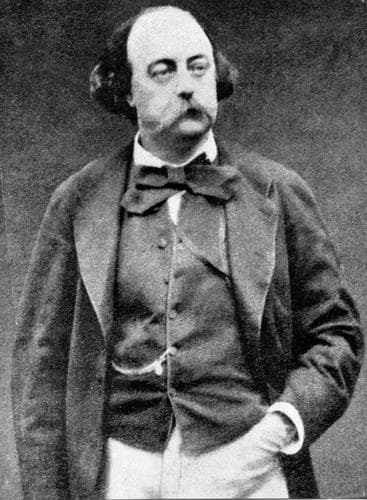
Gustave Flaubert was a French novelist. He has been considered the leading exponent of literary realism in his country and abroad. According to the literary theorist Kornelije Kvas, "in Flaubert, realism strives for formal perfection, so the presentation of reality tends to be neutral, emphasizing the values and importance of style as an objective method of presenting reality". He is known especially for his debut novel Madame Bovary (1857), his Correspondence, and his scrupulous devotion to his style and aesthetics. The celebrated short story writer Guy de Maupassant was a protégé of Flaubert.







