“The universe is a big place, and we're just tiny little specks in it. But even tiny little specks can do big things.”
— Alex's recurring thought about his place in the cosmos.

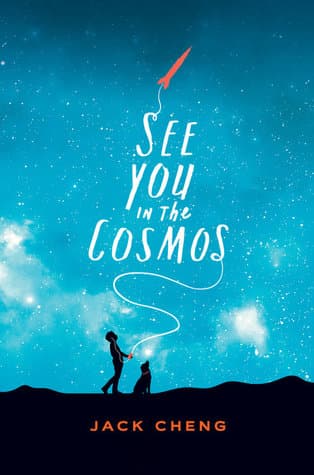
Jack Cheng (2017)
Genre
Children's / Young Adult
Reading Time
360 min
Key Themes
See below
Sign in to track this book
An eleven-year-old boy, with his dog Carl Sagan, goes on a cross-country trip to launch his iPod into space. He finds unexpected family secrets and human connections on Earth.
Eleven-year-old Alex Petroski, an aspiring rocket scientist from Rockview, Colorado, likes space and his hero, Carl Sagan. He plans to launch his golden iPod into space, like the Voyager Golden Record, to tell the story of Earth to potential alien life. Alex records his daily life, thoughts, and observations. These include his dog, Carl Sagan (the dog), his older brother Ronnie, and his mother, who has mental health issues. He packs his rocket, named 'Voyager 3,' with the iPod and gets ready for his trip to the Southwest High-Altitude Rocket Festival (SHARF) in New Mexico. He believes this launch will be his best contribution to understanding space.
At SHARF in New Mexico, Alex launches his rocket, but it does not reach space. He meets Terra, a girl his age who is also at the festival with her father, Zed. Terra is quiet at first but starts to like Alex. During their talks, Terra says that Alex's father, who Alex thought died before he was born, was a man named Ben. Ben was involved in rockets and worked with her father. She shows Alex a picture of Ben, confirming who he is. This changes what Alex thought about his past. He decides to go to California, where Terra says his father lived, to learn more about him.
With his new goal to learn about his father, Alex gets Zed, Terra's father, to give him a ride to California. Zed is kind but quirky, and their trip becomes an unexpected road trip. Alex keeps recording his experiences on his iPod, documenting the places, talks, and the growing friendship with Terra and Zed. He learns about Zed's love for music and Terra's relationship with her father, often taking care of him. Their trip has interesting stops and discussions, further shaping Alex's view of the world and people, especially as he deals with the truth about his own family.
The group stops in Las Vegas. While there, Alex, still wanting to find out more about his father, Ben, discovers that Ben had a storage unit in the city. With Terra and Zed's help, he gets inside. He finds many of his father's things, including journals, photos, and rocket models. These items give Alex a closer look into Ben's life, his love for rockets, and his dreams. He also finds proof of Ben's connection to a woman named Willow, suggesting another part of his father's past and the chance of more family.
Following clues from the storage unit, Alex, Terra, and Zed arrive in Los Angeles and find Willow, a woman who knew Alex's father, Ben. Willow is surprised to see Alex but welcomes him. She says she and Ben were close and that Ben always wanted to be a father. Willow shares stories and memories of Ben, showing him as a loving and adventurous man. More importantly, Willow says she is Alex's paternal grandmother. This completely changes what Alex thought about his family and heritage. This discovery gives Alex a sense of belonging he did not know he was missing.
Willow, now known as Alex's grandmother, sits with Alex and tells him the full story of his parents. She says his mother, Alex's 'Mama,' and Ben loved each other deeply. But his mother had mental health issues, making her unreliable. Ben wanted to raise Alex, but his mother took Alex and left, cutting off contact. Willow expresses her sadness about not finding Alex sooner. This helps Alex understand his mother's behavior and the hole left by his absent father. It provides context for his whole life and the family secrets he carried.
Ronnie, Alex's older brother, eventually arrives in California. Someone (likely Zed or Willow) contacted him because they were worried about Alex. His arrival brings another truth to light. Willow says that Ronnie is not Ben's son, but the son of another man from his mother's past. This news shocks Alex, who always thought Ronnie was his full brother. This revelation creates some tension as Alex deals with this new understanding of his family. But his bond with Ronnie stays strong, built on shared experiences and love, no matter their biological ties.
With the truths about his family finally known, Alex starts his new life in California with Willow, his paternal grandmother. Terra and Zed also stay close, forming a support network around Alex. He feels stable and like he belongs, something he has not known before. Willow provides a loving home, and Alex finds comfort in learning more about his father through her memories and the items from Ben's storage unit. His dog, Carl Sagan, is also happy in their new home, and Alex continues to record his experiences, now with hope and connection.
Alex's mother, after being gone and acting erratically, eventually reappears. With Willow, Ronnie, and his new friends' help, a plan is made to care for her. Alex, now understanding her mental health struggles and his family's history, approaches his mother with love and a more realistic view. Her condition remains hard, but the family, now bigger and more informed, commits to supporting her. Alex realizes that while his search for cosmic understanding is important, the human connections and family he has found are just as, if not more, important.
Alex continues to follow his love for space and rockets, but his journey has changed his view. He still records on his iPod, but his focus has grown from just reaching aliens to documenting the complex, beautiful, and sometimes messy reality of his own life and the people in it. He has found a loving, extended family in Willow, Terra, and Zed, and his bond with Ronnie is stronger. Alex learns that understanding space also means understanding the web of human relationships, love, loss, and the journey of self-discovery on Earth. His story ends with hope, belonging, and an appreciation for space and family.
The Protagonist
Alex evolves from a boy focused on external cosmic exploration to one who discovers the vastness and wonder of his own internal world and family.
The Supporting
Remains a constant, loving presence, representing stability and unconditional companionship throughout Alex's journey.
The Supporting
Evolves from a somewhat distant figure to a more present and understanding brother, accepting the new family dynamics.
The Supporting
Her story is revealed, providing context for her past actions and leading to a plan for her future care and support within the newly formed family.
The Supporting
Opens up emotionally, forms a deep friendship with Alex, and becomes an integral part of his extended family.
The Supporting
Serves as a supportive adult figure and driver for Alex's journey, helping him connect with his past.
The Mentioned
His past is gradually revealed, shaping Alex's understanding of his own identity and family history.
The Supporting
Provides a sense of belonging and completes Alex's family, offering a stable and loving home.
Alex's journey is about finding out who he is, as an aspiring astronaut and as a person with a complex family history. His trip to launch an iPod into space turns into a search for his biological father, Ben. This leads him to learn about his mother, his brother, and his own past. This discovery of his extended family, especially his grandmother Willow, gives him a strong sense of belonging and helps him understand his place in the world, both in space and personally.
“Maybe if other life-forms heard my story, they'd understand that even though I'm just one person, I'm also part of something bigger.”
The book looks at what family means. Alex's idea of family grows beyond his immediate, broken home (his mother and Ronnie) to include his biological father's side, his grandmother Willow, and the 'found family' of Terra and Zed. The truths about his mother's mental health and Ronnie's different father challenge old ideas of family. It shows that love, support, and shared experiences can make bonds as strong as, or stronger than, biological ties. It highlights that family is not always perfect but is a source of deep connection.
“I guess family isn't just about who you're born with, but who you find along the way.”
Even though he lives with a mother with mental health issues, a brother who is often gone, and initially thinking he had no father, Alex stays hopeful and optimistic. His love for space and his mission to send his iPod into space give him wonder and purpose. Even when he learns hard truths about his past, Alex's hope lets him deal with these revelations and accept his new, bigger family with an open heart. This shows how strong people can be.
“The universe is a big place, and sometimes it feels like my problems are too. But then I remember that even a tiny little rocket can go a long way.”
Alex's whole project of recording his life for aliens comes from a deep desire for connection and understanding across long distances. This mirrors his personal search for connection with his absent father and a deeper understanding of his family's past. The story shows how people try to make sense of their lives, whether through science, art (Zed's music), or finding out about their personal histories. Ultimately, Alex finds that the most important connections are often with the people closest to him.
“I want to show them what it's like to be me, to be us, on Earth. So they can understand.”
The novel shows the effects of mental illness through Alex's mother. Alex struggles to understand her behavior and eventually realizes her condition. The family's efforts to support her build empathy. The book shows how mental illness affects families and how love and understanding, even without a cure, are important for helping those who struggle. It encourages readers to look past surface behaviors to understand the challenges underneath.
“Mama's brain is like a radio that's sometimes tuned to a different station. She's still Mama, just on a different frequency.”
A first-person narrative device that captures Alex's thoughts, observations, and journey.
The entire novel is narrated through Alex's audio recordings on his golden iPod, intended for extraterrestrial life. This device provides a unique, intimate, and authentic first-person perspective, allowing readers direct access to Alex's innocent yet profound thoughts, his scientific explanations, his emotional reactions, and his detailed observations of the world around him. It serves as both a narrative framework and a symbol of Alex's quest for connection and understanding, evolving from a cosmic mission to a personal journal of self-discovery and family history.
A physical journey that mirrors Alex's emotional and intellectual growth.
The cross-country journey from Colorado to New Mexico (for SHARF) and then to California (to find his father) serves as a classic road trip narrative device. The changing landscapes and the various people Alex encounters along the way (Terra, Zed, Willow) directly influence his character development and the unfolding of the plot. The physical distance covered parallels Alex's emotional distance from his past and his eventual arrival at a new understanding of his identity and family. Each stop on the journey reveals another piece of the puzzle.
Discovered documents that reveal hidden family secrets and Alex's father's past.
The discovery of his father Ben's old letters, journals, and other personal effects in a storage unit in Las Vegas acts as a crucial plot device. These documents serve as direct conduits to the past, providing Alex and the reader with essential information about Ben's life, his relationship with Alex's mother, and his dreams. They are tangible evidence that helps Alex piece together his family history, turning abstract questions into concrete revelations and deepening his connection to a father he never knew.
Alex uses space and science concepts to understand complex human emotions and situations.
Alex frequently employs metaphors and analogies drawn from space, physics, and scientific principles to explain his feelings, his observations of human behavior, and the complex situations he faces. For example, he might compare his mother's mental state to a radio on a different frequency or his own journey to a rocket trajectory. This device highlights his unique way of processing the world and provides both humor and profound insight, making complex emotional themes accessible through his scientific lens and reinforcing his identity as a budding astronomer.
“The universe is a big place, and we're just tiny little specks in it. But even tiny little specks can do big things.”
— Alex's recurring thought about his place in the cosmos.
“Sometimes you have to go a long way to find out what's right in front of you.”
— Alex reflecting on his journey and the people he left behind.
“A story isn't just about what happened. It's about how you tell it.”
— Alex thinking about the nature of his audio recordings and narrative.
“The best way to understand something is to try and explain it to someone else.”
— Alex's motivation for recording his journey for his alien audience.
“It's okay to be scared. Everyone's scared sometimes. The important thing is what you do when you're scared.”
— A reassuring thought or advice Alex receives or gives.
“You can't choose your family, but you can choose who you let into your heart.”
— Alex's evolving understanding of family and friendship.
“Sometimes the most important discoveries aren't out in space, but right here on Earth.”
— Alex realizing the value of human connection and experiences.
“The stars don't care about your problems, but they're always there, watching.”
— Alex finding comfort in the constancy of the night sky.
“Every person has their own universe inside them.”
— Alex contemplating the complexity and uniqueness of individuals.
“It's not about being perfect. It's about being brave enough to try.”
— Alex's internal monologue about overcoming his anxieties.
“Silence can be a kind of language, too.”
— Alex observing quiet moments of understanding between people.
“The greatest adventure isn't always the one with the biggest explosions, but the one that changes you the most.”
— Alex reflecting on his personal growth during his journey.
“Even if no one else is listening, the act of telling your story still matters.”
— Alex's commitment to his recordings, regardless of an alien audience.
“Sometimes, the best way to help someone is just to listen.”
— Alex learning the importance of empathy and active listening.
Ready to see how well you understood this book? Take our interactive quiz with 10 questions.

Dan Gemeinhart
4.5

Kate O'Hearn
4.4

Jeanne Birdsall
4.4

Jen Wang
4.4

Wendelin Van Draanen
4.3

John Marsden
4.3

Chris Van Allsburg
4.3

Jennifer A. Nielsen
4.2