“It’s not proper for a princess to go about gallivanting, especially with dragons.”
— Cimorene's mother scolding her for her un-princess-like behavior.

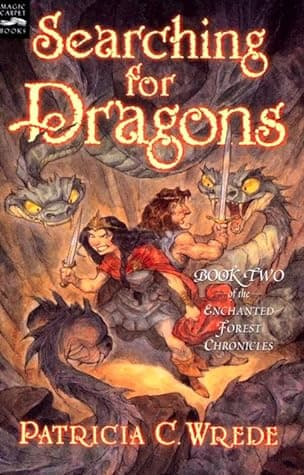
Patricia C. Wrede (1991)
Genre
Fantasy / Children's / Young Adult
Reading Time
240 min
Key Themes
See below
Sign in to track this book
A spirited princess and an un-kingly king embark on a whimsical quest with a broken magic carpet and soapy lemon water to rescue a kidnapped dragon, proving that even the most proper of quests can be delightfully unconventional.
King Mendanbar of the Enchanted Forest travels to the Caves of the Dragons to visit Queen Kazul. He expects a grand reception but finds the caves quiet and messy. Upon entering, he discovers soot-stained walls, overturned furniture, and distraught young dragons. Morwen, the witch who often visits the caves, tells him Kazul has been missing for several days. She explains that a mysterious, highly magical force seems to have taken her, leaving no trace. The dragons, especially the younger ones, are terrified and without a leader, struggling with their Queen's sudden disappearance.
Princess Cimorene, having heard of the disturbance, arrives at the Caves of the Dragons shortly after Mendanbar. She quickly assesses the situation, noting the unusual magical residue and the general panic among the dragons. Cimorene, known for her practical nature, immediately questions the younger dragons and Morwen, trying to gather useful information. She discovers that a strange, powerful, and unidentifiable magic was involved, far beyond anything the dragons had encountered. Cimorene, with her experience in dealing with magical mishaps, quickly takes charge, calming the dragons and organizing an initial search for clues, much to Mendanbar's quiet admiration.
Cimorene and Mendanbar decide to consult the ancient, petrified Stone Dragons, known for their vast, though often unhelpful, knowledge. They travel to the Stone Dragon's lair, a place of immense age and stillness. The Stone Dragons, as usual, are grumpy and resistant to giving clear answers, speaking in riddles and obscure prophecies. After much urging and Cimorene's persistent questioning, they hint at a powerful, ancient magic at play, possibly involving the 'old magic' that predates current magical systems. They also mention a 'gathering' and 'unwanted attention,' but refuse to say more, leaving Cimorene and Mendanbar with more questions than answers.
Believing the witches might have insight into the unusual magic, Cimorene and Mendanbar attend a meeting of the Witches' Council. The council is a cacophony of bickering and minor magical mishaps, with various witches arguing over petty grievances. Cimorene, with Morwen's help, tries to steer the conversation toward Kazul's disappearance and the strange magic involved. While most witches are more interested in their own squabbles, a few of the older, more powerful witches acknowledge the presence of a 'very old' and 'dangerous' magic. They warn against meddling with it directly but offer no concrete assistance, only vague warnings about 'unintended consequences' and 'things best left undisturbed.'
Realizing they need more than just their wits, Cimorene and Mendanbar decide to equip themselves for a journey. They discover a temperamental and opinionated magic carpet that requires constant coaxing and specific instructions to fly. The carpet, named 'Rug,' often complains and tends to get lost or land in inconvenient places. They also acquire a magical sword from a wizard's abandoned workshop. This sword, while capable of powerful magic, is leaky, constantly dripping water, and occasionally speaks in cryptic or unhelpful phrases, adding another layer of eccentricity to their quest. Despite their flaws, these items become essential, if annoying, companions.
Cimorene and Mendanbar, along with Rug and the leaky sword, begin their quest through the Enchanted Forest. The forest presents many magical challenges: trees that try to trip them, talking animals with unhelpful advice, and pathways that constantly change. They encounter grumpy gnomes who demand riddles for passage, and a confused unicorn who mistakes Mendanbar for a lost prince. These encounters test their patience and resourcefulness, forcing them to rely on each other's strengths - Cimorene's practicality and Mendanbar's surprising knack for diplomacy and understanding magical creatures, despite his initial awkwardness.
Following a trail of increasingly strong, ancient magic, Cimorene and Mendanbar stumble upon a hidden Wizard's Academy, a place long thought abandoned or mythical. They learn that a group of ambitious and power-hungry wizards, led by a devious individual named Zemenar, has kidnapped Kazul. These wizards are trying to drain Kazul's immense magical power for their own purposes, specifically to gain control over the 'old magic' and reshape the world. The academy is protected by powerful enchantments and various magical traps, making entry dangerous for the duo.
Cimorene and Mendanbar devise a plan to infiltrate the Wizard's Academy. Using Rug for aerial reconnaissance and the leaky sword's unexpected magical bursts to disarm some wards, they bypass the outer defenses. Cimorene's practical approach to magic, often involving 'soapy lemon water' to neutralize enchantments, proves surprisingly effective against the wizards' complex spells. Mendanbar's knowledge of the Enchanted Forest's quirks helps them navigate the academy's magically shifting corridors and avoid detection. They discover Kazul held captive in a central chamber, weakened but still defiant, surrounded by a complex array of magical draining devices.
Cimorene and Mendanbar confront Zemenar and his fellow renegade wizards. A magical battle begins, with the wizards unleashing many spells. Cimorene, using quick thinking and unconventional magical methods, counters their attacks, often turning their own spells against them. Mendanbar, despite his initial shyness, shows surprising courage and a latent magical ability connected to the Enchanted Forest, subtly disrupting the wizards' more powerful enchantments. Together, they disable the magical devices draining Kazul's power. Kazul, though still weak, regains enough strength to unleash a powerful burst of dragonfire, scattering the remaining wizards and forcing Zemenar to retreat.
With Kazul freed and the wizards' plans stopped, Cimorene, Mendanbar, and a recovering Kazul escape from the collapsing Wizard's Academy. Zemenar, defeated and humiliated, is left to face the consequences of his actions, his power diminished. As Kazul regains her full strength, the 'old magic' that the wizards had tried to manipulate begins to settle back into its natural balance. They return triumphantly to the Caves of the Dragons, where the young dragons rejoice at their Queen's safe return. Cimorene and Mendanbar, having shown their bravery and resourcefulness, reaffirm their friendship with Kazul and their commitment to protecting the balance of magic in their respective realms.
The Protagonist
Cimorene further embraces her unique identity and leadership qualities, solidifying her role as a capable and respected figure in the magical world.
The Co-Protagonist
Mendenbar grows in confidence and embraces his role as king and his unique magical abilities, becoming a more assertive and capable leader.
The Supporting/Central Figure
Kazul endures capture and recovery, reaffirming her status as a powerful queen and her trust in her allies.
The Supporting
Morwen remains a steadfast ally, offering consistent support and wisdom.
The Antagonist
Zemenar is ultimately defeated, his plans for power thwarted and his reputation ruined.
The Supporting
Rug reluctantly becomes a reliable and helpful companion, overcoming his own obstinacy.
The Supporting
The Leaky Sword provides unexpected magical assistance, proving its worth despite its flaws.
The Mentioned/Supporting
They serve as a static source of cryptic information, reinforcing the ancient nature of the conflict.
The novel continues Cimorene's defiance of traditional princess roles. She is practical, resourceful, and actively seeks adventure, preferring to deal with dragons and magic rather than courtly duties. This is clear in her immediate and effective leadership when Kazul goes missing, contrasting with Mendanbar's initial shyness. Her use of 'soapy lemon water' to neutralize powerful enchantments highlights her unconventional, yet effective, approach, directly challenging the idea that magic must be grand or traditionally feminine to be powerful. She proves that intelligence and practicality are more valuable than adherence to societal norms, showing a strong female protagonist who defines her own path.
“"Being a princess wasn't just about looking pretty and marrying a prince. It was about solving problems, even if the problems involved magic carpets with opinions and leaky swords."”
The story emphasizes the balance between different forms of magic and the natural world. The renegade wizards' attempt to manipulate 'old magic' and drain Kazul's power directly threatens this balance. Mendanbar's connection to the Enchanted Forest and his growing understanding of its subtle magic highlights the importance of respecting natural magical forces. The chaos at the Caves of the Dragons after Kazul's abduction and the restoration of order upon her return shows that disturbing this balance has far-reaching, negative consequences, and that true power lies in harmony, not control.
“"Some magic was meant to be coaxed, not commanded. It was a part of the world, not something to be twisted to fit a wizard's whim."”
Cimorene and Mendanbar are not traditional heroes; they rely on their wits, practicality, and an assortment of quirky, often malfunctioning, magical items. Cimorene's use of everyday solutions like 'soapy lemon water' against complex spells, and Mendanbar's quiet observation skills, prove more effective than brute force or grand magical displays. Their journey is filled with humorous mishaps and challenges that they overcome through clever thinking rather than raw power. This theme suggests that heroism comes in many forms and that resourcefulness and adaptability are important assets, especially when facing overwhelming magical threats.
“"Magic wasn't always about explosions and thunderbolts. Sometimes, it was about knowing which spell would be most annoying to the enemy, and sometimes, it was about a good bucket of suds."”
The bond between Cimorene, Mendanbar, and Kazul is a central part of the story. Cimorene and Mendanbar undertake a perilous quest not for personal gain, but out of loyalty and friendship to Kazul. Morwen's consistent support and the younger dragons' distress at Kazul's absence further highlight the importance of these relationships. Their shared trust and willingness to face danger for one another show that strong alliances and mutual respect are essential in overcoming formidable challenges, reinforcing the idea that true strength often lies in collective effort and unwavering loyalty.
“"We're not leaving until we find her. That's what friends do."”
The inciting incident that sets Cimorene and Mendenbar on their quest.
Kazul's mysterious disappearance serves as the primary catalyst for the entire plot. Her abduction by unknown magical forces immediately creates a central mystery and a clear goal for the protagonists: to find and rescue her. This device not only establishes the conflict but also raises the stakes, as Kazul is a powerful and important figure, and her absence causes widespread disruption and fear among the dragons and other magical beings. It forces Cimorene and Mendenbar to unite and embark on a dangerous adventure, leading them to uncover a larger magical conspiracy.
The unreliable yet ultimately helpful magic carpet and leaky sword.
The talking magic carpet, Rug, and the constantly dripping, occasionally speaking Leaky Sword serve as both comedic relief and essential tools. Their eccentricities and unreliability force Cimorene and Mendenbar to be more resourceful and adaptable, often finding unconventional ways to utilize their 'flaws.' These artifacts are not perfectly functioning plot devices; instead, their imperfections create additional challenges and opportunities for character interaction and clever problem-solving, underscoring the theme of unconventional heroism. They symbolize that even flawed tools can be invaluable in the right hands.
A powerful, primordial magical force that the antagonists seek to control.
The concept of 'old magic' is a significant plot device, representing a primordial and dangerous form of magic that predates current magical systems. The renegade wizards' attempts to harness and control this power, specifically by draining it from Kazul, establishes the primary threat and the high stakes of the narrative. It provides a deeper, more profound magical context for the conflict, elevating it beyond a simple kidnapping. This 'old magic' is mysterious and powerful, hinting at a larger magical universe and the potential for catastrophic consequences if mishandled, thus driving the urgency of the protagonists' quest to prevent its misuse.
The secret antagonist base and source of the magical threat.
The discovery of the hidden Wizard's Academy serves as the primary location for the climax and resolution of the plot. Its secrecy and powerful enchantments create an obstacle for the protagonists to overcome, requiring them to use their unique skills and resources for infiltration. As the source of the 'old magic' manipulation, it centralizes the threat and provides a clear objective for Cimorene and Mendenbar. The academy acts as a symbolic representation of the antagonists' attempts to control and corrupt magic, making its eventual defeat a significant victory for the balance of the magical world.
“It’s not proper for a princess to go about gallivanting, especially with dragons.”
— Cimorene's mother scolding her for her un-princess-like behavior.
“I’m not supposed to be rescued. I’m a princess, and I’m supposed to be kidnapped.”
— Cimorene explaining to Kazul why she's at the cave.
“The trouble with being a princess is that it’s such hard work. You have to be so beautiful all the time.”
— Cimorene complaining about the demands of being a princess.
“I don't think it's proper for a princess to be running a household for a dragon, either, but it's certainly more interesting.”
— Cimorene reflecting on her new role with Kazul.
“There are dragons, and there are dragons. Just like people.”
— Kazul explaining the diversity within dragonkind.
“No one ever told me that dragons keep their caves so messy.”
— Cimorene's initial reaction to Kazul's cave.
“Being a princess is a lot like being a dragon, really. Everyone expects you to be a certain way, and they don’t like it when you’re not.”
— Cimorene drawing a parallel between her life and Kazul's.
“Some dragons like to eat princesses. Others prefer chocolate.”
— Kazul discussing dragon dietary preferences.
“It’s amazing how much more sensible a situation looks when you have a good hot cup of tea in your hand.”
— Cimorene finding comfort and clarity with tea.
“Magic is all very well, but it doesn't do much good if you don't know what you're doing with it.”
— Cimorene reflecting on the practicalities of magic.
“You can always tell a good story by how much trouble it causes.”
— Morwen commenting on the unfolding events.
“Sometimes the most important thing a person can do is refuse to be what everyone else expects them to be.”
— A general theme exemplified by Cimorene's journey.
“It doesn't matter what you're called, as long as you know who you are.”
— Cimorene's evolving understanding of her identity.
“Being sensible is highly overrated.”
— Cimorene's attitude towards conventional wisdom.
Ready to see how well you understood this book? Take our interactive quiz with 10 questions.

Biography coming soon.







