“He was born with a gift of laughter and a sense that the world was mad.”
— Describing André-Louis Moreau's initial disposition.

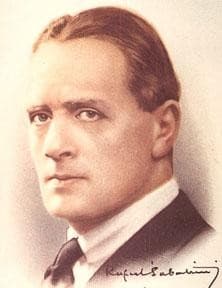
Rafael Sabatini (2022)
Genre
Historical Fiction / Romance
Reading Time
900 min
Key Themes
See below
Sign in to track this book
A lawyer, angered by a nobleman's injustice, becomes the theatrical Scaramouche. He uses his wit and sword to spark revolution and find love during the French Revolution.
In Gavrillac, Brittany, André-Louis Moreau, a young lawyer raised by Quintin de Kercadiou, lives a quiet life, mostly unaware of the growing revolutionary feelings in France. His world breaks apart when his friend, Philippe de Vilmorin, a supporter of the Third Estate, is provoked into a duel by the arrogant Marquis de La Tour d'Azyr. The Marquis, an expert fencer, kills Vilmorin without mercy. Seeing this injustice and the Marquis's freedom due to his noble status, André-Louis becomes radicalized. He promises to avenge Vilmorin and fight for the common people, a decision that will change his life and pull him into the French Revolution.
After Vilmorin's death, André-Louis, full of grief and anger, gives a passionate speech at a public meeting. He openly accuses the Marquis de La Tour d'Azyr of murder and criticizes the oppressive aristocracy. His words move the common people but also mark him as a dangerous rebel to the authorities. Knowing he will be arrested for sedition, André-Louis must leave Gavrillac. He becomes a fugitive, constantly avoiding capture while still looking for chances to spread revolutionary ideas and stir up unhappiness among the people, using his legal skills and speaking ability to show the injustices of the old regime.
While on the run, André-Louis finds a traveling Commedia dell'Arte troupe led by Monsieur Binet. Desperate for a disguise and a way to survive, he joins them, first as a stagehand. His quick mind and talent for imitation soon become clear. When the actor playing Scaramouche, the mischievous clown, gets sick, André-Louis takes his place. He quickly masters the role, using the character's improvisational style to subtly put revolutionary messages into his shows. He delights audiences and improves his public speaking and crowd manipulation skills, all while hiding in plain sight from those chasing him.
As Scaramouche, André-Louis becomes very popular. He cleverly includes hidden criticisms of the aristocracy and calls for freedom and equality in his comedic improvisations. His shows draw large crowds and quietly awaken their political awareness. The authorities, though vaguely aware of a subversive element in the plays, cannot find the source, as Scaramouche's words are hidden in humor and theater. This time allows André-Louis to become an excellent swordsman through stage combat, a skill that will be important later. He becomes a symbol of resistance, an unexpected hero hiding in plain sight.
While touring with the troupe, André-Louis, still as Scaramouche, has a dangerous encounter with the Marquis de La Tour d'Azyr. The Marquis, seeing something familiar in Scaramouche's movements or wit, starts a fight. André-Louis, despite his new stage combat skills, is no match for the Marquis's real dueling experience and is badly wounded. He barely escapes with his life, saved by his fellow actors and the confusion of the moment. This encounter restarts his personal quest for revenge and strengthens his resolve to become a truly strong opponent for the Marquis.
After healing, André-Louis wants to prepare for his fight with La Tour d'Azyr. He decides to become a fencing master. He goes to Paris and, using a new name, becomes a respected instructor. He teaches fencing to members of the Third Estate, especially those who are becoming leaders in the revolutionary movement. His school becomes a place for political discussion and practical training, giving commoners the skills to defend themselves against the often-abusive nobility. This period changes him from a theoretical revolutionary into a practical leader.
With the storming of the Bastille and the growing revolution, André-Louis's reputation as a skilled speaker and a champion of the people grows. He is elected to the National Assembly, where he quickly stands out with his powerful speeches and sharp legal mind. He navigates the dangerous political world, often arguing with radical groups and seeking a more moderate, fair revolution. He becomes an important figure, influencing laws and debating fiercely, always with the goal of avenging Vilmorin and ensuring the rights of common people, even as the revolution becomes more chaotic.
Throughout his journey, André-Louis has romantic relationships with two women: Aline de Kercadiou, his foster sister and childhood love, and Climène, an actress from the Commedia dell'Arte troupe. His feelings for Aline are complicated by their family bond and her initial connection to La Tour d'Azyr. Climène, a strong and independent woman, offers him companionship and understanding during his time as Scaramouche. This love triangle adds a personal layer to his struggle, making him face his own desires and loyalties amid the political chaos. It affects his decisions and emotional state.
As the revolution intensifies, a shocking truth comes out: André-Louis discovers that his father is the Marquis de La Tour d'Azyr, the man he swore to kill. Quintin de Kercadiou reveals this devastating truth. The Marquis had an affair with André-Louis's mother, who died in childbirth. This discovery throws André-Louis into a deep moral and emotional crisis. His entire reason for revenge is undermined, and he must deal with the terrible idea of patricide, forcing him to rethink who he is and his purpose in the revolution.
The novel's climax sees André-Louis, now knowing who his father is, confront the Marquis de La Tour d'Azyr during the Marquis's desperate escape attempt. Despite his inner conflict, André-Louis fights his father in a final, intense duel. His superior swordsmanship, honed over years, lets him disarm and defeat the Marquis. However, instead of killing him, André-Louis, overwhelmed by the truth and the weight of his actions, chooses to spare his father's life, leaving him to face the revolutionary mob. This act shows his victory over personal revenge and his choice of a higher moral code.
After the chaotic events and the final fight with La Tour d'Azyr, André-Louis rebuilds his life. The revolution continues its bloody path, but André-Louis finds peace. He eventually marries Aline de Kercadiou, who now understands and loves him. His journey from a detached lawyer to a revolutionary, actor, fencing master, and politician ends with a sense of purpose beyond just revenge. He has helped shape a new France and looks forward to a future with his wife, having survived personal and political storms.
The Protagonist
From a detached observer, he transforms into a passionate revolutionary leader, actor, and fencing master, ultimately choosing mercy over vengeance after a shocking revelation about his parentage.
The Antagonist
He remains largely unrepentant, representing the unyielding old order, until he faces defeat and public humiliation at the hands of his own son.
The Supporting
She evolves from a somewhat naive aristocratic sympathizer to a woman who understands and supports André-Louis's revolutionary ideals, ultimately marrying him.
The Supporting/Catalyst
His death serves as the inciting incident for André-Louis's entire journey, making him a martyr for the cause.
The Supporting
He remains steadfast in his royalist beliefs but ultimately reveals a crucial secret that reshapes André-Louis's life, demonstrating his profound love for his foster son.
The Supporting
She provides André-Louis with companionship and love during his 'Scaramouche' phase, offering a different kind of life before he commits to politics and Aline.
The Supporting
He serves as a mentor figure in the theatrical world, providing André-Louis with a crucial sanctuary and a new set of skills.
The novel explores the line between seeking justice and wanting personal revenge. André-Louis's journey begins with his desire to avenge Philippe de Vilmorin's death by La Tour d'Azyr. But as he gets more involved in the larger revolutionary cause, his fight changes from personal revenge to a broader struggle for justice. The revelation of his parentage forces him to face this theme directly, leading him to choose mercy and collective justice over killing his father in the final duel. This inner conflict defines his moral growth.
““Revenge is a kind of wild justice; which the more man’s nature runs to, the more ought law to weed it out.””
André-Louis's change into 'Scaramouche' shows how performance can transform and how identity can be fluid. By becoming the clown, he finds not only safety but also a powerful way to express revolutionary ideas without direct punishment. His theatrical skills, developed through improvisation and stage combat, become essential for his survival and success, as both an agitator and later a fencing master. The mask of Scaramouche allows him to leave behind his old cynical self and take on a more active, influential role. This shows how adopted identities can empower people to make changes, even in dangerous times.
““Last Wednesday he had been engaged in moving an audience of Rennes to anger; on this Wednesday he was to move an audience of Guichen to mirth…””
Set during the French Revolution, the novel clearly shows the reality of social class and the huge inequalities that caused the uprising. The nobility's arrogance and freedom from punishment, shown by the Marquis de La Tour d'Azyr, contrast sharply with the oppressed and powerless Third Estate. André-Louis's journey is a direct response to this system. He dedicates himself to empowering common people, first with speeches, then with theatrical shows, and finally as a political leader and fencing master. The story shows how unfair systems can make people radical and start widespread social unrest.
““They are born to privilege, and they die in it, and they have no understanding of the world outside their own gilded cage.””
The novel highlights the impact one person can have during major historical events. André-Louis Moreau, initially a cynical and detached intellectual, becomes an important figure in the French Revolution through his intelligence, adaptability, and bravery. His ability to change roles—from lawyer to fugitive, actor to fencing master, and then to politician—shows how one person's actions, skills, and beliefs can greatly influence history. He does not just react to the revolution; he actively shapes it, proving that even against overwhelming forces, individual action can drive change, for better or worse.
““A man is not born a revolutionary. He is made one.””
Amidst political turmoil and personal danger, the novel explores complex love and loyalty. André-Louis's relationships with Aline and Climène show different kinds of love—the deep, family bond turning into romantic love with Aline, and the passionate, adventurous connection with Climène. His loyalty to his foster father, Quintin de Kercadiou, is tested by their differing political views. These personal relationships provide emotional anchors and reasons for André-Louis. They show how human connections survive and even thrive despite the chaos of revolution, influencing decisions and offering comfort or conflict.
““Love, like a revolution, often begins with a spark and ends in an inferno.””
André-Louis adopts multiple aliases and personas to evade capture and achieve his goals.
The most prominent plot device is André-Louis's use of mistaken identity and disguise. His transformation into 'Scaramouche' the actor allows him to hide in plain sight from the authorities, subtly spread revolutionary messages, and hone his skills. Later, he adopts another alias as a fencing master. These disguises are crucial for his survival and enable him to move between different social strata and roles, demonstrating his adaptability and the revolutionary's need for subterfuge. It also highlights the theme of identity and how one can transcend their given circumstances by adopting a new persona.
A recurring motif that drives the plot and symbolizes the conflict between classes.
The duel serves as a powerful and recurring plot device. It is the inciting incident of the novel, with Philippe de Vilmorin's death at the hands of the Marquis de La Tour d'Azyr. This act sets André-Louis on his path of vengeance and justice. Subsequent duels, including André-Louis's stage combat and his eventual real-life confrontations with the Marquis, symbolize the larger class struggle and André-Louis's personal quest for skill and retribution. It represents the violent resolution of conflict, both personal and societal, and the mastery of the sword becomes a metaphor for gaining power and agency in a chaotic world.
The initial driving force behind André-Louis's actions.
While not a traditional MacGuffin, the quest for revenge for Philippe de Vilmorin's death acts as the primary initial motivator for André-Louis. It is the concrete goal that propels him into action, leading him to join the actors, become a fencing master, and engage in revolutionary politics. This 'MacGuffin' evolves over the course of the novel, transforming from a purely personal vendetta into a broader commitment to justice for the Third Estate, especially after the revelation of his parentage. It provides the initial narrative thrust before larger themes and personal growth take over.
The audience is aware of André-Louis's true identity and parentage before he is.
Dramatic irony is employed, particularly regarding André-Louis's true parentage. The audience is led to suspect, or is eventually revealed, that the Marquis de La Tour d'Azyr is André-Louis's father, long before André-Louis himself discovers this truth. This creates profound tension and suspense, as the reader watches André-Louis meticulously plan and execute his revenge against the man he unknowingly seeks to commit patricide against. It amplifies the emotional impact of the eventual revelation and the moral dilemma André-Louis faces, adding depth to his internal conflict.
Subtle hints about André-Louis's parentage and future skills are dropped throughout the narrative.
Foreshadowing is used to hint at key revelations and developments. For instance, André-Louis's natural aptitude for swordsmanship, even in stage combat, subtly foreshadows his future as a fencing master and his ability to eventually challenge the Marquis. More significantly, subtle clues about his true parentage are scattered throughout, such as the Marquis's intense, almost personal, interest in André-Louis, or Quintin de Kercadiou's guarded behavior. These hints build anticipation and make the eventual reveals more impactful, creating a sense of an unfolding destiny rather than random events.
“He was born with a gift of laughter and a sense that the world was mad.”
— Describing André-Louis Moreau's initial disposition.
“His world, that had been so orderly, so well-mapped and charted, had suddenly become a chaos.”
— André-Louis's reaction to the death of Philippe de Vilmorin.
“He had merely expressed an opinion; but in France of that day, to express an opinion was to risk one's life.”
— Reflecting on the dangers of free speech in pre-Revolutionary France.
“He did not know what it was, this new emotion, this burning, suffocating thing that had taken possession of him.”
— André-Louis's first experience of overwhelming love/passion.
“The people, my friend, are a beast that must be led, not driven.”
— A philosophical observation on governing the populace.
“To be a fool is to be happy, but to be a wise man is to be alone.”
— A cynical reflection on wisdom and companionship.
“He had come to play the fool, and he had learned to play the man.”
— André-Louis's transformation during his time as Scaramouche.
“The greatest tragedy of life is not that men are mad, but that they are sane, and yet do nothing.”
— A comment on human inaction in the face of injustice.
“Every man has his breaking point, and beyond that point, he is no longer a man, but a brute.”
— Contemplating the limits of human endurance and morality.
“Revenge, my friend, is a dish best served cold, and with a keen edge.”
— A classic line about the nature of vengeance.
“Life is a comedy to those who think, a tragedy to those who feel.”
— A philosophical dualism presented in the narrative.
“He had never known how much he loved her until he had lost her.”
— André-Louis's realization of his feelings for Aline.
“The sword, like the pen, is a weapon; but the pen is mightier than the sword.”
— A reflection on the power of words versus physical force, echoing a famous proverb.
“There are times when a man must choose between what is right and what is easy.”
— André-Louis facing a moral dilemma.
“It is not the part of a gentleman to strike a woman, even a woman who deserves it.”
— A statement reflecting the social codes and chivalry of the era.
Ready to see how well you understood this book? Take our interactive quiz with 10 questions.
Biography coming soon.







