“All I want is a good time. The rest is propaganda.”
— Arthur Seaton's defiant declaration of his hedonistic lifestyle.

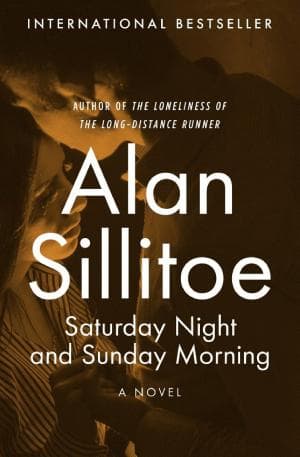
Alan Sillitoe (2016)
Genre
Literary Fiction
Reading Time
240 min
Key Themes
See below
Sign in to track this book
Arthur Seaton, a factory worker with a thirst for gin, married women, and rebellion, navigates the boozy Saturdays and sobering Sunday mornings of postwar Nottingham, only to discover that even the most rapscallion playboys eventually face the consequences of their carousing.
The novel opens with Arthur Seaton, a young factory worker in Nottingham, recounting his wild Saturday night. He spent the evening at the White Horse pub, drinking many pints of beer and gins. Drunk, he tumbles down stairs, passes out, and later vomits on a middle-aged couple. He then goes to the house of Brenda, a married woman with two children, with whom he is having an affair. Brenda lets him in, and they spend the night together. This establishes Arthur's reputation as a hard-drinking, anti-establishment playboy who lives for the weekend.
During the week, Arthur works at the Raleigh bicycle factory. He dislikes the job but endures it for the money. He takes pride in his ability to shirk work, cheat the system, and avoid paying too much income tax. He often expresses his dislike for his foremen, the government, the army (having recently completed his National Service), and the upper classes. His internal thoughts show a working-class resentment and a fierce independence. He sees his factory work as a necessary evil that funds his weekend escapades and his pleasure-seeking life, which he considers a rebellion against his dull daily existence.
Arthur's affair with Brenda continues. It involves secret meetings and the constant threat of discovery by her husband, Jack. Despite the risks, Arthur enjoys the thrill and sexual freedom it offers. However, he soon turns his attention to Winnie, Brenda's younger sister, who is also married. Arthur begins a new, equally illicit affair with Winnie, adding more complexity and danger to his life. He juggles both relationships, showing a disregard for emotional consequences and the potential for scandal within the tight-knit working-class community.
As Arthur's affairs with Brenda and Winnie continue, the small, gossipy nature of their Nottingham community starts to close in. A local busybody, Mrs. Bull, and other neighbors notice Arthur's frequent visits and late-night movements. Whispers and suspicions grow, and his secret life starts to become unstable. The possibility of Brenda's husband, Jack, or Winnie's husband, Bill, discovering the truth becomes a growing threat, adding tension to Arthur's otherwise carefree existence. He remains defiant, convinced he can outsmart anyone.
Brenda tells Arthur she is pregnant. This news shatters his complacent worldview. It forces him to confront the real and irreversible consequences of his actions, far beyond the casual thrills he sought. He is shocked and initially resists the idea of fatherhood and the responsibility it entails. Brenda, desperate, tries various methods to end the pregnancy, including drinking gin in a hot bath, but without success. The impending birth puts immense pressure on both of them, and Arthur's usual bravado begins to falter.
The inevitable happens: Brenda's husband, Jack, and Winnie's husband, Bill, finally discover Arthur's infidelity. This leads to a violent confrontation. Jack and Bill, with an accomplice, ambush Arthur in a dark alley. They beat him, leaving him bruised and battered. This physical assault is a harsh punishment and a reminder that his reckless lifestyle has tangible and painful results. The beating is a turning point, forcing Arthur to acknowledge the limits of his defiance and the pain his actions have caused.
After the beating, Arthur spends time recovering, physically and emotionally. The pain and humiliation of the attack force him to think. He is no longer the invincible, carefree lad he once was. The experience, with Brenda's pregnancy, makes him consider his life's direction. He starts to think about a future with more stability and responsibility, a contrast to his previous pleasure-seeking. This period marks the beginning of a subtle change in his character, away from pure rebellion and toward a grudging acceptance of societal norms.
Amidst the chaos of his affairs, Arthur has also been casually seeing Doreen, a young woman who represents a more conventional path. Unlike Brenda and Winnie, Doreen is unmarried and seems to offer the promise of a stable, long-term relationship. After his beating and the ongoing complications with Brenda, Arthur begins to see Doreen in a new light. He starts to seriously consider settling down with her, a significant change from his previous dislike of marriage and domesticity. Doreen embodies the 'Sunday morning' aspect, a potential antidote to his wild 'Saturday nights'.
As his relationship with Doreen deepens, Arthur finds himself contemplating marriage, a concept he once strongly rejected. He struggles with giving up his freedom, his illicit affairs, and his anti-establishment stance. He weighs the benefits of a settled life – security, companionship, and an end to the constant threat of scandal – against the loss of his independent, rebellious identity. This internal conflict is central to his character development, as he battles between his ingrained desire for anarchy and the growing pressure to conform to societal expectations and find a sense of belonging.
The novel ends with Arthur and Doreen walking together on a hill overlooking Nottingham. This scene represents Arthur's journey toward a more settled existence. He still feels a spark of rebellion and a desire for his old freedoms, but he acknowledges the inevitability and perhaps even the appeal of a different life. He reflects on his past escapades and the consequences, understanding that while 'Saturday night' offers excitement, 'Sunday morning' brings a different kind of reality. He tacitly accepts that marriage to Doreen is likely his future, marking a significant shift from his earlier, wilder self, even if the spirit of defiance still flickers within him.
The Protagonist
Arthur transitions from a completely carefree, rebellious bachelor to someone grudgingly contemplating the responsibilities of marriage and a settled life, though his rebellious spirit remains.
The Supporting
Brenda moves from a woman seeking escapism through an affair to facing the harsh reality of an unwanted pregnancy and the potential collapse of her family.
The Supporting
Winnie's arc is less defined, serving primarily as a catalyst for Arthur's downfall when her husband discovers their affair.
The Supporting
Doreen remains a relatively stable character, her role being to represent the 'settled' future that Arthur eventually considers.
The Supporting
Jack's role is largely static, serving as a force of retribution against Arthur.
The Supporting
Bill's role is static, serving as an instrument of punishment.
The Mentioned
Mrs. Bull is a static character, serving as a plot device to advance the conflict.
The Supporting
Fred's role is static, providing context for Arthur's social life.
The central theme explores Arthur's constant struggle against societal norms, authority, and the monotony of working-class life. His heavy drinking, illicit affairs, and dislike for his factory job and National Service are all acts of rebellion. However, as the novel progresses and consequences mount (Brenda's pregnancy, the beating), Arthur must confront the limits of his freedom and grudgingly considers a more conventional, settled life with Doreen. This internal conflict between his desire for anarchy and the pressure to conform underpins his character arc.
“What's in it for us, eh? Nothing. So we'll take our pleasure where we can, and damn the rest.”
The novel provides a raw and authentic portrayal of working-class life in post-war Nottingham. It shows the daily grind of factory work, the limited opportunities, the importance of community (both supportive and judgmental), and the ways individuals seek escape and meaning. Arthur's identity is rooted in his working-class background, shaping his anti-establishment views and his pursuit of immediate gratification as a form of resistance against a system he feels exploits him. The novel shows the social and economic conditions that fuel his defiance.
“A good time was what he was living for, for the next eighteen years of his life, which was the limit of his working life.”
Initially, Arthur believes he can escape the repercussions of his reckless behavior, but the plot increasingly focuses on the theme of consequences. Brenda's pregnancy and the brutal beating Arthur receives from the wronged husbands are direct results of his illicit affairs. These events force Arthur to mature and consider the impact of his choices, particularly on others. The transition from 'Saturday Night' (hedonism) to 'Sunday Morning' (reckoning and responsibility) is a metaphor for this theme. It shows that even the most defiant individual must eventually face the fallout of their actions.
“He knew he couldn't keep on like this forever, though he felt he'd like to try.”
The novel explores various aspects of love, sex, and infidelity within working-class society. Arthur's affairs with Brenda and Winnie are driven by physical desire and a sense of rebellion, rather than deep emotional connection. These relationships show the moral complexities and social risks associated with extramarital affairs in a tight-knit community. The consequences of infidelity (pregnancy, violence, social shame) are central to the plot. This contrasts with the more conventional and potentially stable relationship Arthur develops with Doreen, which offers a different kind of 'love' and future.
“Sex was all right, but it was just another way of trying to get rid of the boredom.”
Provides deep insight into Arthur's rebellious mind.
The novel predominantly uses a first-person narrative, primarily through Arthur Seaton's internal monologues and direct address to the reader. This allows for an intimate understanding of his cynical, anti-establishment worldview, his justifications for his actions, and his internal struggles. The occasional shift to a more objective third-person perspective provides context and broadens the scope, offering glimpses into the community's perception of Arthur and the broader social landscape, while still keeping Arthur at the core of the narrative.
Represents the dichotomy between hedonism and responsibility.
The title itself functions as a powerful symbol. 'Saturday Night' embodies Arthur's wild, rebellious, hedonistic lifestyle – the drinking, the illicit affairs, the freedom from work and responsibility. 'Sunday Morning' represents the inevitable hangover, the consequences, the reckoning, and the eventual move towards conformity, marriage, and a more settled, responsible life. This dichotomy is central to Arthur's character arc and the novel's exploration of his journey from youthful abandon to grudging acceptance of adulthood.
Depicts working-class life with unvarnished authenticity.
Sillitoe employs social realism to vividly portray the gritty realities of post-war working-class life in Nottingham. This device is evident in the detailed descriptions of factory work, pub culture, domestic life, and the language used by the characters. The narrative doesn't romanticize poverty or hardship but presents it with a stark, honest tone. This focus on authenticity grounds the story in a specific time and place, making Arthur's struggles and desires feel genuine and representative of a broader social experience.
Used to highlight the gap between Arthur's intentions and reality.
Irony is frequently used to underscore the contradictions in Arthur's life and his anti-establishment stance. For example, his fierce independence often leads him into situations where he is ultimately controlled by circumstances (like Brenda's pregnancy) or by the very societal norms he despises (the forced consideration of marriage). There's also irony in his pursuit of 'freedom' through illicit affairs that ultimately bind him more tightly to the consequences of his actions. This device adds depth and a subtle layer of critique to Arthur's rebellious worldview.
“All I want is a good time. The rest is propaganda.”
— Arthur Seaton's defiant declaration of his hedonistic lifestyle.
“I'm me and nobody else; and whatever people think I am or say I am, that's what I'm not, because they don't know a bloody thing about me.”
— Arthur asserting his individuality against societal expectations.
“What I'm out for is a good time. All the rest is propaganda.”
— A variation on Arthur's central philosophy, emphasizing pleasure over responsibility.
“It's a good life if you don't weaken.”
— Arthur's mantra for enduring the monotony of factory work and life.
“I'm a bloody animal, and I know it. But I'm a human being as well.”
— Arthur reflecting on his primal desires and human complexity.
“The world is full of bastards, the number increasing rapidly the further one gets from Missis's front door.”
— Arthur's cynical view of society beyond his immediate comfort.
“You've got to fight every day to stop from going under.”
— Arthur on the daily struggle of working-class existence.
“I'm not going to be like my dad, working all his life for nothing.”
— Arthur rejecting the traditional, unfulfilling path of his father.
“It's a hard life if you don't weaken.”
— Another iteration of Arthur's resilience motto, highlighting hardship.
“I'm a rebel because I've got a brain.”
— Arthur justifying his nonconformity as intellectual rather than mere defiance.
“The factory's a prison, but it's a prison with wages.”
— Arthur's ambivalent view of his job as both confinement and necessity.
“I'll be twenty-five next week, and I've done nowt with my life.”
— Arthur's moment of self-doubt and reflection on his lack of achievement.
“You can't get away from it, you've got to live with yourself.”
— Arthur acknowledging the inescapability of one's own conscience and identity.
“It's not what you do, it's the way that you do it.”
— Arthur's philosophy on approaching life with style and attitude.
Ready to see how well you understood this book? Take our interactive quiz with 10 questions.

Alan Sillitoe FRSL was an English writer and one of the so-called "angry young men" of the 1950s. He disliked the label, as did most of the other writers to whom it was applied. He is best known for his debut novel Saturday Night and Sunday Morning and his early short story "The Loneliness of the Long Distance Runner", both of which were adapted into films.







